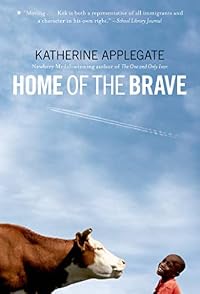
Home of the Brave
by Katherine Applegate
On This Page
Description
Kek, an African refugee, is confronted by many strange things at the Minneapolis home of his aunt and cousin, as well as in his fifth grade classroom, and longs for his missing mother, but finds comfort in the company of a cow and her owner.Tags
Recommendations







Member Reviews
Katherine Applegate writes beautiful books for young people. Her Newbery Award-winning novel "The One and Only Ivan" is quite possibly one of my favorite books of all time. Her adorable book "Odder" has the same combination of humor and heart and heartbreaking honesty. "Home of the Brave" was her first stand-alone novel and shows that Applegate is incredibly consistent in her ability to capture the feelings of wonder in a young person or animal -- in this case, a young boy Kek, who has fled the wars of his African homeland for refuge in America. Like her book "Odder," this book is written in free verse, which I find works very well in her storytelling.
Back in Africa Kek lived with his parents and brother, but only Kek and his mother show more have survived the war. The two escape to refugee camps, and then Kek makes it to his aunt and cousin's home in Minnesota, but his mother is missing, and Kek does not know if she is alive or dead. "Home of the Brave" follows Kek as he learns to live in a strange land. As he slowly makes new friends, he continues to await news of his mother, all the while maintaining optimism for both her fate and for his belief in his new country. At times adorably humorous as Kek misinterprets the English language and its idioms, the book doesn't shy away from laying bare Kek's pain from what he endured in his homeland. Without ever getting graphic about the horrors of war, Applegate deftly conveys the consequences of war and the devastating effects that war has on its people. And, as usual, she does this while also conveying the hope of the indomitable human spirit. Such a beautiful book. show less
Back in Africa Kek lived with his parents and brother, but only Kek and his mother show more have survived the war. The two escape to refugee camps, and then Kek makes it to his aunt and cousin's home in Minnesota, but his mother is missing, and Kek does not know if she is alive or dead. "Home of the Brave" follows Kek as he learns to live in a strange land. As he slowly makes new friends, he continues to await news of his mother, all the while maintaining optimism for both her fate and for his belief in his new country. At times adorably humorous as Kek misinterprets the English language and its idioms, the book doesn't shy away from laying bare Kek's pain from what he endured in his homeland. Without ever getting graphic about the horrors of war, Applegate deftly conveys the consequences of war and the devastating effects that war has on its people. And, as usual, she does this while also conveying the hope of the indomitable human spirit. Such a beautiful book. show less
First sentence: When the flying boat
returns to earth at last,
I open my eyes
and gaze out the window.
What is all the white? I whisper.
Where is all the world?
Premise/plot: Kek is newly arrived in America after spending time in a refugee camp. He's been separated from his family. Some he knows are gone forever, but, he holds out home that his mother is alive somewhere and that someday the two will be reunited. He is staying with his aunt and older cousin. He's coming of age in a strange-to-him country unsure of his future and mourning his past. He takes comfort where he can. One of his great comforts is working on a farm part time and befriending the cow, Gol.
My thoughts: Home of the Brave is a verse novel, a coming of age novel, a refugee show more story. It was a quick read, a mostly compelling read. The narrative captures his awe, his confusion, his frustration, his aching heart. In some ways it's a heavy read. I'm not sure how realistic the ending is. show less
returns to earth at last,
I open my eyes
and gaze out the window.
What is all the white? I whisper.
Where is all the world?
Premise/plot: Kek is newly arrived in America after spending time in a refugee camp. He's been separated from his family. Some he knows are gone forever, but, he holds out home that his mother is alive somewhere and that someday the two will be reunited. He is staying with his aunt and older cousin. He's coming of age in a strange-to-him country unsure of his future and mourning his past. He takes comfort where he can. One of his great comforts is working on a farm part time and befriending the cow, Gol.
My thoughts: Home of the Brave is a verse novel, a coming of age novel, a refugee show more story. It was a quick read, a mostly compelling read. The narrative captures his awe, his confusion, his frustration, his aching heart. In some ways it's a heavy read. I'm not sure how realistic the ending is. show less
Surprisingly easy to read and enjoyable. Of course it's a big deal for Kek to have lost most of his family, and his home, and be shipped 1/2way around the world, but it doesn't have to be a bleak & depressing story, and in Applegate's hands it's not. Don't think she's a hack just because she's written Animorphs and other series. This is actually the most heartfelt and graceful free verse immigrant story I've read lately,* and it rates pretty high up there in all modern MG realistic fiction I've ever read, too.
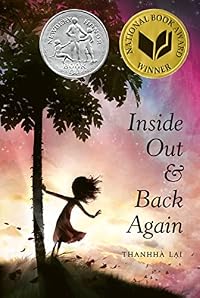
*I'm comparing it, offhand, to The Weight of Water and Inside Out and Back Again.
Upon meeting his teacher in Minnesota:
I'm ready to begin
my learning, I say,
and she tosses out a loud laugh
like a ball into the air..."
Upon reflecting show more about the MN cow that has made him less homesick for his father's herd:
"You can have your dogs and cats,
your gerbils and hamsters
and sleek sparkling fish.
But you will have lived
just half a life
if you never love a cow."
I especially admire the way the author uses a limited vocabulary and shows us a bewildered child at the beginning of the book, but uses more advanced words and ideas as the boy learns more English and grows more confident and comfortable in his new home." show less
*I'm comparing it, offhand, to The Weight of Water and Inside Out and Back Again.
Upon meeting his teacher in Minnesota:
I'm ready to begin
my learning, I say,
and she tosses out a loud laugh
like a ball into the air..."
Upon reflecting show more about the MN cow that has made him less homesick for his father's herd:
"You can have your dogs and cats,
your gerbils and hamsters
and sleek sparkling fish.
But you will have lived
just half a life
if you never love a cow."
I especially admire the way the author uses a limited vocabulary and shows us a bewildered child at the beginning of the book, but uses more advanced words and ideas as the boy learns more English and grows more confident and comfortable in his new home." show less
After losing his father and brother and being separated from his mother during the war, Kek, a 5th grader, moves from Sudan to Minneapolis to live with his aunt and cousin and tries to make sense of his new life in America. Everything is unfamiliar – Kek calls the stove the “cooking fire” and airplanes the “flying boat” and tries to wash dishes in the washing machine. Except one day, Kek spots a cow which reminds him of home.
With the help of Hannah, a neighbor who is in foster care who understands what it’s like to feel displaced, Kek begins caring for the cow and slowly starts to rebuild a sense of connection and purpose. The cow becomes a symbol of his past, his hope, and his healing.
The book is written in verse format. show more The format really helps capture how overwhelmed and out of place Kek feels—it reads like someone trying to find the right words in a new language. It’s accessible for upper elementary and middle grade readers, especially those interested in stories about resilience, refugees, and starting over.
I did find myself wishing there were more details about Kek’s culture and background. His tribe, language, and personal history are mostly left out, which makes him feel more symbolic than specific at times. Still, the story does a good job showing what it’s like to arrive somewhere completely new and try to figure out where you belong.
Home of the Brave offers an accessible and empathetic entry point for middle grade readers into conversations about war, displacement, and the immigrant experience. show less
With the help of Hannah, a neighbor who is in foster care who understands what it’s like to feel displaced, Kek begins caring for the cow and slowly starts to rebuild a sense of connection and purpose. The cow becomes a symbol of his past, his hope, and his healing.
The book is written in verse format. show more The format really helps capture how overwhelmed and out of place Kek feels—it reads like someone trying to find the right words in a new language. It’s accessible for upper elementary and middle grade readers, especially those interested in stories about resilience, refugees, and starting over.
I did find myself wishing there were more details about Kek’s culture and background. His tribe, language, and personal history are mostly left out, which makes him feel more symbolic than specific at times. Still, the story does a good job showing what it’s like to arrive somewhere completely new and try to figure out where you belong.
Home of the Brave offers an accessible and empathetic entry point for middle grade readers into conversations about war, displacement, and the immigrant experience. show less
Kek comes from Africa. In America he sees snow for the first time, and feels its sting. He's never walked on ice, and he falls. He wonders if the people in this new place will be like the winter – cold and unkind.
In Africa, Kek lived with his mother, father, and brother. But only he and his mother have survived, and now she's missing. Kek is on his own. Slowly, he makes friends: a girl who is in foster care; an old woman who owns a rundown farm, and a cow whose name means "family" in Kek's native language. As Kek awaits word of his mother's fate, he weathers the tough Minnesota winter by finding warmth in his new friendships, strength in his memories, and belief in his new country.
In Africa, Kek lived with his mother, father, and brother. But only he and his mother have survived, and now she's missing. Kek is on his own. Slowly, he makes friends: a girl who is in foster care; an old woman who owns a rundown farm, and a cow whose name means "family" in Kek's native language. As Kek awaits word of his mother's fate, he weathers the tough Minnesota winter by finding warmth in his new friendships, strength in his memories, and belief in his new country.
I know this book is talked about as being one of the greatest of last year, but I found it contrived. The verses are so adult as to lose the feel for the teenager writing them. Some of the scenes are incredibly vivid, however, and the premise is both relevant to our times and moving.
In her first stand-alone book, Applegate (the Animorphs series) effectively uses free verse to capture a Sudanese refugee's impressions of America and his slow adjustment. After witnessing the murders of his father and brother, then getting separated from his mother in an African camp, Kek alone believes that his mother has somehow survived. The boy has traveled by flying boat to Minnesota in winter to live with relatives who fled earlier. An onslaught of new sensations greets Kek (This cold is like claws on my skin, he laments), and ordinary sights unexpectedly fill him with longing (a lone cow in a field reminds him of his father's herd; when he looks in his aunt's face, I see my mother's eyes/ looking back at me). Prefaced by an show more African proverb, each section of the book marks a stage in the narrator's assimilation, eloquently conveying how his initial confusion fades as survival skills improve and friendships take root. Kek endures a mixture of failures (he uses the clothes washer to clean dishes) and victories (he lands his first paying job), but one thing remains constant: his ardent desire to learn his mother's fate. Precise, highly accessible language evokes a wide range of emotions and simultaneously tells an initiation story. A memorable inside view of an outsider. Ages 10-14 show less
Members
- Recently Added By
Lists

Kids' Tour of the US in Books
50 works; 5 members

Novels in verse -- children's/young adult fiction
28 works; 7 members
Author Information

448+ Works 89,948 Members
Katherine Applegate was born in Michigan on July 19, 1956. She writes science fiction, young adult romances, and pop-up books. She is the author of the Making Waves, Making Out, and Roscoe Riley Rules series. She writes the Animorphs, Everworld, and Remnants series under the pen name K. A. Applegate. She also writes under the pen names of C. show more Archer, Catherine Kendall and Elizabeth Benning. She has received numerous awards including a Golden Duck Award (Eleanor Cameron Award for Middle Grades) for The Message in 1997, the SCBWI 2008 Golden Kite Award for Best Fiction and the Bank Street 2008 Josette Frank Award for Home of the Brave, and the 2013 Newbery Medal and the Rebecca Caudill Young Readers' Book Award (Illinois) for The One and Only Ivan. (Bowker Author Biography) show less
Some Editions
Awards and Honors
Awards
Notable Lists
Common Knowledge
- Important places*
- Soedan
*Some information comes from Common Knowledge in other languages. Click "Edit" for more information.
Classifications
- Genres
- Poetry, Kids, Fiction and Literature, Tween, Children's Books
- DDC/MDS
- 813.54 — Literature & rhetoric American literature in English American fiction in English 1900-1999 1945-1999
- LCC
- PZ7 .A6485 .H — Language and Literature Fiction and juvenile belles lettres Fiction and juvenile belles lettres Juvenile belles lettres
- BISAC
Statistics
- Members
- 1,490
- Popularity
- 15,495
- Reviews
- 60
- Rating
- (4.27)
- Languages
- English
- Media
- Paper, Audiobook, Ebook
- ISBNs
- 12
- ASINs
- 7