
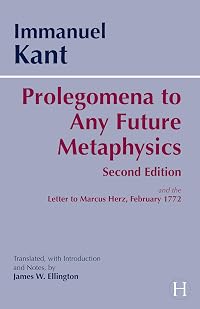
Prolegomena to Any Future Metaphysics
by Immanuel Kant
On This Page
Description
In 1781, Immanuel Kant published his first and most famous work, the "Critique of Pure Reason." To the German philosopher's dismay, the work was at first poorly received and largely misunderstood by his readers. As a result, two years later Kant produced his "Prolegomena to any Future Metaphysics that will be Able to Present Itself as a Science" to serve as an introduction to the "Critique." He restated the main ideas of his philosophy in what Schopenhauer, in 1819, declared was "the finest show more and most comprehensible of Kant's principal works, which is far too little read, for it immensely facilitates the study of his philosophy." Immanuel Kant (1724-1804) was considered to be one of the most important and influential figures in Western philosophy for his work in the areas of metaphysics, anthropology, theoretical physics, logic, and moral philosophy. Remarkably, Kant never left the town of Kn igsberg, Germany, where he had been born, received schooling, and served as lecturer at the University for many years. show lessTags
Recommendations














Member Reviews
Como o próprio Kant enfatiza, trata-se de um livro derivativo, um guia para sua monumental obra prima, a crítica da razão pura. Como guia, acredito que é um livro interessante, desenhando um panorama geral bem mais acessível e que incessantemente bate na tecla da regulação do que a razão pode, afim de mostrar como toda metafísica dogmática é um castelo de cartas, sem fundamentação possível porque afastado da experiência. Também tem uma discussão breve mas interessante sobre a exploração dos limites entre a razão e o entendimento, a zona limítrofe entre a especulação e a empiria que poderia abrigar uma metafísica futura. O método de exposição também tem seu interesse, embora eu ache o resultado pálido show more comparado ao da crítica: aqui existem práticas, a matemática, as ciências naturais e a metafísica, e a pergunta de suas possibilidades (a pergunta crítica) leva à tratar da estética transcendental e o papel da intuição, depois a analítica e suas tábuas de categorias, depois a dialética e suas aporias. show less
The Critique of Pure Reason for Dummies, Kant's popularization of his own famously indecipherable work of metaphysics is itself at the border of decipherability, but only just, and it will reward those with some background in philosophy who are willing to make the slog. I'm not one—I gave up after the first couple of chapters—but I am convinced that it would be possible to make it all the way through.
100 KAN 1
Síntese da Crítica da razón pura, aínda así non é unha obra doada de ler para os que non estean afeitos á escrita da época e os tratados filosóficos.
Jul 30, 2011Galician
UBB-4
Sep 7, 2021Catalan
193 KAN
Apr 23, 2020Italian
Members
- Recently Added By
Author Information

The greatest of all modern philosophers was born in the Baltic seaport of Konigsberg, East Prussia, the son of a saddler and never left the vicinity of his remote birthplace. Through his family pastor, Immanuel Kant received the opportunity to study at the newly founded Collegium Fredericianum, proceeding to the University of Konigsberg, where he show more was introduced to Wolffian philosophy and modern natural science by the philosopher Martin Knutzen. From 1746 to 1755, he served as tutor in various households near Konigsberg. Between 1755 and 1770, Kant published treatises on a number of scientific and philosophical subjects, including one in which he originated the nebular hypothesis of the origin of the solar system. Some of Kant's writings in the early 1760s attracted the favorable notice of respected philosophers such as J. H. Lambert and Moses Mendelssohn, but a professorship eluded Kant until he was over 45. In 1781 Kant finally published his great work, the Critique of Pure Reason. The early reviews were hostile and uncomprehending, and Kant's attempt to make his theories more accessible in his Prolegomena to Any Future Metaphysics (1783) was largely unsuccessful. Then, partly through the influence of former student J. G. Herder, whose writings on anthropology and history challenged his Enlightenment convictions, Kant turned his attention to issues in the philosophy of morality and history, writing several short essays on the philosophy of history and sketching his ethical theory in the Foundations of the Metaphysics of Morals (1785). Kant's new philosophical approach began to receive attention in 1786 through a series of articles in a widely circulated Gottingen journal by the Jena philosopher K. L. Reinhold. The following year Kant published a new, extensively revised edition of the Critique, following it up with the Critique of Practical Reason (1788), treating the foundations of moral philosophy, and the Critique of Judgment (1790), an examination of aesthetics rounding out his system through a strikingly original treatment of two topics that were widely perceived as high on the philosophical agenda at the time - the philosophical meaning of the taste for beauty and the use of teleology in natural science. From the early 1790s onward, Kant was regarded by the coming generation of philosophers as having overthrown all previous systems and as having opened up a whole new philosophical vista. During the last decade of his philosophical activity, Kant devoted most of his attention to applications of moral philosophy. His two chief works in the 1790s were Religion Within the Bounds of Plain Reason (1793--94) and Metaphysics of Morals (1798), the first part of which contained Kant's theory of right, law, and the political state. At the age of 74, most philosophers who are still active are engaged in consolidating and defending views they have already worked out. Kant, however, had perceived an important gap in his system and had begun rethinking its foundations. These attempts went on for four more years until the ravages of old age finally destroyed Kant's capacity for further intellectual work. The result was a lengthy but disorganized manuscript that was first published in 1920 under the title Opus Postumum. It displays the impact of some of the more radical young thinkers Kant's philosophy itself had inspired. Kant's philosophy focuses attention on the active role of human reason in the process of knowing the world and on its autonomy in giving moral law. Kant saw the development of reason as a collective possession of the human species, a product of nature working through human history. For him the process of free communication between independent minds is the very life of reason, the vocation of which is to remake politics, religion, science, art, and morality as the completion of a destiny whose shape it is our collective task to frame for ourselves. (Bowker Author Biography) Philosopher Immanuel Kant was born in 1724 in Konigsberg, East Prussia. He studied at the University of Konigsberg, where he would act as a lecturer and professor after a brief career as a private tutor. Kant was an incredibly influential philosopher, his theories having impact on the likes of Schopenhauer and Hegel. Kant's most prominent works include Critique of Pure Reason (1781), Foundations of the Metaphysics of Morals (1785) and Critique of Practical Reason (1788). He died in 1804. (Bowker Author Biography) show less
Some Editions
Series
Belongs to Publisher Series
Work Relationships
Common Knowledge
- Canonical title
- Prolegomena to Any Future Metaphysics
- Original title
- Prolegomena to Any Future Metaphysics That Will be Able to Come Forward as Science
- Alternate titles
- Prolegomena
- Original publication date
- 1783
- First words
- These Prolegomena are for the use, not of mere learners, but of future teachers, and even the latter should not expect that they will be serviceable for the systematic exposition of a ready-made science, but merely for... (show all) the discovery of the science itself. • • Introduction
- Last words
- (Click to show. Warning: May contain spoilers.)Last, but not least, it cannot be otherwise than important to a teacher of metaphysics to be able to say with universal assent that what he expounds as science,and by it genuine services will be rendered to the commonweal. • • Appendix
- Blurbers
- Genova, A. C.
- Original language
- German
Classifications
Statistics
- Members
- 1,552
- Popularity
- 14,721
- Reviews
- 7
- Rating
- (3.52)
- Languages
- 23 — Catalan, Czech, Danish, Dutch, English, Estonian, Finnish, French, German, Greek, Hebrew, Hungarian, Italian, Latvian, Polish, Portuguese, Romanian, Russian, Serbian, Slovenian, Spanish, Swedish, Turkish
- Media
- Paper, Audiobook, Ebook
- ISBNs
- 84
- ASINs
- 37