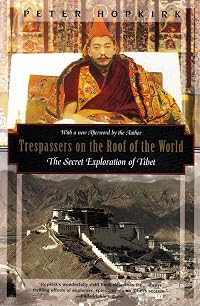
Trespassers on the Roof of the World: The Secret Exploration of Tibet (Kodansha Globe)
by Peter Hopkirk
On This Page
Description
Hidden behind the Himalayas and ruled over by a God-king, Tibet has always cast a powerful spell over travellers form the West. In this remarkable, and ultimately tragic narrative, Peter Hopkirk recounts the forcible opening up of this medieval land during the nineteenth and twentieth centuries, and the extraordinary race between agents, soldiers, missionaries, mountaineers, explorers, and mystics from nine different countries to reach Lhasa, Tibet's sacred capital. His story concludes with show more the ultimate act of trespass - the Chinese invasion of 1950. show lessTags
Recommendations























Member Reviews
Peter Hopkirk, a leading British journalist, wrote a series of excellent popular histories of Central Asia, between 1980 and 1996, which opened up the area to the British public and re-introduced them to the Great Game for control of Eurasia that continues to this day.
This volume, the second of six and published in 1982, concentrates on Tibet after it closed its borders to protect its unique culture and then became the subject of intense curiosity by Victorians with many different motives, prepared to risk severe deprivation and death in order to reach Lhasa.
The book speaks for itself. The first half is essentially a long series of individual stories, some of which are basically espionage, others simple adventuring and some absurd show more idealistic efforts to Christianise the country. Each an adventure and each a good read.
Surveying Tibet was a military concern for the British since there was, probably ill informed, fears that Moscow might appear in Lhasa one day and the way south to British India be laid open. The Russians themselves clearly had some interest in keeping Tibet out of British control.
Throughout this time, Tibet held a curious place within the Chinese Empire, nominally part of it but essentially independent in all but name - desperately poor and ruled by an exceptionally brutal theocratic caste operating a form of feudalism maintained through religious fear.
The virtue of the book lies in the skills of Hopkirk as journalist. He reports things straight without ideological overlay (contemporary journalists might have learned a thing or two from him) and in a way that allows us, with maps, to construct a strong sense of Tibet's topography.
The climax of the book is Younghusband's Expedition of 1903 which was a classically British reluctant invasion against an unprepared feudal army led by religious numskulls where even the invaders were horrified by the slaughter and were quick to try to save the lives of those they shot.
The book loses impetus towards the very end because Younghusband effectively opened up Lhasa to British influence (which the British Cabinet clearly did not entirely care about) with a line of trading situations out of Sikkim that probably benefited Raj and Tibet alike.
But the British always respected Chinese suzerainty and did nothing substantial to improve the condition of the country. Tibet also declined to be anything but studiously neutral in the Second World War which probably sealed its fate later.
The final chapter is a fair account of the Chinese invasion of Tibet which really has nothing to do with the main theme of the book but is a necessary coda for a readership that, at time of publication, was very aware of the role of Central Asia (Afghanistan) in the Cold War.
This brings out the modern moral problem of Tibet. On the one hand, the Tibet that China invaded in 1950 was recognised as within China by the international community and China was invading a regime that was only marginally less brutal, feudal and poor than 100 years before.
On the other hand, anyone who believes in national self determination might recognise that the Tibetans ought to have had a right to determine their future - that is, if they had been anything close to a democracy.
Hopkirk is sound in his judgements. The British had withdrawn from the Raj and Nehru did not want confrontation with China. The Chinese came in as 'class liberators' (not without some justification) but faced the fact that much of the population was dependent on the existing system.
In disrupting that system, the Chinese authorities instigated rebellion and a genuine Tibetan nationalist revolt counteracted any class liberation strategy. Things deteriorated from Chinese mismanagement and then brutality as Chinese investigators were later to accept.
The romance of the current Dalai Lama, however, should not stop us from considering that the story of Tibet is not a black and white story and no doubt the US has been dabbling as it often does with agit-prop and subversion. It is a complex story that needs more up to date telling.
As a whole, this well written book is largely about individual tales of adventure and derring-do by remarkable men and some women who make our contemporaries look like wimps in terms of what they were prepared to do for whatever ends they had in mind.
As so often, the uniqueness of the British Raj shines through. Though ultimately always beholden to the British Government in London on policy, it really ran itself and developed political, military, diplomatic and espionage systems that were 'state of the art' at the time.
At the other end of the book from the Chinese invasion is the remarkable story not of the incursion of lone Westerners but of the Indians who worked for British intelligence and went undercover in Tibet at great risk, literally to pace out a survey of Tibet with their feet and hidden instruments.
Indeed, one of the problems of the book is how to claim discovery when, of course, the Chinese had no problem of access and neither did, say, Russian Buryats or Raj Ladakhs. Self-evidently the book is only about those excluded by Lhasa - the presumed agents of foreign imperial powers.
So, this book is not to be regarded as a book of 'discovery' or even exploration (since the Tibetans knew their own country only too well) but one of imperial incursion and cultural invasion, even if the Tibetans perhaps could have done with some modern ideas for the sake of their people.
Romantics may want or have wanted Tibet to be preserved in the aspic of theocracy because of its unique Buddhist culture but we should be clear about this - that culture was obscurantist and capable of extreme cruelty and exploitation.
The 'spiritual' aspects of Buddhism did not require thousands of parasitical lamas and many of the beliefs were and are absurd uses of human energy in obeisance to a structure of power that brought few material benefits to the population and was based largely on fear - of demons and lamas.
Which brings us back to modern Tibet which is in limbo - modernised up to a point by China with a condition of the people improved materially but not master of its own destiny and now with large numbers of Han Chinese settlers having diluted its ethnic base.
One has no doubt that feudalism has gone for good but the structures and networks of the old families in exile no doubt stand ready to return and create a form of neo-liberal Buddhism if this can be engineered by Washington so that little is resolved.
One might hope that the Tibetans themselves might be given some form of democracy free of foreign but also of theocratic influence but its geo-political situation and the ambitions of elites of all stripes make this unlikely. It remains subject to a zero sum game between empires.
All we can hope for is continued material improvements as the Chinese economy improves and as Eurasia becomes a unified economic zone and sufficient respect for tradition that Tibetans can feel that their identity is still theirs and can be built on for the future. show less
This volume, the second of six and published in 1982, concentrates on Tibet after it closed its borders to protect its unique culture and then became the subject of intense curiosity by Victorians with many different motives, prepared to risk severe deprivation and death in order to reach Lhasa.
The book speaks for itself. The first half is essentially a long series of individual stories, some of which are basically espionage, others simple adventuring and some absurd show more idealistic efforts to Christianise the country. Each an adventure and each a good read.
Surveying Tibet was a military concern for the British since there was, probably ill informed, fears that Moscow might appear in Lhasa one day and the way south to British India be laid open. The Russians themselves clearly had some interest in keeping Tibet out of British control.
Throughout this time, Tibet held a curious place within the Chinese Empire, nominally part of it but essentially independent in all but name - desperately poor and ruled by an exceptionally brutal theocratic caste operating a form of feudalism maintained through religious fear.
The virtue of the book lies in the skills of Hopkirk as journalist. He reports things straight without ideological overlay (contemporary journalists might have learned a thing or two from him) and in a way that allows us, with maps, to construct a strong sense of Tibet's topography.
The climax of the book is Younghusband's Expedition of 1903 which was a classically British reluctant invasion against an unprepared feudal army led by religious numskulls where even the invaders were horrified by the slaughter and were quick to try to save the lives of those they shot.
The book loses impetus towards the very end because Younghusband effectively opened up Lhasa to British influence (which the British Cabinet clearly did not entirely care about) with a line of trading situations out of Sikkim that probably benefited Raj and Tibet alike.
But the British always respected Chinese suzerainty and did nothing substantial to improve the condition of the country. Tibet also declined to be anything but studiously neutral in the Second World War which probably sealed its fate later.
The final chapter is a fair account of the Chinese invasion of Tibet which really has nothing to do with the main theme of the book but is a necessary coda for a readership that, at time of publication, was very aware of the role of Central Asia (Afghanistan) in the Cold War.
This brings out the modern moral problem of Tibet. On the one hand, the Tibet that China invaded in 1950 was recognised as within China by the international community and China was invading a regime that was only marginally less brutal, feudal and poor than 100 years before.
On the other hand, anyone who believes in national self determination might recognise that the Tibetans ought to have had a right to determine their future - that is, if they had been anything close to a democracy.
Hopkirk is sound in his judgements. The British had withdrawn from the Raj and Nehru did not want confrontation with China. The Chinese came in as 'class liberators' (not without some justification) but faced the fact that much of the population was dependent on the existing system.
In disrupting that system, the Chinese authorities instigated rebellion and a genuine Tibetan nationalist revolt counteracted any class liberation strategy. Things deteriorated from Chinese mismanagement and then brutality as Chinese investigators were later to accept.
The romance of the current Dalai Lama, however, should not stop us from considering that the story of Tibet is not a black and white story and no doubt the US has been dabbling as it often does with agit-prop and subversion. It is a complex story that needs more up to date telling.
As a whole, this well written book is largely about individual tales of adventure and derring-do by remarkable men and some women who make our contemporaries look like wimps in terms of what they were prepared to do for whatever ends they had in mind.
As so often, the uniqueness of the British Raj shines through. Though ultimately always beholden to the British Government in London on policy, it really ran itself and developed political, military, diplomatic and espionage systems that were 'state of the art' at the time.
At the other end of the book from the Chinese invasion is the remarkable story not of the incursion of lone Westerners but of the Indians who worked for British intelligence and went undercover in Tibet at great risk, literally to pace out a survey of Tibet with their feet and hidden instruments.
Indeed, one of the problems of the book is how to claim discovery when, of course, the Chinese had no problem of access and neither did, say, Russian Buryats or Raj Ladakhs. Self-evidently the book is only about those excluded by Lhasa - the presumed agents of foreign imperial powers.
So, this book is not to be regarded as a book of 'discovery' or even exploration (since the Tibetans knew their own country only too well) but one of imperial incursion and cultural invasion, even if the Tibetans perhaps could have done with some modern ideas for the sake of their people.
Romantics may want or have wanted Tibet to be preserved in the aspic of theocracy because of its unique Buddhist culture but we should be clear about this - that culture was obscurantist and capable of extreme cruelty and exploitation.
The 'spiritual' aspects of Buddhism did not require thousands of parasitical lamas and many of the beliefs were and are absurd uses of human energy in obeisance to a structure of power that brought few material benefits to the population and was based largely on fear - of demons and lamas.
Which brings us back to modern Tibet which is in limbo - modernised up to a point by China with a condition of the people improved materially but not master of its own destiny and now with large numbers of Han Chinese settlers having diluted its ethnic base.
One has no doubt that feudalism has gone for good but the structures and networks of the old families in exile no doubt stand ready to return and create a form of neo-liberal Buddhism if this can be engineered by Washington so that little is resolved.
One might hope that the Tibetans themselves might be given some form of democracy free of foreign but also of theocratic influence but its geo-political situation and the ambitions of elites of all stripes make this unlikely. It remains subject to a zero sum game between empires.
All we can hope for is continued material improvements as the Chinese economy improves and as Eurasia becomes a unified economic zone and sufficient respect for tradition that Tibetans can feel that their identity is still theirs and can be built on for the future. show less
This little book on the history of the infiltration of Tibet by the West is quite fascinating. Beginning in the mid-1800’s, a number of brave and/or crazy but ultimately unsuccessful explorers and missionaries from England, Russia, America, France, India, and China were “hell-bent” on being the first into the holy city of Lhasa – at 12,000 feet the world’s highest capital. The terrain was perilous, the weather worse, and the Tibetans resistant. It was not until a British mission was put together in 1903 with more than a thousand soldiers, 7,000 mules, 4,000 yaks, and 10,000 “coolies” that the mission was accomplished. The British had to fight a battle though to get through the last barrier, Karo Pass. At 16,000 feet, the show more skirmish was fought at a higher altitude than any other engagement in history. (The British, with their advanced weaponry, lost five men with another 13 wounded, while the Tibetans suffered more than four hundred dead and wounded.) Once the British crossed into Lhasa, however, they saw this squalid and unprepossessing city full of wild roaming pigs and dogs, and wondered what all the fuss had been about….
The story of the early attempts to get to Lhasa are pretty awe-inspiring, beginning with the Indian spies trained by the British. They wandered through Tibet for years disguised as holy men, with measuring and recording instruments hidden inside Buddhist prayer wheels and Tibetan rosaries. They never succeeded in getting to Lhasa however, as there was little incentive for locals to assist them: Tibetans who were discovered helping foreigners get to Lhasa, even by selling them food or providing shelter, would be tortured and killed. Then there was the young missionary couple whose newborn died as they trudged along at sixteen and seventeen thousand feet, not understanding that little lungs were inadequate to the challenge. A couple of the adventurers were even women traveling alone.
The book ends with the unfortunate story of the transfer of Tibet’s sovereignty to China in 1950, and the failure of the rest of the world to respond to Tibet’s pleas for help. Tibetans suffered religious and political persecution, and it is estimated that up to one million Tibetans may have died in the repression by the Chinese and attempts at resistance to it. In 1980, some reforms were instituted by the Chinese government, including the decision to allow tourists to visit certain areas. But calls for independence by Tibet halted the liberalization. China keeps a tight control over press coverage in Tibet, and it seems as difficult as it ever was for the West to know what is going on in Lhasa.
Discussion: I found this book very interesting, and I especially enjoyed learning about Tibetan Buddhism. As for Tibet's sad history, I’d have to agree with Hopkirk’s closing statement: "…it is hard not to feel some sympathy for this gentle, cheerful and long-suffering people who only ever asked one thing of the outside world. And that was to be left alone.”
Evaluation: This book was written in 1982 and updated in 1994, but while dated, it is still considered to be one of the better resources for understanding Tibet and the history of its exploration and conquest. show less
The story of the early attempts to get to Lhasa are pretty awe-inspiring, beginning with the Indian spies trained by the British. They wandered through Tibet for years disguised as holy men, with measuring and recording instruments hidden inside Buddhist prayer wheels and Tibetan rosaries. They never succeeded in getting to Lhasa however, as there was little incentive for locals to assist them: Tibetans who were discovered helping foreigners get to Lhasa, even by selling them food or providing shelter, would be tortured and killed. Then there was the young missionary couple whose newborn died as they trudged along at sixteen and seventeen thousand feet, not understanding that little lungs were inadequate to the challenge. A couple of the adventurers were even women traveling alone.
The book ends with the unfortunate story of the transfer of Tibet’s sovereignty to China in 1950, and the failure of the rest of the world to respond to Tibet’s pleas for help. Tibetans suffered religious and political persecution, and it is estimated that up to one million Tibetans may have died in the repression by the Chinese and attempts at resistance to it. In 1980, some reforms were instituted by the Chinese government, including the decision to allow tourists to visit certain areas. But calls for independence by Tibet halted the liberalization. China keeps a tight control over press coverage in Tibet, and it seems as difficult as it ever was for the West to know what is going on in Lhasa.
Discussion: I found this book very interesting, and I especially enjoyed learning about Tibetan Buddhism. As for Tibet's sad history, I’d have to agree with Hopkirk’s closing statement: "…it is hard not to feel some sympathy for this gentle, cheerful and long-suffering people who only ever asked one thing of the outside world. And that was to be left alone.”
Evaluation: This book was written in 1982 and updated in 1994, but while dated, it is still considered to be one of the better resources for understanding Tibet and the history of its exploration and conquest. show less
I'm quite a fan of Peter Hopkirk and while "Trespassers on the roof of the world" is not his best I still found myself turning the pages long after my bedtime. When it comes to remoteness, few places can beat Tibet and for many people over the centuries it was the stuff of legends. Mt Everest, the Yeti, Shangri La, the Tibetan Blue Bear, flying monks, the highest altitude goldfields in the world and Lhasa to name just a few of the legends around the Forbidden Kingdom.
"Trespassers on the roof of the world" covers all the attempts by westerners to enter Tibet and be the first to clap eyes on Lhasa. Some did it for science while other, somewhat nuttier, explorers travelled there to convert the Dalai Lama to Christianity, be the first to show more reach Everest's peak by crashlanding a plane half way up and legging it the rest of the way, or similar, "trespassers" supplies a wealth of knowledge about Tibet. show less
"Trespassers on the roof of the world" covers all the attempts by westerners to enter Tibet and be the first to clap eyes on Lhasa. Some did it for science while other, somewhat nuttier, explorers travelled there to convert the Dalai Lama to Christianity, be the first to show more reach Everest's peak by crashlanding a plane half way up and legging it the rest of the way, or similar, "trespassers" supplies a wealth of knowledge about Tibet. show less
Trespassers on the Roof of the World is a narrative history of outside travel into Tibet during the period of about 1850 to 1950. It is not an exhaustive survey but retells some of the most well known and interesting stories for a popular audience. Hopkirk is a skilled journalistic story teller and he keeps the reader enthralled with one amazing story after the next, I hardly wanted to put the book down. As is the case in books like this, a lot of ground is covered at the expense of wanting to know more and not getting a good feel for the people involved. In the end the book is a popularizer of some really good travel literature about Tibet and it should send the reader off to explore in more detail some of these great and now obscure show more works.
--Review by Stephen Balbach, via CoolReading (c) 2008 cc-by-nd show less
--Review by Stephen Balbach, via CoolReading (c) 2008 cc-by-nd show less
I generally enjoyed Peter Hopkirk's look at the efforts of the West to invade Lhasa in his book "Trespassers on the Roof of the World." This book had been recommended to me on both of my reading websites, but I kept avoiding it, thinking I had read it before. It actually was new to me, though I've read many of the first-hand accounts that Hopkirk summarizes in his work.
He does a great job writing up the various attempts of the mainly British efforts to see Lhasa first-hand. They were mostly entertaining, (even as I shook my head and wondered why they couldn't just leave the Tibetans alone, as they requested.)
There is, however, something curiously Euro-centric about the book (especially as Hopkirk dismisses the Japanese man who lived in show more Tibet for years as the person to "win the race" to the Forbidden City.) This irked me in other places in the book as well.
Overall, it is, however, a good look at the history of Tibet (from a Western "I will conquer the world" perspective.) show less
He does a great job writing up the various attempts of the mainly British efforts to see Lhasa first-hand. They were mostly entertaining, (even as I shook my head and wondered why they couldn't just leave the Tibetans alone, as they requested.)
There is, however, something curiously Euro-centric about the book (especially as Hopkirk dismisses the Japanese man who lived in show more Tibet for years as the person to "win the race" to the Forbidden City.) This irked me in other places in the book as well.
Overall, it is, however, a good look at the history of Tibet (from a Western "I will conquer the world" perspective.) show less
This is the story of how foreigners opened up the closed kingdom of Tibet and entered the forbidden city of Llhasa. It looks pretty well researched as the story covers some very obscure people as well as some well-known people. Focusing on the race to be the first Westerner to enter Llhasa, other Eastern explorers are covered as well. It roughly covers the period of about 1800 to 1950.
A good resource for games set in the Raj - a lot of the race was driven by the Tsarist expansion into Asia - as the first documented entrants were some 'pundits'.
A good resource for games set in the Raj - a lot of the race was driven by the Tsarist expansion into Asia - as the first documented entrants were some 'pundits'.
Members
- Recently Added By
Author Information

Peter Hopkirk has traveled widely over many years in Central Asia, Russia, China, India, Pakistan, and the Middle East as writer
Awards and Honors
Series
Belongs to Publisher Series
Common Knowledge
- Canonical title*
- Alla conquista di Lhasa
- Original title
- Trespassers on the Roof of the Word. The Race for Lhasa
- Original publication date
- 1983
- Important places
- Tibet; Lhasa, Tibet; Thak Jalong, Tibet
- Important events
- Great Game
- First words
- This book tells the story - often bizarre, sometimes tragic, frequently hair-raising - of the prising open of Tibet by an inquisitive outside world.
- Last words
- (Click to show. Warning: May contain spoilers.)And that was to be left alone.
- Original language
- English
*Some information comes from Common Knowledge in other languages. Click "Edit" for more information.
Classifications
Statistics
- Members
- 532
- Popularity
- 56,423
- Reviews
- 7
- Rating
- (4.08)
- Languages
- 5 — Dutch, English, French, German, Italian
- Media
- Paper, Ebook
- ISBNs
- 16
- ASINs
- 8