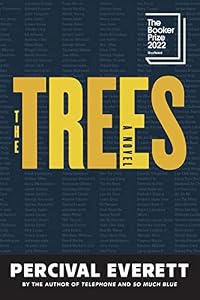
The Trees
by Percival Everett
On This Page
Description
An uncanny literary thriller addressing the painful legacy of lynching in the US, by the author of Telephone Percival Everett's The Trees is a must-listen that opens with a series of brutal murders in the rural town of Money, Mississippi. When a pair of detectives from the Mississippi Bureau of Investigation arrive, they meet expected resistance from the local sheriff, his deputy, the coroner, and a string of racist white townsfolk. The murders present a puzzle, for at each crime scene there show more is a second dead body: that of a man who resembles Emmett Till. The detectives suspect that these are killings of retribution, but soon discover that eerily similar murders are taking place all over the country. Something truly strange is afoot. As the bodies pile up, the MBI detectives seek answers from a local root doctor who has been documenting every lynching in the country for years, uncovering a history that refuses to be buried. In this bold, provocative book, Everett takes direct aim at racism and police violence. The Trees is an enormously powerful novel of lasting importance from an author with his finger on America's pulse. show lessTags
Recommendations












Member Recommendations
Member Reviews
Baffling murders, gruesome and apparently vengeful, are troubling the small town of Money, Mississippi---two White men, found separately, each strangled with barbed wire, each emasculated, each with a battered and dirty Black corpse nearby. Both White men have a family connection to the men believed to have murdered Emmett Till 60 years before. Then, the decrepit old White woman who first accused Emmett of whistling at her, and later recanted her story, is found dead of natural causes...but also accompanied by the same--or a very similar--Black corpse. It all proves too much for Sheriff Red Jetty and his force. Enter two special agents from the Mississippi Bureau of Investigation...two Black special agents from the MBI. They don't make show more a lot of progress in figuring out what the devil is going on either...but for a while they, and the reader, have a hell of a lot of fun trying. There are some of the darkest bits of humor I have ever encountered in the first two hundred pages of this book, and I could not put it down. Everett's characters are drawn with wicked accuracy, and named with a whimsy that defies description. As deaths multiply all across the U. S., the mysterious unidentified unmutilated companion corpses begin to include Chinese and Native American men in addition to Black men. The situation gets less amusing, more profound, more bewildering and even the instigators of the original retributive killings do not understand what they have set in motion. There is no subtlety here, and ultimately not the slightest suggestion of hope for a resolution of either the burgeoning Rising, or the historical atrocities that brought it all into being. Unforgettable. show less
Well, I fell for the hype again, but didn't get short-changed this time! The first half of the story is hilarious, full of dark (like light-absorbing black paint DARK) humour and droll southern wit. In Money, Mississippi, two redneck family men are brutally murdered in their homes, found alongside the corpse of a Black man who has been beaten to death. The body of the Black victim disappears from one crime scene and reappears at the next, hopelessly confusing the sheriff and his deputies. The mother of one victim, Carolyn Bryant, recognises the mysterious man and terrorised into a heart attack by her own guilt.
Now, I must confess that although I knew about the lynching of fourteen year old Emmett Till in 1955, I did not recognise the show more family names of the men who killed him nor the woman whose accusations led to the horrendous murder of the young boy (Carolyn Bryant). When the penny dropped, the book took on a far more sinister tone and a deeper level of historical relevance - but I could still laugh at local yokels living in the past (as the author has said, 'Humour is a fantastic tool because you can use it to get people to relax and then do anything you want to them'). Two (Black) agents from the Mississippi Bureau of Investigation - which is actually a thing? - are sent to Money to help the sheriff's department with the murders and missing bodies, and somehow manage to maintain both sarcasm and cynicism in a losing battle against useless deputies, racist locals and zombie killers.
I preferred the supernatural take on the murders at the start of the story to the second half of the book - at one point, even the agents are convinced that Emmett Till has returned from the grave (twice) to exact his revenge. The mash-up of irreverent humour and violent deaths fit the Southern gothic tradition perfectly and I almost didn't want to know what was really going on (and certainly didn't need a cameo appearance from Trump!) But I could also appreciate the necessary reminder of America's record of racism and violence - and the (albeit very campy) warning for the future:
When I write the names they become real, not just statistics. When I write the names they become real again. It’s almost like they get a few more seconds here. Do you know what I mean? I would never be able to make up this many names. The names have to be real. They have to be real. Don’t they? show less
Now, I must confess that although I knew about the lynching of fourteen year old Emmett Till in 1955, I did not recognise the show more family names of the men who killed him nor the woman whose accusations led to the horrendous murder of the young boy (Carolyn Bryant). When the penny dropped, the book took on a far more sinister tone and a deeper level of historical relevance - but I could still laugh at local yokels living in the past (as the author has said, 'Humour is a fantastic tool because you can use it to get people to relax and then do anything you want to them'). Two (Black) agents from the Mississippi Bureau of Investigation - which is actually a thing? - are sent to Money to help the sheriff's department with the murders and missing bodies, and somehow manage to maintain both sarcasm and cynicism in a losing battle against useless deputies, racist locals and zombie killers.
I preferred the supernatural take on the murders at the start of the story to the second half of the book - at one point, even the agents are convinced that Emmett Till has returned from the grave (twice) to exact his revenge. The mash-up of irreverent humour and violent deaths fit the Southern gothic tradition perfectly and I almost didn't want to know what was really going on (and certainly didn't need a cameo appearance from Trump!) But I could also appreciate the necessary reminder of America's record of racism and violence - and the (albeit very campy) warning for the future:
When I write the names they become real, not just statistics. When I write the names they become real again. It’s almost like they get a few more seconds here. Do you know what I mean? I would never be able to make up this many names. The names have to be real. They have to be real. Don’t they? show less
Strange things are happening in Money, Mississippi. Two descendants of the men who lynched Emmett Till have been brutally murdered and mutilated. And each time a dead black man was found at the scene. The same dead black man. And it doesn’t take long before someone notices that he looks rather a lot like Emmett Till. What in the world is going on?
In blistering fashion, Percival Everett takes on the history of lynching in America. It is gruesome, both the history and his archly comic response. But since there is a mystery at hand, it needs investigating. Everett takes us along with his two black Special Detectives and later a black, female, FBI agent as they try to piece together what has happened. However, the problem is that things show more are about to get completely out of hand. What started out as a crime is blossoming into a full-blown metaphysical application of justice.
The best of this novel is the first half (apart from Everett’s trademark gags that continue to appear even in the latter half). At some point, however, the story seems to almost get away from its author. And once metaphysical justice gets out of the box, there seems to be no way to rein it in. You will laugh at times at Everett’s almost juvenile puns and plays on words. At other times you will be utterly appalled, the latter due to the actual history of race in America. And there’s just no way that is going to end well even in a comic novel.
Recommended. show less
In blistering fashion, Percival Everett takes on the history of lynching in America. It is gruesome, both the history and his archly comic response. But since there is a mystery at hand, it needs investigating. Everett takes us along with his two black Special Detectives and later a black, female, FBI agent as they try to piece together what has happened. However, the problem is that things show more are about to get completely out of hand. What started out as a crime is blossoming into a full-blown metaphysical application of justice.
The best of this novel is the first half (apart from Everett’s trademark gags that continue to appear even in the latter half). At some point, however, the story seems to almost get away from its author. And once metaphysical justice gets out of the box, there seems to be no way to rein it in. You will laugh at times at Everett’s almost juvenile puns and plays on words. At other times you will be utterly appalled, the latter due to the actual history of race in America. And there’s just no way that is going to end well even in a comic novel.
Recommended. show less
Shortlisted for the 2022 Booker Prize!
Percival Everett’s “The Trees” begins in Money, Mississippi with the consecutive murders of two of its white residents. In both cases, two bodies, one Black and the other White, respectively disfigured and mutilated, are discovered. When mysterious circumstances connect the two murders, the MBI (Mississippi Bureau of Investigation) sends two Black detectives to take charge of the case. These murders are found to have ties to the decades-old lynching of fourteen-year-old Emmett Till. However, the spree of murders is just beginning, and as the narrative progresses, similar murders are being committed in different parts of the country. An FBI agent joins the MBI detectives in a race to uncover show more the truth behind the crimes and find whoever is responsible.
The small town of Money, MS is home to a cast of interesting characters (the author entertains us with some not-so-subtly named characters) and deep-rooted racism. As incidents of violence directed toward white men become more frequent and the body count increases, we get a glimpse into the reactions among White Supremacist groups and how they gear up for the “race war” that they knew was coming. Here, the author addresses relevant issues with a good dose of humor, keeping it light-hearted but impactful.
We also meet a 105-year-old woman,who maintains “records” of everything ever written about every lynching in the United States of America since 1913 ( she mentions the number “seven thousand and six”), the year she was born. She takes pride in her efforts and does not hesitate to share her records with the investigators in charge of the case. She makes it a point to mention that she considers police shootings to be lynchings.
“They’re investigating a crime, a crime of history. They need to know about this place, so of course they would come to me.”
She enlists the help of an assistant professor at the University of Chicago, who visits Money, MS at the urging of her great-granddaughter. He assists in her efforts to chronicle past and present events.
“When I write the names they become real, not just statistics. When I write the names they become real again. It’s almost like they get a few more seconds here. Do you know what I mean? I would never be able to make up this many names. The names have to be real. They have to be real. Don’t they?……
Mama Z put her hand against the side of Damon face. “Why pencil?” “When I’m done, I’m going to erase every name, set them free.”
Percival Everett is a masterful storyteller. This was my first book by this author and I could not put it down. He weaves an insightful and absorbing narrative of what begins as a murder mystery but evolves into so much more. While on the one hand, we have moments of humor and elements of social satire there are also moments of darkness and elements of surrealism. But at the heart of this story is racial discrimination and violence – a narrative of the history and the legacy of injustice with an emphasis on the lynching of Black people . In turn suspenseful, funny, infuriating, heartbreaking and terrifying, Percival Everett blends fact and fiction to create a layered, genre-defying novel. (In 1955, Emmett Till, a fourteen-year-old Black boy was kidnapped and murdered, and his body dumped into the Tallahatchie River, by family members of a White woman who alleged that he had misbehaved with her. His case garnered national attention and was pivotal in the Civil Rights Movement. )
“Everybody talks about genocides around the world, but when the killing is slow and spread over a hundred years, no one notices. Where there are no mass graves, no one notices. American outrage is always for show. It has a shelf life."
(Please note that there are graphic descriptions of the crime scenes and frequent usage of racial slurs in the story.) show less
Percival Everett’s “The Trees” begins in Money, Mississippi with the consecutive murders of two of its white residents. In both cases, two bodies, one Black and the other White, respectively disfigured and mutilated, are discovered. When mysterious circumstances connect the two murders, the MBI (Mississippi Bureau of Investigation) sends two Black detectives to take charge of the case. These murders are found to have ties to the decades-old lynching of fourteen-year-old Emmett Till. However, the spree of murders is just beginning, and as the narrative progresses, similar murders are being committed in different parts of the country. An FBI agent joins the MBI detectives in a race to uncover show more the truth behind the crimes and find whoever is responsible.
The small town of Money, MS is home to a cast of interesting characters (the author entertains us with some not-so-subtly named characters) and deep-rooted racism. As incidents of violence directed toward white men become more frequent and the body count increases, we get a glimpse into the reactions among White Supremacist groups and how they gear up for the “race war” that they knew was coming. Here, the author addresses relevant issues with a good dose of humor, keeping it light-hearted but impactful.
We also meet a 105-year-old woman,who maintains “records” of everything ever written about every lynching in the United States of America since 1913 ( she mentions the number “seven thousand and six”), the year she was born. She takes pride in her efforts and does not hesitate to share her records with the investigators in charge of the case. She makes it a point to mention that she considers police shootings to be lynchings.
“They’re investigating a crime, a crime of history. They need to know about this place, so of course they would come to me.”
She enlists the help of an assistant professor at the University of Chicago, who visits Money, MS at the urging of her great-granddaughter. He assists in her efforts to chronicle past and present events.
“When I write the names they become real, not just statistics. When I write the names they become real again. It’s almost like they get a few more seconds here. Do you know what I mean? I would never be able to make up this many names. The names have to be real. They have to be real. Don’t they?……
Mama Z put her hand against the side of Damon face. “Why pencil?” “When I’m done, I’m going to erase every name, set them free.”
Percival Everett is a masterful storyteller. This was my first book by this author and I could not put it down. He weaves an insightful and absorbing narrative of what begins as a murder mystery but evolves into so much more. While on the one hand, we have moments of humor and elements of social satire there are also moments of darkness and elements of surrealism. But at the heart of this story is racial discrimination and violence – a narrative of the history and the legacy of injustice with an emphasis on the lynching of Black people . In turn suspenseful, funny, infuriating, heartbreaking and terrifying, Percival Everett blends fact and fiction to create a layered, genre-defying novel. (In 1955, Emmett Till, a fourteen-year-old Black boy was kidnapped and murdered, and his body dumped into the Tallahatchie River, by family members of a White woman who alleged that he had misbehaved with her. His case garnered national attention and was pivotal in the Civil Rights Movement. )
“Everybody talks about genocides around the world, but when the killing is slow and spread over a hundred years, no one notices. Where there are no mass graves, no one notices. American outrage is always for show. It has a shelf life."
(Please note that there are graphic descriptions of the crime scenes and frequent usage of racial slurs in the story.) show less
I finally succumbed to the well-deserved buzz surrounding "The Trees" after seeing @somethingarosie mind-boggled stories about it and Holy Shit this book!!!!
We start in the town of Money, Mississippi—a place deeply divided by racism. When black agents Jim and Ed from the MBI (Mississippi Bureau of Investigation) arrive to investigate a murder, they encounter resistance from the local sheriff, his deputy, and the town's racist inhabitants. But what they uncover is beyond perplexing: at each crime scene, there lies a second victim resembling Emmett Till, a black boy lynched decades ago. As their investigation delves deeper, they realize these murders are not isolated incidents but part of a chilling nationwide phenomenon.
In "The Trees," show more you'll meet a range of incredible characters, like the remarkable 105-year-old Mama Z, who has meticulously recorded every lynching in America since her birth; and FBI agent Herberta (Herbie) Hind, who joins the team as more murders start to occur.
While reading, you'll feel transported to a different era, as if the story should be set decades in the past. But here's the genius of Percival Everett—he places the novel in 2018, expertly showcasing the deep-seated racism and bigotry that still permeates our world. The casual use of the N-word by white townsfolk, nostalgic KKK meetings, and a tense encounter between the black agents and a white patrolman—all serve as reminders of how close to the surface racism still resides. However, amidst these challenging themes, Everett infuses the story with black humor (no pun intended) and scenes that defy explanation, keeping you on the edge of your seat.
With every page, the mystery deepens, and an understanding of what is actually happening remains elusive. At the end, I was left in awe.
"The Trees" is a powerful and compelling novel that tackles racism head-on while delivering unexpected twists and turns. Brace yourself for a thought-provoking and unforgettable reading experience! show less
We start in the town of Money, Mississippi—a place deeply divided by racism. When black agents Jim and Ed from the MBI (Mississippi Bureau of Investigation) arrive to investigate a murder, they encounter resistance from the local sheriff, his deputy, and the town's racist inhabitants. But what they uncover is beyond perplexing: at each crime scene, there lies a second victim resembling Emmett Till, a black boy lynched decades ago. As their investigation delves deeper, they realize these murders are not isolated incidents but part of a chilling nationwide phenomenon.
In "The Trees," show more you'll meet a range of incredible characters, like the remarkable 105-year-old Mama Z, who has meticulously recorded every lynching in America since her birth; and FBI agent Herberta (Herbie) Hind, who joins the team as more murders start to occur.
While reading, you'll feel transported to a different era, as if the story should be set decades in the past. But here's the genius of Percival Everett—he places the novel in 2018, expertly showcasing the deep-seated racism and bigotry that still permeates our world. The casual use of the N-word by white townsfolk, nostalgic KKK meetings, and a tense encounter between the black agents and a white patrolman—all serve as reminders of how close to the surface racism still resides. However, amidst these challenging themes, Everett infuses the story with black humor (no pun intended) and scenes that defy explanation, keeping you on the edge of your seat.
With every page, the mystery deepens, and an understanding of what is actually happening remains elusive. At the end, I was left in awe.
"The Trees" is a powerful and compelling novel that tackles racism head-on while delivering unexpected twists and turns. Brace yourself for a thought-provoking and unforgettable reading experience! show less
A small town in Mississippi is shocked by a series of brutal killings, where in each case the corpse of an unidentified Black man is found next to the even more badly mutilated body of an unpopular white resident. Bizarrely, it seems to be the same Black man each time, and the body has an odd resemblance to a certain historical photograph. The local sheriff’s office is overwhelmed, and external detectives are sent in from State and Federal forces to assist with the investigation. The locals have to mind their words when it becomes clear that all these outsiders are Black…
As everyone says, it’s a mystery how Everett managed to write a genuinely funny book about lynchings. Part of the answer seems to be Everett’s use of a Swiftian show more style of satire that exaggerates reality to the point of absurdity and sees absolutely no need to cater to the requirements of good taste, but there’s obviously more to it than that. There was something about the set-up that reminded me oddly of Terry Pratchett’s angrier books — Everett makes the cliché southern small town (and perhaps, by extension, the whole United States and its troubled history of racist violence) into a world as weird and remote from common-sense reality as Pratchett’s Discworld, allowing him to make us laugh at things that would be exceedingly dark and disturbing in any other context.
Of course, there is a serious message behind all the clever literary foolery: Everett is making fun of the right-wing notion of “race war” or “threats to white America” by imagining what those things would look like if they did exist, and he also wants us to understand how much we owe it to the victims of racism and slavery to remember their stories. In some ways, he’s coming to the same point as Toni Morrison, but from a diametrically opposed perspective. show less
As everyone says, it’s a mystery how Everett managed to write a genuinely funny book about lynchings. Part of the answer seems to be Everett’s use of a Swiftian show more style of satire that exaggerates reality to the point of absurdity and sees absolutely no need to cater to the requirements of good taste, but there’s obviously more to it than that. There was something about the set-up that reminded me oddly of Terry Pratchett’s angrier books — Everett makes the cliché southern small town (and perhaps, by extension, the whole United States and its troubled history of racist violence) into a world as weird and remote from common-sense reality as Pratchett’s Discworld, allowing him to make us laugh at things that would be exceedingly dark and disturbing in any other context.
Of course, there is a serious message behind all the clever literary foolery: Everett is making fun of the right-wing notion of “race war” or “threats to white America” by imagining what those things would look like if they did exist, and he also wants us to understand how much we owe it to the victims of racism and slavery to remember their stories. In some ways, he’s coming to the same point as Toni Morrison, but from a diametrically opposed perspective. show less
Imagine that Chester Himes, Ishmael Reed, and Toni Morrison sat down one day and said, “Let’s write a novel about the descendants of everyone involved in the murder of Emmett Till. And let’s pretend to be Faulkner on acid!” The Trees by Percival Everett might be the result. Let us just say that Money, Mississippi, ain’t Mayberry.
Members
- Recently Added By
Published Reviews
ThingScore 75
The setting is a small town called Money, Mississippi, “named in that persistent Southern tradition of irony”. We meet a dysfunctional white family unit with its morose matriarch Granny C, her son Wheat Bryant, and her nephew, Junior Junior. This time it’s the white folks’ turn to be rendered in grotesque caricature, and the actions of this feckless clan are played as broad knockabout, show more almost like a reverse minstrel show. show less
added by bergs47
Lists

2022 Tournament of Books
18 works; 15 members

1001 Books You Must Read Before You Die
1,448 works; 1,132 members

Best Horror Books
281 works; 85 members

Recommend the 20 best books you've read in the last five years
2,168 works; 601 members

Top Five Books of 2022
736 works; 272 members

Top Five Books of 2021
604 works; 181 members

Best African American Literature
53 works; 9 members
Black Authors
381 works; 32 members

Books Read in 2023
5,547 works; 145 members

ScaredyKIT 2023
12 works; 1 member

Books Read in 2022
5,164 works; 113 members

Books Set in Mississippi
15 works; 3 members

Diverse Horror
262 works; 6 members

Fiction: Crime, Detective, Mystery
350 works; 3 members

Top Five Books of 2025
950 works; 302 members

BBC World Book Club
261 works; 5 members

Books We Couldn't Put Down
443 works; 197 members

I Love Horror
29 works; 3 members

Books With Trees and Plants in the Title
27 works; 2 members
Top Five Books of 2024
795 works; 264 members

Dublin Literary Award 2023 Longlist
67 works; 5 members

Fiction Published in 2021
27 works; 1 member

Top Five Books of 2023
767 works; 317 members
Talk Discussions
Past Discussions
Is this (name a book!) worth finishing? in Book talk (March 2023)
Author Information

46+ Works 12,839 Members
Percival Everett is a professor of English at the University of Southern California.
Some Editions
Awards and Honors
Awards
Distinctions
Work Relationships
Common Knowledge
- Canonical title
- The Trees
- Original publication date
- 2021-09-21
- People/Characters
- Ed Morgan; Jim Davis; Herberta Hind; Helvetica Quip; Dixie Foster/ Gertrude Penstock; Mama Z (show all 7); Damon Thruff
- Important places
- Money, Mississippi, USA
- Epigraph
- The art of war is simple enough. Find out where your enemy is. Get at him as soon as you can. Strike at him as hard as you can and as often as you can, and keep moving on. --U. S. Grant
- Dedication
- For Steve, Katie, Marisa, Caroline, Anitra, and Fiona
- First words
- Money, Mississippi, looks exactly like it sounds.
- Quotations
- Y'all is damn near dead, but y'all can hear just fine.
But looking dead is not the same thing as, well, being dead.
Bass paced the floor of Jetty's private office. “I don't understand how you could let this happen.” “Which part?” Jetty leaned back in his special-ordered swivel desk chair, his boots on his desk. “Which part?” Ba... (show all)ss asked. “The part where a dead man walked out of your custody. Obviously, he weren't dead.” “Fondle said he was dead.” “That quack? Didn't you check?” “Ain't my job. Plus, if you had seen him, even you woulda known he was dead. You saw the picture.” “Yeah, I saw it. I saw it along with every gawddamn person in this gawddamn country. He looked plenty dead, I'll give you that, but apparently he weren't.” -Page 25
Jetty smiled at the idle ceiling fan and pretended to blow smoke rings. “Mr. Mayor, this here is the sovereign state of Mississippi. There ain't no law enforcement, there's just rednecks like me paid by rednecks like you.â€... (show all)� -Page 26
“You okay, Red?” “No. I hate this crap. I hate this job. I hate them fancy state police. I hate my dumbass deputies. I hate this dumbass town.” “Do you hate me?” Hattie asked. “Not yet, but you're next.” “It... (show all)'s nice to be included.” -Page 73
“If you want to know a place, you talk to its history,” Mama Z said. -Page 104
“What do you want to drink?” Chester asked. “Bring me a Kool-Aid,” Gertrude said. “You should try it,” she said to Damon. “It's great.” “I don't like the sound of that,” Damon said. “But, okay.” -Page ... (show all)128
“Have you ever been called a nigger?” “No, as a matter of fact. You?” “Not personally,” she said. “What's that mean, ‘not personally'?” Gertrude attended to the road, seeming to make a point of not looking a... (show all)t her friend. “Every time anybody gets called a nigger, I get called a nigger.” “What is that? A bumper sticker slogan?” “Yeah, you like it? I've got more. How about this one: Once you go Black, you die. Or, Dead is the new Black.” -Page 140
Damon looked at Gertrude, as if for clarification, only to see her shrug as well. “Scholastic,” he repeated. “Don't take it the wrong way,” Gertrude said. “Your book is very interesting,” Mama Z said, “because y... (show all)ou were able to construct three hundred and seven pages on such a topic without an ounce of outrage.” Damon was visibly bothered by this. “One hopes that dispassionate, scientific work will generate proper outrage.” -Page 151
They parked and stood in front of the building. It sat on a corner in a neighborhood that had begun to gentrify. Jim Davis hated that word because it seemed to suggest that something better was coming, or at least that someth... (show all)ing bad was leaving. -Page 203
“Here we are. The Lorraine Motel. There on that corner of that balcony. I was ten. That's why I'm a cop.” “It's a museum now,” Jim said. “And it shouldn't be,” Ed said. “Why not?” Quip asked. “It's just a mo... (show all)tel. That's what it is. That's all it is,” Ed said. “People should rent out that very room and sleep in that very bed and step through that very door and stand on that balcony and realize what happened there. People should know, understand that not all Thursdays are the same.” -Page 252
“Everybody talks about genocides around the world, but when the killing is slow and spread over a hundred years, no one notices. Where there are no mass graves, no one notices. American outrage is always for show. It has a ... (show all)shelf life. If that Griffin book had been Lynched Like Me, America might have looked up from dinner or baseball or whatever they do now. Twitter?” “You've been sitting here rehearsing that speech?” “Pretty much.” -Page 291 - Last words
- (Click to show. Warning: May contain spoilers.)"Shall I stop him?"
- Original language
- English US
- Canonical DDC/MDS
- 813.54; 813.6
- Canonical LCC
- PS3555.V34
- Disambiguation notice
- Winner of the Bollinger Everyman Wodehouse Prize for Comic Fiction (2022), for when LT 'Awards and honors' are unlocked.
Classifications
Statistics
- Members
- 1,425
- Popularity
- 16,443
- Reviews
- 81
- Rating
- (4.08)
- Languages
- 9 — Catalan, English, French, German, Greek, Italian, Portuguese, Spanish, Turkish
- Media
- Paper, Audiobook, Ebook
- ISBNs
- 30
- ASINs
- 11