
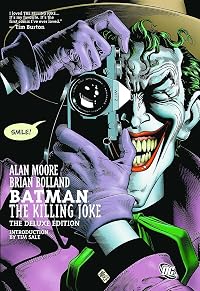
Batman: The Killing Joke [Deluxe Edition]
by Alan Moore (Author), Brian Bolland (Illustrator)
On This Page
Description
This is the unforgettable work that forever changed Batman's world, adding a new element of darkness with its unflinching portrayal of The Joker's twisted psyche. Writer Alan Moore, acclaimed author of Watchmen and V For Vendetta, offers his take on the disturbing relationship between The Dark Knight and his greatest foe. The Clown Prince of Crime has never been more ruthless than in this brutal tale. This edition also includes a story written and exquisitely illustrated by Brian Bolland.Tags
Recommendations



Member Reviews
In The Killing Joke, the Joker has escaped from Arkham Asylum and has a twisted plan in mind for Commissioner Gordon and his daughter Barbara. Meanwhile, he flashes back to his own life as an average guy before becoming the Joker.
While I certainly enjoyed this short comic book, I expected more after all the rave reviews it’s gotten over the years. Likewise, the plotting of the story is well done but over-hyped in the introduction by Tim Sale in the Deluxe edition. I didn't care for the ambiguous ending myself but do see how it’s appropriate given that this is only one arc in a much bigger story.
This was really the Joker's story and we see far more of him than of the Dark Knight. I ended up with a William Blake moment when reading show more the section where the Joker explains that insanity is more reasonable than sanity given the world we live in. (William Blake famously wrote in his poem “The Marriage of Heaven and Hell” that John Milton knew more of demons than of angels and thus wrote better about demons. “The reason Milton wrote in fetters when he wrote of Angels & God, and at liberty when of Devils & Hell, is because he was a true Poet and of the Devil's party without knowing it.”) The Joker is given more time (or some it feels) to narrate than the Batman, who I feel really doesn’t have a lot of screen time in this particular title. The Joker’s reasoning actually sounds more logical in a way than the Batman’s, even if it appears that the Batman gets the last word and we are meant to take his opinion as the true one (as he is the hero after all). Take, for instance, this passage where the Joker mocks Commissioner Gordon: “Now, shudder, as you observe, before your very eyes, that most rare and tragic of nature’s mistakes! I give you … the average man! Physically unremarkable, it has instead a deformed set of values. Notice the hideously bloated sense of humanity’s importance, the club-footed social conscience, and the withered optimism. … Most repulsive of all, are its frail and useless notions of order and sanity. If too much weight is placed upon them... they snap. How does it live, I hear you ask? How does this poor, pathetic specimen survive in today’s harsh and irrational world? The sad answer is “not very well.” Faced with the inescapable fact that human existence is mad, random and pointless, one in eight of them crack up and go stark slavering buggo! Who can blame them? In a world as psychotic as this...any other response would be crazy!” Maybe the logic to the Joker’s insanity was part of the book's intention (Moore said it was the book’s intention to show that the Batman and the Joker are mirror images; one bad day changed everything for both of them) or maybe it was just my feelings about the world today.
I liked having a backstory for the Joker, although I actually felt that it didn’t go into enough detail for my liking (and really, the fall into chemical waste turns his skin white and his hair green? I still find that explanation cheesy.) I also find it fitting with the Joker's character that he casts doubt on the veracity of his narrative so this may not be the definitive telling of his past after all.
I didn't like the artwork all that much in the first few pages but it quickly grew on me and I started to appreciate it more and more. I enjoyed the little details, such as when you see the other people at the bar during some of the flashbacks. There's an almost cinematic feel to the way Bolland presents various angles to look at the characters. Apparently the coloring is different in the Deluxe edition than the original; I have no comparison point but I think the color palette is excellent.
The Deluxe edition also contains a short comic written and illustrated by Bolland, which he refers to as “An Innocent Guy.” It’s always nice to have an extra bonus like this, but while the art work was great and the story was well plotted, the content of this short piece was too disturbing for me to truly enjoy. show less
While I certainly enjoyed this short comic book, I expected more after all the rave reviews it’s gotten over the years. Likewise, the plotting of the story is well done but over-hyped in the introduction by Tim Sale in the Deluxe edition. I didn't care for the ambiguous ending myself but do see how it’s appropriate given that this is only one arc in a much bigger story.
This was really the Joker's story and we see far more of him than of the Dark Knight. I ended up with a William Blake moment when reading show more the section where the Joker explains that insanity is more reasonable than sanity given the world we live in. (William Blake famously wrote in his poem “The Marriage of Heaven and Hell” that John Milton knew more of demons than of angels and thus wrote better about demons. “The reason Milton wrote in fetters when he wrote of Angels & God, and at liberty when of Devils & Hell, is because he was a true Poet and of the Devil's party without knowing it.”) The Joker is given more time (or some it feels) to narrate than the Batman, who I feel really doesn’t have a lot of screen time in this particular title. The Joker’s reasoning actually sounds more logical in a way than the Batman’s, even if it appears that the Batman gets the last word and we are meant to take his opinion as the true one (as he is the hero after all). Take, for instance, this passage where the Joker mocks Commissioner Gordon: “Now, shudder, as you observe, before your very eyes, that most rare and tragic of nature’s mistakes! I give you … the average man! Physically unremarkable, it has instead a deformed set of values. Notice the hideously bloated sense of humanity’s importance, the club-footed social conscience, and the withered optimism. … Most repulsive of all, are its frail and useless notions of order and sanity. If too much weight is placed upon them... they snap. How does it live, I hear you ask? How does this poor, pathetic specimen survive in today’s harsh and irrational world? The sad answer is “not very well.” Faced with the inescapable fact that human existence is mad, random and pointless, one in eight of them crack up and go stark slavering buggo! Who can blame them? In a world as psychotic as this...any other response would be crazy!” Maybe the logic to the Joker’s insanity was part of the book's intention (Moore said it was the book’s intention to show that the Batman and the Joker are mirror images; one bad day changed everything for both of them) or maybe it was just my feelings about the world today.
I liked having a backstory for the Joker, although I actually felt that it didn’t go into enough detail for my liking (and really, the fall into chemical waste turns his skin white and his hair green? I still find that explanation cheesy.) I also find it fitting with the Joker's character that he casts doubt on the veracity of his narrative so this may not be the definitive telling of his past after all.
I didn't like the artwork all that much in the first few pages but it quickly grew on me and I started to appreciate it more and more. I enjoyed the little details, such as when you see the other people at the bar during some of the flashbacks. There's an almost cinematic feel to the way Bolland presents various angles to look at the characters. Apparently the coloring is different in the Deluxe edition than the original; I have no comparison point but I think the color palette is excellent.
The Deluxe edition also contains a short comic written and illustrated by Bolland, which he refers to as “An Innocent Guy.” It’s always nice to have an extra bonus like this, but while the art work was great and the story was well plotted, the content of this short piece was too disturbing for me to truly enjoy. show less
In The Killing Joke, Batman attempts to settle the score with a presumedly imprisoned Joker once and forever, by trying to prove it to him that their mutual story does not necessarily have to end with the death of one or the other. Of course, Joker has his own plans ... We get a glimpse of the man who became Joker and his tragic life story that propelled him along the tracks of madness - it only takes one bad day - rendered in the truly stunning art of Brian Bolland and excellent writing of Alan Moore, who truly may be the best writer in comics (along with Frank Miller).
The issue features one other masterpiece by Alan Moore, titled Mortal Clay, about a man who finds his ideal woman in the form of a department store mannequin, begins show more living with her in the store and constructs an entire reality inside his head, including her possible cheating with Batman.
Also very good is a shorter story about an ordinary guy who wants to become famous by pointlessly assassinating Batman, in the mold of John Lennon's killer.
These three stories are all deliciously dark and disturbing forays into the depths of a broken human mind and are sort of needlessly rounded up by the first story where Joker appears (from Batman #1), which doesn't really fit the theme, as it is a pretty classic villain-hero story. The again, it was written in 1940, so a good start.
Read the German-language edition by Panini Comics, titled The Killing Joke. show less
The issue features one other masterpiece by Alan Moore, titled Mortal Clay, about a man who finds his ideal woman in the form of a department store mannequin, begins show more living with her in the store and constructs an entire reality inside his head, including her possible cheating with Batman.
Also very good is a shorter story about an ordinary guy who wants to become famous by pointlessly assassinating Batman, in the mold of John Lennon's killer.
These three stories are all deliciously dark and disturbing forays into the depths of a broken human mind and are sort of needlessly rounded up by the first story where Joker appears (from Batman #1), which doesn't really fit the theme, as it is a pretty classic villain-hero story. The again, it was written in 1940, so a good start.
Read the German-language edition by Panini Comics, titled The Killing Joke. show less
Access a version of the below that includes illustrations on my blog.
This is probably the most widely-read Batman comic that's not by Frank Miller. So of course it's by Alan Moore. Moore is an exquisite craftsman: the way this builds up tension is perfect. Of course, a large part of that's in the art, too, and Bolland and Moore make a helluva team here. It's great to look at and great to read.
But: really, this is it? Why is this one of the most read Batman stories? It's nasty, brutish, and short, and it all seems to be in service of those last two to three pages, which are brilliant, I think. I love the idea that Batman believes he or the Joker must kill the other,* but all that really happens is they share a joke. And kind of a dumb show more one at that. (Though I am familiar with the theory that someone is dying on that last page, I'm reading this as part of a sequence of stories, so it definitely can't happen in this context!) But I'm not convinced this story says enough to justify its existence. I dunno, maybe I'm overthinking it, but I admired this story intellectually much more than emotionally. Well crafted, but sort of empty, and cruel.
It seems pretty clear to me in reading The Killing Joke that Barbara was raped, but a lot of people (including Alan Moore, allegedly) insist that she was not. Again, this is something that I think changes if you view the story as in- or out-of-continuity. If it's out, then yes she was because there are some insinuations that don't make any sense if you don't think that's what they're adding up to. But if it's in, then pretty clearly not, because none of the subsequent 23 years of Barbara Gordon stories ever indicated something like that had happened. That said, the mental trauma this must have caused isn't really dwelt on at all by later stories, which mostly just focus on the physical act of crippling caused by Joker's bullet.
I did like "An Innocent Guy," an eight-page story written, drawn, and colored by Brian Bolland that is also collected here. It felt like "Harvey Pekar Does Batman," actually. Is that weird?
* I must say, this sticks out as odd in the context of my readthrough, in which the Joker has a been a major villain in exactly two stories (The Man Who Laughs, Batman: Batgirl) and a minor one in a few others (The Long Halloween, Strange Apparitions, The Cat and the Bat). If the previous 28 stories were all I knew about Batman, I'd be hard-pressed to identify the Joker as his greatest nemesis! He's been curiously absent from these tales. I feel like Two-Face probably pops up the most consistently. Or maybe, strangely enough, Hugo Strange. I should make a chart and find out.
Batman "Year One" Stories: « Previous in sequence | Next in sequence » show less
This is probably the most widely-read Batman comic that's not by Frank Miller. So of course it's by Alan Moore. Moore is an exquisite craftsman: the way this builds up tension is perfect. Of course, a large part of that's in the art, too, and Bolland and Moore make a helluva team here. It's great to look at and great to read.
But: really, this is it? Why is this one of the most read Batman stories? It's nasty, brutish, and short, and it all seems to be in service of those last two to three pages, which are brilliant, I think. I love the idea that Batman believes he or the Joker must kill the other,* but all that really happens is they share a joke. And kind of a dumb show more one at that. (Though I am familiar with the theory that someone is dying on that last page, I'm reading this as part of a sequence of stories, so it definitely can't happen in this context!) But I'm not convinced this story says enough to justify its existence. I dunno, maybe I'm overthinking it, but I admired this story intellectually much more than emotionally. Well crafted, but sort of empty, and cruel.
It seems pretty clear to me in reading The Killing Joke that Barbara was raped, but a lot of people (including Alan Moore, allegedly) insist that she was not. Again, this is something that I think changes if you view the story as in- or out-of-continuity. If it's out, then yes she was because there are some insinuations that don't make any sense if you don't think that's what they're adding up to. But if it's in, then pretty clearly not, because none of the subsequent 23 years of Barbara Gordon stories ever indicated something like that had happened. That said, the mental trauma this must have caused isn't really dwelt on at all by later stories, which mostly just focus on the physical act of crippling caused by Joker's bullet.
I did like "An Innocent Guy," an eight-page story written, drawn, and colored by Brian Bolland that is also collected here. It felt like "Harvey Pekar Does Batman," actually. Is that weird?
* I must say, this sticks out as odd in the context of my readthrough, in which the Joker has a been a major villain in exactly two stories (The Man Who Laughs, Batman: Batgirl) and a minor one in a few others (The Long Halloween, Strange Apparitions, The Cat and the Bat). If the previous 28 stories were all I knew about Batman, I'd be hard-pressed to identify the Joker as his greatest nemesis! He's been curiously absent from these tales. I feel like Two-Face probably pops up the most consistently. Or maybe, strangely enough, Hugo Strange. I should make a chart and find out.
Batman "Year One" Stories: « Previous in sequence | Next in sequence » show less
I didn't expect to enjoy this as much as I did! I LOVE villains and have always liked the Joker but I'd be lying if I said I was a huge fan. This was just SO GOOD though. I was obviously already aware of how vile the Joker was but Batman: The Killing Joke takes him to a whole new level.
Alan Moore created a great origin story for the Joker and the artwork was freaking amazing. It was interesting getting a peek into Jokers past and seeing what turned him into a villain but at the same time, you can't help but wonder how accurate his tale is. I mean, he is quite mad...
Aside from his backstory, this is quite a dark story. Between shooting Barbara Gordon (aka Batgirl) and kidnapping Commissioner Gordon in an attempt to make him go show more crazy...this is certainly recommended for more mature readers. show less
Alan Moore created a great origin story for the Joker and the artwork was freaking amazing. It was interesting getting a peek into Jokers past and seeing what turned him into a villain but at the same time, you can't help but wonder how accurate his tale is. I mean, he is quite mad...
Aside from his backstory, this is quite a dark story. Between shooting Barbara Gordon (aka Batgirl) and kidnapping Commissioner Gordon in an attempt to make him go show more crazy...this is certainly recommended for more mature readers. show less
This is often cited as being one of the best comic books (or graphic novels, whatever you want to to call it). I can understand why! It’s only 46 odd pages long and it really packs a punch. If the Joker gets much more disturbing than this I don’t want to know! You get an origin story for The Joker cut between his present day endeavour to drive Gordon insane, as Batman ponders that all this can only end one way... one of them will have to kill the other.
It is disturbing. This is Joker at his most psychotic. This book features that life and career defining tragedy for Barbara Gordon (Batgirl)… it’s very dark, and brutal. I didn’t appreciate all his book/librarian puns! The Joker is out to try and prove that anybody can become show more him under the right circumstances (life gave him a pretty bad deal), and I thought it was a nice touch to try to humanise him. His plan is to drive the sanest man in Gotham (Gordon) insane.
Batman for his part is taking more steps to trying to understand his enemy than we usually see him do. He also from giving The Joker a beating in the end, rather doing things the right way as Gordon urges him to. At the end of the day the story questions the brokenness of humanity, do we give in to it or do we cling to the hope of building something better.
It looks awesome, the edition I had was coloured by the original illustrator I believe. It’s bright, almost lurid in places and the Joker looks really scary in some frames. The sleeve cover is gorgeous, but underneath I loved the shiny purple embossing on the hardcover even more! I love the whole book.
Five stars! I can total see why people rave about this one!
Obviously this is Alan Moore, and of what I’ve read of Alan Moore so far I’m obsessed. The Watchmen is one of my favourite things ever. This has reminded me I need to read more. I’m going to try to get hold of [b:From Hell|23529|From Hell|Alan Moore|https://d.gr-assets.com/books/1327894621s/23529.jpg|191464] I think! show less
It is disturbing. This is Joker at his most psychotic. This book features that life and career defining tragedy for Barbara Gordon (Batgirl)… it’s very dark, and brutal. I didn’t appreciate all his book/librarian puns! The Joker is out to try and prove that anybody can become show more him under the right circumstances (life gave him a pretty bad deal), and I thought it was a nice touch to try to humanise him. His plan is to drive the sanest man in Gotham (Gordon) insane.
Batman for his part is taking more steps to trying to understand his enemy than we usually see him do. He also from giving The Joker a beating in the end, rather doing things the right way as Gordon urges him to. At the end of the day the story questions the brokenness of humanity, do we give in to it or do we cling to the hope of building something better.
It looks awesome, the edition I had was coloured by the original illustrator I believe. It’s bright, almost lurid in places and the Joker looks really scary in some frames. The sleeve cover is gorgeous, but underneath I loved the shiny purple embossing on the hardcover even more! I love the whole book.
Five stars! I can total see why people rave about this one!
Obviously this is Alan Moore, and of what I’ve read of Alan Moore so far I’m obsessed. The Watchmen is one of my favourite things ever. This has reminded me I need to read more. I’m going to try to get hold of [b:From Hell|23529|From Hell|Alan Moore|https://d.gr-assets.com/books/1327894621s/23529.jpg|191464] I think! show less
This 'Deluxe Edition' was the first time I'd read this famous Batman story and I enjoyed it a lot. It’s surprisingly short at only 46 pages, and this obviously restricts the possible complexity of the story, but I think it packs depth and information into its short length. It’s about the origin of the Joker and also about the relationship and parallels between him and Batman. Single events impacted and defined both their lives but it’s about how you react to grief and adversity that distinguishes people. "So maybe ordinary people don't always crack."
The artwork by Brian Bolland is really impressive and it’s a real shame that he and Alan Moore didn't do more work together. Scenes and characters are beautifully portrayed in great show more detail but there is real taste and restraint as well. I don't know about the original colour scheme but I think the re-colouring here suits the sombre mood of the story very well. (Surely it’s a good thing to be able to see how the artist originally fully envisioned the artwork ?) show less
The artwork by Brian Bolland is really impressive and it’s a real shame that he and Alan Moore didn't do more work together. Scenes and characters are beautifully portrayed in great show more detail but there is real taste and restraint as well. I don't know about the original colour scheme but I think the re-colouring here suits the sombre mood of the story very well. (Surely it’s a good thing to be able to see how the artist originally fully envisioned the artwork ?) show less
Classic Batman villain the Joker has been enjoying somewhat of a renaissance lately, it seems. Given the late lamented Heath Ledger’s astonishing performance as Joker in “Batman: The Dark Knight,” it’s easy to see why. Jack Nicholson’s Joker, while certainly still darkly crazy in many ways, was still somewhat more sane than not…at least where his motives for crime were concerned. But Ledger’s performance was much more in line with the classic portrayal of the Joker as a force of pure insanity, driven to inflict his own madness upon the world. The graphic novel “Batman: The Killing Joke,” first published over twenty years ago and now republished in an anniversary edition, should be of interest to any fans of the recent show more movie as well as to long-time Batman readers.
“The Killing Joke” contains a Joker origin story…one of many, as the Joker himself has been known to state that he does not remember his own past clearly. In this particular origin story, however, the man that Joker used to be had one very bad day…everything in his life went wrong all at once, ending with a dunk in a chemical bath that produced the Joker’s characteristic crazed red grin, green hair, and dead white skin. It was this one very bad day that pushed him over the line into insanity, and now, in present day, he decides to prove that even the sanest of men is only one very bad day away from becoming just as mad as he himself became. To that end, he kidnaps Commissioner Gordon— after shooting his daughter Barbara (also known as Batgirl) in the spine and paralyzing her from the waist down—and drags the Commissioner to a twisted carnival funhouse of the Joker’s own design and shows him just how bad life can get in the course of just one day. Of course, Batman intervenes, and in the end…well, the Joker’s own day gets a heck of a lot worse. show less
“The Killing Joke” contains a Joker origin story…one of many, as the Joker himself has been known to state that he does not remember his own past clearly. In this particular origin story, however, the man that Joker used to be had one very bad day…everything in his life went wrong all at once, ending with a dunk in a chemical bath that produced the Joker’s characteristic crazed red grin, green hair, and dead white skin. It was this one very bad day that pushed him over the line into insanity, and now, in present day, he decides to prove that even the sanest of men is only one very bad day away from becoming just as mad as he himself became. To that end, he kidnaps Commissioner Gordon— after shooting his daughter Barbara (also known as Batgirl) in the spine and paralyzing her from the waist down—and drags the Commissioner to a twisted carnival funhouse of the Joker’s own design and shows him just how bad life can get in the course of just one day. Of course, Batman intervenes, and in the end…well, the Joker’s own day gets a heck of a lot worse. show less
Members
- Recently Added By
Lists

Books Read in 2008
335 works; 8 members

Novels/Poems/Short Stories/Anything Storytelling Related
112 works; 2 members

Neuro Pride Book Club Book Shares
98 works; 1 member
Author Information

Multiple award-winning author Alan Moore is universally considered the best writer of graphic novels in the medium's history. Among his many awards are the Hugo Award, the Bram Stoker Award, the Eisner Award, and the International Horror Guild Award

All Editions
Some Editions
Awards and Honors
Awards
Work Relationships
Is contained in
Is an expanded version of
Common Knowledge
- Canonical title
- Batman: The Killing Joke [Deluxe Edition]
- Original publication date
- 2008-04
- Related movies
- Batman: The Killing Joke (2016 | IMDb)
- Disambiguation notice
- Deluxe 2008 version of Batman: The Killing Joke graphic novel with recoloring of the original artwork. Also includes the short work Batman: An Innocent Guy, and new introduction and epilogue.
Classifications
- Genre
- Graphic Novels & Comics
- DDC/MDS
- 741.5973 — Arts & recreation Drawing & decorative arts Drawing Comic books, graphic novels, fotonovelas, cartoons, caricatures, comic strips History, geographic treatment, biography North American United States (General)
- LCC
- PN6728 .B36 .M663 — Language and Literature Literature (General) Literature (General) Collections of general literature Comic books, strips, etc.
- BISAC
Statistics
- Members
- 3,331
- Popularity
- 5,072
- Reviews
- 72
- Rating
- (4.06)
- Languages
- 10 — English, Finnish, French, German, Greek, Italian, Portuguese, Spanish, Turkish, Ukrainian
- Media
- Paper, Ebook
- ISBNs
- 33
- ASINs
- 9