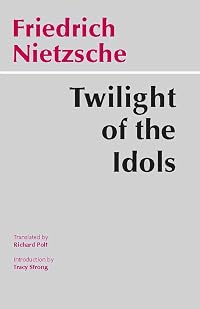
Twilight of the Idols, or, How to Philosophize with a Hammer
by Friedrich Nietzsche 
On This Page
Description
Nietzsche intended Twilight of the Idols to serve as a short introduction to the whole of his philosophy, and to be the most synoptic of all his books. A masterpiece of polemic, this `great declaration of war' targets not only `eternal idols' like Socratic rationality and Christian morality but also their contemporary counterparts, as Nietzsche the `untimely man' goes roaming in the gloaming of nineteenth-century European culture. This brilliant new translation issupplemented by a detailed show more commentary on one of Neitzsche's most condensed works. - ;`Anyone who wants to gain a quick idea of how b show lessTags
Recommendations
















Member Reviews
el maldito canalla me dejo una impresion agradable, es necesario una previa lectura de los dialogos socraticos y los platonicos para entender la tiradera que se volcara, nietzsche aqui se sentra en el aspecto moral y en un marco metalogico, desdeña la razon como medio primario para entender el mundo y extiende sus intenciones de seguir ideales de vida y de poder. En base a esto desarrolla la conexion entre platon, su ideal y el cristianismo.
Habla mucho de lo malo que la modernidad ha resultado, y se vale de ejemplos concretos para hacer valer su punto; los alemanes y la revolución.
ya en el penultimo sector del libro, se dedica a hacer criticas ingeniosas sobre varios temas, explicando teorias que desarrolla en otras obras y termina show more con una ovación a Goethe
me gusto bastante, lo recomiendo bastante! show less
Habla mucho de lo malo que la modernidad ha resultado, y se vale de ejemplos concretos para hacer valer su punto; los alemanes y la revolución.
ya en el penultimo sector del libro, se dedica a hacer criticas ingeniosas sobre varios temas, explicando teorias que desarrolla en otras obras y termina show more con una ovación a Goethe
me gusto bastante, lo recomiendo bastante! show less
"جدل آخرین سلاح است برای کسی که سلاح دیگری ندارد. باید به زور نشان دهی که حق با توست وگرنه فن جدل به چه کار می آید؟!"
قطعا نیاز خواهد بود که این کتاب رو بار دیگه یا حتی چند بار دیگه بخونم. کتاب صوتی خوب بود اما خوندن متن رو برای دفعات بعدی انتخاب می کنم. کتاب شامل چندین بخشه که نیچه سعی داره تفکرات خودش رو به طور مختصر پیرامون مسائل مختلفی بیان کنه. برای مثال فصل های اول از اخلاق، سقراط و جایگاه عقل در فلسفه می گن. برای show more من "اخلاق ناباوری" مفهوم جالبی بود که تقریبا از اوایل کتاب بهش اشاره می شه... "بت" های اخلاق یونانی از جمله سقراط و افلاطون مورد نقد و انتقاد قرار می گیرن و در ادامه به "مسیحیت ستیزی" پرداخته می شه. همچنین مبانی فلسفی مشترک مسیحیت و باورهای افلاطون رو از نظر اخلاق و خیر و شر بررسی می کنه. به طور کلی اولین کتابی بود که از نیچه خوندم و فکر می کنم با یک بار شنیدن کتاب به خوبی نمی تونم نتیجه گیری کنم. نیچه از دید کاملا متفاوتی به قضایا نگاه می کنه که این خیلی جذاب هست اما من احساس کردم رد پای نژادپرستی و شاید سکسیسم تا حدودی توی متن حس می شه که البته نیاز هست مجددا دقیق تر بخونم تا ابهام ها رفع بشن.
"'اگر من بی سر و پایم، پس تو چرا نیستی؟' با این منطق است که انقلاب می کنند." show less
قطعا نیاز خواهد بود که این کتاب رو بار دیگه یا حتی چند بار دیگه بخونم. کتاب صوتی خوب بود اما خوندن متن رو برای دفعات بعدی انتخاب می کنم. کتاب شامل چندین بخشه که نیچه سعی داره تفکرات خودش رو به طور مختصر پیرامون مسائل مختلفی بیان کنه. برای مثال فصل های اول از اخلاق، سقراط و جایگاه عقل در فلسفه می گن. برای show more من "اخلاق ناباوری" مفهوم جالبی بود که تقریبا از اوایل کتاب بهش اشاره می شه... "بت" های اخلاق یونانی از جمله سقراط و افلاطون مورد نقد و انتقاد قرار می گیرن و در ادامه به "مسیحیت ستیزی" پرداخته می شه. همچنین مبانی فلسفی مشترک مسیحیت و باورهای افلاطون رو از نظر اخلاق و خیر و شر بررسی می کنه. به طور کلی اولین کتابی بود که از نیچه خوندم و فکر می کنم با یک بار شنیدن کتاب به خوبی نمی تونم نتیجه گیری کنم. نیچه از دید کاملا متفاوتی به قضایا نگاه می کنه که این خیلی جذاب هست اما من احساس کردم رد پای نژادپرستی و شاید سکسیسم تا حدودی توی متن حس می شه که البته نیاز هست مجددا دقیق تر بخونم تا ابهام ها رفع بشن.
"'اگر من بی سر و پایم، پس تو چرا نیستی؟' با این منطق است که انقلاب می کنند." show less
Twilight of the Idols was written by Friedrich Nietzsche with the intention of having it serve as a brief, compact presentation of his philosophical themes, resulting in the most thematically comprehensive work of his prolific literary career. This brilliantly conceived and composed collection of penetrating assertions critically evaluates longstanding philosophical traditions rooted in ancient Greek rationalism and the ethical dimensions of Christianity, exposing the degenerate components of these intellectual perspectives and their destructive influence on modern thinking. Nietzsche identifies the signs of decadence in both cultures and individuals through philo-psychological analysis, looking in every direction for manifestations of show more strength and courage overcoming moral weakness and cultural deterioration. Masterful skill and highly distinct stylistic expression combines with genuine joy in his self-appointed role of philosophy's diabolical transgressor. show less
This book is by far the most beginner friendly work of Nietzsche but by no means the least bombastic. I found it fascinating how Nietzsche has noticed things a century earlier that we are noticing right now (like the degradation of the education system and the effect of Christian morality). Great read
Philosopher Friedrich Nietzsche examines the values of Western European society, discussing the values of enduring importance that must be upheld, and the values that must be eliminated from the practice of modern human endeavor. The morality which forms the base of society is considered to no longer be appropriate for Western peoples. Strong emphasis is placed on European culture, and what it has done to harm or elevate Western society, and on the coming of a new kind of human person in the distant future.
“I am afraid we are not rid of God because we still have faith in grammar”
Никога през живота си не бях чел такава безподобна сбирщина от безсмислени дрънканици.
Даже "Гьодел, Ешер, Бах: Една гирлянда към безкрайността" не се доближава до тия логореични бълнувания.
Даже "Гьодел, Ешер, Бах: Една гирлянда към безкрайността" не се доближава до тия логореични бълнувания.
Members
- Recently Added By
Lists

German Literature
518 works; 56 members

el
1,139 works; 1 member
Author Information

1,400+ Works 78,618 Members
The son of a Lutheran pastor, Friedrich Wilhelm Nietzsche was born in 1844 in Roecken, Prussia, and studied classical philology at the Universities of Bonn and Leipzig. While at Leipzig he read the works of Schopenhauer, which greatly impressed him. He also became a disciple of the composer Richard Wagner. At the very early age of 25, Nietzsche show more was appointed professor at the University of Basel in Switzerland. In 1870, during the Franco-Prussian War, Nietzsche served in the medical corps of the Prussian army. While treating soldiers he contracted diphtheria and dysentery; he was never physically healthy afterward. Nietzsche's first book, The Birth of Tragedy Out of the Spirit of Music (1872), was a radical reinterpretation of Greek art and culture from a Schopenhaurian and Wagnerian standpoint. By 1874 Nietzsche had to retire from his university post for reasons of health. He was diagnosed at this time with a serious nervous disorder. He lived the next 15 years on his small university pension, dividing his time between Italy and Switzerland and writing constantly. He is best known for the works he produced after 1880, especially The Gay Science (1882), Thus Spake Zarathustra (1883-85), Beyond Good and Evil (1886), On the Genealogy of Morals (1887), The Antichrist (1888), and Twilight of the Idols (1888). In January 1889, Nietzsche suffered a sudden mental collapse; he lived the last 10 years of his life in a condition of insanity. After his death, his sister published many of his papers under the title The Will to Power. Nietzsche was a radical questioner who often wrote polemically with deliberate obscurity, intending to perplex, shock, and offend his readers. He attacked the entire metaphysical tradition in Western philosophy, especially Christianity and Christian morality, which he thought had reached its final and most decadent form in modern scientific humanism, with its ideals of liberalism and democracy. It has become increasingly clear that his writings are among the deepest and most prescient sources we have for acquiring a philosophical understanding of the roots of 20th-century culture. (Bowker Author Biography) show less
Friedrich Nietzsche has a Legacy Library. Legacy libraries are the personal libraries of famous readers, entered by LibraryThing members from the Legacy Libraries group.
Some Editions
Series
Belongs to Publisher Series
Άπαντα (Nietzsche) / Βάνιας (3)
Work Relationships
Common Knowledge
- Canonical title
- Twilight of the Idols, or, How to Philosophize with a Hammer
- Original title
- Götzen-Dämmerung, oder, Wie man mit dem Hammer philosophiert
- Alternate titles*
- Crépuscule des idoles ou Comment on philosophe avec un marteau
- Original publication date
- 1888
- First words*
- No es poco habilidoso que conservemos nuestra serenidad en medio de ocupaciones oscuras y excesivamente cargadas de responsabilidad (...)
- Last words*
- (Click to show. Warning: May contain spoilers.)Así hablaba Zarathustra.
- Original language*
- Alemán
*Some information comes from Common Knowledge in other languages. Click "Edit" for more information.
Classifications
Statistics
- Members
- 1,454
- Popularity
- 16,210
- Reviews
- 18
- Rating
- (3.82)
- Languages
- 20 — Chinese, Czech, Danish, Dutch, English, Finnish, French, German, Greek, Hungarian, Italian, Lithuanian, Norwegian (Bokmål), Polish, Romanian, Russian, Spanish, Swedish, Turkish, Portuguese (Portugal)
- Media
- Paper, Audiobook, Ebook
- ISBNs
- 139
- UPCs
- 1
- ASINs
- 32