Tokyo Express
by Matsumoto Seichō
On This Page
Description
In a rocky cove in the bay of Hakata, the bodies of a young and beautiful couple are discovered. Stood in the coast's wind and cold, the police see nothing to investigate: the flush of the couple's cheeks speaks clearly of cyanide, of a lovers' suicide. But in the eyes of two men, Torigai Jutaro, a senior detective, and Kiichi Mihara, a young gun from Tokyo, something is not quite right. Together, they begin to pick at the knot of a unique and calculated crime...Tags
Recommendations





Member Reviews
This novel includes maps of Japan, railroad timetables, and plane schedules. You will need them. For Seicho Matsumoto's masterpiece of a thriller takes the reader on one of the most convoluted and intricate detective puzzles in the history of the genre. And where does it all lead? On the trail of a Hitchcockian McGuffin unsurpassed by even Hitchcock himself. In fact, the key to Points and Lines is it never lets the reader take a vantage point above the McGuffin. Instead, you become just as involved as the detective, Kiichi Mihara, himself.
How so? For the first 100 pages or so, the reader is caught up on how the crime, the involvement of a business tycoon in the apparent double suicide of two young people, could possibly have taken show more place. As Mihara becomes fixated, so does the reader. Is this the world's dumbest detective? When finally Mihara comes to the solution of just how the perpetrator pulled things off, it's a "No sh*t, Sherlock" moment of epic proportions. As befuddlement continues and it takes Mihara beating on his forehead to figure things out, those "No sh*t, Sherlock" moments multiply. The reader begins to imagine himself the master of crime solving, while Mihara appears a dunce.
It's then you realize you've joined Mihara on the trail of the McGuffin, not the true mystery of the novel. It was a search for "why," a motive, all along. Not a search for "how," or means. What a psychological twist. Masterful. As the true story then unfolds, you begin to gain a heretofore disregarded respect for Mihara. It's quite a journey. And all put into a uniquely Japanese frame of reference culturally.
One final note: Matsumoto gives us a clue that we should expect a McGuffin at the very beginning. It comes with the lack of focus on a central protagonist. At first, we share the point of view of Tatsuo Yasuda, a wealthy industrialist. Then our focus takes us to an aging detective on Kyushu, Jutaro Torigai, before finally settling on Mihara. Oh, yes, and the not so subtle subtext of this novel is one familiar to readers of Matsumoto's mysteries: the corruption of Japanese government and society, all made possible by adherence to outdated tradition.
This marks the fourth novel of Matsumoto's that I have read. It seems there are no others in English translation. Why the heck not? show less
How so? For the first 100 pages or so, the reader is caught up on how the crime, the involvement of a business tycoon in the apparent double suicide of two young people, could possibly have taken show more place. As Mihara becomes fixated, so does the reader. Is this the world's dumbest detective? When finally Mihara comes to the solution of just how the perpetrator pulled things off, it's a "No sh*t, Sherlock" moment of epic proportions. As befuddlement continues and it takes Mihara beating on his forehead to figure things out, those "No sh*t, Sherlock" moments multiply. The reader begins to imagine himself the master of crime solving, while Mihara appears a dunce.
It's then you realize you've joined Mihara on the trail of the McGuffin, not the true mystery of the novel. It was a search for "why," a motive, all along. Not a search for "how," or means. What a psychological twist. Masterful. As the true story then unfolds, you begin to gain a heretofore disregarded respect for Mihara. It's quite a journey. And all put into a uniquely Japanese frame of reference culturally.
One final note: Matsumoto gives us a clue that we should expect a McGuffin at the very beginning. It comes with the lack of focus on a central protagonist. At first, we share the point of view of Tatsuo Yasuda, a wealthy industrialist. Then our focus takes us to an aging detective on Kyushu, Jutaro Torigai, before finally settling on Mihara. Oh, yes, and the not so subtle subtext of this novel is one familiar to readers of Matsumoto's mysteries: the corruption of Japanese government and society, all made possible by adherence to outdated tradition.
This marks the fourth novel of Matsumoto's that I have read. It seems there are no others in English translation. Why the heck not? show less
A wonderful read from an author who is new to me.
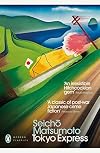
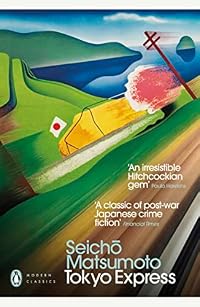
Written in 1958 and apparently previously published in English under the title "Points and Lines", this is a new translation issued by Penguin Modern Classics with a wonderful cover!
Having read the book, I think the previous title is more suitable, but I can understand how meaningless it would appear to someone unfamiliar with the storyline.
Some have described it as "cosy crime" or a "procedural", but to me it is an intriguing masterpiece, concerning what at appears to be a double suicide of two young people (Toki and Sayama), with two quite different detectives, one older regionally based (Jutaro), the other younger Tokyo based (Mihara), with quite different approaches.
You "know" from show more almost the very beginning that business man Yasuda has to be involved with the suicides somehow, but he seems to have iron-clad alibis (being located at the very north of Japan days before and after the likely time of the deaths, with those deaths occurring at the very south of Japan.
Most of those investigating have written off the deaths as indeed being suicides, but Jutaro thinks that, with Toki and Sayama having been seen animatedly talking to each other when alighting a long distance train in Tokyo, it is curious that a receipt for a single train mealis found on Sayama's body if indeed the two were travelling together.
Mihara is with the white crime division in Tokyo, and becomes interested in Jutaro's thoughts when Sayama is identified as a middle ranking executive within a Government Ministry, that is racked with rumours of corruption.
What makes the book so interesting is how the 2 detectives support each other, as they piece together not only how, but also why, these crimes are effected. Such is done by interrogating train and plane timetables, the sending and receipt of telegrams and passenger lists.
As they investigate, the facts seem to confirm that Yasuda has manufactured various events, but those very events (if to be believed) seem to confirm that Yasuda was at the wrong end of the country at the time of the deaths.
The writing is clear and spare. The denouement is a cracker.
An authorial note states that all of the train and plane times mentioned in the book are as per the relevant 1957 timetables in use in Japan (being the time set for the novel).
I will bee on the lookout for more by Matsumoto.
Big Ship
24 July 2023 show less
Written in 1958 and apparently previously published in English under the title "Points and Lines", this is a new translation issued by Penguin Modern Classics with a wonderful cover!
Having read the book, I think the previous title is more suitable, but I can understand how meaningless it would appear to someone unfamiliar with the storyline.
Some have described it as "cosy crime" or a "procedural", but to me it is an intriguing masterpiece, concerning what at appears to be a double suicide of two young people (Toki and Sayama), with two quite different detectives, one older regionally based (Jutaro), the other younger Tokyo based (Mihara), with quite different approaches.
You "know" from show more almost the very beginning that business man Yasuda has to be involved with the suicides somehow, but he seems to have iron-clad alibis (being located at the very north of Japan days before and after the likely time of the deaths, with those deaths occurring at the very south of Japan.
Most of those investigating have written off the deaths as indeed being suicides, but Jutaro thinks that, with Toki and Sayama having been seen animatedly talking to each other when alighting a long distance train in Tokyo, it is curious that a receipt for a single train mealis found on Sayama's body if indeed the two were travelling together.
Mihara is with the white crime division in Tokyo, and becomes interested in Jutaro's thoughts when Sayama is identified as a middle ranking executive within a Government Ministry, that is racked with rumours of corruption.
What makes the book so interesting is how the 2 detectives support each other, as they piece together not only how, but also why, these crimes are effected. Such is done by interrogating train and plane timetables, the sending and receipt of telegrams and passenger lists.
As they investigate, the facts seem to confirm that Yasuda has manufactured various events, but those very events (if to be believed) seem to confirm that Yasuda was at the wrong end of the country at the time of the deaths.
The writing is clear and spare. The denouement is a cracker.
An authorial note states that all of the train and plane times mentioned in the book are as per the relevant 1957 timetables in use in Japan (being the time set for the novel).
I will bee on the lookout for more by Matsumoto.
Big Ship
24 July 2023 show less
Two bodies were lying on the dark rocks, an unwelcome blight on this familiar landscape. They were stretched out bleakly in the pale half-light of morning. The hems of their clothing flapped in the cold wind but, other than their hair, nothing moved.
Published in 1958, this author’s first novel is more a howdunnit than a whodunnit, as the murderer is clear from the start. The police detective’s problem is how to break a seemingly airtight alibi, which made for an intriguing mystery.
Published in 1958, this author’s first novel is more a howdunnit than a whodunnit, as the murderer is clear from the start. The police detective’s problem is how to break a seemingly airtight alibi, which made for an intriguing mystery.
There is something about Matsumoto's writing style that I just simply adore. I find it hard to explain, except that it's just completely charming (which is a weird descriptor of a mystery novel). I love his characters, especially the detectives and Points and Lines has two very fantastic ones.
At the center of this mystery is a man who's alibi can't be broken and it's up to the two detectives, working on hunches from the very beginning of the case, to break it. They must find a way to prove that a murder actually occurred. Though they only work together briefly, Torigai (the old, veteran and rural located detective who first decides there's something fishy about the case) and Mihara (the younger detective from Tokyo) establish a show more relationship that lasts throughout the novel.
Matsumoto's writing is fantastic, his focus on details is endlessly interesting (who knew that train schedule could be so fascinating) and his ability to describe places in few words all makes up for a great (and quick) read. What makes Points and Lines so good (and so different from Inspector Imanishi Investigates) is the fact that early on Mihara has a hunch as to who committed the murder (that isn't even established as a murder) and it's not so much that we ever think the character is innocent (because we don't), it's more that we are just reading to find out how it was done. Almost like a Columbo episode.
I loved this book as I loved Inspector Imanishi Investigates. I can't wait to read the two other Matsumoto that have been translated into English and I only wish there were more. show less
At the center of this mystery is a man who's alibi can't be broken and it's up to the two detectives, working on hunches from the very beginning of the case, to break it. They must find a way to prove that a murder actually occurred. Though they only work together briefly, Torigai (the old, veteran and rural located detective who first decides there's something fishy about the case) and Mihara (the younger detective from Tokyo) establish a show more relationship that lasts throughout the novel.
Matsumoto's writing is fantastic, his focus on details is endlessly interesting (who knew that train schedule could be so fascinating) and his ability to describe places in few words all makes up for a great (and quick) read. What makes Points and Lines so good (and so different from Inspector Imanishi Investigates) is the fact that early on Mihara has a hunch as to who committed the murder (that isn't even established as a murder) and it's not so much that we ever think the character is innocent (because we don't), it's more that we are just reading to find out how it was done. Almost like a Columbo episode.
I loved this book as I loved Inspector Imanishi Investigates. I can't wait to read the two other Matsumoto that have been translated into English and I only wish there were more. show less
Would I read another book by this author?
Yes.
Would I recommend this book?
Yes.
To whom would I recommend it?
People who like murder mysteries and Japanese culture and stories.
Did this book inspire me to do anything?
Yes. I consulted maps to see where different places where. While there were maps included in the book I went to larger scale maps to see where local areas mentioned in the story were located.
One of the things I like about reading Japanese books is the glimpses of Japanese culture that are contained within the stories.
I enjoyed this book but found that towards the end it resorted more to telling rather than showing. I would have given it four stars out of five rather than three-and-a-half if it had not resorted to this approach show more to tie up the solving of the crime. show less
Yes.
Would I recommend this book?
Yes.
To whom would I recommend it?
People who like murder mysteries and Japanese culture and stories.
Did this book inspire me to do anything?
Yes. I consulted maps to see where different places where. While there were maps included in the book I went to larger scale maps to see where local areas mentioned in the story were located.
One of the things I like about reading Japanese books is the glimpses of Japanese culture that are contained within the stories.
I enjoyed this book but found that towards the end it resorted more to telling rather than showing. I would have given it four stars out of five rather than three-and-a-half if it had not resorted to this approach show more to tie up the solving of the crime. show less
Trainspotting 3*
A review of the Modern Library eBook (2025) translated by [author:Jesse Kirkwood|22144666] from the Japanese language original [book:点と線|876446] (Points and Lines) (1958).
This is actually the same translation as previously published by Penguin Modern Classics in 2022 and which I reviewed as Breaking an Alibi. Both of these supersede the very early 1970 translation published as [book:Points and Lines|880842] which correctly translated the title.
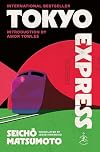
There is nothing much to add to my earlier review, but the point of interest here is the enthusiastic Introduction by novelist [author:Amor Towles|4536964].
Footnote
* My lede header is not meant in reference to the movie. It is just that this is the 3rd English language edition of Matsumoto's novel where the solution involves analyzing a considerable amount of train 🚂🚄🚅 schedule details. show less
A review of the Modern Library eBook (2025) translated by [author:Jesse Kirkwood|22144666] from the Japanese language original [book:点と線|876446] (Points and Lines) (1958).
This is actually the same translation as previously published by Penguin Modern Classics in 2022 and which I reviewed as Breaking an Alibi. Both of these supersede the very early 1970 translation published as [book:Points and Lines|880842] which correctly translated the title.
There is nothing much to add to my earlier review, but the point of interest here is the enthusiastic Introduction by novelist [author:Amor Towles|4536964].
The death of one person at the hand of another is one of the most consequential of human interactions, on par withshow more
marriage, intercourse, and birth. Murder inevitably springs from an array of emotions spanning hatred, anger, avarice, and jealousy, and results in profound grief and loss. And yet, in Matsumoto’s depiction of the modern era, the proliferation of numbers, letters, timelines, and diagrams suggests that the crime of homicide is less a human tragedy than a mathematical problem which must be solved.*Pro-tip* If you only want to read the new Introduction you can do that for free by requesting the sample excerpt at sources such as Amazon. The sample provides the complete Introduction text.
Footnote
* My lede header is not meant in reference to the movie. It is just that this is the 3rd English language edition of Matsumoto's novel where the solution involves analyzing a considerable amount of train 🚂🚄🚅 schedule details. show less
A man and woman are witnessed by Tatsuo Yasuda, and two others, getting on a train in Tokyo and one week later are found dead: result of a double suicide in Kyushu. They are found neatly put together and everything seems to be typical of a suicide. But one Fukuoka detective, Jutaro Torigai, finds a strange receipt and starts to believe something is off. He passes along his investigation to a Tokyo detective, Kiichi Mihara, who finds himself chasing a man from Kyushu to Hokkaido. They know this man is part of this suicide, but how? The answers can be found in a train timetable with the intersection of points and lines.
A classic in Japanese mystery (so my Japanese boyfriend says) and certainly interesting. I was able to come up with the show more how on my own but the why was a bit more mystical as it wasn't really investigated until the last chapter. Still, seeing the amount of detail that goes into an investigation was interesting and seeing the frustration of the detective as he went against a perfect alibi made you really sympathize with the character.
I enjoyed this one. I'm still not sure how to rank mysteries but this one feels like a 4 star mystery. show less
A classic in Japanese mystery (so my Japanese boyfriend says) and certainly interesting. I was able to come up with the show more how on my own but the why was a bit more mystical as it wasn't really investigated until the last chapter. Still, seeing the amount of detail that goes into an investigation was interesting and seeing the frustration of the detective as he went against a perfect alibi made you really sympathize with the character.
I enjoyed this one. I'm still not sure how to rank mysteries but this one feels like a 4 star mystery. show less
Members
- Recently Added By
Lists

Books Read in 2024
4,623 works; 126 members

Japanese Literature
230 works; 40 members

read in 2024
21 works; 1 member

Reading LIst
648 works; 1 member

To Read
133 works; 1 member

Books Read in 2026
1,657 works; 61 members
Author Information

163+ Works 2,550 Members
The creator of the social detective story, Seicho is credited with reviving the mystery genre after World War II. He began writing in his middle age and has produced over 450 fiction and nonfiction works. (Bowker Author Biography)
Some Editions
Awards and Honors
Series
Belongs to Publisher Series
Work Relationships
Common Knowledge
- Canonical title
- Tokyo Express
- Original title
- 点と線
- Alternate titles
- Ten to Sen; Points and Lines; Breaking an Alibi
- Original publication date
- 1958
- People/Characters
- Jūtarō Torigai; Kiichi Mihara; Tatsuo Yasuda; Kenichi Sayama; Hideko Kuwayama (Toki); Sumiko Torigai (show all 11); Inspector Kasai; Ryōku Yasuda; Dr. Hasugawa; Yoshio Ishida; Kawanishi
- Important places
- Japan; Akasaka, Tokyo, Japan; Tokyo, Japan; Kashii, Fukuoka, Japan; Hakata, Fukuoka, Japan; Fukuoka, Japan (show all 9); Kamakura, Japan; Sapporo, Japan; Hakodate, Japan
- Related movies
- Ten to sen (2007 | IMDb)
- First words
- On the evening of the thirteenth of January, Tatsuo Yasuda invited one of his clients to join him at the Koyuki restaurant in Akasaka.
- Quotations
- Si era appena fatto giorno. Il mare era avvolto in una foschia lattiginosa. Shikanoshima, l'isola dei cervi, si vedeva a malapena, così come il sentiero del mare. Tirava una brezza fredda e salmastra. L'operaio, col bavero a... (show all)lzato e il capo chino, procedeva a passo svelto. Attraversava quella spiaggia rocciosa per arrivare prima in fabbrica, come era sua abitudine. Ma qualcosa di totalmente inatteso attirò il suo sguardo, sempre rivolto al suolo. Due corpi adagiati su una lastra di roccia scura stonavano incredibilmente con quel paesaggio a lui così familiare.
- Last words
- (Click to show. Warning: May contain spoilers.)Please accept my warmest wishes - and do take care of yourself.
Yours, Kiichi Mihara. - Blurbers
- Hawkins, Paula; Barry, Kevin; Hall, Lisa
- Original language
- Japanese
Classifications
- Genres
- Fiction and Literature, Mystery
- DDC/MDS
- 895.635 — Literature & rhetoric Literatures of other languages Literatures of East and Southeast Asia Japanese Japanese fiction 1945–2000
- LCC
- PL856 .A8 .T413 — Language and Literature Languages and literatures of Eastern Asia, Africa, Oceania Languages of Eastern Asia, Africa, Oceania Japanese language and literature Japanese literature Individual authors and works
- BISAC
Statistics
- Members
- 837
- Popularity
- 32,583
- Reviews
- 33
- Rating
- (3.69)
- Languages
- 8 — English, Finnish, French, German, Italian, Japanese, Russian, Spanish
- Media
- Paper, Audiobook, Ebook
- ISBNs
- 24
- ASINs
- 9