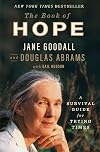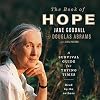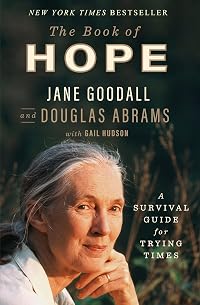
The Book of Hope: A Survival Guide for Trying Times
by Jane Goodall, Douglas Abrams, Gail Hudson
Global Icons (2)
On This Page
Description
In a world that seems so troubled, how do we hold on to hope?This program is read by the authors and includes a bonus PDF.
Looking at the headlines—the worsening climate crisis, a global pandemic, loss of biodiversity, political upheaval—it can be hard to feel optimistic. And yet hope has never been more desperately needed.
In this urgent audiobook, Jane Goodall, the world's most famous living naturalist, and Douglas Abrams, the internationally bestselling co-author of The Book of Joy, show more explore through intimate and thought-provoking dialogue one of the most sought after and least understood elements of human nature: hope. In The Book of Hope, Jane focuses on her "Four Reasons for Hope": The Amazing Human Intellect, The Resilience of Nature, The Power of Young People, and The Indomitable Human Spirit.
Drawing on decades of work that has helped expand our understanding of what it means to be human and what we all need to do to help build a better world, The Book of Hope touches on vital questions, including: How do we stay hopeful when everything seems hopeless? How do we cultivate hope in our children? What is the relationship between hope and action? Filled with moving and inspirational stories and photographs from Jane's remarkable career, The Book of Hope is a deeply personal conversation with one of the most beloved figures in the world today.
While discussing the experiences that shaped her discoveries and beliefs, Jane tells the story of how she became a messenger of hope, from living through World War II to her years in Gombe to realizing she had to leave the forest to travel the world in her role as an advocate for environmental justice. And for the first time, she shares her profound revelations about her next, and perhaps final, adventure.
The second audiobook in the Global Icons Series—which launched with the instant classic The Book of Joy with His Holiness the Dalai Lama and Archbishop Desmond Tutu—The Book of Hope is a rare and intimate look not only at the nature of hope but also into the heart and mind of a woman who revolutionized how we view the world around us and has spent a lifetime fighting for our future.
There is still hope, and this book will help guide us to it.
A Macmillan Audio production from Celadon Books
. show less
Tags
Recommendations








Member Reviews
***received as an ARC from the publisher
I’m SO not the person who reads self-help books, collections of affirmations, or even most books that fall into the memoir/autobiography category, but I figured that I would give Jane Goodall’s new book a try after the publishers sent it to me, and surprisingly I quite enjoyed it! Formatted like a longform conversation (with some exposition) between Goodall and co-author Douglas Abrams, the book has a cosy sort of feeling, like you’re hanging out talking about the big ideas in the world with two of your close friends over a cup of good coffee - or in Goodall’s case, a glass of fine whiskey. Foremost of the ideas discussed by Goodall and Abrams is the titular idea of hope - something that show more seems to be in far too short a supply in the trying times that we live in. After the year we’ve had in my hometown, being hit hard by COVID-19, an inevitable economic downturn, and a summer spent surrounded by monumental forest fires, the book hit a bit harder than I expected, since all of the major ideas that Jane is trying to help have taken on a very personal note. And yet, even in these darkest of times, the concept of hope is one that doesn’t seem to have really gone away. Day to day may be a struggle, but when it comes down to it, we’re still doing what we can to make a better world for tomorrow. At least that’s my hope. I don’t know if this book adds up to its promise of being “a survival guide for trying times,” but it definitely has a little spark driven by Jane’s seemingly endless personal hope, and her matter of fact discussion of how the world keeps turning in its many ways (no matter what) make it well worth the read. show less
I’m SO not the person who reads self-help books, collections of affirmations, or even most books that fall into the memoir/autobiography category, but I figured that I would give Jane Goodall’s new book a try after the publishers sent it to me, and surprisingly I quite enjoyed it! Formatted like a longform conversation (with some exposition) between Goodall and co-author Douglas Abrams, the book has a cosy sort of feeling, like you’re hanging out talking about the big ideas in the world with two of your close friends over a cup of good coffee - or in Goodall’s case, a glass of fine whiskey. Foremost of the ideas discussed by Goodall and Abrams is the titular idea of hope - something that show more seems to be in far too short a supply in the trying times that we live in. After the year we’ve had in my hometown, being hit hard by COVID-19, an inevitable economic downturn, and a summer spent surrounded by monumental forest fires, the book hit a bit harder than I expected, since all of the major ideas that Jane is trying to help have taken on a very personal note. And yet, even in these darkest of times, the concept of hope is one that doesn’t seem to have really gone away. Day to day may be a struggle, but when it comes down to it, we’re still doing what we can to make a better world for tomorrow. At least that’s my hope. I don’t know if this book adds up to its promise of being “a survival guide for trying times,” but it definitely has a little spark driven by Jane’s seemingly endless personal hope, and her matter of fact discussion of how the world keeps turning in its many ways (no matter what) make it well worth the read. show less
Subtitled "A Survival Guide for Trying Times", this volume is based on several conversations between the authors about how important it is to humans to have hope for the future, and how we can sustain that hope in the face of wars, pandemics, political upheaval, personal tragedy, climate change and other global catastrophes. Full of examples of positive change through individual and communal efforts, it is a pep talk for anyone who thinks we are doomed by our own stupidity, and that humanity is beyond (or not worth) saving anyway. Goodall is no Pollyanna, and her life experiences have shown her plenty of unpleasant realities, but she has also seen the good we can do when we unleash our "amazing human intellect...the power of youth, and show more the indomitable human spirit". Her view that these three human attributes, together with the resilience of nature, are grounds for hope that the planet may be brought back from the brink. Definitely a worthwhile read, although I found the style a bit clunky---Abrams took the many hours of discussion between him and Dr. Goodall, and attempted to make a narrative dialog, which sometimes felt forced. Nevertheless, the content rises above that, and the final chapter, written by Jane Goodall herself, is a call to action we should not brush off. show less
Everyone should read The Book of Hope, a collaboration between renowned environmentalist and primatologist Jane Goodall, and author and publisher Douglas Abrams. I loved how this book was written. It is the culmination of a months-long conversation between the authors, in which the reader has the sense that they are there, sitting in a living room with the authors, discussing important questions and issues. In a kind voice Jane Goodall describes her four reasons for hope in a world that seems so ravaged and destitute: human intellect, nature's resilience, the power of young people, and "the indomitable human spirit." Fascinating examples, memories, and stories are provided throughout. Goodall makes the important point that social and show more environmental justice are intertwined. Local communities must be empowered in order to be part of conservation solutions and the fight against climate change. The Book of Hope helps us understand the magnitude of the damage done to our world and how important it is that we not lose hope and take action against what is an existential threat. It is an inspiring and compelling call to action.
Thanks to @CeladonBooks and @JaneGoodallInst for an ARC of this book. #TheBookofHope #CeladonReads #partner show less
Thanks to @CeladonBooks and @JaneGoodallInst for an ARC of this book. #TheBookofHope #CeladonReads #partner show less
As much as I admire Jane Goodall's life and work, I just couldn't stomach this book. It's mostly composed of what seems to be a very contrived "conversation" between the fawning co-author Douglas Abrams and an elderly Mary Poppins. Jane Goodall is a prominent thinker in the fields of animal behavior, ecology, and anthropology; there's little evidence of that here. I expected to read something more engaging than Hallmark Card sentiments. I felt talked down to so that a best-seller that won't offend anyone, nor make us think too hard, could be mass marketed to a crises numbed public.
Maybe it's especially hard to read this during the last week of May, 2022, as yet another fucker with an assault rifle has massacred yet another batch of show more school children. Resulting in yet another batch of politicians sending "thoughts and prayers" while refusing to even consider why children's lives are negotiable, yet the right to own military grade assault weapons has been guaranteed by both the NRA and Jesus himself. show less
Maybe it's especially hard to read this during the last week of May, 2022, as yet another fucker with an assault rifle has massacred yet another batch of show more school children. Resulting in yet another batch of politicians sending "thoughts and prayers" while refusing to even consider why children's lives are negotiable, yet the right to own military grade assault weapons has been guaranteed by both the NRA and Jesus himself. show less
this is another hard one to critique. i love jane goodall's voice. and i mean that in both the literary sense of what she's saying and how she's saying it, being allowed into her mind and her world, and also actually listening to her voice, which is soothing and somehow carries so much wisdom and hope in it. i also am a cynical pessimist and have trouble with some of the things she wants us to believe and feel. i don't think she's wrong about what makes her hopeful for the future, and i appreciate her honesty about the dire straits we are in. but i don't find the same hope in the things that bring her hope, i guess. i mean, maybe it depends on my mood.
it's true that there are amazing people who are working on solving our climate crisis show more and that they can lead us to a more sustainable future. but the fact that we have to rely on them and on people we consider incredible and extraordinary isn't hopeful to me, it's tragic. but the way she talks about it does inspire, just not as much as i wanted it to. my cynical wall is too thick, i guess. still, this is valuable and well done, and i really do always love hearing her and what she has to say. show less
it's true that there are amazing people who are working on solving our climate crisis show more and that they can lead us to a more sustainable future. but the fact that we have to rely on them and on people we consider incredible and extraordinary isn't hopeful to me, it's tragic. but the way she talks about it does inspire, just not as much as i wanted it to. my cynical wall is too thick, i guess. still, this is valuable and well done, and i really do always love hearing her and what she has to say. show less
In these dark times when we are faced with multiple threats of our own making, Jane Goodall offers us hope for the future, inspiration to change our lives, and assurance that every one of us can impact the world for good.
In a series of interviews, Douglas Abrams asked Goodall about the source of her hope. She offers four reasons to hope.
First, Goodall knows that humans have an intellect that can be used for “unfortunate ways” or for good. If enough people take individual action for the better, and bond together, we can implement changes for good. She often references Britain during WWII, the horror of Nazism and the boundless, hopeful courage of the British that made them resilient. She saw good victorious over evil.
Goodall has show more traveled the world and seen first hand the resilience of nature. She believes it is not too late to prevent a collapse of the world as we know it. Readers learn about species like the black robin that was brought back from the brink of extinction, and refers to other species that have rebounded, like the whooping crane and California condor, and how wolves reintroduced to Yellowstone National Park restored its ecosystem. Nature is resilient.
Young people across the world understand the world they are to inherit and are demanding and implementing change. Goodall’s Roots and Shoots program supports children to identify and create programs that impact their world, planting gardens and trees, demanding school cafeterias disband Styrofoam, and even removing the image of a chimpanzee from a cereal box after learning that its ‘smile’ was one of fear. They are not responsible for doing all the work to correct our mistakes, but they lead us to awareness of the work to be done.
Goodall has faith in the indomitable human spirit, which with our ability to think and cooperate and adapt, has allowed us to be successful as a species. Her own husband, Derek was crippled during WWII and told he would never walk again. He never gave up, and learned to walk with a cane. She shares the unforgettable story of two Chinese men, one blind and one who lost his arms in an accident. They needed purpose in their lives and decided to restore their degraded land by planting trees. The sighted, armless man led the blind man who planted the trees. They have planted over ten thousand trees.
The stories of Goodall communicating with animals and humans, her loving acceptance, her spirituality and goodness, makes me understand that she is a saint, one who reflects God into our world. She believes in a spirit that embraces us all.
I dread the idea that if I had grandchildren they would have to contend with a world in crisis, with climate change and mass migrations and geopolitical turmoil and food and water insecurity. Can humanity give up our habits of indulgent waste, our alliance to business profit and wealth over protecting our home? Will we claim all living things our brothers and sisters and work to protect them?
We cannot survive without hope. Hope allows us to seek answers and implement growth through change.
I have read books warning about the future and encouraging change. This book is one that also offers encouragement that we CAN take on this huge responsibility and we CAN restore a balance to the world.
I received an ARC from Celadon Books in exchange for a fair and unbiased review. show less
In a series of interviews, Douglas Abrams asked Goodall about the source of her hope. She offers four reasons to hope.
First, Goodall knows that humans have an intellect that can be used for “unfortunate ways” or for good. If enough people take individual action for the better, and bond together, we can implement changes for good. She often references Britain during WWII, the horror of Nazism and the boundless, hopeful courage of the British that made them resilient. She saw good victorious over evil.
Goodall has show more traveled the world and seen first hand the resilience of nature. She believes it is not too late to prevent a collapse of the world as we know it. Readers learn about species like the black robin that was brought back from the brink of extinction, and refers to other species that have rebounded, like the whooping crane and California condor, and how wolves reintroduced to Yellowstone National Park restored its ecosystem. Nature is resilient.
Young people across the world understand the world they are to inherit and are demanding and implementing change. Goodall’s Roots and Shoots program supports children to identify and create programs that impact their world, planting gardens and trees, demanding school cafeterias disband Styrofoam, and even removing the image of a chimpanzee from a cereal box after learning that its ‘smile’ was one of fear. They are not responsible for doing all the work to correct our mistakes, but they lead us to awareness of the work to be done.
Goodall has faith in the indomitable human spirit, which with our ability to think and cooperate and adapt, has allowed us to be successful as a species. Her own husband, Derek was crippled during WWII and told he would never walk again. He never gave up, and learned to walk with a cane. She shares the unforgettable story of two Chinese men, one blind and one who lost his arms in an accident. They needed purpose in their lives and decided to restore their degraded land by planting trees. The sighted, armless man led the blind man who planted the trees. They have planted over ten thousand trees.
The stories of Goodall communicating with animals and humans, her loving acceptance, her spirituality and goodness, makes me understand that she is a saint, one who reflects God into our world. She believes in a spirit that embraces us all.
I dread the idea that if I had grandchildren they would have to contend with a world in crisis, with climate change and mass migrations and geopolitical turmoil and food and water insecurity. Can humanity give up our habits of indulgent waste, our alliance to business profit and wealth over protecting our home? Will we claim all living things our brothers and sisters and work to protect them?
We cannot survive without hope. Hope allows us to seek answers and implement growth through change.
I have read books warning about the future and encouraging change. This book is one that also offers encouragement that we CAN take on this huge responsibility and we CAN restore a balance to the world.
I received an ARC from Celadon Books in exchange for a fair and unbiased review. show less
There is nothing egregiously misleading about this book in that it delivers exactly what the title announces, i.e., Goodall's definition of “hope” and what is required to achieve hoped-for ends. As suggested by the title, the book does not deal with objective observations about chimpanzees or other species but with Goodall's personal philosophies of life, using, of course, some of her experiences with chimpanzees (and with some Homo sapiens) to illustrate and explain those philosophies. The revelations into Jane Goodall's thought are undoubtedly the strong points of the book, and some of the illustrative stories she tells are delightful. I wish there had been more of them.
I do find a few things annoying. First, the cover prominently show more displays the name of Jane Goodall, but she apparently did practically no writing of the contents at all. Douglas Abrams appears to be the actual author with some sort of undefined help from Gail Hudson, who is minimally identified in the book as Goodall's literary collaborator. Ballyhooing Goodall's name on the cover comes close in my mind to false advertising.
In the latter pages of the book, the reader is subjected to near-superstitious chatter about some overarching Intelligence (the word is capitalized in the book) that created the universe and the life in it. If that weren't far enough from objective rationality, the reader then is presented a sort of life-after-death rationale. One who does not seek scientific facts in this book won't be disappointed. However, one who expects logic and reason may find this part of the book, which is about as far from scientific inquiry as one can get, somewhat lacking.
One other thing troubles me as well. Although the book frequently emphasizes the fact that other members of the animal kingdom have emotions, feelings, and psychological needs in the same manner as humans, and once or twice does identify humans as members of that kingdom, there are ubiquitous passages that refer to “animals” and to “humans” as if they were totally separate. Instead of speaking of “humans and other animals” the reader is told of “humans and animals,” linguistically creating a separation that exists primarily in the human ego. This is typical of those whom I classify as human supremacists. Humans are animals, very prideful and egotistical animals to be sure, but animals nonetheless. Failing to recognize this fact consistently in the wording of the text amounts to parroting Genesis 1:26-28 from the Old Testament. I hesitate to believe that Goodall, with her experience with the other great apes, fails to see this; perhaps it is purely Abrams' unfortunate contribution.
In brief, The Book of Hope aims to explicate the beliefs and philosophies of Jane Goodall. How accurately Abrams achieves this aim remains, perhaps, a topic of conjecture. I believe I would prefer to read My Life with the Chimpanzees or perhaps 50 Years at Gombe, at any rate something more objectively factual. However, depending on how accurately Abrams (“with Hudson”) paints his portrait of Jane Goodall's philosophies, The Book of Hope does reveal the thoughts and hopes of the woman whose studies of the great apes have earned their rightful place in scientific literature. show less
I do find a few things annoying. First, the cover prominently show more displays the name of Jane Goodall, but she apparently did practically no writing of the contents at all. Douglas Abrams appears to be the actual author with some sort of undefined help from Gail Hudson, who is minimally identified in the book as Goodall's literary collaborator. Ballyhooing Goodall's name on the cover comes close in my mind to false advertising.
In the latter pages of the book, the reader is subjected to near-superstitious chatter about some overarching Intelligence (the word is capitalized in the book) that created the universe and the life in it. If that weren't far enough from objective rationality, the reader then is presented a sort of life-after-death rationale. One who does not seek scientific facts in this book won't be disappointed. However, one who expects logic and reason may find this part of the book, which is about as far from scientific inquiry as one can get, somewhat lacking.
One other thing troubles me as well. Although the book frequently emphasizes the fact that other members of the animal kingdom have emotions, feelings, and psychological needs in the same manner as humans, and once or twice does identify humans as members of that kingdom, there are ubiquitous passages that refer to “animals” and to “humans” as if they were totally separate. Instead of speaking of “humans and other animals” the reader is told of “humans and animals,” linguistically creating a separation that exists primarily in the human ego. This is typical of those whom I classify as human supremacists. Humans are animals, very prideful and egotistical animals to be sure, but animals nonetheless. Failing to recognize this fact consistently in the wording of the text amounts to parroting Genesis 1:26-28 from the Old Testament. I hesitate to believe that Goodall, with her experience with the other great apes, fails to see this; perhaps it is purely Abrams' unfortunate contribution.
In brief, The Book of Hope aims to explicate the beliefs and philosophies of Jane Goodall. How accurately Abrams achieves this aim remains, perhaps, a topic of conjecture. I believe I would prefer to read My Life with the Chimpanzees or perhaps 50 Years at Gombe, at any rate something more objectively factual. However, depending on how accurately Abrams (“with Hudson”) paints his portrait of Jane Goodall's philosophies, The Book of Hope does reveal the thoughts and hopes of the woman whose studies of the great apes have earned their rightful place in scientific literature. show less
Members
- Recently Added By
Lists

Biographies: Women
112 works; 1 member
Author Information

69+ Works 10,081 Members
Jane Goodall, 1934 - Jane Goodall, a well-respected English zoologist, is famous for her fieldwork with chimpanzees in Africa. An early interest in African wild animals and the opportunity, at age 18, to stay on a friend's farm in Kenya, led her to Dr. Louis Leakey; then curator of the National Museum of Natural History in Nairobi. Almost show more immediately Leakey hired Goodall as his assistant secretary, and she was soon accompanying Leakey and his wife on their expeditions. Following Leakey's suggestion that a field study of some of the higher primates would be a major contribution to the understanding of animal behavior, she began studying the chimpanzees of the Gombe Stream Research Center in Tanganyika (now Tanzania) in 1960. Although she had no undergraduate degree, Goodall earned a Ph.D. from Cambridge University in 1965, based on her first five years of research at the Gombe Center. After more than 20 years of extensive study and direct contact with wild chimpanzees in their natural habitat, Goodall continues to research, teach, and write about primate behavior today. (Bowker Author Biography) Jane Goodall's research at Gombe, Tanzania, is entering its fifth decade. Her books include "In the Shadow of Man", "Through a Window: My Thirty Years with the Chimpanzees of Gombe", & "Africa in My Blood: An Autobiography in Letters", edited by Dale Peterson. She resides in Dar es Salaam, Tanzania. (Bowker Author Biography) show less
6+ Works 706 Members
4 Works 1,654 Members
Awards and Honors
Awards
Series

Common Knowledge
- Canonical title
- The Book of Hope: A Survival Guide for Trying Times
- Original title
- The Book of Hope: A Survival Guide for Trying Times
- People/Characters
- Jane Goodall
Classifications
- Genres
- Science & Nature, General Nonfiction, Nonfiction, Biography & Memoir
- DDC/MDS
- 304.2 — Society, government, & culture Social sciences, sociology & anthropology Factors affecting social behavior Human ecology
- LCC
- GE220 .G68 — Geography, Anthropology and Recreation Environmental Sciences Environmental sciences
- BISAC
Statistics
- Members
- 701
- Popularity
- 40,640
- Reviews
- 23
- Rating
- (4.02)
- Languages
- 5 — Dutch, English, Italian, Portuguese, Spanish
- Media
- Paper, Audiobook, Ebook
- ISBNs
- 18
- ASINs
- 3