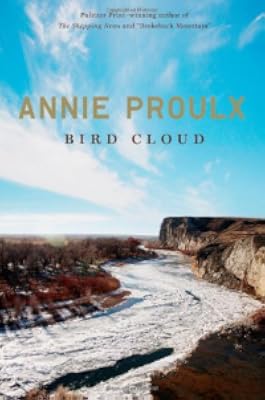
Bird Cloud: A Memoir
by Annie Proulx
On This Page
Description
"Bird Cloud" is the name the author gave to 640 acres of Wyoming wetlands and prairie and four hundred foot cliffs plunging down to the North Platte River. On the day she first visited, a cloud in the shape of a bird hung in the evening sky. She also saw pelicans, bald eagles, golden eagles, great blue herons, ravens, scores of bluebirds, harriers, kestrels, elk, deer and a dozen antelope. She fell in love with the land, then owned by the Nature Conservancy, and she knew what she wanted to show more build on it, a house in harmony with her work, her appetites and her character, a library surrounded by bedrooms and a kitchen. Her first work of nonfiction in more than twenty years, this book is the story of designing and constructing that house, with its solar panels, Japanese soak tub, concrete floor and elk horn handles on kitchen cabinets. It is also an enthralling natural history and archaeology of the region, inhabited for millennia by Ute, Arapaho and Shoshone Indians, and a family history, going back to nineteenth century Mississippi riverboat captains and Canadian settlers. The author here turns her lens on herself. We understand how she came to be living in a house surrounded by wilderness, with shelves for thousands of books and long worktables on which to heap manuscripts, research materials and maps, and how she came to be one of the great American writers of her time. show lessTags
Recommendations


Member Reviews
This memoir of a favorite author was a mixed bag for me. It was chock full of geographical information, family research, and the difficulties of building a dream house. I feel like I know Annie Proulx better after reading Bird Cloud - and that's a good thing.
I would recommend the book to fans of Annie, or someone moving to Wyoming, or those interested in architecture and building. Towards the end of the book were some fascinating thoughts about Native Americans and birds of the area. She did much research for the book and her keen eye for nature transfers well to the written page. I much prefer her fiction books, but her writing is top quality no matter what her subject. Bottom line: I'm glad I read it.
I would recommend the book to fans of Annie, or someone moving to Wyoming, or those interested in architecture and building. Towards the end of the book were some fascinating thoughts about Native Americans and birds of the area. She did much research for the book and her keen eye for nature transfers well to the written page. I much prefer her fiction books, but her writing is top quality no matter what her subject. Bottom line: I'm glad I read it.
This is a memoir of Proulx's experience building what was meant to be her dream house and final home on 640 acres in Southern Wyoming, along the North Platte River, on the west slope of the Medicine Bow range, part of the Rocky Mountains. She was 70 years old when she began the process of buying the land, planning and building the house. Very little went as planned, everything took longer and cost more than expected, and ultimately Proulx realized that it would be impossible for her to live in the finished house through the deep Wyoming winters. Contrary to what she had been told, the county road leading to the house site was not maintained in the winter...the house would be inaccessible once the heavy snows came. All of this merely show more confirmed my long-held belief that I would never be tempted or persuaded to build a house, and made me wonder why anyone would choose Wyoming wilderness to live in. Proulx framed this central story with background on the history of the land and its previous owners, her own family history and genealogy, and best of all, the natural history of the area. I felt a bit bogged down in the discouraging details of the house construction, especially when the author reiterated periodically how she was running out of money, and yet went on to describe more and more projects, acquisitions, do-overs, re-designs, and trips that must have cost what I would consider a small fortune. Furthermore, a few of her design elements sounded like really bad ideas to begin with, to me. I mean -- a concrete floor in the kitchen? Mmmm...why? The reward for suffering through all of this with her was the final chapter, "A Year of Birds", which contains some really fine nature writing. I give the book a grudging 3 stars overall, as I just didn't think it was a cohesive whole, but meeting the eagles, elk, falcons, mountain lion, horned larks, jackrabbits and rosy finches with which the author shared her months at Bird Cloud made the read worthwhile. show less
Ordinarily, when I see a book about a person who buys some land and builds a house, my interest doesn’t go much further. However, when the builder is noted author, Annie Proulx, and the house is her dream home in Wyoming, my interest piqued.
Proulx is one of the best novelists and short story writers of the late 20th and into the 21st centuries. Her award-winning novel, The Shipping News and That Old Ace in the Hole are my favorite of her books. I always show my creative writing class a documentary about Ms Proulx writing Ace. It shows them the amount of research and hard, meticulous work that a novelist of Proulx’s stature puts into a new work of fiction. Her short stories, however, represent another whole aspect of her talent. I show more can honestly say, I have never read a Proulx short story that I did not like.
In Bird Cloud, Proulx tells the story of her family from its French-Canadian roots through to New England. She describes several places she lives, but none of them match her ideal home for reading, research, and writing. She searches Wyoming -- three collections of her short stories are subtitled “Wyoming Stories” – for a perfect plot of land, secluded, but near enough to civilization for food and supplies. She wanted a place where she could have rooms that looked out over the vast prairies nearby and mountains in the distance. Then she launches into a history of the area she selected dating back to the earliest inhabitants several thousand years ago, through to the Native Americans pushed out by white settlers in the 19th century. Then the search began for an architect and construction crew. The delays and pitfalls were frustrating and costly.
Once the house is finished, she takes a detailed inventory of the flora and fauna surrounding her. She has particular interest in birds, and spots several pairs of eagles – bald and golden – along with falcons, hawks, ravens, owls, and myriad song birds. Here, she describes one unique encounter.
“It was a big thrill when I saw a white-faced ibis near the front gate where there was irrigation overflow. The ibis stayed around for weeks. A few days after this sighting I was sitting near the river and saw two herons fly to the bald eagles’ favorite fishing tree. They were too small to be blue herons, and did not really look like little blues. A few minutes with the heron book cleared up the mystery; they were tricolored herons, the first I had ever seen. By the end of the month, American goldfinches were shooting around like tossed gold pieces despite another cold spell” (220).
This conversational style gives her prose a smooth and seamless fluidity that paints a digital-quality image in the mind of the reader. She welcomes me into her world as a expected visitor. This memoir will appeal to those interested in wildlife, because her keen eye for observation reveals much about the fauna of a wilderness area most of us would never visit.
The house is complicated in its orientation, layout, and construction, and I can imagine such a wonderful hideaway for a writer and reader. If you have never read Proulx, start with one of her collections of stories and get a feel for her exquisite view of nature -- flora, fauna, and human. 5 stars
--Chiron, 3/8/11 show less
Proulx is one of the best novelists and short story writers of the late 20th and into the 21st centuries. Her award-winning novel, The Shipping News and That Old Ace in the Hole are my favorite of her books. I always show my creative writing class a documentary about Ms Proulx writing Ace. It shows them the amount of research and hard, meticulous work that a novelist of Proulx’s stature puts into a new work of fiction. Her short stories, however, represent another whole aspect of her talent. I show more can honestly say, I have never read a Proulx short story that I did not like.
In Bird Cloud, Proulx tells the story of her family from its French-Canadian roots through to New England. She describes several places she lives, but none of them match her ideal home for reading, research, and writing. She searches Wyoming -- three collections of her short stories are subtitled “Wyoming Stories” – for a perfect plot of land, secluded, but near enough to civilization for food and supplies. She wanted a place where she could have rooms that looked out over the vast prairies nearby and mountains in the distance. Then she launches into a history of the area she selected dating back to the earliest inhabitants several thousand years ago, through to the Native Americans pushed out by white settlers in the 19th century. Then the search began for an architect and construction crew. The delays and pitfalls were frustrating and costly.
Once the house is finished, she takes a detailed inventory of the flora and fauna surrounding her. She has particular interest in birds, and spots several pairs of eagles – bald and golden – along with falcons, hawks, ravens, owls, and myriad song birds. Here, she describes one unique encounter.
“It was a big thrill when I saw a white-faced ibis near the front gate where there was irrigation overflow. The ibis stayed around for weeks. A few days after this sighting I was sitting near the river and saw two herons fly to the bald eagles’ favorite fishing tree. They were too small to be blue herons, and did not really look like little blues. A few minutes with the heron book cleared up the mystery; they were tricolored herons, the first I had ever seen. By the end of the month, American goldfinches were shooting around like tossed gold pieces despite another cold spell” (220).
This conversational style gives her prose a smooth and seamless fluidity that paints a digital-quality image in the mind of the reader. She welcomes me into her world as a expected visitor. This memoir will appeal to those interested in wildlife, because her keen eye for observation reveals much about the fauna of a wilderness area most of us would never visit.
The house is complicated in its orientation, layout, and construction, and I can imagine such a wonderful hideaway for a writer and reader. If you have never read Proulx, start with one of her collections of stories and get a feel for her exquisite view of nature -- flora, fauna, and human. 5 stars
--Chiron, 3/8/11 show less
On the inside of this book, the title is accompanied by the words ‘a memoir’. Unless I’m completely wrong about the meaning of the word ‘memoir’ I think that that is somewhat of a misnomer.
Bird Cloud is a collection of essays loosely connected by themes of home. Annie Proulx gives a recounting of her own place on earth via her genealogy. That section was just skimmed over with not much detail. She relayed what information she had, but that was given to her by someone she hired to track it down. She didn’t do her own research. If she had and then described that discovery process in an essay I would have found it more absorbing – as it was I thought that particular essay only mildly interesting. Another essay recounts the show more many birds that populate her area of Bird Cloud and how she came to know them. She mentions that she isn’t a ‘list-maker’ and does not make note of every bird that crosses her path. And that’s fine – but (and perhaps I’m being too sensitive here) I disliked the sense that there’s something wrong with making a ‘I’ve seen this bird’ list.
This book is also about history and how Bird Cloud (the 640 acres where Annie Proulx built her house) itself came to be in the author’s hands. She writes about its early history and more recent events concerning overgrazing. I would have enjoyed seeing photos of the areas she described and this is where I think the book is missing most. There are small, hand-drawn pictures and diagrams at the beginning of the chapters but real photos of the area and perhaps the people she spent the most time talking about would have been an added bonus.
What I liked was the description of buying the land and building on it. The people she described, the weather, the impassable roads – all was well done. Having gone through a building process myself, I could easily relate to the big and small hiccups. Her foray with friends onto the land to look for historical remnants of previous inhabitants was also quite interesting. There’s nothing better than a fossil hunt!
What I most liked most of all about this book was the author’s writing. She has a way with words and knows how to put them together and that, above all else, is what kept me reading. This woman can write! While I don’t think this book is what I expected it to be I will read another Annie Proulx book (this was my first) simply for the joy of reading great prose. show less
Bird Cloud is a collection of essays loosely connected by themes of home. Annie Proulx gives a recounting of her own place on earth via her genealogy. That section was just skimmed over with not much detail. She relayed what information she had, but that was given to her by someone she hired to track it down. She didn’t do her own research. If she had and then described that discovery process in an essay I would have found it more absorbing – as it was I thought that particular essay only mildly interesting. Another essay recounts the show more many birds that populate her area of Bird Cloud and how she came to know them. She mentions that she isn’t a ‘list-maker’ and does not make note of every bird that crosses her path. And that’s fine – but (and perhaps I’m being too sensitive here) I disliked the sense that there’s something wrong with making a ‘I’ve seen this bird’ list.
This book is also about history and how Bird Cloud (the 640 acres where Annie Proulx built her house) itself came to be in the author’s hands. She writes about its early history and more recent events concerning overgrazing. I would have enjoyed seeing photos of the areas she described and this is where I think the book is missing most. There are small, hand-drawn pictures and diagrams at the beginning of the chapters but real photos of the area and perhaps the people she spent the most time talking about would have been an added bonus.
What I liked was the description of buying the land and building on it. The people she described, the weather, the impassable roads – all was well done. Having gone through a building process myself, I could easily relate to the big and small hiccups. Her foray with friends onto the land to look for historical remnants of previous inhabitants was also quite interesting. There’s nothing better than a fossil hunt!
What I most liked most of all about this book was the author’s writing. She has a way with words and knows how to put them together and that, above all else, is what kept me reading. This woman can write! While I don’t think this book is what I expected it to be I will read another Annie Proulx book (this was my first) simply for the joy of reading great prose. show less
I liked this book about Proulx’s house land buying and house building journey on the Platte River in Wyoming. She had definite ideas about how she wanted the house to be and despite many problems with the weather and contractors she mostly got what she wanted. I also liked her descriptions of the land, its history, all the birds, and her own history, both personal and family. This is the fourth Proulx book I’ve read and I look forward to reading more.
Anyone who has undertaken a DIY project will know that it can be painful, anyone who has had to listen to somebody telling them about their DIY project will know that it is both painful and tedious. Here is a book about a major project which appears to have all the drawbacks of DIY and none of the benefits of just buying something fully formed, as the author decides to build her perfect house in an isolated and unpopulated piece of prairie.
Unpopulated, that should have been the clue right there. Some places, humans are just not meant to live. Survive maybe, but not settle, not put down roots and thrive. Some places are only ever going to be home to such critters that can live there, tough critters. If you get excited about matching your show more pillow covers to your curtain material, this is unlikely to be the place for you. Some places, like Bird Cloud, are home to so many birds because it's just so damn hard for anything to live on the ground. Some places, the only thing that thrives, that's really alive and vibrant, is the weather, is the elements, is the blizzard blown snow. Maybe that's why the house at Bird Cloud is made up of materials as hard, as unyielding and as uncompromising as the weather or the author.
So, getting a house built where the buffalo used to roam turns out to be something of a protracted process, at some point during which the author probably thought 'there's a book in this...there had better be, because I have to pay for that sodding new kitchen somehow'.
There's plenty of room in any construction project for slapstick, like when imperial meets metric. And there's prairie scale room for slapstick here in this construction project in the wilds, like elk footprints in the concrete, or plummeting cows. Any levity however is quickly quashed by the author's dry humourlessness, which is appropriate for a book about a self build, a process that, according to this book, is about as much fun as being trapped in a wagon train in a blizzard.
Problems and obstacles abound; the weather, materials, labour, the weather, wild animals, domestic animals, animals generally, more weather, material costs, unexpected costs and yet more bloody weather. The only way in which this build could have been more difficult would be the involvement of B&Q. The author may have a beautiful house (not a home, she can only live there part of the year because of the weather) but we are assured that the process of achieving this is not to be envied, even if the outcome is.
About half way through 'Bird Cloud' I was wondering what the point of this book was. It appeared, the further I read, to be something of a scrapbook of pieces about family, history, family history, houses, building, house building, nature, extreme nature and building a house in an area where there is lots of nature, both of the ooh-ahh view type and the Christ-what-was-that variety, but a fair amount of it of the angry type, and angry on a climatic scale. Angry climates are great for dramatic scenery, but not so great on either access by road, or the complexion.
Perhaps scrapbook is a disservice, perhaps patchwork would be a better description. For one thing, it's more folksy. But if scrapbook is a disservice, it's not a great one. The is an interesting insight into the area through its history, and a revealing insight into the author through a small slice of family life recalled. The book does read if it is comprised of magazine articles, say on the travails of a challenging self build, or a guest piece on American history, but for quality magazines.
This could have been more effective as more modest volume because there are some real pleasures here, the author obviously loves Bird Cloud. She also loves the people in the community. The only thing that seems lacking is humour, which was maybe never there to begin with, because on completion of the book the reader is assured that completion of the house was no laughing matter. show less
Unpopulated, that should have been the clue right there. Some places, humans are just not meant to live. Survive maybe, but not settle, not put down roots and thrive. Some places are only ever going to be home to such critters that can live there, tough critters. If you get excited about matching your show more pillow covers to your curtain material, this is unlikely to be the place for you. Some places, like Bird Cloud, are home to so many birds because it's just so damn hard for anything to live on the ground. Some places, the only thing that thrives, that's really alive and vibrant, is the weather, is the elements, is the blizzard blown snow. Maybe that's why the house at Bird Cloud is made up of materials as hard, as unyielding and as uncompromising as the weather or the author.
So, getting a house built where the buffalo used to roam turns out to be something of a protracted process, at some point during which the author probably thought 'there's a book in this...there had better be, because I have to pay for that sodding new kitchen somehow'.
There's plenty of room in any construction project for slapstick, like when imperial meets metric. And there's prairie scale room for slapstick here in this construction project in the wilds, like elk footprints in the concrete, or plummeting cows. Any levity however is quickly quashed by the author's dry humourlessness, which is appropriate for a book about a self build, a process that, according to this book, is about as much fun as being trapped in a wagon train in a blizzard.
Problems and obstacles abound; the weather, materials, labour, the weather, wild animals, domestic animals, animals generally, more weather, material costs, unexpected costs and yet more bloody weather. The only way in which this build could have been more difficult would be the involvement of B&Q. The author may have a beautiful house (not a home, she can only live there part of the year because of the weather) but we are assured that the process of achieving this is not to be envied, even if the outcome is.
About half way through 'Bird Cloud' I was wondering what the point of this book was. It appeared, the further I read, to be something of a scrapbook of pieces about family, history, family history, houses, building, house building, nature, extreme nature and building a house in an area where there is lots of nature, both of the ooh-ahh view type and the Christ-what-was-that variety, but a fair amount of it of the angry type, and angry on a climatic scale. Angry climates are great for dramatic scenery, but not so great on either access by road, or the complexion.
Perhaps scrapbook is a disservice, perhaps patchwork would be a better description. For one thing, it's more folksy. But if scrapbook is a disservice, it's not a great one. The is an interesting insight into the area through its history, and a revealing insight into the author through a small slice of family life recalled. The book does read if it is comprised of magazine articles, say on the travails of a challenging self build, or a guest piece on American history, but for quality magazines.
This could have been more effective as more modest volume because there are some real pleasures here, the author obviously loves Bird Cloud. She also loves the people in the community. The only thing that seems lacking is humour, which was maybe never there to begin with, because on completion of the book the reader is assured that completion of the house was no laughing matter. show less
Bird Cloud – Annie Proulx
3 stars
This was an interesting, but disjointed memoir of the Pulitzer Prize winning author, Annie Proulx. Proulx relates some stories from her childhood and gives a bit of family history, but mostly this is her story of building her dream house in a remote area of Wyoming. As she details the laborious process of building her house, she includes memories of previous homes. Her stories are filled with the humor, frustration and eventually satisfaction with tasks completed. The best parts of the book were Proulx’s beautiful descriptive passages about the wildlife, especially the birds, who inhabit her extensive property.
Members
- Recently Added By
Published Reviews
ThingScore 38
Reading Ms. Proulx’s prose is like bouncing along rutted country roads in a pickup truck with no shock absorbers. Her books are packed with arcane flora and fauna and eccentrically named towns and characters. Many writers employ unusual verbs and adjectives; Ms. Proulx likes weird nouns. Her cluttered style is, in a kind of reverse way, as jewel-encrusted as Gustav Klimt’s.
In “Bird show more Cloud” these qualities turn against her. She visually absorbs Wyoming’s long vistas and spits out data like a seed catalog. show less
In “Bird show more Cloud” these qualities turn against her. She visually absorbs Wyoming’s long vistas and spits out data like a seed catalog. show less
added by lorax
There are three brilliantly researched and written chapters in Bird Cloud that construct a fine gallery interpreting the human and natural history of a wild stretch of Wyoming landscape. Unfortunately, they are the last three chapters and to get to them we have to make it through a meandering, overwrought and badly conceived foyer of “I-built-a-house” memoir, seven chapters long....For the show more reader, though, it also signals the disappointment of the first two-thirds of her book. We stand at a window Proulx created to provide a certain view, but in looking through it we wonder just what it was she wanted us to see show less
added by vancouverdeb
Lists

Living Among Wild Animals
13 works; 8 members

Biggest Disappointments
606 works; 163 members
Author Information

44+ Works 35,299 Members
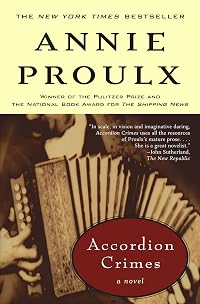
Edna Annie Proulx was born in Norwich, Connecticut on August 22, 1935. She graduated from the University of Vermont in 1969 and earned an M. A. from Sir George Williams University in Montreal in 1973. She was a journalist, wrote nonfiction articles for numerous publications, and was the author of several "how-to" books before beginning to write show more fiction in her 50s. She became the first woman to win the prestigious PEN/Faulkner Award for Fiction, for her debut novel Postcards. Her novel The Shipping News won the Pulitzer Prize for Fiction and the National Book Award in 1994. Accordion Crimes, published in 1996, won the Dos Passos Prize for literature. She also won the O. Henry prize for the year's best short story twice; in 1998 for Brokeback Mountain and in 1999 for The Mud Below. She has written more than 50 articles and stories for periodicals and edited Best American Short Stories of 1997. (Bowker Author Biography) show less
Common Knowledge
- Original title
- Bird Cloud : A Memoir
- Original publication date
- 2011-01
- Epigraph
- . . . a very curious dish of Viennese sausages which were sizzling hot at one end and frozen at the other -- a striking example of the non-conductivity of sausages in high altitudes. --H. W. Tilman
- Dedication
- For Harry Teague who designed it
and for the James Gang who built it
and for Dudley Gardner who dug it - First words
- The cow-speckled landscape is an ashy grey color.
- Last words
- (Click to show. Warning: May contain spoilers.)It was too late in the season to raise a family, the common wildlife situation of hope deferred.
- Blurbers
- Fuller, Alexandra; Minzesheimer, Bob; Garner, Dwight; Seaman, Donna
Classifications
Statistics
- Members
- 485
- Popularity
- 62,673
- Reviews
- 38
- Rating
- (3.33)
- Languages
- Dutch, English, French, German
- Media
- Paper, Audiobook, Ebook
- ISBNs
- 22
- ASINs
- 8