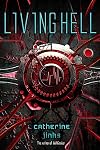
Living Hell
by Catherine Jinks
On This Page
Description
Chronicles the transformation of a spaceship into a living organism, as seventeen-year-old Cheney leads the hundreds of inhabitants in a fight for survival while machines turn on them, treating all humans as parasites.Tags
Recommendations




















Member Recommendations
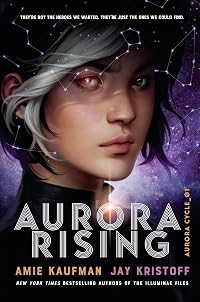
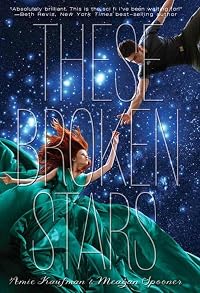
FFortuna Both awesome YA sci-fi novels.
Member Reviews
In the beginning, I admit I was wary. I had heard phenomenal things about this book, but then the first couple of chapters were kind of dry and dull. However, I now firmly believe that this was done on purpose. Because hot damn.
It's beautiful. And horrifying. And heart-wrenching. And superb.
Cheney is just wonderful. I love him as a main character. And I actually like all the other characters too. I like all the details we got of Plexus, because that made the ending more powerful.
I would actually encourage people to read this book without knowing hardly anything about the plot beforehand, because that's how I went into it and it made every twist and turn SO good. So don't read a synopsis or a summary. Just read it.
This is one of those show more books that I will read again and again and again... but because it's so exhausting and intense, I'll have to wait a very long time between reads. show less
It's beautiful. And horrifying. And heart-wrenching. And superb.
Cheney is just wonderful. I love him as a main character. And I actually like all the other characters too. I like all the details we got of Plexus, because that made the ending more powerful.
I would actually encourage people to read this book without knowing hardly anything about the plot beforehand, because that's how I went into it and it made every twist and turn SO good. So don't read a synopsis or a summary. Just read it.
This is one of those show more books that I will read again and again and again... but because it's so exhausting and intense, I'll have to wait a very long time between reads. show less
Speeding through space, a large and complex space station carries earthlings searching for another livable planet. After an encounter with a radiation field, the ship morphs into a living being. Things get rather gruesome as seventeen-year old Cheney and a few other plucky souls figure out how to survive now that their home thinks they are parasites and attacks them with antibodies. Author Catherine Jinks maintains a high level of suspense. For readers who are not intimidated by the inclusion of many scientific terms.
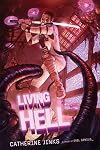
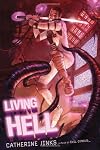
The first book I read by Catherine Jinks was Evil Genius and I quite enjoyed it. The next book I had planned on reading by Jinks was Genius Squad, the next book in the series, though admittedly I haven't gotten around to it yet. But when I saw the awesome cover art by Cameron Davis for Jinks' standalone young adult science fiction novel Living Hell, I couldn't pass the book up. (Even better, it turns out the cover fits the story perfectly.) Living Hell was first published in Jinks' native Australia in 2007, making its way to U.S. shores in 2010. I find it interesting that even though Jinks is a medieval scholar (not to pigeonhole anyone or anything), many of her books have science fictional elements to them--this is certainly true in show more the case of Living Hell. Generally speaking, Jinks handled these components quite well in Evil Genius, which is more real to life, and so I was looking forward to seeing what she would do with the even greater freedom that Living Hell would allow.
Cheney is seventeen although he was technically born thirty-three years ago--it's just that he's been in stasis off and on his entire life, just like everyone else aboard Plexus, searching for a new planet that can support human life. Plexus is a complicated system, making use of DNA and microbial colonies to efficiently function. The ship must be constantly monitored and kept in careful balance. That balance is catastrophically upset when the ship encounters an unknown radiation wave. Soon, Plexus develops into an independent, living system and the humans have lost all control. In fact, they find themselves being hunted down and destroyed by the ship's newly evolved immune system and defense mechanisms. If humanity can adapt fast enough, the people aboard Plexus might just survive. But then what?
For as huge as I imagine the Plexus must be, we actually see very little of the ship in Living Hell. There are however plenty of named characters which I will admit I occasionally found difficult to distinguish--particularly the adults. Part of this was because the writing style included little descriptive material, focusing more on the action. This isn't necessarily a problem in and of itself, but some details seemed only to be introduced as the plot needed them as opposed to being incorporated into the story as a whole. Still, Jinks has a good premise to start with and a strong back-story to support it. I enjoyed her version of a ship with biological elements and most of her basic science fiction is believable. And what isn't is at least a lot of fun.
I was actually somewhat disappointed with Living Hell, despite it being quick, fun, and easy read. The book did give me a warm, fuzzy feeling of nostalgia for the science fiction stories that I read when I was much younger than I am now, which I appreciated and made me smile. But at the same time, I wanted Living Hell to be more complex than it ended up being. I was sorry to see intriguing plot points introduced, but not actually lead anywhere--the genetic heritage of some of the characters being one example. I also felt cheated towards the end of the book when one character stops another from revealing what had previously happened because there were more important things to attend to at that very moment. Granted, that was true, but still, I wanted to know. However the Epilogue, appropriately written in a completely different style, was excellent and a very nice touch. It did make me want to read the appendices referred to, though. Living Hell had a great premise to it, but Jinks didn't pull it off quite as well as I had hoped. She does get some thing right though--Cheney makes a wonderful and very likable protagonist and the background is well thought out--and even sneaks some great biology lessons into the story. I expect that Living Hell will be enjoyed by the younger readers at which it is aimed, but most adults will probably be left wanting something a little more substantial.
Experiments in Reading show less
Cheney is seventeen although he was technically born thirty-three years ago--it's just that he's been in stasis off and on his entire life, just like everyone else aboard Plexus, searching for a new planet that can support human life. Plexus is a complicated system, making use of DNA and microbial colonies to efficiently function. The ship must be constantly monitored and kept in careful balance. That balance is catastrophically upset when the ship encounters an unknown radiation wave. Soon, Plexus develops into an independent, living system and the humans have lost all control. In fact, they find themselves being hunted down and destroyed by the ship's newly evolved immune system and defense mechanisms. If humanity can adapt fast enough, the people aboard Plexus might just survive. But then what?
For as huge as I imagine the Plexus must be, we actually see very little of the ship in Living Hell. There are however plenty of named characters which I will admit I occasionally found difficult to distinguish--particularly the adults. Part of this was because the writing style included little descriptive material, focusing more on the action. This isn't necessarily a problem in and of itself, but some details seemed only to be introduced as the plot needed them as opposed to being incorporated into the story as a whole. Still, Jinks has a good premise to start with and a strong back-story to support it. I enjoyed her version of a ship with biological elements and most of her basic science fiction is believable. And what isn't is at least a lot of fun.
I was actually somewhat disappointed with Living Hell, despite it being quick, fun, and easy read. The book did give me a warm, fuzzy feeling of nostalgia for the science fiction stories that I read when I was much younger than I am now, which I appreciated and made me smile. But at the same time, I wanted Living Hell to be more complex than it ended up being. I was sorry to see intriguing plot points introduced, but not actually lead anywhere--the genetic heritage of some of the characters being one example. I also felt cheated towards the end of the book when one character stops another from revealing what had previously happened because there were more important things to attend to at that very moment. Granted, that was true, but still, I wanted to know. However the Epilogue, appropriately written in a completely different style, was excellent and a very nice touch. It did make me want to read the appendices referred to, though. Living Hell had a great premise to it, but Jinks didn't pull it off quite as well as I had hoped. She does get some thing right though--Cheney makes a wonderful and very likable protagonist and the background is well thought out--and even sneaks some great biology lessons into the story. I expect that Living Hell will be enjoyed by the younger readers at which it is aimed, but most adults will probably be left wanting something a little more substantial.
Experiments in Reading show less
Teen science fiction/thriller. The first 50 pages are a confusing whirlwind of names, characters, and futuristic descriptions, but after the action starts (about 50 pages in) readers will be hooked. Quite a bit of biological science (and some pseudo-science) in this one, and once it gets going it reads like a movie.
Catherine Jinks put together quite an enjoyable tale here.
Imagine that you are 17 years old on a pioneering space ship, traversing the stars in search of a new home world. Your ship is a living entity of delicately balanced alloys and bacteria, self cleaning and self repairing.
You are at the birthday bash of another crew member, when alarms are tripped. Within 24 hours, you have to watch as the people you love die. This is very much a coming of age story, but in fast forward. Moving quickly from a strategic and heavily monitored existence to self reliance in order to survive.
A couple plot holes found but nothing that can not be easily disregarded.
In the end, this was not a challenging read, taking me the equivalent of one and a half show more days transit to and from work to make it through (2-3 hours). The concepts were clear and concise. The conversational manner and tone of characters was believable. I did not feel as if Jinks was talking down to me as a reader, instead attempting to coax to the reading level she needed. Very smooth in that manner. nice work Jinks!
Living Hell has excellent flow and character development. This is so much the case that it was not until i had read about a third of the book in that I realized it was technically a young adult novel. It was fast, fun, and in the end, I did not find that I had the ending figured out in advance. This is a huge bonus when it comes to YA fiction as much of it is fairly formulaic and predictable :)
Jinks originally published this in 2007, but the copy I read was published 4/12/2010, this is likely the difference between an Aussie release vs US edition.
Note to the cover illustrator, Cameron Davis: bad ass cover art! nice work there :)
~~
Catherine Jinks is an Australian born author of over 30 books. She is not genre focused or dependent on a specific blend to get it tight and feel right. Check out her site for a full bio and list of both Teen and adult book availability. – catherinejinks.com - show less
Imagine that you are 17 years old on a pioneering space ship, traversing the stars in search of a new home world. Your ship is a living entity of delicately balanced alloys and bacteria, self cleaning and self repairing.
You are at the birthday bash of another crew member, when alarms are tripped. Within 24 hours, you have to watch as the people you love die. This is very much a coming of age story, but in fast forward. Moving quickly from a strategic and heavily monitored existence to self reliance in order to survive.
A couple plot holes found but nothing that can not be easily disregarded.
In the end, this was not a challenging read, taking me the equivalent of one and a half show more days transit to and from work to make it through (2-3 hours). The concepts were clear and concise. The conversational manner and tone of characters was believable. I did not feel as if Jinks was talking down to me as a reader, instead attempting to coax to the reading level she needed. Very smooth in that manner. nice work Jinks!
Living Hell has excellent flow and character development. This is so much the case that it was not until i had read about a third of the book in that I realized it was technically a young adult novel. It was fast, fun, and in the end, I did not find that I had the ending figured out in advance. This is a huge bonus when it comes to YA fiction as much of it is fairly formulaic and predictable :)
Jinks originally published this in 2007, but the copy I read was published 4/12/2010, this is likely the difference between an Aussie release vs US edition.
Note to the cover illustrator, Cameron Davis: bad ass cover art! nice work there :)
~~
Catherine Jinks is an Australian born author of over 30 books. She is not genre focused or dependent on a specific blend to get it tight and feel right. Check out her site for a full bio and list of both Teen and adult book availability. – catherinejinks.com - show less
First of all, I’d like to thank Harcourt Children’s Books and Houghton Mifflin Harcourt for giving me a copy of this book. I’m always on the lookout for new (to me) authors and think Catherine Jinks is a wonderful find.
Living Hell is set aboard the spaceship Plexus. Humans have left Earth and have been travelling aboard the Plexus for years. Our hero Cheney was board about the ship and knows life to be organized, self-contained and structured. Everything changes, though, when the Plexus is hit by a radiation wave that transforms the ship, turning her against her crew. Cheney and his friends are forced to survive by their wits, trying to find a way to fight back against their home, which is now bent on their destruction.
This is a show more fantastic book. I read it in one sitting. Catherine Jinks has crafted such a great story, with really engaging characters and a gripping plot. The transformation that the Plexus experiences is very interesting and original, with a slight education bent, which was rather cool. In terms of tone, it sort of reminded me of Suzanne Collins‘ Hunger Games, since Living Hell deals with life-and-death situations in a very real and honest way.
The author’s website says she’s got more books out so I’m going to keep my eyes peeled the next time I’m at the library. And I’m going to buy a copy of this book for my cousin, who’s a huge fan of the Hunger Games series.
Also published at http://ireadgood.wordpress.com show less
Living Hell is set aboard the spaceship Plexus. Humans have left Earth and have been travelling aboard the Plexus for years. Our hero Cheney was board about the ship and knows life to be organized, self-contained and structured. Everything changes, though, when the Plexus is hit by a radiation wave that transforms the ship, turning her against her crew. Cheney and his friends are forced to survive by their wits, trying to find a way to fight back against their home, which is now bent on their destruction.
This is a show more fantastic book. I read it in one sitting. Catherine Jinks has crafted such a great story, with really engaging characters and a gripping plot. The transformation that the Plexus experiences is very interesting and original, with a slight education bent, which was rather cool. In terms of tone, it sort of reminded me of Suzanne Collins‘ Hunger Games, since Living Hell deals with life-and-death situations in a very real and honest way.
The author’s website says she’s got more books out so I’m going to keep my eyes peeled the next time I’m at the library. And I’m going to buy a copy of this book for my cousin, who’s a huge fan of the Hunger Games series.
Also published at http://ireadgood.wordpress.com show less
I really enjoy Catherine Jinks' writing and this is no exception. She tackles such a wide variety of topics and genre and does them all well.
In this book, Cheney lives on the spaceship Plexus along with hundreds of others, all dependent on the ship for survival. After an energy wave hits them, strange changes start taking place on Plexus - it starts becoming organic and the humans within it are no more than bacteria to be wiped out. So begins a real fight for survival.
This would be a great read for 13 yrs up. My only quibble is that the ending seemed a bit sudden - 5 pages from the end I thought we were in for a second volume.
In this book, Cheney lives on the spaceship Plexus along with hundreds of others, all dependent on the ship for survival. After an energy wave hits them, strange changes start taking place on Plexus - it starts becoming organic and the humans within it are no more than bacteria to be wiped out. So begins a real fight for survival.
This would be a great read for 13 yrs up. My only quibble is that the ending seemed a bit sudden - 5 pages from the end I thought we were in for a second volume.
Members
- Recently Added By
Author Information

58 Works 6,260 Members
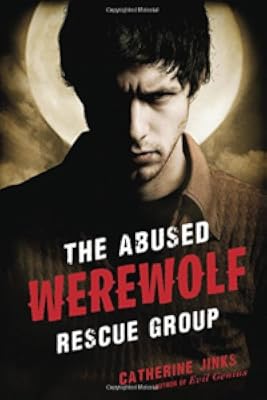
Catherine Jinks was born November 17, 1963 in Brisbane, Queensland. She received a degree in medieval history from the University of Sydney in 1986. After college, she worked as a journalist and editor before becoming a full-time writer. She has written more than 30 books for both children and adults including Pagan's Vows, Eye to Eye, Piggy in show more the Middle, The Reformed Vampire Support Group, and The Abused Werewolf Rescue Group. She is also the author of the Pagan Chronicles and Allie's Ghost Hunters series. She has won numerous awards including the Children's Book Council of Australia Book of the Year Award three times, the Victorian Premier's Literary Award, the Aurealis Award for Science Fiction, the Australian Ibby Award, and the Davitt Award for Crime Fiction. (Bowker Author Biography) show less
Common Knowledge
- Canonical title
- Living Hell
- Original publication date
- 2010-04-12 [2010] U.S., 2007 Australia
- Dedication
- To Peter and Hannah, with love
Classifications
- Genres
- Fiction and Literature, Tween, Science Fiction, Teen, Horror
- DDC/MDS
- 823.3 — Literature & rhetoric English & Old English literatures English fiction 1558-1625
- LCC
- PZ7 .J5754 .L — Language and Literature Fiction and juvenile belles lettres Fiction and juvenile belles lettres Juvenile belles lettres
- BISAC
Statistics
- Members
- 140
- Popularity
- 233,861
- Reviews
- 10
- Rating
- (3.70)
- Languages
- English
- Media
- Paper, Ebook
- ISBNs
- 9
- ASINs
- 3