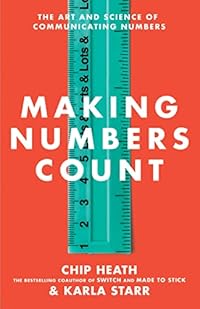
Making Numbers Count: The Art and Science of Communicating Numbers
by Chip Heath, Karla Starr
On This Page
Description
Understanding numbers is essential - but humans aren't built to understand them. Chip Heath outlines specific principles that reveal how to translate a number into our brain's language. This book is filled with examples of extreme number makeovers, vivid before-and-after examples that take a dry number and present it in a way that people click in and say "Wow, now I get it!" This book will help math-lovers and math-haters alike translate the numbers that animate our world - allowing us to show more bring more data, more naturally, into decisions in our schools, our workplaces, and our society. Print run 200,000. show lessTags
Recommendations








Member Reviews
The title of this book might suggest a dry read, but I found it anything but. Each of the chapters covers an easy-to-understand (though possibly not quite so easy to implement) method for helping your target audience appreciate whatever amount/size/proportion etc you’re talking about. I found it quite easy to dip into individual chapters over a few weeks without feeling like I’d lost my place.
Personally, I don’t find myself in many situations where I would need to do this professionally (eg lecturing, writing proposals). But having read Making Numbers Count, I find myself more number-aware and inclined to translate information, even if only for my own use.
Personally, I don’t find myself in many situations where I would need to do this professionally (eg lecturing, writing proposals). But having read Making Numbers Count, I find myself more number-aware and inclined to translate information, even if only for my own use.
Making Numbers Count tells us that there are two types of people in the world – those that understand numbers (very few of us) and those who don’t (most of us). It’s difficult for nearly everyone to comprehend large numbers (millions, billions) but really, our brains start to get confused when numbers are more than just five. This book describes many ways in which you can make numbers meaningful to everyone – whether they understand your field of expertise or not.
The book has a good premise – how to take your relatively dry numbers and make them snazzy and memorable. That’s really useful when you are trying to convey a message about the urgency or importance of numbers. Rather than saying ‘1 million people will get this show more disease’ you say ‘1 person in 10 will get this disease’ for example. It also talks about adding feelings to your numbers to make them more relatable to the audience, for example Florence Nightingale talked about the losses of the army in terms of regiments when showing how infection control and better nursing saved lives.
There are many examples like this throughout the book, some interesting and some less so to me. I did feel that some of the book was saying the same thing over in a different way – make your numbers relatable in a scale, setting or size that means something to your audience. Turn numbers into stories. Make people feel the weight of the meaning of the numbers. I think this would be a useful book to have on hand for a presentation to executives/accounts to describe why you might be asking for money for a program or intervention. As a read cover to cover book, I felt it was a bit repetitive when reading in chunks but better when reading a couple of (short) chapters at a time. There was less of ‘yes, I know you told me this already’…
One thing that struck me as odd was the combination of examples from countries using different units, such as temperatures from the UK in degrees Celsius and then American Fahrenheit in another. Maybe the authors were trying to capture a global audience, but to me, the mixing of units felt messy. Put both in, or stick to one. Also the rounding of figures felt a bit sacrilegious to those who report in exact statistics – sometimes a few % make a LOT of difference! Also, most of us who read widely can do rough calculations between units of distance, weight, currency, temperature and more. Although it isn’t quite clear who the audience is – academics/clinicians looking to explain their work to those outside their field? The general reader?
It’s an interesting read but then premise wears thin quickly and there’s not enough substance to bring the reader back.
http://samstillreading.wordpress.com show less
The book has a good premise – how to take your relatively dry numbers and make them snazzy and memorable. That’s really useful when you are trying to convey a message about the urgency or importance of numbers. Rather than saying ‘1 million people will get this show more disease’ you say ‘1 person in 10 will get this disease’ for example. It also talks about adding feelings to your numbers to make them more relatable to the audience, for example Florence Nightingale talked about the losses of the army in terms of regiments when showing how infection control and better nursing saved lives.
There are many examples like this throughout the book, some interesting and some less so to me. I did feel that some of the book was saying the same thing over in a different way – make your numbers relatable in a scale, setting or size that means something to your audience. Turn numbers into stories. Make people feel the weight of the meaning of the numbers. I think this would be a useful book to have on hand for a presentation to executives/accounts to describe why you might be asking for money for a program or intervention. As a read cover to cover book, I felt it was a bit repetitive when reading in chunks but better when reading a couple of (short) chapters at a time. There was less of ‘yes, I know you told me this already’…
One thing that struck me as odd was the combination of examples from countries using different units, such as temperatures from the UK in degrees Celsius and then American Fahrenheit in another. Maybe the authors were trying to capture a global audience, but to me, the mixing of units felt messy. Put both in, or stick to one. Also the rounding of figures felt a bit sacrilegious to those who report in exact statistics – sometimes a few % make a LOT of difference! Also, most of us who read widely can do rough calculations between units of distance, weight, currency, temperature and more. Although it isn’t quite clear who the audience is – academics/clinicians looking to explain their work to those outside their field? The general reader?
It’s an interesting read but then premise wears thin quickly and there’s not enough substance to bring the reader back.
http://samstillreading.wordpress.com show less
I have a hate-hate relationship with math in general (with the admitted occasional flirtation with statistics) so why would I pick up a book about numbers? Well I have a professional interest in how we communicate complex ideas, and this book definitely delivered on that even for a “not a numbers person” like me.
I was made to feel better by the assertion that the human brain isn’t programmed to deal with large complex numbers, and the author’s stance that math is a second language that needs translation. The book offers a guide through several different techniques for doing that, several of which I know I will put into practice going forward. It’s a fun, engaging, educational read that also provides practical show more advice.
Unfortunately it also suffers from a trope I come across in US business communications on an all too regular basis - an over-reliance on sports-metaphors in general and American stick & ball sports in detail. show less
I was made to feel better by the assertion that the human brain isn’t programmed to deal with large complex numbers, and the author’s stance that math is a second language that needs translation. The book offers a guide through several different techniques for doing that, several of which I know I will put into practice going forward. It’s a fun, engaging, educational read that also provides practical show more advice.
Unfortunately it also suffers from a trope I come across in US business communications on an all too regular basis - an over-reliance on sports-metaphors in general and American stick & ball sports in detail. show less
Useful, Engaging, And Exceedingly Well Documented. As a software engineering professional who has a mathematics-related degree (Computer Science), very nearly got two others at the same time (Mathematics, Secondary Mathematics Education), spent a year in the middle school/ high school classroom, and who has been engaged in talking about politically-oriented numbers off and on for over a decade now... this is one helluva book. While I would have preferred fewer leftist-leaning number communication examples (attacks on "the 1%" and Jeff Bezos in particular are a common refrain), overall the points raised here are truly so spot-on, to the level that I personally can't think of any better or any way to really refute them. Further, the show more writing style here is very engaging and written in a style that can be read straight through, referred to as a common reference guide, or even taught in chapter form via an actual class itself. For those reading straight through, this is a very quick read due to both the book's overall brevity - barely 250 pages - and because of its exceedingly thorough documentation - clocking in at roughly 42% of the text of this Advanced Reader Copy. Very much recommended. show less
Excellent collection of ideas and techniques for presenting numbers to others who may/not be number savvy. The authors provide lots of examples that are very helpful as well. Highly recommended!
A book teaching you how to make really big or really small number have actual meaning.
Ratings
Members
- Recently Added By
Author Information

15+ Works 10,412 Members
Chip Heath, is an American bestselling author, and speaker. He, along with his brother Dan Heath, has co-authored three books, Switch: How to Change Things When Change Is Hard, Made to Stick: Why Some Ideas Survive and Others Die, and Decisive. He is also a columnist for Fast Company magazine. Made to Stick, was named the Best Business Book of the show more Year, was on the BusinessWeek bestseller list for 24 months, and has been translated into 29 languages. In 2013, his title Decisive made The New York Times Best Seller List. (Bowker Author Biography) show less
3 Works 210 Members
Some Editions
Awards and Honors
Awards
Common Knowledge
- Canonical title
- Making Numbers Count: The Art and Science of Communicating Numbers
- Alternate titles
- Making Numbers Count: How to Translate Data into Stories That Stick
Classifications
- Genres
- Nonfiction, General Nonfiction
- DDC/MDS
- 001.4226 — Computer science, information & general works Computer science, knowledge & systems Knowledge and learning in general Research; Evaluation research, works discussing what research is Research methods Statistical methods Presentation of data (charts, graphs)
- LCC
- P93.5 .H43 — Language and Literature Philology. Linguistics Communication. Mass media
- BISAC
Statistics
- Members
- 187
- Popularity
- 174,231
- Reviews
- 6
- Rating
- (4.03)
- Languages
- English
- Media
- Paper, Audiobook, Ebook
- ISBNs
- 9
- ASINs
- 6