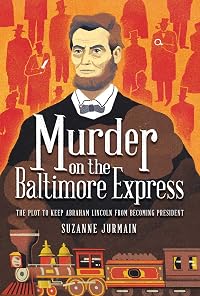
Murder on the Baltimore Express: The Plot to Keep Abraham Lincoln from Becoming President
by Suzanne Jurmain
On This Page
Description
"In February 1861 newly elected President Abraham Lincoln set out on a triumphant 2,000 mile cross-country railroad trip that would take him to his inauguration in Washington, D.C. At the same time, a band of fanatic southern Confederate sympathizers decided to stop Lincoln from reaching Washington and taking office. Furious because the new president's desire to end slavery threatened their way of life, they devised a secret plan: Lincoln would be murdered by an assassin's bullet in show more Baltimore. But as rushing railway trains carried Abraham Lincoln towards death, Detective Allan Pinkerton learned of the plot-and set out to save the president. Dive into this incredibly fun and suspenseful true story and learn what other history books never told you: the secret of Lincoln's great escape"-- show lessTags
Recommendations



















Member Reviews
Murder on the Baltimore Express came to my attention, as do most of the books on my “want to read” list, because of its mention in something else I was already reading and, as usual, I never bothered to look up any reviews or more detailed descriptions before getting a copy. Therefore, I was a bit surprised to find that the book is classified as being for “young readers” and that a review in the School Library Journal called it a “must-have for any middle school library.” In this case, I'm just as glad that I did not further research the book, for I might not have followed through in obtaining a copy, in which case I would have missed out on a well-written, entertaining, and informative bit of U.S. history.
The text is highly show more readable and is in no way overly simplified for young readers. Other than the font and the between-line spacing being somewhat more generous than I had anticipated, this book is as good a quality as any “fully adult” history book I've come across—and is even superior to some. The historical photographs that appear between several of the chapters are both pertinent to the topic and intriguing to the senses in that they are not the usual, often-used images in numerous other books. In fact, I cannot recall having seen any of them elsewhere!
Did Murder on the Baltimore Express teach me anything new or at least remind me of historical events I had forgotten? Yes indeed. First of all, I had never read of the plot to assassinate Lincoln on his journey to Washington to be sworn in as the new president of the United States. Books are filled with accounts of the successful assassination by John Wilkes Booth, but of the earlier plot I can remember having read nothing at all. Now, as to the location of that plot, I must say that my early home and education were in the American South, where many nuances concerning seceding and non-seceding states were not exactly emphasized. Knowing that Maryland was not among seceding states left me with the impression that it was firmly part of the North and filled with abolitionist Yankees. Only now do I understand, thanks to Jurmain's book, that the state was replete with pro-secession advocates, was far from being unified behind the Union cause, and that the new president-elect ran substantial risk by traveling through the state, much less the hotbed of secessionist advocates in Baltimore!
Yet another new fact that I gleaned from the book was the effort expended by Allan Pinkerton and his agents in confirming the existence of the rumored assassination plot, in identifying the plotters, and in devising actions that enabled Lincoln to avoid the trap. I don't believe that I had ever connected Pinkerton with the Lincoln presidency before. Oh yes, how did Pinkerton even learn of the plot and who engaged him to investigate? For that, we must thank a railroad company president, yet another small fact of history that I learned for the first time from Jurmain's book. I believe that these examples are enough to show that this book for young readers has a lot to teach even us old readers.
I appreciate the fact that the book does include an outlined timeline of major pertinent events beginning with the first slave sale in Virginia in 1619 through adoption of the Thirteenth Amendment of the Constitution in 1865, a list identifying the “principal characters” of this historical narrative, source notes, a bibliography, and an index.
Now, just to balance the scales, I must pick a few nits with the book. Let's begin with the title. There was no murder though one was certainly planned. Even that one was planned to occur in the city of Baltimore, not on any train, so we see that there was absolutely no “murder on the Baltimore Express.” The title is egregiously misleading.
The next nit is not an error but is rather a lament for a missed opportunity by the author. In mentioning the Electoral College on page 60, Jurmain notes that the U.S. voting “process is pretty automatic. In most cases the candidate who gets the most popular votes on Election Day also gets the most electoral votes. But sometimes problems occur.” This woefully understates the dangers implicit in the outmoded, undemocratic, and indeed “un-American” institution of the Electoral College. Five times has this obsolete holdover from the 18th Century imposed a loser on the country in spite of the will of the citizens as expressed through their popular vote. The nation has thus been presided over by five men who were actually rejected by the voters: John Quincy Adams, Rutherford B. Hayes, Benjamin Harrison, George W. Bush, and Donald Trump. Jurmain could have put just a bit more emphasis on the potential danger of the outmoded Electoral College system. True, that was not the main focus of her book, but inasmuch as she brought it up, she could have shown the extent of the damage it has caused over the nation's history.
Moving on to the third nit, while describing Lincoln's flag raising in Philadelphia on Washington's birthday, Jurmain perhaps unwittingly falls into the common trap of patriotic blindness (and quite possibly Lincoln did, too). On page 154, the author tells us that Lincoln was intensely interested that there in Independence Hall in 1776, fifty-six men signed a document that “freed the thirteen American colonies from England.” Does Jurmain (and possibly Lincoln) not see the irony of celebrating the forceful separation of England's colonies from their lawful government in London while disapproving of several Southern states separating themselves from their lawful government in Washington? This is followed by citing the Declaration's statement that “all men are created equal,” though, at the time, slaves in the United States were legally defined as property, not as men. The realities of history are typically far more nuanced than flag-waving patriots care to comprehend or acknowledge. To achieve a more balanced presentation, Jurmain could have made some note of that fact.
The final nit is actually a plea for a little more information. By page 189, we learn that part of Pinkerton's plan to protect Lincoln required that the railroad car in which he and his small party were concealed be dragged by horses through the streets of Baltimore from one railroad's station to that of another railroad, which will then complete the trip to Washington. Considering that there is no way to steer a railroad car once it has been lifted off the rails of the track and that the flanges on the steel wheels would prove to be quite damaging to any sort of pavement (brick, perhaps?) over which they were dragged, a short paragraph explaining how these problems were overcome would have been greatly appreciated. For that matter, how was the car even removed from one track and then re-railed on another? There were surely several difficult technical problems in this transfer of a rail car to be worked out, but Jurmain does not seem to appreciate them, much less explain their solution.
Despite the nits I have picked at here, Jurmain's book remains an interesting and generally well-narrated history of a relatively little known event in the presidency of Abraham Lincoln, and I feel that the time I spent with it to be quite adequately rewarded. I certainly agree with the School Library Journal that the book should be part of middle school libraries—and just possibly part of high school and public libraries, too. I also love this observation from pages 42 and 43: “Once, when he didn't want to reveal what he really thought about a book, Abraham Lincoln said, 'For those who like this sort of thing, this is exactly the sort of thing they would like.'” I believe that Jurmain's book is exactly the sort of thing that readers would indeed like. show less
The text is highly show more readable and is in no way overly simplified for young readers. Other than the font and the between-line spacing being somewhat more generous than I had anticipated, this book is as good a quality as any “fully adult” history book I've come across—and is even superior to some. The historical photographs that appear between several of the chapters are both pertinent to the topic and intriguing to the senses in that they are not the usual, often-used images in numerous other books. In fact, I cannot recall having seen any of them elsewhere!
Did Murder on the Baltimore Express teach me anything new or at least remind me of historical events I had forgotten? Yes indeed. First of all, I had never read of the plot to assassinate Lincoln on his journey to Washington to be sworn in as the new president of the United States. Books are filled with accounts of the successful assassination by John Wilkes Booth, but of the earlier plot I can remember having read nothing at all. Now, as to the location of that plot, I must say that my early home and education were in the American South, where many nuances concerning seceding and non-seceding states were not exactly emphasized. Knowing that Maryland was not among seceding states left me with the impression that it was firmly part of the North and filled with abolitionist Yankees. Only now do I understand, thanks to Jurmain's book, that the state was replete with pro-secession advocates, was far from being unified behind the Union cause, and that the new president-elect ran substantial risk by traveling through the state, much less the hotbed of secessionist advocates in Baltimore!
Yet another new fact that I gleaned from the book was the effort expended by Allan Pinkerton and his agents in confirming the existence of the rumored assassination plot, in identifying the plotters, and in devising actions that enabled Lincoln to avoid the trap. I don't believe that I had ever connected Pinkerton with the Lincoln presidency before. Oh yes, how did Pinkerton even learn of the plot and who engaged him to investigate? For that, we must thank a railroad company president, yet another small fact of history that I learned for the first time from Jurmain's book. I believe that these examples are enough to show that this book for young readers has a lot to teach even us old readers.
I appreciate the fact that the book does include an outlined timeline of major pertinent events beginning with the first slave sale in Virginia in 1619 through adoption of the Thirteenth Amendment of the Constitution in 1865, a list identifying the “principal characters” of this historical narrative, source notes, a bibliography, and an index.
Now, just to balance the scales, I must pick a few nits with the book. Let's begin with the title. There was no murder though one was certainly planned. Even that one was planned to occur in the city of Baltimore, not on any train, so we see that there was absolutely no “murder on the Baltimore Express.” The title is egregiously misleading.
The next nit is not an error but is rather a lament for a missed opportunity by the author. In mentioning the Electoral College on page 60, Jurmain notes that the U.S. voting “process is pretty automatic. In most cases the candidate who gets the most popular votes on Election Day also gets the most electoral votes. But sometimes problems occur.” This woefully understates the dangers implicit in the outmoded, undemocratic, and indeed “un-American” institution of the Electoral College. Five times has this obsolete holdover from the 18th Century imposed a loser on the country in spite of the will of the citizens as expressed through their popular vote. The nation has thus been presided over by five men who were actually rejected by the voters: John Quincy Adams, Rutherford B. Hayes, Benjamin Harrison, George W. Bush, and Donald Trump. Jurmain could have put just a bit more emphasis on the potential danger of the outmoded Electoral College system. True, that was not the main focus of her book, but inasmuch as she brought it up, she could have shown the extent of the damage it has caused over the nation's history.
Moving on to the third nit, while describing Lincoln's flag raising in Philadelphia on Washington's birthday, Jurmain perhaps unwittingly falls into the common trap of patriotic blindness (and quite possibly Lincoln did, too). On page 154, the author tells us that Lincoln was intensely interested that there in Independence Hall in 1776, fifty-six men signed a document that “freed the thirteen American colonies from England.” Does Jurmain (and possibly Lincoln) not see the irony of celebrating the forceful separation of England's colonies from their lawful government in London while disapproving of several Southern states separating themselves from their lawful government in Washington? This is followed by citing the Declaration's statement that “all men are created equal,” though, at the time, slaves in the United States were legally defined as property, not as men. The realities of history are typically far more nuanced than flag-waving patriots care to comprehend or acknowledge. To achieve a more balanced presentation, Jurmain could have made some note of that fact.
The final nit is actually a plea for a little more information. By page 189, we learn that part of Pinkerton's plan to protect Lincoln required that the railroad car in which he and his small party were concealed be dragged by horses through the streets of Baltimore from one railroad's station to that of another railroad, which will then complete the trip to Washington. Considering that there is no way to steer a railroad car once it has been lifted off the rails of the track and that the flanges on the steel wheels would prove to be quite damaging to any sort of pavement (brick, perhaps?) over which they were dragged, a short paragraph explaining how these problems were overcome would have been greatly appreciated. For that matter, how was the car even removed from one track and then re-railed on another? There were surely several difficult technical problems in this transfer of a rail car to be worked out, but Jurmain does not seem to appreciate them, much less explain their solution.
Despite the nits I have picked at here, Jurmain's book remains an interesting and generally well-narrated history of a relatively little known event in the presidency of Abraham Lincoln, and I feel that the time I spent with it to be quite adequately rewarded. I certainly agree with the School Library Journal that the book should be part of middle school libraries—and just possibly part of high school and public libraries, too. I also love this observation from pages 42 and 43: “Once, when he didn't want to reveal what he really thought about a book, Abraham Lincoln said, 'For those who like this sort of thing, this is exactly the sort of thing they would like.'” I believe that Jurmain's book is exactly the sort of thing that readers would indeed like. show less
Members
- Recently Added By
Author Information

11 Works 1,202 Members
Awards and Honors
Classifications
Statistics
- Members
- 50
- Popularity
- 602,426
- Reviews
- 1
- Rating
- (5.00)
- Languages
- English
- Media
- Paper, Ebook
- ISBNs
- 3