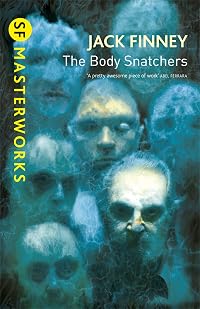
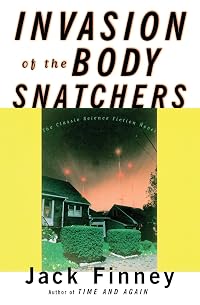
The Body Snatchers
by Jack Finney
On This Page
Description
Originally published in 1955 Jack Finney's sinister SF tale has outgrown the initial debate about whether it satirized Communism or the conformity of US society at the time, to become a classic of paranoia; an examination of our fear of 'the other'. Most people know the story from seeing THE INVASION OF THE BODY SNATCHERS, the classic 1978 remake (one of the few Hollwood remakes said to better than the original, made in 1956) starring Donald Sutherland. Here's your chance to read the show more original source; a story that has resonated with readers and viewers for more than 50 years. show lessTags
Recommendations

























Member Reviews
This is my second read-through, and really it's 3.5 stars. It's hard to rate this on its own merit at this point, as I'm a huge fan of the 70s adaptation and I've seen the 1956 one many times. Additionally, this book has entered the culture in a way that makes it hard to separate the text from the influence it's had. It's also dated at parts, which is not a surprise but can make it a bit hard to get through. This time reading it, however, I'm convinced it's doing some subversive things regarding gender that are perhaps not intentional but fascinating.
I'd grown up here, from boyhood I'd known every street, house and path, most of the backyards, and every hill, field and road for miles around.
And now I didn't know it any more. Unchanged to the eye, what I was seeing out there now - in my eye, and beyond that in my mind — was something alien. The lighted circle of pavement below me, the familiar front porches, and the dark mass of houses and town beyond them — were fearful. Now they were menacing, all these familiar things and faces; the town had changed or was changing into something very terrible, and was after me. It wanted me, too, and I knew it.
I don't think I've ever seen any of the film versions of "Invasion of the body snatchers", but this is the original novel, set in 1953 show more and published in 1955. I like how the prejudices of the time actually come in handy when fighting the body snatchers, and I loved the downbeat ending,as the remaining aliens gradually die off and are replaced by newcomers as the town of Santa Mira slowly comes back to life . show less
And now I didn't know it any more. Unchanged to the eye, what I was seeing out there now - in my eye, and beyond that in my mind — was something alien. The lighted circle of pavement below me, the familiar front porches, and the dark mass of houses and town beyond them — were fearful. Now they were menacing, all these familiar things and faces; the town had changed or was changing into something very terrible, and was after me. It wanted me, too, and I knew it.
I don't think I've ever seen any of the film versions of "Invasion of the body snatchers", but this is the original novel, set in 1953 show more and published in 1955. I like how the prejudices of the time actually come in handy when fighting the body snatchers, and I loved the downbeat ending,
This was a surprisingly good horror novel. I have watched the movies and, lets be honest, from the very title reader is aware of what is the main twist here.
But it is in the way story is told that I truly enjoyed it. Told from the perspective of a local physician we follow what at first seems like to be a mass hysteria slowly becomes a palpable danger which unfortunately our heroes cannot fight, let alone defeat because ... they just cannot. They can resist it and they can slow it down but for all means and purposes infiltration is just too good and too thorough to be stopped. Also the very nature of the infiltration is such that not once our heroes start to question themselves - is it what they see and witness real or not.
One of the show more comments I read for the book commented about one of the discussions in the book where there is mention of the weight of the sun-light but, if we put aside rather clumsiness of the explanation (which again for me is all right because these are discussions between laymen) what is described as a motor that spreads the invasion is nothing more than a form of solar sail. Another great concept here is the way copies are made - pure genius if you ask me. No need for physical contact or drawing blood, no aliens popping up from chest-cavity. The very process is the ultimate horror of all, waking up completely changed, feeling same but also completely different. As I said, excellent idea.
And while narrative flow is at times a little bit slow, novel itself aged more than well. And yes, after reading the novel I have to say no movie did it justice yet, they did capture the paranoia but the novel is much more terrifying than the movies in the sheer level of despair.
Recommended to fans of SF and horror. show less
But it is in the way story is told that I truly enjoyed it. Told from the perspective of a local physician we follow what at first seems like to be a mass hysteria slowly becomes a palpable danger which unfortunately our heroes cannot fight, let alone defeat because ... they just cannot. They can resist it and they can slow it down but for all means and purposes infiltration is just too good and too thorough to be stopped. Also the very nature of the infiltration is such that not once our heroes start to question themselves - is it what they see and witness real or not.
One of the show more comments I read for the book commented about one of the discussions in the book where there is mention of the weight of the sun-light but, if we put aside rather clumsiness of the explanation (which again for me is all right because these are discussions between laymen) what is described as a motor that spreads the invasion is nothing more than a form of solar sail. Another great concept here is the way copies are made - pure genius if you ask me. No need for physical contact or drawing blood, no aliens popping up from chest-cavity. The very process is the ultimate horror of all, waking up completely changed, feeling same but also completely different. As I said, excellent idea.
And while narrative flow is at times a little bit slow, novel itself aged more than well. And yes, after reading the novel I have to say no movie did it justice yet, they did capture the paranoia but the novel is much more terrifying than the movies in the sheer level of despair.
Recommended to fans of SF and horror. show less
For a sci-fi novel to still be entertaining and not feel particularly dated over fifty years later is definitely an achievement. The menace that The Body Snatchers builds is still palpable today. With interesting and entertaining leads the much imitated (and indeed re-released) Snatchers is a solid piece of history that should be in every readers to-do list. It's relatively short, although larger than a novella, and refuses to outstay its welcome by remaining sharp and to the point at all times. Go on, invest a couple of hours with it - it won't even feel like nostalgia.
It was never clear to me what the body snatchers were doing with the bodies they snatched, and the ending is ridiculous, but I still liked this tale of small-town American conformity undermined by extraterrestrial conformity quite a lot.
The Body Snatchers - Jack FInney
Published in 1955 and now in the sci-fi Masterwork Series; The Body Snatchers is a title more famous for the number of film versions (four at the last count). It is certain that more people will have seen a film version than will have read the novel and so readers like me will probably be approaching the book already knowing much of the story, however they may well be surprised by this tightly written little novel. Much like H G Wells' novel War of the worlds which had a distinctly provincial feel despite it's title (the action takes place in rural suburbs outside London); the Body Snatchers is confined to small town America and although the story has global implications they are not explored in the show more novel.
There is enough background to the story to make this more than just a plot driven science fiction caper. There are no super-heroes or even heroes, just a small town doctor faced with some extraordinary events that he cannot explain which seem to be changing the people with whom he lives and works. Miles is recently divorced and the events in the town bring him into the company of Becky a friend from his school days and a love story develops. Although the story does eventually lead to a couple against the rest of the world scenario, the rest of the world is the town of Santa Mira
and so Finney is still able to keep his story well grounded with some keen observations about life in the town. This observation about the lack human activity in his town leads Miles to feel very uneasy about his situation.
"We might have been on a finished stage set, completed to the last nail and final stroke of a brush. You can't walk ten blocks on an ordinary street inhabited by human beings, without seeing evidence of say, a garage being built. a new cement sidewalk being laid, a yard being spaded, a picture window being installed - at least some little signs of the endless urge to change and improve that marks the human race"
Finney also finds the space to observe through Miles how a black shoe shine boy (Billy) can occasionally let the bitterness come through at the condescending way he is treated by the white folks which makes Miles despair of the human race. This is however a story about the strength and qualities of some human beings who are prepared to fight for their way of life, even when others appear to have given up. It is a good subject for a movie and Finney provides a good dose of mystery and suspense leading up to the denouement, and even though you might know what that is; there is still much to be gained from reading this novel. Characters are well drawn and there is something consoling when reading through a familiar plot line just to see how it all works out in the novel. A four star read for me. show less
Published in 1955 and now in the sci-fi Masterwork Series; The Body Snatchers is a title more famous for the number of film versions (four at the last count). It is certain that more people will have seen a film version than will have read the novel and so readers like me will probably be approaching the book already knowing much of the story, however they may well be surprised by this tightly written little novel. Much like H G Wells' novel War of the worlds which had a distinctly provincial feel despite it's title (the action takes place in rural suburbs outside London); the Body Snatchers is confined to small town America and although the story has global implications they are not explored in the show more novel.
There is enough background to the story to make this more than just a plot driven science fiction caper. There are no super-heroes or even heroes, just a small town doctor faced with some extraordinary events that he cannot explain which seem to be changing the people with whom he lives and works. Miles is recently divorced and the events in the town bring him into the company of Becky a friend from his school days and a love story develops. Although the story does eventually lead to a couple against the rest of the world scenario, the rest of the world is the town of Santa Mira
and so Finney is still able to keep his story well grounded with some keen observations about life in the town. This observation about the lack human activity in his town leads Miles to feel very uneasy about his situation.
"We might have been on a finished stage set, completed to the last nail and final stroke of a brush. You can't walk ten blocks on an ordinary street inhabited by human beings, without seeing evidence of say, a garage being built. a new cement sidewalk being laid, a yard being spaded, a picture window being installed - at least some little signs of the endless urge to change and improve that marks the human race"
Finney also finds the space to observe through Miles how a black shoe shine boy (Billy) can occasionally let the bitterness come through at the condescending way he is treated by the white folks which makes Miles despair of the human race. This is however a story about the strength and qualities of some human beings who are prepared to fight for their way of life, even when others appear to have given up. It is a good subject for a movie and Finney provides a good dose of mystery and suspense leading up to the denouement, and even though you might know what that is; there is still much to be gained from reading this novel. Characters are well drawn and there is something consoling when reading through a familiar plot line just to see how it all works out in the novel. A four star read for me. show less
Miles Brennel is a small town, old fashioned doctor, the kind who used to make house calls. He still stores files detailing the aches and pains of much of the towns residents in one of the rooms of his house, a house he inherited from his father. The town. The town is sleepy and insular. The story opens with Miles seeing his last patient of the day, a sprained thumb, the kind of mundane, simple problems Miles is used to treating.
So, when Becky Driscoll shows up and tells Miles that her aunt is certain that her unle is an imposter, Miles is faced with something completely outside his realm of experience. More and more residents report similar fears that their loved ones have been replaced with exact duplicates and Miles refers them to a show more psychiatrist. Little does Miles know that the psychiatrist is not the person he used to be.
Eventually, Miles and Becky learn that the towns residents are slowly being replaced with duplicates grown from seed pods from outer space. The pods, interested only in the survivial of their own species, replace humans, assimilating their memories, experiences, and motives with the human host's, taking control of the human. The only real difference in the human experience after replacement is a curious lack of emotion and will. This difference is ultimately what helps Miles and Becky focus their defiance.
Escaping from the replaced town residents, Miles and Becky stumble on a field of newly grown pods, ready for distribution to the rest of the country and world. They set fire to the pods and the pods, in an act of survival, begin floating up and back to outer space to visit some other unsuspecting planet.
Most of the film adaptations of Finney's story focus on the paranoid, conspiratorial nature of the townspeoples efforts to replace everyone. Many of the early literary criticisms boiled the story down to a McCarthy era, anti-Communist allegory. The story that shines through to me, however, is a more basic one - a battle against outside societal influences which tend to numb our own personal human experience - the destruction of human interaction and community.
Many will discount this book as pulp sci-fi. But there is a lot more here to appreciate for the careful reader.
4 bones!!!! show less
So, when Becky Driscoll shows up and tells Miles that her aunt is certain that her unle is an imposter, Miles is faced with something completely outside his realm of experience. More and more residents report similar fears that their loved ones have been replaced with exact duplicates and Miles refers them to a show more psychiatrist. Little does Miles know that the psychiatrist is not the person he used to be.
Eventually, Miles and Becky learn that the towns residents are slowly being replaced with duplicates grown from seed pods from outer space. The pods, interested only in the survivial of their own species, replace humans, assimilating their memories, experiences, and motives with the human host's, taking control of the human. The only real difference in the human experience after replacement is a curious lack of emotion and will. This difference is ultimately what helps Miles and Becky focus their defiance.
Escaping from the replaced town residents, Miles and Becky stumble on a field of newly grown pods, ready for distribution to the rest of the country and world. They set fire to the pods and the pods, in an act of survival, begin floating up and back to outer space to visit some other unsuspecting planet.
Most of the film adaptations of Finney's story focus on the paranoid, conspiratorial nature of the townspeoples efforts to replace everyone. Many of the early literary criticisms boiled the story down to a McCarthy era, anti-Communist allegory. The story that shines through to me, however, is a more basic one - a battle against outside societal influences which tend to numb our own personal human experience - the destruction of human interaction and community.
Many will discount this book as pulp sci-fi. But there is a lot more here to appreciate for the careful reader.
4 bones!!!! show less
Members
- Recently Added By
Lists

Stephen King Danse Macabre Appendix Starred List
53 works; 1 member
Stephen King's Danse Macabre Full Appendix List
110 works; 2 members
Author Information

46+ Works 9,207 Members
Jack Finney was born on October 2, 1911 with the given name John Finney. His father died when he was three years old and he was renamed Walter Braden Finney in honor of his father. He attended Knox College in Galesburg, Illinois. After moving to New York and working in the advertising industry, he began writing stories for popular magazines like show more Collier's, The Saturday Evening Post and McCall's. His first novel, "Five Against the House" (1954), told the story of five college students who plot to rob a casino in Reno. A year later he published "The Body Snatchers" which was later reissued as "Invasion of the Body Snatchers." Many critics interpreted the insidious infiltration by aliens as a cold-war allegory that dramatized America's fear of a takeover by Communists. Mr. Finney maintained that the novel was nothing more than popular entertainment. The 1956 film "Invasion of the Body Snatchers" was remade twice. With "Time and Again," Mr. Finney won the kind of critical praise and attention not normally accorded to genre fiction. Finney died November 16, 1995 of pneumonia and emphysema at Marin General Hospital in Greenbrae, Calif. He was 84. (Bowker Author Biography) show less
Series
Belongs to Publisher Series
Work Relationships
Is contained in
Has the adaptation
Is expanded in
Common Knowledge
- Canonical title
- The Body Snatchers
- Original publication date
- 1955
- Disambiguation notice
- This is the original novel, first published in 1955. Do not combine with Invasion of the Body Snatchers, a revised and updated version issued as a tie-in to the 1978 film of that name.
Classifications
Statistics
- Members
- 416
- Popularity
- 74,739
- Reviews
- 18
- Rating
- (4.02)
- Languages
- English, French
- Media
- Paper, Ebook
- ISBNs
- 8
- ASINs
- 10