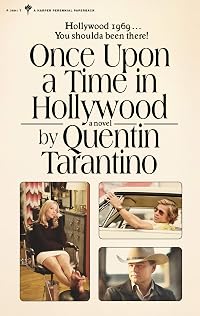
Once Upon a Time in Hollywood
by Quentin Tarantino
On This Page
Description
Narrated by Jennifer Jason LeighQuentin Tarantino's long-awaited first work of fiction — at once hilarious, delicious, and brutal — is the always surprising, sometimes shocking new novel based on his Academy Award- winning film.
RICK DALTON – Once he had his own TV series, but now Rick's a washed-up villain-of-the week drowning his sorrows in whiskey sours. Will a phone call from Rome save his fate or seal it?
CLIFF BOOTH – Rick's stunt double, and the most infamous man on any movie show more set because he's the only one there who might have gotten away with murder. . . .
SHARON TATE – She left Texas to chase a movie-star dream, and found it. Sharon's salad days are now spent on Cielo Drive, high in the Hollywood Hills.
CHARLES MANSON – The ex-con's got a bunch of zonked-out hippies thinking he's their spiritual leader, but he'd trade it all to be a rock 'n' roll star.
HOLLYWOOD 1969 – YOU SHOULDA BEEN THERE
. show less
Tags
Recommendations



Member Reviews
Read this and more crime, thriller, horror and pulp reviews on CriminOlly.com
As a kid and teenager I read A LOT of movie novelisations. A lot of this was down to me inability to see the movies they were based on. In a world before VHS (in my house at least), missing something at the cinema meant missing it until it turned up on network TV. Plus there as the pesky fact that many of the films I really wanted to see were ones forbidden by my parents. Books, on the other hand, were always fair game. So whilst even the mildest horror films were out of reach, my local library had the books based on David Cronenberg’s fucked up body horror S&M nightmare ‘Videodrome’.
It would be fair to say then, that movie novelisations have given me a show more lot of reading pleasure over the years, but honestly, they’re generally companions to the movie they are based on, rather than independent works of art. Fans might rave about Alan Dean Foster’s ‘Alien’ adaptation, but the gulf between movie and book is far greater than book to movie conversions. No-one ever does ‘novels that were better than the films they were based on lists’.
So Quentin Tarantino’s novelisation of his film ‘Once Upon a Time in Hollywood’ is a strange thing. Partly because movie novelisations aren’t really a thing any more, conversely because he’s a big name and it’s his first novel, also because it’s really kind of brilliant.
What makes it so good? Well most importantly it turns out Tarantino can write. I expected the dialogue to be good (because duh) but in reality it’s all good. Easy to read, inventive and fun. The words flow beautifully off the page and the story and characters grip.
Secondly, it’s very different from the film. Don’t get me wrong, a lot is the same, but the focus is different. The Manson family are less of a big deal. Cliff is the main character (rather than then dual billing that Pitt and DiCaprio had in the film), and also more of a dick than he seemed with Pitt’s grinning face slapped on his character.
Thirdly, the prose form allows Tarantino to indulge his film nerd side even more than the movie did. There are long sections in the book that read like articles from film journals. Some might find that off putting, but I kind of loved it. Even more so than the film, it feels like his love letter to Hollywood. The shift in focus away from Manson allows him to indulge that side even more and the result is a more tender piece. It still has a satisfying story to it, but it’s one more rooted in characters than action. Weirdly (and perhaps brilliantly) it ends up feeling like the book came first.
show less
As a kid and teenager I read A LOT of movie novelisations. A lot of this was down to me inability to see the movies they were based on. In a world before VHS (in my house at least), missing something at the cinema meant missing it until it turned up on network TV. Plus there as the pesky fact that many of the films I really wanted to see were ones forbidden by my parents. Books, on the other hand, were always fair game. So whilst even the mildest horror films were out of reach, my local library had the books based on David Cronenberg’s fucked up body horror S&M nightmare ‘Videodrome’.
It would be fair to say then, that movie novelisations have given me a show more lot of reading pleasure over the years, but honestly, they’re generally companions to the movie they are based on, rather than independent works of art. Fans might rave about Alan Dean Foster’s ‘Alien’ adaptation, but the gulf between movie and book is far greater than book to movie conversions. No-one ever does ‘novels that were better than the films they were based on lists’.
So Quentin Tarantino’s novelisation of his film ‘Once Upon a Time in Hollywood’ is a strange thing. Partly because movie novelisations aren’t really a thing any more, conversely because he’s a big name and it’s his first novel, also because it’s really kind of brilliant.
What makes it so good? Well most importantly it turns out Tarantino can write. I expected the dialogue to be good (because duh) but in reality it’s all good. Easy to read, inventive and fun. The words flow beautifully off the page and the story and characters grip.
Secondly, it’s very different from the film. Don’t get me wrong, a lot is the same, but the focus is different. The Manson family are less of a big deal. Cliff is the main character (rather than then dual billing that Pitt and DiCaprio had in the film), and also more of a dick than he seemed with Pitt’s grinning face slapped on his character.
Thirdly, the prose form allows Tarantino to indulge his film nerd side even more than the movie did. There are long sections in the book that read like articles from film journals. Some might find that off putting, but I kind of loved it. Even more so than the film, it feels like his love letter to Hollywood. The shift in focus away from Manson allows him to indulge that side even more and the result is a more tender piece. It still has a satisfying story to it, but it’s one more rooted in characters than action. Weirdly (and perhaps brilliantly) it ends up feeling like the book came first.
show less
"Rick knows that will never happen, but it's a nice thing to say." (pg. 392)
This line, coming towards the end of a scene between Steve McQueen and the fictional character Rick Dalton, reflects two of the three great things about Once Upon a Time in Hollywood, Quentin Tarantino's novelization of his own 2019 film of the same name. Both book and film are a re-imagining of events in Hollywood in 1969, and there is an exuberance to this on the part of Tarantino that makes it magical. The film reflects the magic of movies simply by being beautifully written and shot, and also provides a happy ending to one of the era's horrors (the Manson murders). With this alternate history, a surprisingly humane Tarantino provides healing for a cultural show more wound, and he conveys it by showing his deep-seated love of the screen and screen idols.
In the novel, this climactic (and cathartic) Manson scene is mentioned only in passing, about one hundred pages into the story, before the book continues forging its own path. This choice is not only of practical interest (we read about the boost to Rick Dalton's career caused by his and Cliff's spectacular foiling of Manson's plot), but is one of the first real signs that the book is its own beast, and not a run-of-the-mill movie 'novelization'. Tarantino's not here for the ego-boost of being a published author, like many 'celebrity' writers. He's here to play, and takes the game seriously. It's similar to his evident respect for movie-making: "they don't just pay us to do it. They pay us to do it great" (pg. 394). Tarantino knows there's more to this story, and he's always respected the greater space and license that a novel provides over a film. He's one of those "certain directors [that] make their films with the same power that great authors do" (pg. 228), and he thrives in his new environment. Those who admire how he constructs and paces his films won't be surprised to learn that the leap is not as wide as you might initially think.
The book, then, follows the film in being both a lovingly-constructed, joyous piece of art and something that revels in its license for indulgence. As with some of those beautiful shots and scenes in the movie, Tarantino enjoys himself in the book: the afore-mentioned Steve McQueen scene with Rick; James Stacy riding on his motorbike; the love of film history, trivia and miscellany; and the expansion of Tarantino's self-created Western mock-ups Bounty Law and Lancer. He provides Trudi, the precocious child actor who stole her scenes in the film, with a filmography that includes being cast in a (fictional) film he himself directs in the Nineties (pg. 354). He raises, delightfully, the notion of Michael Caine being cast in the McQueen role in The Great Escape (pg. 377). He even has Rick Dalton sign an autograph for a six-year-old Quentin Tarantino (pg. 364). It's wish fulfilment in the best possible sense: Tarantino is enjoying himself, while also ensuring he maintains his auteur standards. That's been the modus operandi of his career since its beginning, and he doesn't falter here. And we enjoy it too. To appropriate the line from the start of this review, we know this alternate history will never happen, and we know that Hollywood magic provides gloss to an often dark reality (as Manson showed), but we also know that these are damn nice things for Tarantino to say. The book, as with the movie, is a lot of good, high-quality fun, and we revel in it.
But I said at the start that this line reflects two of the three great things about Tarantino's novelization of Once Upon a Time in Hollywood. There is the catharsis of the alternate history and the joyousness of the story. What, then, is the third? The third is the most surprising: it's actually a damn good novel, by any reasonable (i.e. non-snobby) metric.
Not only is Once Upon a Time in Hollywood a cut above your usual movie novelization, but it's a cut above your standard pulp fiction, just as Pulp Fiction was a class above the pulpy crime films it was inspired by. Tarantino is arguably the best writer of dialogue alive today; it just pops, and this novel not only has great passages from the movie but delivers its own. Tarantino has always had an evident Elmore Leonard influence in his writing for the screen, and he leans with great success on that here (the writer is namechecked in chapter 12). Despite one or two clunky moments (so few it would be churlish to quote them), Tarantino's book is very readable. Sometimes, he even provides a flourish. The washed-up Rick's "downswings seemed to find a deeper basement than before" (pg. 109). Sharon Tate has an argument with her husband, and she's always had "such a sunny presence that whenever she blocks out the sun, the effect is chilling" (pg. 385). Some readers will always be inclined to gatekeep, but Tarantino certainly isn't embarrassing himself. This is good writing.
Tarantino also writes good characters. Greater backstory is added to Rick and Cliff (I was going to say greater depth, but because of the different demands of the medium, the depth in the film is provided by the great acting by Leonardo DiCaprio and Brad Pitt). Some of this was a mixed bag (I liked the information on Cliff's wife, but found the "greatest hero of World War Two" stuff hard to buy). But some of it is great. The rationale behind the infamous Bruce Lee scene is convincing, while elsewhere Rick is given closure for his character: in the final pages, he recognises his good fortune to be in the movie-making business. Tarantino knows how to spin a story. When the author digresses into a colourful sidebar about Cliff lending money to his screw-up friend Buster (pg. 66), it got me thinking that this would be recognised as a good story even without the Tarantino name. The book is refreshing, it has energy and originality, and Tarantino is bolder here than many contemporary novelists. Not to mention his dialogue puts them to shame.
What, then, is the result of Tarantino's foray into novel-writing? The big question that remains is how much debt is owed to the film the book is based on. Certainly, it would be difficult to get into this book without having seen the film; the foreknowledge definitely enhances it. At the same time, the book is well-constructed, with great characters, dialogue and scenes. That shouldn't be discarded, or diminished, just because Tarantino had already deployed them in a different medium.
The book even has literary merit, using the greater space and more considered pace that is allowed to a novel to enhance the themes of the film. Leaning more heavily into Rick Dalton's anxieties as a washed-up actor, we begin to see more readily how the Tate murders frame the wider story of how Hollywood chews up its famous denizens. And when Tarantino writes of how Charles Manson would have abandoned his hippie 'Family' cult, "say goodbye to all of them, all that he created, and all he taught them, to trade places with Micky Dolenz and join the Monkees" (pg. 162), he skewers both Manson and the counterculture myth in the same breath. The Sixties dream never went sour; it was always sour. The flower children were always Boomers underneath, and the fame-chasing, underage-groupie-loving superficiality that Tarantino identifies in that line is emphatic. This is a compelling, provocative and downright literary weave from a bona fide writer. Tarantino is in command of his medium, and it bodes well for any writing he might pursue in the future. A great novelist? It's too soon to say, but after Once Upon a Time in Hollywood, the prospect seems far less ridiculous. show less
This line, coming towards the end of a scene between Steve McQueen and the fictional character Rick Dalton, reflects two of the three great things about Once Upon a Time in Hollywood, Quentin Tarantino's novelization of his own 2019 film of the same name. Both book and film are a re-imagining of events in Hollywood in 1969, and there is an exuberance to this on the part of Tarantino that makes it magical. The film reflects the magic of movies simply by being beautifully written and shot, and also provides a happy ending to one of the era's horrors (the Manson murders). With this alternate history, a surprisingly humane Tarantino provides healing for a cultural show more wound, and he conveys it by showing his deep-seated love of the screen and screen idols.
In the novel, this climactic (and cathartic) Manson scene is mentioned only in passing, about one hundred pages into the story, before the book continues forging its own path. This choice is not only of practical interest (we read about the boost to Rick Dalton's career caused by his and Cliff's spectacular foiling of Manson's plot), but is one of the first real signs that the book is its own beast, and not a run-of-the-mill movie 'novelization'. Tarantino's not here for the ego-boost of being a published author, like many 'celebrity' writers. He's here to play, and takes the game seriously. It's similar to his evident respect for movie-making: "they don't just pay us to do it. They pay us to do it great" (pg. 394). Tarantino knows there's more to this story, and he's always respected the greater space and license that a novel provides over a film. He's one of those "certain directors [that] make their films with the same power that great authors do" (pg. 228), and he thrives in his new environment. Those who admire how he constructs and paces his films won't be surprised to learn that the leap is not as wide as you might initially think.
The book, then, follows the film in being both a lovingly-constructed, joyous piece of art and something that revels in its license for indulgence. As with some of those beautiful shots and scenes in the movie, Tarantino enjoys himself in the book: the afore-mentioned Steve McQueen scene with Rick; James Stacy riding on his motorbike; the love of film history, trivia and miscellany; and the expansion of Tarantino's self-created Western mock-ups Bounty Law and Lancer. He provides Trudi, the precocious child actor who stole her scenes in the film, with a filmography that includes being cast in a (fictional) film he himself directs in the Nineties (pg. 354). He raises, delightfully, the notion of Michael Caine being cast in the McQueen role in The Great Escape (pg. 377). He even has Rick Dalton sign an autograph for a six-year-old Quentin Tarantino (pg. 364). It's wish fulfilment in the best possible sense: Tarantino is enjoying himself, while also ensuring he maintains his auteur standards. That's been the modus operandi of his career since its beginning, and he doesn't falter here. And we enjoy it too. To appropriate the line from the start of this review, we know this alternate history will never happen, and we know that Hollywood magic provides gloss to an often dark reality (as Manson showed), but we also know that these are damn nice things for Tarantino to say. The book, as with the movie, is a lot of good, high-quality fun, and we revel in it.
But I said at the start that this line reflects two of the three great things about Tarantino's novelization of Once Upon a Time in Hollywood. There is the catharsis of the alternate history and the joyousness of the story. What, then, is the third? The third is the most surprising: it's actually a damn good novel, by any reasonable (i.e. non-snobby) metric.
Not only is Once Upon a Time in Hollywood a cut above your usual movie novelization, but it's a cut above your standard pulp fiction, just as Pulp Fiction was a class above the pulpy crime films it was inspired by. Tarantino is arguably the best writer of dialogue alive today; it just pops, and this novel not only has great passages from the movie but delivers its own. Tarantino has always had an evident Elmore Leonard influence in his writing for the screen, and he leans with great success on that here (the writer is namechecked in chapter 12). Despite one or two clunky moments (so few it would be churlish to quote them), Tarantino's book is very readable. Sometimes, he even provides a flourish. The washed-up Rick's "downswings seemed to find a deeper basement than before" (pg. 109). Sharon Tate has an argument with her husband, and she's always had "such a sunny presence that whenever she blocks out the sun, the effect is chilling" (pg. 385). Some readers will always be inclined to gatekeep, but Tarantino certainly isn't embarrassing himself. This is good writing.
Tarantino also writes good characters. Greater backstory is added to Rick and Cliff (I was going to say greater depth, but because of the different demands of the medium, the depth in the film is provided by the great acting by Leonardo DiCaprio and Brad Pitt). Some of this was a mixed bag (I liked the information on Cliff's wife, but found the "greatest hero of World War Two" stuff hard to buy). But some of it is great. The rationale behind the infamous Bruce Lee scene is convincing, while elsewhere Rick is given closure for his character: in the final pages, he recognises his good fortune to be in the movie-making business. Tarantino knows how to spin a story. When the author digresses into a colourful sidebar about Cliff lending money to his screw-up friend Buster (pg. 66), it got me thinking that this would be recognised as a good story even without the Tarantino name. The book is refreshing, it has energy and originality, and Tarantino is bolder here than many contemporary novelists. Not to mention his dialogue puts them to shame.
What, then, is the result of Tarantino's foray into novel-writing? The big question that remains is how much debt is owed to the film the book is based on. Certainly, it would be difficult to get into this book without having seen the film; the foreknowledge definitely enhances it. At the same time, the book is well-constructed, with great characters, dialogue and scenes. That shouldn't be discarded, or diminished, just because Tarantino had already deployed them in a different medium.
The book even has literary merit, using the greater space and more considered pace that is allowed to a novel to enhance the themes of the film. Leaning more heavily into Rick Dalton's anxieties as a washed-up actor, we begin to see more readily how the Tate murders frame the wider story of how Hollywood chews up its famous denizens. And when Tarantino writes of how Charles Manson would have abandoned his hippie 'Family' cult, "say goodbye to all of them, all that he created, and all he taught them, to trade places with Micky Dolenz and join the Monkees" (pg. 162), he skewers both Manson and the counterculture myth in the same breath. The Sixties dream never went sour; it was always sour. The flower children were always Boomers underneath, and the fame-chasing, underage-groupie-loving superficiality that Tarantino identifies in that line is emphatic. This is a compelling, provocative and downright literary weave from a bona fide writer. Tarantino is in command of his medium, and it bodes well for any writing he might pursue in the future. A great novelist? It's too soon to say, but after Once Upon a Time in Hollywood, the prospect seems far less ridiculous. show less
I am a huge fan of Quentin Tarantino’s ONCE UPON A TIME IN HOLLYWOOD. It just might be the best film of the past decade, and just about my favorite one, though QT is always an easy sell with me. So of course I was going to buy and read his novel based on the film. Tarantino has never actually written and published a book before, so for us fans it was a big deal. Was it worth the price? Did it live up to expectations? Is Tarantino as good of a storyteller on the printed page as he is on the movie screen? I think every fan may have a different answer, for this book is very much written for the fans. If you haven’t seen the movie, you are really going to be in over your head reading it. This book, like the film, is definitely not plot show more driven, we simply hang with a set of characters for a set period of time in the Hollywood of 1969, get to know them, and wait for the inevitable conclusion when a certain group of hippie killers collide with a has-been TV western star and his loyal stuntman friend. Only in the book, that ending of the film is just mentioned in passing about halfway, for this is not a straight screen to page novelization of the film, but mainly a companion piece to it where the author/director fills in some back stories, and elaborates on what was happening behind the scenes.
In the book, we again meet up with Rick Dalton, the former star of Bounty Law, now reduced to guest spots on other actor’s shows and contemplating traveling to Italy and Spain to make spaghetti westerns for Sergio Corbucci, which Rick sees as the ultimate degradation, and Cliff Booth, a hero of WWII and veteran stuntman with some unsavory incidents in his past. We also spend some time with Sharon Tate, the beautiful starlet on the verge of major stardom, and married to the very hot director, thanks to Rosemary’s Baby, Roman Polanski. And lurking around is Charles Manson, the leader of a hippie “family” made up of cast off and runway kids, the epitome of the counter culture, who in reality, just badly wanted to be a rock star, if only the powers that be wouldn’t keep brushing him off. We learn a lot about Rick’s early days in TV westerns and how the industry worked in those days, and Cliff’s background is fleshed out, and the question of whether he murdered his wife is answered. We meet up with Sharon in a flashback that poignantly recounts her journey from Texas to Los Angeles to seek her fortune in the movie business, and later on her visit to the movie theater where the Matt Helm film where she was a featured player is playing. There are some interesting anecdotes on TV in the ‘60s told by Rick that is clearly Tarantino just riffing on the past, and the same with a section where Cliff muses on his favorite foreign films that is clearly the author speaking. There are long passages where the pilot script of the western TV series Lancer is gone into in great detail, which makes it sound much more dramatic and interesting than a show that came in on the tail end of the TV western fad in the late ‘60s and soon faded into obscurity. Lots of now obscure names are dropped, everybody from George Maharis to George Peppard to Ty Hardin to Kaz Garas, and if you haven’t heard of them, they were big deals for a very short time in Hollywood long ago. There was a section on the excessive drinking habits of some famous actors of the time that is interesting if true. Tarantino often touches on how fleeting fame is in a cruel business that uses talent and throws it away. This is made plain in a sad encounter Cliff has in Spain with the wreck that was once Aldo Ray. Fame, attention, adoration and the wealth and sex that came with it was the measure that everyone was judged against, and once you’d obtained it, you were never free of the fear of losing it. And if you felt it slipping away, you scrambled and grabbed at anything which would get it back. In 1969, guys who wore pompadours and were big deals when Kennedy was President, now had to put on hippie wigs and fake moustaches in order to try and fit in among the long hairs and denims of a new Hollywood.
Though many readers have complained that parts of this book are indulgent, while other parts are just a wallow in a past that they know nothing about, I’m not among them. I totally dug the vibe of this book, and happily went along for the ride, trusting in where Tarantino was taking me. I like that Tarantino really has genuine affection for this time and place, and the people who made it so unique—the rising stars, the has-beens, and the never-weres. He doesn’t judge them, except for the truly evil Manson, he just asks us to take them as they were, and the stories their lives told. Other writers on this period would be quick to condemn the casual sexism, racism, homophobia, and “toxic masculinity,” of 1969, but Tarantino, never one to parade his virtue, lets the time and place speak for itself, and the reader take from it what they will. There’s a part of me that hopes he is not completely done with Rick and Cliff yet. Maybe a sequel that gives us a hint at what happened in the years ahead. Does the fame that would come after dispatching a gang of hippie killers lead Rick to a comeback? Does Cliff find a new career as a director of ‘70s action films?
And I really liked it that the book was produced like a mass market paperback from the era, always thought it was a mistake for the publishing industry to get away from that model. Like 1969, one more thing that came and went, and is fondly remembered. show less
In the book, we again meet up with Rick Dalton, the former star of Bounty Law, now reduced to guest spots on other actor’s shows and contemplating traveling to Italy and Spain to make spaghetti westerns for Sergio Corbucci, which Rick sees as the ultimate degradation, and Cliff Booth, a hero of WWII and veteran stuntman with some unsavory incidents in his past. We also spend some time with Sharon Tate, the beautiful starlet on the verge of major stardom, and married to the very hot director, thanks to Rosemary’s Baby, Roman Polanski. And lurking around is Charles Manson, the leader of a hippie “family” made up of cast off and runway kids, the epitome of the counter culture, who in reality, just badly wanted to be a rock star, if only the powers that be wouldn’t keep brushing him off. We learn a lot about Rick’s early days in TV westerns and how the industry worked in those days, and Cliff’s background is fleshed out, and the question of whether he murdered his wife is answered. We meet up with Sharon in a flashback that poignantly recounts her journey from Texas to Los Angeles to seek her fortune in the movie business, and later on her visit to the movie theater where the Matt Helm film where she was a featured player is playing. There are some interesting anecdotes on TV in the ‘60s told by Rick that is clearly Tarantino just riffing on the past, and the same with a section where Cliff muses on his favorite foreign films that is clearly the author speaking. There are long passages where the pilot script of the western TV series Lancer is gone into in great detail, which makes it sound much more dramatic and interesting than a show that came in on the tail end of the TV western fad in the late ‘60s and soon faded into obscurity. Lots of now obscure names are dropped, everybody from George Maharis to George Peppard to Ty Hardin to Kaz Garas, and if you haven’t heard of them, they were big deals for a very short time in Hollywood long ago. There was a section on the excessive drinking habits of some famous actors of the time that is interesting if true. Tarantino often touches on how fleeting fame is in a cruel business that uses talent and throws it away. This is made plain in a sad encounter Cliff has in Spain with the wreck that was once Aldo Ray. Fame, attention, adoration and the wealth and sex that came with it was the measure that everyone was judged against, and once you’d obtained it, you were never free of the fear of losing it. And if you felt it slipping away, you scrambled and grabbed at anything which would get it back. In 1969, guys who wore pompadours and were big deals when Kennedy was President, now had to put on hippie wigs and fake moustaches in order to try and fit in among the long hairs and denims of a new Hollywood.
Though many readers have complained that parts of this book are indulgent, while other parts are just a wallow in a past that they know nothing about, I’m not among them. I totally dug the vibe of this book, and happily went along for the ride, trusting in where Tarantino was taking me. I like that Tarantino really has genuine affection for this time and place, and the people who made it so unique—the rising stars, the has-beens, and the never-weres. He doesn’t judge them, except for the truly evil Manson, he just asks us to take them as they were, and the stories their lives told. Other writers on this period would be quick to condemn the casual sexism, racism, homophobia, and “toxic masculinity,” of 1969, but Tarantino, never one to parade his virtue, lets the time and place speak for itself, and the reader take from it what they will. There’s a part of me that hopes he is not completely done with Rick and Cliff yet. Maybe a sequel that gives us a hint at what happened in the years ahead. Does the fame that would come after dispatching a gang of hippie killers lead Rick to a comeback? Does Cliff find a new career as a director of ‘70s action films?
And I really liked it that the book was produced like a mass market paperback from the era, always thought it was a mistake for the publishing industry to get away from that model. Like 1969, one more thing that came and went, and is fondly remembered. show less
Conceptually complicated. A novelization of a movie on its own is simple, but when done by a writer-director of that movie in his reverent postmodern way it adds another layer. This one gave himself and his step-dad a shoutout through his characters. If you like the movie, this works as a good companion piece. It’s a novelization after all. But it’s not just the script with perfunctory prose added around. It’s got that Tarantino Narrator voice to it. It’s not amazing prose, but it’s functional, and it’s definitely got his style to it—a lot of the Lancer-focused chapters serve very little purpose and explain details in several pages that are ultimately too simple to need all that space, but the man likes to take his time. show more He also expands a lot, and even changes around a few things. Not only does it provide “extended” versions of scenes from the film, but it also provides extra details on what happens to the main characters long after the story’s end, and it switches small things like point of view or setting to great effect. I especially appreciated the expansion of the precocious child actor Trudi, whose presence alongside Rick adds a further layer of likability to the story. Meanwhile, Cliff’s expanded awfulness left a worse impression. On the whole, the story is approached in an entirely different light, so it’s worth a look. (less) show less
Pensándolo seriamente, si Quentin Tarantino decide un día dejar de hacer cine para convertirse en escritor, perderemos a un cineasta, pero ganaremos a un magnífico narrador en la literatura. El paso de Tarantino de la dirección a la escritura se siente como una transición natural luego de esos monstruosos guiones en Pulp Fiction (1994) y Inglourious Basterds (2009), por mencionar sólo dos ejemplos en una filmografía corta, pero certera. Érase una vez en Hollywood (2021) es una novela que expande y renueva el universo planteado en la película de 2019; nos encontramos de nuevo con las desventuras del actor en decadencia Rick Dalton y la vida marital de la encantadora Sharon Tate con Roman Polanski; sin embargo, el verdadero show more protagonista del relato es el doble de acción Cliff Booth, el personaje interpretado por Brad Pitt. Dividido por capítulos, en sus 400 páginas el libro agrega nuevas escenas que dan información sobre el pasado de Booth; sabremos si en verdad mató o no a su esposa y cómo fue que consiguió a la temible/adorable pitbull Brandy. Atiborrado de referencias a series de televisión, películas y nombres de actores/actrices de la época, Érase una vez en Hollywood resulta un deleite para los fanáticos del estilo del director, y demuestra lo que Tarantino ha decretado desde su primer ejercicio artístico en 1992: el cine no es sólo imagen, el guion es tan importante como el plano y es en los divertidos diálogos donde está la inconfundible marca de la casa. También hay la habitual violencia, música, western, muchos pies, e incluso algunas autorreferencias que van enlazando con cada capítulo una narración que divierte e intriga al mismo tiempo, revelando en sus minuciosas descripciones dónde decide poner Tarantino la cámara cuando llega al set. No cabe aquí la pregunta si la película es mejor que el libro o viceversa, la experiencia cinematográfica se enriquece de la literaria en un ameno viaje al corazón del Hollywood de finales de los 60. show less
Tarantino’s reimagined late ‘60s alternate reality/reality adjacent fiction debut reads as a strangely engrossing Hollywood criticism - pulp novel hybrid. This was the first time I read a ‘novelisation’ of a film, and I haven’t seen the film, but being a self-confessed past-obsessive of Bugliosi’s ‘Helter Skelter’, and the changing power dynamics in the ‘Hollyweird’ of Biskind’s superb ‘Easy Riders, Raging Bulls’; I felt reasonably prepared.
QT introduces us to the world of almost washed up TV cowboy/action star Rick Dalton and his best (only?) buddy and intermittent stunt double Cliff Booth. Dalton’s neighbours on Cielo Drive, in LA’s Benedict Canyon are the lauded young auteur-director Roman Polanski and show more his new wife, rising star Sharon Tate. The rest isn’t ‘quite’ “history as we know it”, as the author plays fast and loose with what does or doesn’t happen, to these characters - seemingly at opposite ends of their career arcs.
The richly depicted supporting cast of Tinseltown residents; the engagingly set scene of 1969 Los Angeles; the blurring of reality with the solid bedrock of Tarantino’s trivia-rich understanding of mid-century cinema; and the pop culture that surrounds it; makes for an evocative and highly compelling read. If you like that sort of thing. The book’s era-specific pulp packaging adds to the flavour of this particular period fantasy. show less
QT introduces us to the world of almost washed up TV cowboy/action star Rick Dalton and his best (only?) buddy and intermittent stunt double Cliff Booth. Dalton’s neighbours on Cielo Drive, in LA’s Benedict Canyon are the lauded young auteur-director Roman Polanski and show more his new wife, rising star Sharon Tate. The rest isn’t ‘quite’ “history as we know it”, as the author plays fast and loose with what does or doesn’t happen, to these characters - seemingly at opposite ends of their career arcs.
The richly depicted supporting cast of Tinseltown residents; the engagingly set scene of 1969 Los Angeles; the blurring of reality with the solid bedrock of Tarantino’s trivia-rich understanding of mid-century cinema; and the pop culture that surrounds it; makes for an evocative and highly compelling read. If you like that sort of thing. The book’s era-specific pulp packaging adds to the flavour of this particular period fantasy. show less
As a fan of the movie, in fact a fan of all of Tarantino's movies, I was (not surprisingly) very excited at the idea of reading his own novelization. I've read a number of movie novelizations in my day, particularly back in the 80's when it was more popular. Before the advent of the home video collection, if a movie's fan wanted to revisit the film they loved so much, they would buy the book and read and re-read to their heart's content. These were typically written on assignment by a known (but not too popular) author. Alan Dean Foster comes to mind as someone who probably made a pretty good living writing movie novelizations.
So when Tarantino decided to write his own, it was with a bit of perplexed curiosity that I approached the show more novel. As this is typically farmed out to someone completely separate and independent of the original film, obviously this project started off from a different footing. The big question I asked myself was, why? Why was he writing this?
The answer came across loud and clear in the 400+ pages of this little book: He had more of this story he wanted to tell. Characters in the movie get fleshed out with much more depth in this novel. We get backstory and inner monologues (the use of the omniscient narrator is in full use here as we often get to hear thoughts from every character in a scene).
He also wanted to dish out his thoughts on Hollywood from the 50's and 60's, and man-oh-man does he have a lot of thoughts. If you removed all of the rambling discourse on this subject, the book would easily be 2/3rds its size. In fact, that's my only gripe, here. I'm sure QT would be highly qualified to write a non-fiction book about the evolution of television and movie properties during these decades (and, I'm sure, easily traveling forward into the 70's and beyond) and perhaps he should do that, but to blend it into the middle of a "novel" like this detracted from the story and these characters. Not that it wasn't interesting, just that I wanted to know what my characters were doing, not the presumed motivations behind the casting of dozens of shows and movies that I'd never heard of.
Also, I suspect, Tarantino wanted a chance to revisit the now-infamous Bruce Lee scene from the movie. If you haven't seen it, the stuntman character of Cliff Booth, played by Brad Pitt, easily defeats Bruce Lee in fight and shows Bruce to be an over-hyped egomaniac. Whether this is historically accurate or not is irrelevant: this is how Tarantino depicted him in this film. Lee's daughter very publicly slammed both Tarantino and this movie when it came out and made quite a bit of noise about it, garnering some notable online attention. In reading this scene with the aforementioned inner monologues and motivations revealed to us, it felt like Quentin was toning down his rhetoric and softening the blow. I doubt this was the sole reason he wrote this book, but it was certainly part of it. That's for sure.
Beyond all of that, it's actually a very good book. If the movie had never been made, this would have been a great read. However, because the movie came first, this book's deviations from the film were highly detracting. For instance, the grand climax of the film never takes place in this book. It's only mentioned in passing in chapter 7, about a quarter of the way through the book. The book takes place over a 2 day period while Rick is filming scenes for a TV pilot, which is shown in the movie. That climax would have taken place months later. Tarantino throws that entire scene out there in a couple paragraphs where he fast forwards through Rick's (the main character) entire career before coming back to the "present" and resuming the story. For those hoping the book would end similar to the film, better luck next time. But if this had been a standalone book, the story of Rick (primarily) and hist stuntman Cliff (secondarily) was laid out in a much better fashion than the movie, which needed some extra action sequences to keep it from being too bland of a drama for what audiences would have expected from Quentin Tarantino.
If this had been a standalone book, not a movie first, and if it had not included probably 100 pages of mostly irrelevant discussion about this history of Hollywood in the 50's and 60's, I would have given this 5 stars. As it is, 4 stars ain't bad.
Also, one final thing which struck me as odd, Tarantino writes this in the present tense, and when he show scenes from the past (back story) he wrote them in the past tense, which is fine, lots of authors do this. But when he includes future stories (like in chapter 7 when he fast forwards and talks about what happens to Rick's career after the flame thrower incident) he also writes those in the past tense. It's as if his rule was: present tense for the 2 days during which the book actually takes place, and past tense for any other time periods. Curious choice. I kind of agree that writing all of those fast forwarded future scenes in the future tense would have been awkward. "The next day, Rick's adventures hit the news, and it became the talk of the town," is how it reads now, even though this scene takes place 7 months in the future. To have that read: "The following day, Rick's adventures will hit the news, and it will become the talk of the town," well that's fine for a single line, but several paragraphs work could be difficult for a reader to follow. I don't know. I'm still mulling over this choice. Still feels odd to me. show less
So when Tarantino decided to write his own, it was with a bit of perplexed curiosity that I approached the show more novel. As this is typically farmed out to someone completely separate and independent of the original film, obviously this project started off from a different footing. The big question I asked myself was, why? Why was he writing this?
The answer came across loud and clear in the 400+ pages of this little book: He had more of this story he wanted to tell. Characters in the movie get fleshed out with much more depth in this novel. We get backstory and inner monologues (the use of the omniscient narrator is in full use here as we often get to hear thoughts from every character in a scene).
He also wanted to dish out his thoughts on Hollywood from the 50's and 60's, and man-oh-man does he have a lot of thoughts. If you removed all of the rambling discourse on this subject, the book would easily be 2/3rds its size. In fact, that's my only gripe, here. I'm sure QT would be highly qualified to write a non-fiction book about the evolution of television and movie properties during these decades (and, I'm sure, easily traveling forward into the 70's and beyond) and perhaps he should do that, but to blend it into the middle of a "novel" like this detracted from the story and these characters. Not that it wasn't interesting, just that I wanted to know what my characters were doing, not the presumed motivations behind the casting of dozens of shows and movies that I'd never heard of.
Also, I suspect, Tarantino wanted a chance to revisit the now-infamous Bruce Lee scene from the movie. If you haven't seen it, the stuntman character of Cliff Booth, played by Brad Pitt, easily defeats Bruce Lee in fight and shows Bruce to be an over-hyped egomaniac. Whether this is historically accurate or not is irrelevant: this is how Tarantino depicted him in this film. Lee's daughter very publicly slammed both Tarantino and this movie when it came out and made quite a bit of noise about it, garnering some notable online attention. In reading this scene with the aforementioned inner monologues and motivations revealed to us, it felt like Quentin was toning down his rhetoric and softening the blow. I doubt this was the sole reason he wrote this book, but it was certainly part of it. That's for sure.
Beyond all of that, it's actually a very good book. If the movie had never been made, this would have been a great read. However, because the movie came first, this book's deviations from the film were highly detracting. For instance, the grand climax of the film never takes place in this book. It's only mentioned in passing in chapter 7, about a quarter of the way through the book. The book takes place over a 2 day period while Rick is filming scenes for a TV pilot, which is shown in the movie. That climax would have taken place months later. Tarantino throws that entire scene out there in a couple paragraphs where he fast forwards through Rick's (the main character) entire career before coming back to the "present" and resuming the story. For those hoping the book would end similar to the film, better luck next time. But if this had been a standalone book, the story of Rick (primarily) and hist stuntman Cliff (secondarily) was laid out in a much better fashion than the movie, which needed some extra action sequences to keep it from being too bland of a drama for what audiences would have expected from Quentin Tarantino.
If this had been a standalone book, not a movie first, and if it had not included probably 100 pages of mostly irrelevant discussion about this history of Hollywood in the 50's and 60's, I would have given this 5 stars. As it is, 4 stars ain't bad.
Also, one final thing which struck me as odd, Tarantino writes this in the present tense, and when he show scenes from the past (back story) he wrote them in the past tense, which is fine, lots of authors do this. But when he includes future stories (like in chapter 7 when he fast forwards and talks about what happens to Rick's career after the flame thrower incident) he also writes those in the past tense. It's as if his rule was: present tense for the 2 days during which the book actually takes place, and past tense for any other time periods. Curious choice. I kind of agree that writing all of those fast forwarded future scenes in the future tense would have been awkward. "The next day, Rick's adventures hit the news, and it became the talk of the town," is how it reads now, even though this scene takes place 7 months in the future. To have that read: "The following day, Rick's adventures will hit the news, and it will become the talk of the town," well that's fine for a single line, but several paragraphs work could be difficult for a reader to follow. I don't know. I'm still mulling over this choice. Still feels odd to me. show less
Members
- Recently Added By
Lists

Books Read in 2022
5,226 works; 115 members

Books Read in 2021
5,361 works; 114 members
Author Information

82+ Works 10,840 Members
Quentin Tarantino wrote and directed the internationally acclaimed films Django Unchained and Pulp Fiction-for both of which he received an Academy Award for Best Original Screenplay-Reservoir Dogs, Death Proof, Jackie Brown, Inglourious Basterds, and Kill Bill: Volumes 7 2. His other screenplays include True Romance, Natural Born Killers, and show more From Dusk Till Dawn. show less
Awards and Honors
Distinctions
The Guardian Book of the Day (2021-07-06)
Series
Belongs to Publisher Series
KiWi (1860)
Work Relationships
Is an adaptation of
Common Knowledge
- Canonical title
- Once Upon a Time in Hollywood
- Original title
- Once Upon a Time in Hollywood
- Original publication date
- 2021-06-29
- People/Characters
- Cliff Booth; Rick Dalton; Sharon Tate; Roman Polanski; Charles Manson; James Stacy (show all 51); Aldo Ray; Rudi Altobelli; Billy Booth; Pat Cardella; Buster Cooley; Trudi Frazer; Squeaky Fromme; Voytek Frykowski; Debra Jo Hillhouse (Pussycat); Janet Himmelsteen; Bruce Lee; Steve McQueen; Terry Melcher; Abigail Pendergast; Marvin Schwarz; Jay Sebring; George Spahn; Warren Vanders; Sam Wanamaker; Paul Wendkos; Dennis Wilson; Ace Woody; Curt Zastoupil; Mike Zitto; Caleb DeCoteau; Bob Gilbert; Johnny Lancer; Marta Galvadon Lancer; Mirabelle Lancer; Murdock Lancer; Scott Lancer; Arthur; Cheyenne; Clem; Gypsy; Maynard; Norman; Pepe; Raymond; Rebekah; Rubin; Shovel Face; Snake; Sonya; Susan
- Important places
- Hollywood, Los Angeles, California, United States
- Related movies
- Once Upon a Time... In Hollywood (2019 | IMDb)
- Dedication
- This book is dedicated to My Wife DANIELLA and My Son LEO Thanks for creating a happy home from which to write in. ALSO To all the actor Old Timers who told me tremendous stories about Hollywood in this period. And it'... (show all)s because of them that you hold this book in your hands now. Bruce Dern * David Carradine * Burt Reynolds * Robert Blake * Michael Parks * Robert Forster and especially Kurt Russell
- First words
- The buzzer on Marvin Schwarz's desk Dictaphone makes a noise.
- Quotations
- Life is a bleeding, screaming, violently jerking pig in your arms. And death is you holding a bunch of heavy unmoving meat.
- Last words
- (Click to show. Warning: May contain spoilers.)And the next day on the Twentieth Century Fox back lot, on the set of Lancer, the two actors knocked 'em dead.
- Original language
- English
Classifications
Statistics
- Members
- 1,010
- Popularity
- 25,905
- Reviews
- 26
- Rating
- (3.70)
- Languages
- 12 — Catalan, Dutch, English, Finnish, French, German, Italian, Polish, Spanish, Swedish, Turkish, Portuguese (Portugal)
- Media
- Paper, Audiobook, Ebook
- ISBNs
- 28
- ASINs
- 10