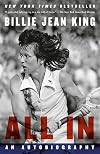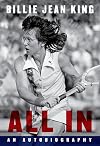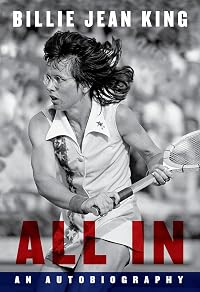
All In: An Autobiography
by Billie Jean King
On This Page
Description
"In this spirited account, Billie Jean King details her life's journey to find her true self. She recounts her groundbreaking tennis career--six years as the top-ranked woman in the world, twenty Wimbledon championships, thirty-nine grand-slam titles, and her watershed defeat of Bobby Riggs in the famous "Battle of the Sexes." She poignantly recalls the cultural backdrop of those years and the profound impact on her worldview from the women's movement, the assassinations and anti-war show more protests of the 1960s, the civil rights movement, and, eventually, the LGBTQ+ rights movement"-- show lessTags
Recommendations









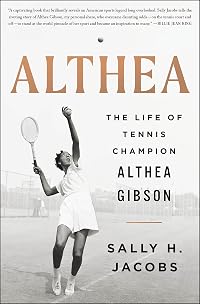


Member Reviews
this was surprisingly good. she included so much here that is valuable to read and learn about, and in such an accessible and interwoven way. (kudos to the ghostwriter!) the history of tennis, the brief biographies of major players in history, her ability to talk about them both as important to the game and as people (especially when not good people) totally separately. the fight both for tennis and for equal pay, for women's rights, for lgbtq rights, for civil rights. she encompasses so much here, and it was such a great reminder not just of how important a player billie jean king was to the sport, but how important she was to so many fights for justice and equality. she is really really impressive and i'm proud to have the grounds of show more the us open named for her. (unlike in australia where yes, margaret court was a great player, but not a great person as she was racist and homophobic and they should rename that stadium so it doesn't carry her name anymore.)
i listened to the audio and there were multiple times throughout as billie read her story and words where she got choked up and you could hear the emotion in her voice. really powerful. show less
i listened to the audio and there were multiple times throughout as billie read her story and words where she got choked up and you could hear the emotion in her voice. really powerful. show less
As a woman, and as a tennis fan, I lapped up this audiobook with tremendous enthusiasm. I've been a King fan since the 70s when she started defeating one tennis foe after another and her story was compelling, but the tennis was only part of her story. Fighting for the rights of women has been a job that King took on very early in her career and still is a prominent activist. Her sexuality, and the way in which it was publicly revealed, was more than a little distressing but her fight for Title IX may be her most important legacy. In her audio narration, she was very emotional about several parts of her history but especially when she talked about her parents and how they struggled to help her achieve success. Highly recommended.
I don't think you can appreciate Billie Jean King unless you grew up in the 1950s and 60s when girls didn't play sports, and being queer was such an alien concept it didn't even register as a possibility. Although that was BJK's reality, she revolutionized women's tennis and women's sports in general, fighting centuries of tradition and male privilege for equal treatment and equal pay.
All In is a very enjoyable if slightly long-winded autobiography, and King is brutally honest about the mistakes she made largely because of the homophobic 1970s when she was at her professional peak. She continued to deny being a lesbian, even when she became the target of an infamous "galimony" suit by her former lover. I didn't even realize that she show more has been in a committed relationship for 40 years, but I'm glad she has found the love and happiness she deserves.
King is very gracious about most of the people she has dealt with in her life, even the ones that openly opposed her efforts to have women's tennis be taken as seriously as men's. The book is strongest when she discussed her personal life, including the revelation that she was treated for an eating disorder. I'm not a tennis fan, but I appreciated the interesting play-by-play of her most notable matches. At times she provides unnecessary history lessons about civil rights and other major events that have taken place in the 70 years of her life. And although the ending drags as she lists all of the organizations she has founded or contributed to that support athletics for girls and youth from low-income families, I don't begrudge her the opportunity to claim her legacy.
Best of all, she describes her relationship with Elton John and the story of "Philadelphia Freedom," surely the only number one hit inspired by a professional tennis team. If I were BJK, that would be my proudest accomplishment. show less
All In is a very enjoyable if slightly long-winded autobiography, and King is brutally honest about the mistakes she made largely because of the homophobic 1970s when she was at her professional peak. She continued to deny being a lesbian, even when she became the target of an infamous "galimony" suit by her former lover. I didn't even realize that she show more has been in a committed relationship for 40 years, but I'm glad she has found the love and happiness she deserves.
King is very gracious about most of the people she has dealt with in her life, even the ones that openly opposed her efforts to have women's tennis be taken as seriously as men's. The book is strongest when she discussed her personal life, including the revelation that she was treated for an eating disorder. I'm not a tennis fan, but I appreciated the interesting play-by-play of her most notable matches. At times she provides unnecessary history lessons about civil rights and other major events that have taken place in the 70 years of her life. And although the ending drags as she lists all of the organizations she has founded or contributed to that support athletics for girls and youth from low-income families, I don't begrudge her the opportunity to claim her legacy.
Best of all, she describes her relationship with Elton John and the story of "Philadelphia Freedom," surely the only number one hit inspired by a professional tennis team. If I were BJK, that would be my proudest accomplishment. show less
Quite good! I didn't know anything about Billie Jean King, but this autobiography shows her as someone who for her whole life has battled both in tennis matches, and for women's sports and LGBT rights. Her demons include binge-eating and her societally condemned sexuality. She shows poor judgement, not infrequently lies, and has multiple simultaneous affairs. Her openness about her mistakes helps make this a worthwhile story—and there is a lot to tell! (Certainly in comparison to the other tennis biography I've recently read, Clarey's "The Master" about solipsistic billionaire Roger Federer.)
King's "Battle of the Sexes" tennis match with Bobby Riggs was ridiculous. What I didn't understand before reading this is how ridiculous the show more context was, in particular the pervasive sexism battled by athletes like King. I still don't know that the match shows quite what King thinks. It is not surprising that the world's best female tennis player can defeat a washed-up huckster who (at least in King's portrayal) can barely even run. King took the match very seriously because she saw it as her duty to protect and grow women's tennis.
> When my parents took Randy and me to Los Angeles to watch our first Pacific Coast League baseball game between the L.A. Angels and the Hollywood Stars when I was nine I expected it to be a thrilling day—until I looked down on the field and it dawned on me for the first time that all the pro players were men. Before that day I had heard about the American Dream and thought it applied unconditionally to me.
> I’d be holding a glass of water in my hand, chatting with club members who were drinking highballs. One of the older men or women would inevitably lean over toward fifteen-year-old me and say, “So, tell me young lady, what are you really going to do with your life? Or are you going to be a tennis bum?” I am doing what I want with my life, was what I wanted to say. Instead, I’d smile politely and say nothing, or assure them that I planned to attend college and marry because I knew that’s what they wanted to hear.
> Althea [Gibson] quit amateur tennis in 1959 at the pinnacle of her career after having swept the singles titles at Wimbledon and Forest Hills in back-to-back years. As she memorably explained it, “You can’t eat trophies.” I would sometimes repeat her line later. Althea went on to break the color line in women’s golf, too, and chase the small purses on the fledgling LPGA tour. To make a living, she even played tennis as the opening act at Harlem Globetrotters’ games, a sight that was as painful to me as Jesse Owens racing a horse for money late in his career, or a broke Joe Louis—another African American icon—working as a casino greeter in Vegas.
> Arthur Ashe, the first president of the ATP, but he was backward on gender issues before he married his wife, Jeanne Moutoussamy, an exceptional photographer and strong professional woman. Arthur told The Boston Globe, “The women are going to disappear because they don’t draw flies.” Clark Graebner said, “I’m just as happy to never see the girls. They’re not very attractive. I wouldn’t want my daughter playing on tour.” The American star Stan Smith told The Daily Mirror of London, “These girls would be much happier if they settled down, got married, and had a family. Tennis is a rough life and it really isn’t good for them. It de-feminizes them…[They become] too independent and they can’t adapt to anyone else, they won’t be dependent on a man. They want to take charge, not only on the courts but at home.”
> The USLTA was the Establishment trying to flick us off before we got traction. I was the only multiple Grand Slam singles winner on the Slims tour. If a kid like Chrissie [Evert] ran away with the crown against our best player and then went back to playing against Margaret, Virginia Wade, and Evonne Goolagong on their rival tour, our circuit could be endangered. Evonne was only nineteen years old herself then, and she had just won Roland-Garros and Wimbledon. So, as much as I already liked Chrissie personally, I knew it was up to me to stop her. Now. After warming up for our semifinal, I felt so much pressure that I went into a shower in the women’s dressing room, blasted the water as high as it would go so no one would hear me, and began sobbing uncontrollably as I contemplated the stakes.
> I steamed off. Rosie was right behind me, her jaw clamped shut in anger too. I’m not proud of it—but it was hysterical when she blinked and told me that she forgot we weren’t playing doubles and she left because she was thinking we were a team. The crowd booed us on our way off and we deserved it. The press massacred us too. We were fined by the USLTA. And that’s how Rosie and I became an infamous footnote in tennis history: We’re still the only two singles players to default after we both took the court.
> In the five decades since, it is not an exaggeration to say not a day has gone by without someone talking to me about the Battle of the Sexes match. Women still tell me about where they were when they saw it, how happy and empowered they felt when I won. … the men who approach me often have tears in their eyes too. They say, “Billie Jean, I was very young when I saw that match and now I have a daughter. It changed me.” One of those men was Barack Obama. When I met him for the first time in the Oval Office after he became president, he told me, “You don’t realize it, but I saw that match at twelve. Now I have two daughters and it has made a difference in how I raise them.”
> To show Sir Brian how much leverage and unity we had, Jerry produced a contract that was signed by more than eighty women players, obligating us to compete the following summer in another tournament to be held the same time as Wimbledon. We told Sir Brian the contract for us to skip Wimbledon and play elsewhere would be binding only if the women didn’t receive at least 70 percent of the prize money the men were paid at Wimbledon in 1976. The second condition: Our percentage would have to be negotiated upward each succeeding year, until equal prize money was achieved.
> tennis remains the leader in women’s sports. Tennis has shown what’s possible, and remains a model that other sports emulate.
> I can’t remember dining in a restaurant until I was eleven years old. Even then, Mom and Dad wouldn’t let us order a milkshake and fries with our burgers; we had to choose one or the other because of the cost. Even at home, it wasn’t uncommon for my father to remark, “Boy, you kids really eat a lot,” or for my mother to shoot us a disapproving look when we reached for another portion. To this day, going to a restaurant and having everyone order whatever they want secretly thrills me.
> Once I held my own in softball games, my father’s coworkers always wanted me to play shortstop or third base on their teams at their fire department picnics. There, I learned an important lesson that applied later in life, in other contexts: Men and boys will accept you more easily when you excel at something they value.
> After I stopped competing, I wasn’t working out regularly and my weight occasionally hit 200 pounds. I became detached, almost remote, which isn’t like me at all. I couldn’t stop overeating, no matter how hard I tried. show less
King's "Battle of the Sexes" tennis match with Bobby Riggs was ridiculous. What I didn't understand before reading this is how ridiculous the show more context was, in particular the pervasive sexism battled by athletes like King. I still don't know that the match shows quite what King thinks. It is not surprising that the world's best female tennis player can defeat a washed-up huckster who (at least in King's portrayal) can barely even run. King took the match very seriously because she saw it as her duty to protect and grow women's tennis.
> When my parents took Randy and me to Los Angeles to watch our first Pacific Coast League baseball game between the L.A. Angels and the Hollywood Stars when I was nine I expected it to be a thrilling day—until I looked down on the field and it dawned on me for the first time that all the pro players were men. Before that day I had heard about the American Dream and thought it applied unconditionally to me.
> I’d be holding a glass of water in my hand, chatting with club members who were drinking highballs. One of the older men or women would inevitably lean over toward fifteen-year-old me and say, “So, tell me young lady, what are you really going to do with your life? Or are you going to be a tennis bum?” I am doing what I want with my life, was what I wanted to say. Instead, I’d smile politely and say nothing, or assure them that I planned to attend college and marry because I knew that’s what they wanted to hear.
> Althea [Gibson] quit amateur tennis in 1959 at the pinnacle of her career after having swept the singles titles at Wimbledon and Forest Hills in back-to-back years. As she memorably explained it, “You can’t eat trophies.” I would sometimes repeat her line later. Althea went on to break the color line in women’s golf, too, and chase the small purses on the fledgling LPGA tour. To make a living, she even played tennis as the opening act at Harlem Globetrotters’ games, a sight that was as painful to me as Jesse Owens racing a horse for money late in his career, or a broke Joe Louis—another African American icon—working as a casino greeter in Vegas.
> Arthur Ashe, the first president of the ATP, but he was backward on gender issues before he married his wife, Jeanne Moutoussamy, an exceptional photographer and strong professional woman. Arthur told The Boston Globe, “The women are going to disappear because they don’t draw flies.” Clark Graebner said, “I’m just as happy to never see the girls. They’re not very attractive. I wouldn’t want my daughter playing on tour.” The American star Stan Smith told The Daily Mirror of London, “These girls would be much happier if they settled down, got married, and had a family. Tennis is a rough life and it really isn’t good for them. It de-feminizes them…[They become] too independent and they can’t adapt to anyone else, they won’t be dependent on a man. They want to take charge, not only on the courts but at home.”
> The USLTA was the Establishment trying to flick us off before we got traction. I was the only multiple Grand Slam singles winner on the Slims tour. If a kid like Chrissie [Evert] ran away with the crown against our best player and then went back to playing against Margaret, Virginia Wade, and Evonne Goolagong on their rival tour, our circuit could be endangered. Evonne was only nineteen years old herself then, and she had just won Roland-Garros and Wimbledon. So, as much as I already liked Chrissie personally, I knew it was up to me to stop her. Now. After warming up for our semifinal, I felt so much pressure that I went into a shower in the women’s dressing room, blasted the water as high as it would go so no one would hear me, and began sobbing uncontrollably as I contemplated the stakes.
> I steamed off. Rosie was right behind me, her jaw clamped shut in anger too. I’m not proud of it—but it was hysterical when she blinked and told me that she forgot we weren’t playing doubles and she left because she was thinking we were a team. The crowd booed us on our way off and we deserved it. The press massacred us too. We were fined by the USLTA. And that’s how Rosie and I became an infamous footnote in tennis history: We’re still the only two singles players to default after we both took the court.
> In the five decades since, it is not an exaggeration to say not a day has gone by without someone talking to me about the Battle of the Sexes match. Women still tell me about where they were when they saw it, how happy and empowered they felt when I won. … the men who approach me often have tears in their eyes too. They say, “Billie Jean, I was very young when I saw that match and now I have a daughter. It changed me.” One of those men was Barack Obama. When I met him for the first time in the Oval Office after he became president, he told me, “You don’t realize it, but I saw that match at twelve. Now I have two daughters and it has made a difference in how I raise them.”
> To show Sir Brian how much leverage and unity we had, Jerry produced a contract that was signed by more than eighty women players, obligating us to compete the following summer in another tournament to be held the same time as Wimbledon. We told Sir Brian the contract for us to skip Wimbledon and play elsewhere would be binding only if the women didn’t receive at least 70 percent of the prize money the men were paid at Wimbledon in 1976. The second condition: Our percentage would have to be negotiated upward each succeeding year, until equal prize money was achieved.
> tennis remains the leader in women’s sports. Tennis has shown what’s possible, and remains a model that other sports emulate.
> I can’t remember dining in a restaurant until I was eleven years old. Even then, Mom and Dad wouldn’t let us order a milkshake and fries with our burgers; we had to choose one or the other because of the cost. Even at home, it wasn’t uncommon for my father to remark, “Boy, you kids really eat a lot,” or for my mother to shoot us a disapproving look when we reached for another portion. To this day, going to a restaurant and having everyone order whatever they want secretly thrills me.
> Once I held my own in softball games, my father’s coworkers always wanted me to play shortstop or third base on their teams at their fire department picnics. There, I learned an important lesson that applied later in life, in other contexts: Men and boys will accept you more easily when you excel at something they value.
> After I stopped competing, I wasn’t working out regularly and my weight occasionally hit 200 pounds. I became detached, almost remote, which isn’t like me at all. I couldn’t stop overeating, no matter how hard I tried. show less
I'm not really interested in tennis as a sport but have always liked outspoken advocates for women's equality in any arena. This book is a fascinating and very readable account of tennis star Billie Jean King's growing awareness of injustice, not just in relation to sex, but also race and sexual orientation, and her determination to do something about it. It paints a clear picture of her drive and enthusiasm for tennis and willingness to encourage others to become involved in the sport she loves. Highly recommended.
Back in the 1960s and 1970s, I was not that big a fan of Billie Jean King. I was more inclined to be a fan of Chris Evert, Tracy Austin or Evonne Goolagong. I became more of a fan of Billie Jean King after she defeated Bobby Riggs in a special challenge match held at the Houston Astrodome.
I have to give Billie Jean her props – – she was a great tennis player and maybe more importantly a great pioneer for women's sports in general and for the LBGT community. Her autobiography details the incredible pushback that she received in promoting women's tennis. I was very surprised and disappointed to read that Arthur Ashe and Stan Smith were two of the male players opposed to more equal pay for women.
This book details her moxie, courage, show more judgment and passion to not just be the number one tennis player in the world but to actually improve the fortunes of women both in sports and outside of it. Billie Jean also suffered because of her sexuality – – she had hidden her relationships with women so not to disrupt her tennis career and outside interests.
A very candid book. An ideal sports book for women. An ideal book on overcoming personal struggles for everyone. show less
I have to give Billie Jean her props – – she was a great tennis player and maybe more importantly a great pioneer for women's sports in general and for the LBGT community. Her autobiography details the incredible pushback that she received in promoting women's tennis. I was very surprised and disappointed to read that Arthur Ashe and Stan Smith were two of the male players opposed to more equal pay for women.
This book details her moxie, courage, show more judgment and passion to not just be the number one tennis player in the world but to actually improve the fortunes of women both in sports and outside of it. Billie Jean also suffered because of her sexuality – – she had hidden her relationships with women so not to disrupt her tennis career and outside interests.
A very candid book. An ideal sports book for women. An ideal book on overcoming personal struggles for everyone. show less
I appreciated learning about King's life before turning pro, but that part of the book lagged a little for me. My favorite parts of the book were the accounts of the first decade or two of the WTA, and the accounts of its formation. I loved the sense of camaraderie among the players. I wonder if that still exists today. I have to admit, I liked reading about her friendship with Elton John--it seems like a true friendship.
Members
- Recently Added By
Lists

Recreation
93 works; 1 member

Biographies: Women
112 works; 1 member
Author Information

13+ Works 457 Members
Awards and Honors
Awards
Distinctions
The Guardian Book of the Day (2021-09-04)
Common Knowledge
- Canonical title
- All In: An Autobiography
- Original publication date
- 2021-08-17
- People/Characters
- Billie Jean King
Classifications
- Genres
- Sports and Leisure, Biography & Memoir, Nonfiction, Sexuality and Gender Studies, General Nonfiction
- DDC/MDS
- 796.342092 — Arts & recreation Recreation, sports, and performing arts Athletic and outdoor sports and games Ball sports Racquet sports Tennis Tennis Biography And History
- LCC
- GV994 .K56 .A3 — Geography, Anthropology and Recreation Recreation. Leisure Recreation. Leisure Sports Ball games: Baseball, football, golf, etc.
- BISAC
Statistics
- Members
- 258
- Popularity
- 125,972
- Reviews
- 14
- Rating
- (4.03)
- Languages
- English
- Media
- Paper, Audiobook, Ebook
- ISBNs
- 16
- ASINs
- 4