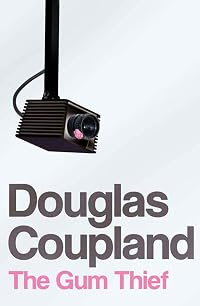
The Gum Thief
by Douglas Coupland
On This Page
Description
Over the course of several months, two retail workers at an office supply superstore--Roger, a divorced, middle aged "aisles associate" at Staples, and his young co-worker, Bethany, an early twenty-something, former Goth--strike up a unique epistolary friendship.Tags
Recommendations
Member Recommendations
Member Reviews
Wow, lots of reviews on this book and they are all over the place. I did not expect to like it, but it snuck up on me. Books about writing a book tend to be mind bogglingly dull, but Coupland pulled it off. I loved the way the imaginary book being written, which starts off as an amazingly bad Cheever rip off, develops into a story with meaning and pain as it reflects the characters inner lives.
-Two misfits find common ground and a unique, surreal friendship via unspoken words in Coupland's latest, a fine return to form. In the two years since his wife's (nonfatal) cancer was diagnosed, Roger Thorpe has devolved into a dejected, hard-drinking, divorced father and the oldest employee by a fair margin at Staples. A frustrated novelist to boot, Roger considers himself lost, continually haunted by dreams of missed opportunities and a long ago car accident that claimed four friends. His younger, disgruntled goth co-worker, Bethany Twain, one day discovers Roger's diary—filled with mock re-imaginings of her thoughts and feelings—in the break room. She lays down a supreme challenge for them both to write diary entries to each show more other, but neither is allowed to acknowledge the other around the store. Through exchanged hopes and dreams, customer stories, world views and cautionary revelations (time speeds up in a terrifying manner in your mid-thirties), the pair become intimately acquainted before things unravel for both. Running parallel to the epistolary narrative are chapters from Roger's novel, Glove Pond, which begins having much in common with the larger narrative it's enclosed in. While smacking of the pretentiousness that made JPod grating, this book’s unique format and lighter writing style made it a page turner. The author’s motivations are certainly questionable but this book was much fresher than his other work. show less
I’ve been hoping for a book like this. This is the kind of book I read for, as if I am fishing. Fishing for what, you ask? I’m not sure, but I know it when I see it and this is it. Here is a novel told simply, starkly, imaginatively and empathetically, with a good deal of humor and philosophy thrown in for good measure. You’d never guess how hard it is to find books like this. I am obviously late to the Douglas Coupland party, but at least I made it despite the horrible traffic.
Another thing: I know this book was vitamins to my soul because I never, not once, intentionally noted what page I was on as I was reading. You know those books—the ones that are just good enough to keep on with, but which are a solid chore to read.
That show more is not this book, at least not to me. This book is funny, smart and sad and it’s a breeze.
Thank you, Douglas Coupland. show less
Another thing: I know this book was vitamins to my soul because I never, not once, intentionally noted what page I was on as I was reading. You know those books—the ones that are just good enough to keep on with, but which are a solid chore to read.
That show more is not this book, at least not to me. This book is funny, smart and sad and it’s a breeze.
Thank you, Douglas Coupland. show less
I suspect I read this at just the right time. The characters are not necessarily different from Coupland's other works. And yet, the novel buried in this novel is different from Coupland's other work. There is an absurdity there that doesn't exist in the main storyline (a basic plot of disaffected youth, middle-aged angst, and life at Staples).
But I think the real accomplishment here is the structure of the novel. We have a novel in diary form that also includes a novel in it. The fact that the characters in the diary-novel are just as compelling as the main characters is a testament to Coupland's skill. I was compelled by this book and find myself still contemplating the way it is put together. That may not excite some people, but as show more a writer I can't help but obsess over the structural marvel. This whole book could have fallen apart in the hands of a less skilled writer. show less
I loved this book. It made me laugh out loud like a crazy person in public, though I admit that the humor is dark. I love the way the novel folds in on itself--how you are never quite certain, from the moment it's revealed that one of the Bethany entries is fake, whether this entire narrative is "real" or another manuscript within a manuscript within a manuscript. I love Glove Pond, and I love the way the author pokes fun at serious literary writing (and writers!) and the sort of stereotypical subject matter. The bleakness of the Roger story and the ending was a perfect contrast to the final chapter, which I found hilarious (maybe because I'm a writer?) I see from other reviews that people find Coupland's other books superior to this, show more so I already have another on order. What an enjoyable read. show less
I really liked this book, particularly the style in which it was written. I realize the epistolary format isn't exactly revolutionary, but it was perfect for this story, which follows the correspondence of a group of individuals who have become, to a certain extent, outcasts from society for a variety of reasons. I particularly liked how two of the characters who could interact face to face on a regular basis (Roger and Bethany, who work together) actively avoid each other in "real life," eschewing personal contact in favor of their missives to each other.
However, I also think it's cool how these characters come together over the course of the novel. In the beginning, Bethany finds Roger creepy, and her mother wants Roger to stay away show more from her daughter. By the end, Bethany is writing such things to Roger as "you're the only one I can talk to," and her mother (DeeDee) is glad the two of them became friends.
I also think it's really interesting how the characters reflect each other. On on hand you have Roger, a middle-aged guy who has gone through a number of life-changing events that, by his own admission, haven't really changed his life. Then you have Bethany, the 24-year-old Goth who goes through some pretty serious changes but doesn't know exactly why and also doesn't really understand or like the person she becomes. And she also remains self-centered throughout: even as she comes to rely on Roger, her letters always revolve around her own issues, even as he clearly has issues of his own and even kind of disappears for a while. She asks about him superficially, but it's really all about her. And I think that speaks to the theme that pops up occasionally about "intimacy vs. closeness." Intimacy may be a one-way street, whereas closeness requires reciprocity.
And then there's the story within the story, Roger's novel, Glove Pond. This is Roger's outlet, his attempt at doing something more with his life. I like the way it kind of echoes and amplifies some of the things from the rest of the book, and also how it turns into the impetus for some of the things that happen in the characters' actual lives. It also serves as the basis for the ending, a smirk-worthy finish that seems totally appropriate. show less
However, I also think it's cool how these characters come together over the course of the novel. In the beginning, Bethany finds Roger creepy, and her mother wants Roger to stay away show more from her daughter. By the end, Bethany is writing such things to Roger as "you're the only one I can talk to," and her mother (DeeDee) is glad the two of them became friends.
I also think it's really interesting how the characters reflect each other. On on hand you have Roger, a middle-aged guy who has gone through a number of life-changing events that, by his own admission, haven't really changed his life. Then you have Bethany, the 24-year-old Goth who goes through some pretty serious changes but doesn't know exactly why and also doesn't really understand or like the person she becomes. And she also remains self-centered throughout: even as she comes to rely on Roger, her letters always revolve around her own issues, even as he clearly has issues of his own and even kind of disappears for a while. She asks about him superficially, but it's really all about her. And I think that speaks to the theme that pops up occasionally about "intimacy vs. closeness." Intimacy may be a one-way street, whereas closeness requires reciprocity.
And then there's the story within the story, Roger's novel, Glove Pond. This is Roger's outlet, his attempt at doing something more with his life. I like the way it kind of echoes and amplifies some of the things from the rest of the book, and also how it turns into the impetus for some of the things that happen in the characters' actual lives. It also serves as the basis for the ending, a smirk-worthy finish that seems totally appropriate. show less
(Reprinted from the Chicago Center for Literature and Photography [cclapcenter.com]. I am the original author of this essay, as well as the owner of CCLaP; it is not being reprinted here illegally.)
Like many writers of critical reviews, I too sometimes think about the idea of one day penning an entire book-long series of essays about a particular artist -- and of all the artists in history that now exist, the one I'm perhaps most qualified at this point to write an entire critical book about would be Canadian author Douglas Coupland; I've read eight of his eleven novels now, the majority of them multiple times, along with a handful of his nonfiction books, all the short pieces he's ever published, and several hundred interviews with him show more that have been conducted over the last 17 years, not to mention a memorable experience actually meeting him in the year 2000. (In a nutshell, while at a Chicago reading he became obsessed with the fact that I'm deaf in one ear, and actually stopped his reading in the middle of it to ask me all these strange random questions about it.) And in this I don't think I'm too terribly different than a large group of other people my age; after all, it was Coupland who wrote 1991's Generation X, the book that literally coined the term for the generation (my generation), the first book to teach all of us that it was okay to dream of a different world than the trippy hairy mess our aging hippie bosses had created, that it is in fact a generational duty. I mean, sure, that single book eventually led us to an entire decade of unnecessary body scarification, Kevin Smith films, and drag queens hosting afternoon talk shows, but that's not Coupland's fault for writing the novel that started it all. Or is it? See, that's the kind of essay I'd write, if I ever wrote a book of essays about Coupland; and it'd be a cool book, too, I'm telling you!
That's why I was looking forward to reading through his latest, 2007's medium-sized and easily digestible The Gum Thief; because the three novels of Coupland's that I haven't gotten to yet read, frankly, are the last three he's published (2003's Hey Nostradamus!, 2004's Eleanor Rigby and 2006's JPod), not for any particular aesthetic reason but merely because I've been permanently broke throughout the 2000s, so I've been happily anticipating getting caught up with his ouevre ever since opening CCLaP a little less than a year ago. And indeed, The Gum Thief finds Coupland in fine if not terribly exciting form, just as is the case with the majority of his books; it'll take most people just a few days to get through it, and it provides exactly a few days worth of entertainment, a good matchup even while not exactly soaring to the heights of his absolute best work (so in other words, this is no Microserfs). On the Coupland Scale of Weirdness, this definitely tips in on the dark, sad and bitter side; more Life After God than Shampoo Planet, more an examination of the endless failures of life than of its few successes.
Because that's really the first thing to understand about Coupland, if you want a chance of deeply getting and enjoying his work; that he lives in this sorta little literary bubble of his own, where it's difficult to compare his plots and style and even way of working to any other writer except himself, and his books against any other books but his own. Coupland's world is a semi-surreal place but not a fully surreal one, a place where things just weird enough are always happening, events very much informed by popular culture and that are conveyed to us through the smooth, minimalist, elegant personal style that Coupland's past as an ad-agency copywriter has given him. It is not unusual within a Coupland story for time to stop, for apocalyptic events to take place, without any of these things being the main point of the story itself; Coupland's main point is always to examine the humanity inherent in each situation, even if it's a sometimes cold and irony-laced humanity that often has problems communicating with each other, and even if told in a much more clever and meta way than most character dramas are.
This is certainly the case with The Gum Thief; it is primarily the story of Roger, a middle-aged alcoholic who has just gone through a series of personal crises (divorce, death of a child, loss of a job), which now find him living in a basement studio apartment in a large anonymous city, sneaking vodka into his new day job as a clerk at office-supply store Staples just in order to make it through each soul-crushing day. Yeah, welcome to Coupland's world, chump! Because that's the thing that's often forgotten about his work, especially by his critics, or not even mentioned in the first place; that when Coupland is in a bad mood, he can be one of the most pathos-infused writers of our generation, painting portraits of human hopelessness and moral weakness that on the bleak scale fall just short of Russian epics about suicidal madmen in winter. The Gum Thief isn't a pleasant book, it isn't a pleasant book at all; it's a relentlessly grim and dour book, in fact, one that wallows in all the filth and garbage of the usual world, hoping merely that the fates of the various losers we meet along the way are somehow just a little bit better by the end, since "good" is too optimistic a fate to hope for.
Because that's the other thing; as the story continues, of course, Roger ends up gathering a host of deeply flawed characters around him as well, all because of a notebook he accidentally leaves in the store's breakroom one day, in which he is writing new fictional character sketches based on his real co-workers and half-heartedly contemplating taking up the challenge again of becoming a published author. It's because of this notebook and these fictional character studies that he then comes to the attention of co-worker Bethany, an overweight goth girl in her early twenties who unfortunately had a plethora of friends and relatives accidentally die around her during childhood. This, then, has left Bethany unsure of herself, sarcastic and bitter about life, unable to trust or love the people around her; so in other words, a perfect match and foil for Roger, someone who starts leaving snotty rambling letters in his notebook that admonish him to never acknowledge them out loud to her while actually on the clock at the store.
This then leads us to the main crux of the novel, which as usual with Coupland is a bit difficult to describe but enjoyable nonetheless. For example, partly this is about the growing complex relationship between Roger and Bethany, the way that their unspoken correspondence very slowly helps push each other to a point of awareness and healing they weren't at before. But also this is about the relationship between Roger and Bethany's mother DeeDee, yet another emotionally-scarred loser who it turns out had actually gone out with Roger on an dual-alcoholic date in the past, and who starts adding her own letters to the correspondence after finding out that Bethany and Roger have started conversing. But then, this is also the story of the new novel that Roger has been inspired by Bethany and DeeDee to sit down and finally write, a dreadful "comedy" called Glove Pond that is a transparent ripoff of Edward Albee's Who's Afraid of Virgina Woolf?; and it's not just the story of the novel itself (large chunks of which are interspersed among the letters), but also how the people around him react to the novel, with to us it being pretty obvious that the novel is awful but with Bethany and DeeDee impressed because of neither being familiar with the Albee original. And because of all this literary trickery, of course, the book ends up becoming something else as well -- a meta story, that is, a story about stories about stories about stories, with there in actuality being hardly any "real" dialogue in The Gum Thief at all, but rather an entire manuscript's worth of letters and emails and office memos and diary entries and novel excerpts and the like.
Now to be fair, there is also a fair dose here of all the things Coupland's critics complain about as well: over-reliance on pop-culture references, for one good example, a glib irony-worshipping writing style that is sure to turn a lot of people off right from the start. And Lord, don't even think about turning to a Coupland novel and expecting some sort of grand message, but rather be ready for a small story about small people that ultimately only says small and quiet things; this is why Generation X became as cultishly huge as it did, after all, is because Coupland never set out to write a book about an entire generation in the first place, but has admitted many times in interviews that he expected no one besides his own circle of friends to understand the point of the book at all. This is the sort of attitude you need to have about Coupland going into his novels, in order to truly appreciate them in a deep way; you need to see them as simple stories about specific people, but who by extension are then telling big stories about all of us in an untold way. And you need to go with Coupland down that road to get there, need to keep thinking about his ideas after the book itself is done; when you do this, he becomes much more than a MTV-friendly pop-culture guru, but actually a sophisticated chronicler of the human condition. That's why I keep reading Coupland and keep enjoying Coupland; it's why I ultimately recommend The Gum Thief as well, even though it will clearly never be thought of as one of Coupland's best. show less
Like many writers of critical reviews, I too sometimes think about the idea of one day penning an entire book-long series of essays about a particular artist -- and of all the artists in history that now exist, the one I'm perhaps most qualified at this point to write an entire critical book about would be Canadian author Douglas Coupland; I've read eight of his eleven novels now, the majority of them multiple times, along with a handful of his nonfiction books, all the short pieces he's ever published, and several hundred interviews with him show more that have been conducted over the last 17 years, not to mention a memorable experience actually meeting him in the year 2000. (In a nutshell, while at a Chicago reading he became obsessed with the fact that I'm deaf in one ear, and actually stopped his reading in the middle of it to ask me all these strange random questions about it.) And in this I don't think I'm too terribly different than a large group of other people my age; after all, it was Coupland who wrote 1991's Generation X, the book that literally coined the term for the generation (my generation), the first book to teach all of us that it was okay to dream of a different world than the trippy hairy mess our aging hippie bosses had created, that it is in fact a generational duty. I mean, sure, that single book eventually led us to an entire decade of unnecessary body scarification, Kevin Smith films, and drag queens hosting afternoon talk shows, but that's not Coupland's fault for writing the novel that started it all. Or is it? See, that's the kind of essay I'd write, if I ever wrote a book of essays about Coupland; and it'd be a cool book, too, I'm telling you!

That's why I was looking forward to reading through his latest, 2007's medium-sized and easily digestible The Gum Thief; because the three novels of Coupland's that I haven't gotten to yet read, frankly, are the last three he's published (2003's Hey Nostradamus!, 2004's Eleanor Rigby and 2006's JPod), not for any particular aesthetic reason but merely because I've been permanently broke throughout the 2000s, so I've been happily anticipating getting caught up with his ouevre ever since opening CCLaP a little less than a year ago. And indeed, The Gum Thief finds Coupland in fine if not terribly exciting form, just as is the case with the majority of his books; it'll take most people just a few days to get through it, and it provides exactly a few days worth of entertainment, a good matchup even while not exactly soaring to the heights of his absolute best work (so in other words, this is no Microserfs). On the Coupland Scale of Weirdness, this definitely tips in on the dark, sad and bitter side; more Life After God than Shampoo Planet, more an examination of the endless failures of life than of its few successes.
Because that's really the first thing to understand about Coupland, if you want a chance of deeply getting and enjoying his work; that he lives in this sorta little literary bubble of his own, where it's difficult to compare his plots and style and even way of working to any other writer except himself, and his books against any other books but his own. Coupland's world is a semi-surreal place but not a fully surreal one, a place where things just weird enough are always happening, events very much informed by popular culture and that are conveyed to us through the smooth, minimalist, elegant personal style that Coupland's past as an ad-agency copywriter has given him. It is not unusual within a Coupland story for time to stop, for apocalyptic events to take place, without any of these things being the main point of the story itself; Coupland's main point is always to examine the humanity inherent in each situation, even if it's a sometimes cold and irony-laced humanity that often has problems communicating with each other, and even if told in a much more clever and meta way than most character dramas are.
This is certainly the case with The Gum Thief; it is primarily the story of Roger, a middle-aged alcoholic who has just gone through a series of personal crises (divorce, death of a child, loss of a job), which now find him living in a basement studio apartment in a large anonymous city, sneaking vodka into his new day job as a clerk at office-supply store Staples just in order to make it through each soul-crushing day. Yeah, welcome to Coupland's world, chump! Because that's the thing that's often forgotten about his work, especially by his critics, or not even mentioned in the first place; that when Coupland is in a bad mood, he can be one of the most pathos-infused writers of our generation, painting portraits of human hopelessness and moral weakness that on the bleak scale fall just short of Russian epics about suicidal madmen in winter. The Gum Thief isn't a pleasant book, it isn't a pleasant book at all; it's a relentlessly grim and dour book, in fact, one that wallows in all the filth and garbage of the usual world, hoping merely that the fates of the various losers we meet along the way are somehow just a little bit better by the end, since "good" is too optimistic a fate to hope for.
Because that's the other thing; as the story continues, of course, Roger ends up gathering a host of deeply flawed characters around him as well, all because of a notebook he accidentally leaves in the store's breakroom one day, in which he is writing new fictional character sketches based on his real co-workers and half-heartedly contemplating taking up the challenge again of becoming a published author. It's because of this notebook and these fictional character studies that he then comes to the attention of co-worker Bethany, an overweight goth girl in her early twenties who unfortunately had a plethora of friends and relatives accidentally die around her during childhood. This, then, has left Bethany unsure of herself, sarcastic and bitter about life, unable to trust or love the people around her; so in other words, a perfect match and foil for Roger, someone who starts leaving snotty rambling letters in his notebook that admonish him to never acknowledge them out loud to her while actually on the clock at the store.
This then leads us to the main crux of the novel, which as usual with Coupland is a bit difficult to describe but enjoyable nonetheless. For example, partly this is about the growing complex relationship between Roger and Bethany, the way that their unspoken correspondence very slowly helps push each other to a point of awareness and healing they weren't at before. But also this is about the relationship between Roger and Bethany's mother DeeDee, yet another emotionally-scarred loser who it turns out had actually gone out with Roger on an dual-alcoholic date in the past, and who starts adding her own letters to the correspondence after finding out that Bethany and Roger have started conversing. But then, this is also the story of the new novel that Roger has been inspired by Bethany and DeeDee to sit down and finally write, a dreadful "comedy" called Glove Pond that is a transparent ripoff of Edward Albee's Who's Afraid of Virgina Woolf?; and it's not just the story of the novel itself (large chunks of which are interspersed among the letters), but also how the people around him react to the novel, with to us it being pretty obvious that the novel is awful but with Bethany and DeeDee impressed because of neither being familiar with the Albee original. And because of all this literary trickery, of course, the book ends up becoming something else as well -- a meta story, that is, a story about stories about stories about stories, with there in actuality being hardly any "real" dialogue in The Gum Thief at all, but rather an entire manuscript's worth of letters and emails and office memos and diary entries and novel excerpts and the like.
Now to be fair, there is also a fair dose here of all the things Coupland's critics complain about as well: over-reliance on pop-culture references, for one good example, a glib irony-worshipping writing style that is sure to turn a lot of people off right from the start. And Lord, don't even think about turning to a Coupland novel and expecting some sort of grand message, but rather be ready for a small story about small people that ultimately only says small and quiet things; this is why Generation X became as cultishly huge as it did, after all, is because Coupland never set out to write a book about an entire generation in the first place, but has admitted many times in interviews that he expected no one besides his own circle of friends to understand the point of the book at all. This is the sort of attitude you need to have about Coupland going into his novels, in order to truly appreciate them in a deep way; you need to see them as simple stories about specific people, but who by extension are then telling big stories about all of us in an untold way. And you need to go with Coupland down that road to get there, need to keep thinking about his ideas after the book itself is done; when you do this, he becomes much more than a MTV-friendly pop-culture guru, but actually a sophisticated chronicler of the human condition. That's why I keep reading Coupland and keep enjoying Coupland; it's why I ultimately recommend The Gum Thief as well, even though it will clearly never be thought of as one of Coupland's best. show less
Members
- Recently Added By
Published Reviews
ThingScore 75
Douglas Coupland’s new novel, “The Gum Thief,” puts the act of writing center stage. The book is not conventionally narrated, but told obliquely, through an assemblage of writings and letters, from which the reader reconstructs the story like the pieces of an Ikea wardrobe.
added by Nickelini
This is a novel so postmodern that it has disappeared up its own irony and come out on the other side.
In anyone else's hands, it could read like an environmental treatise by Al Gore translated by a teenage dirtbag after 17 vodka Red Bulls. But Coupland's skill is in his love of the ridiculous, like a schoolboy whose words make him giggle. His books are essentially pointless. Maybe that's why show more they are such a guilty pleasure. show less
added by Nickelini
Lists
Epistolary Books
105 works; 24 members
Books Read in 2007
326 works; 8 members
Books With Body Parts in the Title
153 works; 9 members
Author Information

44+ Works 38,660 Members
Douglas Coupland was born December 30, 1961 on a Canadian military base in Baden-Soellingen, Germany. He graduated from Sentinel Secondary School in West Vancouver in 1979 and went on to McGill University. He was unhappy there and went on to Emily Carr College of Art and Design. He has said that these were the best four years of his life. He show more graduated in 1984 with a focus on sculpture and moved on to study at the European Design Institute in Milan. He also completed a two-year course in Japanese business science in Hawaii in 1986.He soon began writing for magazines as a means of paying the bills. He soon started work on his first novel Generation X: Tales for an Accelerated Culture which was published in 1991. His second novel Shampoo Planet focused on the generation after Generation X and was published in 1992. This generation was termed "Global Teens". His career has consisted of writing, sculpting, and editing and he also hosted The Search for Generation X, a PBS documentary, 1991. Douglas Coupland has also worked on a magazine called Wired . He wrote a short story about the life of the employees of Mocrosoft Corporation. This short story provided inspiration for his novel Microserfs. (Bowker Author Biography) show less
Awards and Honors
Work Relationships
Is contained in
Common Knowledge
- Canonical title
- The Gum Thief
- Original publication date
- 2007
- People/Characters
- Roger Thorpe; Bethany Twain; DeeDee Twain; Joan Epke (Joan Thorpe); Kyle; Shawn Paxton (show all 12); Zoë Thorpe; Greg (Mr. Rant); Gloria (Glove Pond); Steve (Glove Pond); Kyle Falconcrest (Glove Pond); Brittany Falconcrest (Glove Pond)
- Important places
- Staples, Inc.; London, England, UK; Paris, France; Vancouver, British Columbia, Canada
- Epigraph
- Q: Brother, are you headed home?
A: Brother, aren't we always headed home?
--Question used by Masons to identify themselves among strangers - First words
- A few years ago it dawned on me that everybody past a certain age -- regardless of how they look on the outside -- pretty much constantly dreams of being able to escape from their lives.
- Quotations
- "I'm no longer a child. It happened to me when I wasn't looking."
- Last words
- (Click to show. Warning: May contain spoilers.)See you at next Wednesday's class,
Ed Matheson, B.A.
Creative Writing Instructor and winner of the 2004 Eileen Braithwaite Memorial Trust Prize for Fiction Dealing with Equality
www.edmatheson.com
Classifications
Statistics
- Members
- 1,629
- Popularity
- 13,792
- Reviews
- 43
- Rating
- (3.54)
- Languages
- 7 — Danish, Dutch, English, German, Hungarian, Italian, Spanish
- Media
- Paper, Ebook
- ISBNs
- 19
- ASINs
- 7