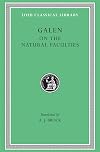
Galen: On the Natural Faculties (Loeb Classical Library, 71)
by Galen
On This Page
Description
If the work of Hippocrates is taken as representing the foundation upon which the edifice of historical Greek medicine was reared, then the work of Galen, who lived some six hundred years later, may be looked upon as the summit of the same edifice. He was born in Pergamum 129 CE, and both there and in other academic centres of the Aegean pursued his medical studies before being appointed physician to the Pergamene gladiators in 157. Becoming dissatisfied with this type of practice he show more emigrated to Rome, where he soon won acknowledgement as the foremost medical authority of his time and where, with one brief interruption, he remained until his death in 199. Galen's merit is to have crystallised or brought to a focus all the best work of the Greek medical schools which had preceded his own time. It is essentially in the form of Galenism that Greek medicine was transmitted to after ages. show lessTags
Recommendations











Member Reviews
An interesting medical account that borders into more nuanced descriptions of early medicine.
Galen produced more work than any author in antiquity,[1] and may have possibly written up to 600 treatises, although less than a third of his works have survived. His surviving work runs to around 3 million words.
Karl Gottlob Kühn of Leipzig (1754-1840) translated 122 of Galen's writings (1821–1833) and his edition, which is the most complete although flawed,[1] consists of the Greek text, with Latin translations, and runs to 22 volumes, 676 index pages, and is over 20,000 pages in length. More modern projects like the Corpus Medicorum Graecorum have still to match the Kühn edition. A digital version of the Galen's corpus is included in the Thesaurus Linguae Graecae a digital library of Greek literature started in 1972. Another show more useful modern source is the French Bibliothèque interuniversitaire de médicine (BIUM).
Cf. http://en.wikipedia.org/wiki/Galenic_corpus
Of the natural faculties De Facultatibus Naturalibus (De Naturalibus Facultatibus) (Nat. Fac.) II
http://classics.mit.edu/Galen/natfac.html show less
Karl Gottlob Kühn of Leipzig (1754-1840) translated 122 of Galen's writings (1821–1833) and his edition, which is the most complete although flawed,[1] consists of the Greek text, with Latin translations, and runs to 22 volumes, 676 index pages, and is over 20,000 pages in length. More modern projects like the Corpus Medicorum Graecorum have still to match the Kühn edition. A digital version of the Galen's corpus is included in the Thesaurus Linguae Graecae a digital library of Greek literature started in 1972. Another show more useful modern source is the French Bibliothèque interuniversitaire de médicine (BIUM).
Cf. http://en.wikipedia.org/wiki/Galenic_corpus
Of the natural faculties De Facultatibus Naturalibus (De Naturalibus Facultatibus) (Nat. Fac.) II
http://classics.mit.edu/Galen/natfac.html show less
Ratings
Members
- Recently Added By
Lists

How to Read a Book's Recommended Reading List
309 works; 10 members

Western Canon
206 works; 2 members
Author Information

78+ Works 1,094 Members
Some Editions
Series
Belongs to Publisher Series
Work Relationships
Is contained in
Common Knowledge
- Canonical title
- Galen: On the Natural Faculties (Loeb Classical Library, 71) (Loeb Classical Library, 71)
- Disambiguation notice
- This is the >work< entitled "On the Natural Faculties" by Galen. Some publishers have bound it in a book with Hippocrates' writings, which is of no relevence to this work by Galen. Do not combine this work with anything... (show all) other than Galen's "On the Natural Faculties".
Classifications
Statistics
- Members
- 193
- Popularity
- 170,075
- Reviews
- 2
- Rating
- (2.30)
- Languages
- English, Greek (Ancient), Swedish
- Media
- Paper, Ebook
- ISBNs
- 9
- ASINs
- 6