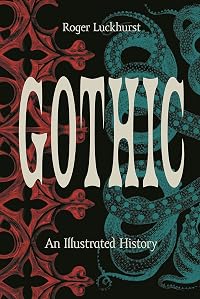
Gothic: An Illustrated History
by Roger Luckhurst
On This Page
Description
A richly illustrated history of the Gothic across a wide range of media, including architecture, literature, and filmTags
Recommendations





















Member Reviews
Roger Luckhurst, an academic specialising in the subject, has produced a lush coffee table book exploring all aspects of the Gothic genre in a thematic way. I found it immensely useful in helping me to find a few new sources and allowing me to define what it all meant to me.
It is not a chronological history by any means (there are plenty of those on the market) but something that weaves its way between trying to recreate the mood of the Gothic in all its forms and (in a rather contradictory way) reveal something of the current academic approach to the subject.
If I have a criticism it is that, by the end, it seems to have become something of a catalogue or an unconventional cultural encyclopedia. The definition of Gothic becomes show more stretched to its limits to encompass all that the academic imperialism of cultural studies can possibly seize for itself.
Luckhurst strains at times to be inclusive as is the current fashion and to claim as much as possible for the genre. He spreads himself widely (and usefully) to introduce not just literary manifestations but alleged cinematic, folklore, historical and intellectual ones. There is little restraint.
Gothic gets stretched far into Horror. Although Horror's roots are certainly in the genre, it is hard to consider something like John Halkin's 'Slither' or the Godzilla movies as truly Gothic. After all, you would not include all Science Fiction on the basis of its origins in 'Frankenstein'.
Similarly, the current sly academic appropriation of almost any issue into the genre and the moonlighting of academic minds as 'writers' gives us cultural studies and politics masquerading as the Gothic, appropriating the form to provide what is often an anti-Gothic substance.
The whole point of the Gothic is that it derives from the Burkean sublime and from the psychic handling of the irrational (which is why the uncanny is very much part of it). Thinking it out and creating reasoned counter-rationalities to meet current ideological needs is not Gothic.
Anti-colonialism, environmentalism, feminism, transgenderism and so on and so forth use the Gothic but are not Gothic which only stands as an expression of actual primal fears rather than stand-offish implicitly outraged commentary on the problems of social existence.
I took the time to explore the academic world of Gothic studies and found a cottage industry busy applying the Gothic to anything within reach like arms traders looking for small wars and hoping for the big one. Who pays for all this in the age of food banks is worth asking.
So, while a very useful, entertaining and interesting book, a bit of a health warning is due. By trying to be encyclopedic about as much of what the term Gothic can take, Luckhurst has taken us into the expanding territories of academic imperialism and even contemporary ideology.
Having said that, it is sumptuously illustrated. It will give a great deal of dark pleasure. Notwithstanding criticisms, it is a great place to get a grounding in the subject and then go down the highways and byways that may interest you. All in all, good value. show less
It is not a chronological history by any means (there are plenty of those on the market) but something that weaves its way between trying to recreate the mood of the Gothic in all its forms and (in a rather contradictory way) reveal something of the current academic approach to the subject.
If I have a criticism it is that, by the end, it seems to have become something of a catalogue or an unconventional cultural encyclopedia. The definition of Gothic becomes show more stretched to its limits to encompass all that the academic imperialism of cultural studies can possibly seize for itself.
Luckhurst strains at times to be inclusive as is the current fashion and to claim as much as possible for the genre. He spreads himself widely (and usefully) to introduce not just literary manifestations but alleged cinematic, folklore, historical and intellectual ones. There is little restraint.
Gothic gets stretched far into Horror. Although Horror's roots are certainly in the genre, it is hard to consider something like John Halkin's 'Slither' or the Godzilla movies as truly Gothic. After all, you would not include all Science Fiction on the basis of its origins in 'Frankenstein'.
Similarly, the current sly academic appropriation of almost any issue into the genre and the moonlighting of academic minds as 'writers' gives us cultural studies and politics masquerading as the Gothic, appropriating the form to provide what is often an anti-Gothic substance.
The whole point of the Gothic is that it derives from the Burkean sublime and from the psychic handling of the irrational (which is why the uncanny is very much part of it). Thinking it out and creating reasoned counter-rationalities to meet current ideological needs is not Gothic.
Anti-colonialism, environmentalism, feminism, transgenderism and so on and so forth use the Gothic but are not Gothic which only stands as an expression of actual primal fears rather than stand-offish implicitly outraged commentary on the problems of social existence.
I took the time to explore the academic world of Gothic studies and found a cottage industry busy applying the Gothic to anything within reach like arms traders looking for small wars and hoping for the big one. Who pays for all this in the age of food banks is worth asking.
So, while a very useful, entertaining and interesting book, a bit of a health warning is due. By trying to be encyclopedic about as much of what the term Gothic can take, Luckhurst has taken us into the expanding territories of academic imperialism and even contemporary ideology.
Having said that, it is sumptuously illustrated. It will give a great deal of dark pleasure. Notwithstanding criticisms, it is a great place to get a grounding in the subject and then go down the highways and byways that may interest you. All in all, good value. show less
This book sits comfortably between academic text and pop culture coffee table book and it was an absolute joy to read as a fan of the Gothic.
Instead of moving chronologically, Luckhurst picks themes and explores them with everything from 18th century rich British weirdos to 21st century Korean film. It’s fascinating and I’m absolutely going to buy a print copy.
The biggest draw is the collection of photos and illustrations Luckhurst gathered. (Pac-Man is beside a Greek labyrinth at one point.) I loved learning the different expressions of the Gothic and wondering at the parts of me that enjoy gothic literature and art considering the variety of prejudices and fears from which the Gothic springs.
The rare nonfiction book that I could show more read in one sitting and enjoy.
Disclosure: I reviewed this for Shelf Awareness and received a digital review copy from the publisher. show less
Instead of moving chronologically, Luckhurst picks themes and explores them with everything from 18th century rich British weirdos to 21st century Korean film. It’s fascinating and I’m absolutely going to buy a print copy.
The biggest draw is the collection of photos and illustrations Luckhurst gathered. (Pac-Man is beside a Greek labyrinth at one point.) I loved learning the different expressions of the Gothic and wondering at the parts of me that enjoy gothic literature and art considering the variety of prejudices and fears from which the Gothic springs.
The rare nonfiction book that I could show more read in one sitting and enjoy.
Disclosure: I reviewed this for Shelf Awareness and received a digital review copy from the publisher. show less
Ratings
Members
- Recently Added By
Lists

History
37 works; 1 member

History: England, Ireland, Scotland, Wales
94 works; 2 members
Author Information

26+ Works 787 Members
Roger Luckhurst is Professor of Modern Literature, Birkbeck College, University of London. He is a specialist in science fiction and the Gothic. His many books include The Angle between Two Walk: The Fiction of J.G. Ballard (1997) and Science Fiction: A Cultural History (2005). He has also edited several Oxford World's Classics, including H.G. show more Wells' The time Machine (2017). show less
Awards and Honors
Common Knowledge
- Original publication date
- 2021
Classifications
- Genres
- Art & Design, Nonfiction, Literature Studies and Criticism, History, General Nonfiction
- DDC/MDS
- 700.41 — Arts & recreation Arts Arts & Recreation Special topics in the arts Arts displaying specific qualities of style, mood, viewpoint
- LCC
- NX449.7 .G68 .L83 — Fine Arts Arts in general Arts in general History of the arts
- BISAC
Statistics
- Members
- 115
- Popularity
- 282,833
- Reviews
- 2
- Rating
- (4.14)
- Languages
- English
- Media
- Paper
- ISBNs
- 2