
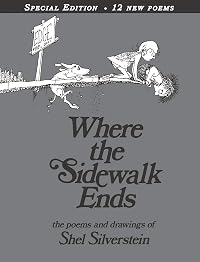
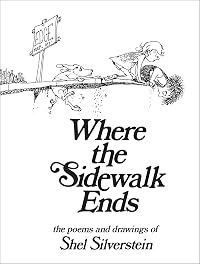
Where the Sidewalk Ends Special Edition with 12 Extra Poems
by Shel Silverstein
On This Page
Description
A boy who turns into a TV set and a girl who eats a whale are only two of the characters in a collection of humorous poetry illustrated with the author's own drawings.Tags
Recommendations


Member Reviews
I've read this poetry collection multiple times as a kid and adult - but let me tell you I felt like I was reading it for the first time when I listened to the audiobook of Shel Silverstein narrating it himself. Equal parts terrifying and hilarious - his voices are next level. I legit thought I was on drugs listening to this. But wow - what a new way to appreciate this masterpiece. I can't wait to read it to Pia someday. Or maybe I'll traumatize her and make her listen to the audiobook as well!
I had managed to get through a childhood in the 70s without ever reading Shel Silverstein, don't quite know how that happened. A very enjoyable batch of poems, though some tended to darker than I expected. I also really loved the illustrations, pen and ink drawings are my one weakness.
I hadn't, not ever, read this book before.
I read it so to see what it had in store.
Instantly I found poetry I adore.
It was far and away not close to a bore.
Neither choreworthy, nor a snoozable snore.
It was sizable but left me wanting more.
Playfulness lies deep in the heart of its core.
The wordplay was something into which I tore.
High up, this ranks on imaginative score.
Wonderful, this entry in Silverstein lore.
Enriching this was, because I had been poor.
Having never, not ever, read this before.
I read it so to see what it had in store.
Instantly I found poetry I adore.
It was far and away not close to a bore.
Neither choreworthy, nor a snoozable snore.
It was sizable but left me wanting more.
Playfulness lies deep in the heart of its core.
The wordplay was something into which I tore.
High up, this ranks on imaginative score.
Wonderful, this entry in Silverstein lore.
Enriching this was, because I had been poor.
Having never, not ever, read this before.
This collection of poetry was a perennial favorite at the school library when I was a kid. You had to be on the waiting list to have a chance for checking it out. I loved it back then, and I love it now. When my girls were in elementary school, I read these poems to them, and they got a kick of this book, as well. Silverstein's poetry is a blend of funny, dreamy, surreal, quirky, and sometimes a little gross. They center on topics that kids can relate to: not wanting to go to school, making up imaginary friends, refusing to take the trash out. With his kid-friendly subject matter and lyrical language that is funny and sometimes eerie or whimsical, it's not surprising that Silverstein's poetry is a hit for both children and adults.
This book contains a number of silly poems and illustrations, with no particular link between any of them (as is often the case with poetry collections). As a child I absolutely LOVED this book as well as some of Silverstein's other collections of poetry. The only poem I actually remembered going into this book, however, was "Sarah Cynthia Sylvia Stout Would Not Take the Garbage Out," and that's also just about the only one that rang any bells as I was re-reading this book recently.
As an adult, it's strange to take another look at this book and realize how morbid some of it is (for instance, one poem is being written by a person being eaten by a boa constrictor, another by a person who just ate a baby). On the other hand, some of it show more requires a bit of sophistication to understand what is going on, such as "The Farmer and the Queen" in which several plays on words make the narrative work; oftentimes the poem makes fun of its child narrator's lack of understanding, such as when a youngster cannot understand why his father is mad that he traded his 1 dollar bill for 5 pennies when that's a larger number of money pieces. Every once in a while, a reference seems dated, such as an illustration of an old tube TV with a "rabbit ear" antenna.
As is always the case it seems with Silverstein, some poems seem to have a teachable moral, albeit done to comic effect. For instance, if you let the garbage pile up or refuse to bath, people will be wary of becoming friends with you. Others, however, relay questionable behaviors or thoughts, such as believing the Earth is flat or that the evil "googies" who steal children actually want the ones who behave well, not the ones who behave badly.
The illustrations in this book serve to further the story or sometimes make it more humorous by contradicting the words. This special edition ends with 12 additional poems not present in the original edition of the book. I'm not sure that makes a huge difference for many, other than die-hard Silverstein fans, but it is nice to have some bonus material. show less
As an adult, it's strange to take another look at this book and realize how morbid some of it is (for instance, one poem is being written by a person being eaten by a boa constrictor, another by a person who just ate a baby). On the other hand, some of it show more requires a bit of sophistication to understand what is going on, such as "The Farmer and the Queen" in which several plays on words make the narrative work; oftentimes the poem makes fun of its child narrator's lack of understanding, such as when a youngster cannot understand why his father is mad that he traded his 1 dollar bill for 5 pennies when that's a larger number of money pieces. Every once in a while, a reference seems dated, such as an illustration of an old tube TV with a "rabbit ear" antenna.
As is always the case it seems with Silverstein, some poems seem to have a teachable moral, albeit done to comic effect. For instance, if you let the garbage pile up or refuse to bath, people will be wary of becoming friends with you. Others, however, relay questionable behaviors or thoughts, such as believing the Earth is flat or that the evil "googies" who steal children actually want the ones who behave well, not the ones who behave badly.
The illustrations in this book serve to further the story or sometimes make it more humorous by contradicting the words. This special edition ends with 12 additional poems not present in the original edition of the book. I'm not sure that makes a huge difference for many, other than die-hard Silverstein fans, but it is nice to have some bonus material. show less
Shel Silverstein’s Where the Sidewalk Ends is a collection of poetry that embraces silliness and escapism in all its rapturous glory. Whether describing unicorns, festoons, dancing pants, or cross-continental garbage, Silverstein brings joy and ridiculousness to every page. Silverstein’s focus is more on wordplay and rhyme than coherence: while the verse is clever and imaginative in its storytelling, it tends to favor feeling over any specific message or theme. For a young child reading these poems, however, theme will not be a primary concern; rather, kids will simply love these improbable stories of Captain Hook, crocodiles, and double-tail dogs. Like Dr. Seuss before him, Silverstein seems uninhibited by reality, and is capable show more of envisioning fantastic worlds full of fancy and fun.
My first exposure to Shel Silverstein came in the form of a song: “A Boy Named Sue,” popularized by the late Johnny Cash. In that song, a male narrator with a girl’s name searches far and wide for his father, only to discover that his ridicule-worthy name was actually a gift from his dad. While “A Boy Named Sue” is a bit darker and more mature than the pieces in Where the Sidewalk Ends, the template of silly narratives remains the same: the impossible becomes merely improbable, and nothing is beyond the reaches of imagination.
My favorite piece in the collection is “Hug O’ War,” which describes a game in which “everyone cuddles / And everyone wins.” Where the Sidewalk Ends has a similar effect on the reader: one is left with the feeling of a warm embrace from an old friend, long after the last page has been turned. This is a wonderful collection of poetry, a book that will engage children with its outlandish creativity and imagination. Even though the book was initially published 36 years ago, it seems as timeless as a child’s chalk drawing on the sidewalk.
Citation:
Silverstein, Shel. Where the Sidewalk Ends: The Poems & Drawings of Shel Silverstein. New York: Harper and Row, 1974. Print. show less
My first exposure to Shel Silverstein came in the form of a song: “A Boy Named Sue,” popularized by the late Johnny Cash. In that song, a male narrator with a girl’s name searches far and wide for his father, only to discover that his ridicule-worthy name was actually a gift from his dad. While “A Boy Named Sue” is a bit darker and more mature than the pieces in Where the Sidewalk Ends, the template of silly narratives remains the same: the impossible becomes merely improbable, and nothing is beyond the reaches of imagination.
My favorite piece in the collection is “Hug O’ War,” which describes a game in which “everyone cuddles / And everyone wins.” Where the Sidewalk Ends has a similar effect on the reader: one is left with the feeling of a warm embrace from an old friend, long after the last page has been turned. This is a wonderful collection of poetry, a book that will engage children with its outlandish creativity and imagination. Even though the book was initially published 36 years ago, it seems as timeless as a child’s chalk drawing on the sidewalk.
Citation:
Silverstein, Shel. Where the Sidewalk Ends: The Poems & Drawings of Shel Silverstein. New York: Harper and Row, 1974. Print. show less
This newer version of Shel Silverstein's poems and drawings is the newest way to draw kids into the reading. The poetry style and pictures are perfect for introducing students to the concept of poetry. It also provides the students with an alternative perspective to being a poet (you can be a guy and not a just an old famous dude). The humor in the book provides the students with examples of how to get creative with writing and the use of words.
Members
- Recently Added By
Lists

4th Grade Books
312 works; 5 members
Author Information

100+ Works 85,840 Members
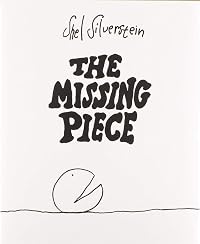
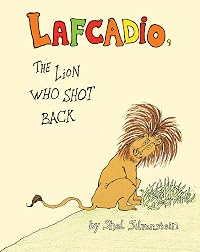
The most popular current writer of humorous verse for children, Shel Silverstein was born in Chicago, Illinois, has been married and divorced, has one daughter, and currently lives in Brooklyn, New York. His career includes composing popular songs, drawing cartoons, writing many adult articles (several for Playboy), and acting. However, he is best show more known for his self-illustrated children's poetry. His first such book was Uncle Shelby's Story of Lafcadio, the Lion Who Shot Back (1963), the humorous tale of a lion who turns the tables on hunters. It was followed by The Giving Tree (1964), a story of a parentlike tree that gives endlessly and is endlessly used by its son. Several other such picture books followed, including The Missing Piece (1976), about a circle that goes in search of a missing piece, and its sequel, The Missing Piece Meets the Big O (1981). However, two collections of poetry are probably his best-loved work: Where the Sidewalk Ends: The Poems and Drawings of Shel Silverstein (1974), and A Light in the Attic (1981). All of Silverstein's poetry for children employs the language play common to Lewis Carroll and Edward Lear. Silverstein is probably the best of the contemporary nonsense poets for children. (Bowker Author Biography) show less
Work Relationships
Is an expanded version of
Common Knowledge
- Canonical title
- Where the Sidewalk Ends Special Edition with 12 Extra Poems
- Alternate titles
- Where the Sidewalk Ends 30th Anniversary Edition
- Original publication date
- 2004
- Disambiguation notice
- Please keep separate this expanded edition of "Where the Sidewalk Ends" (ISBNs 0060572345, 0439812321, 0060586532) from the original edition and others which do not contain the extra poems.
Classifications
Statistics
- Members
- 5,719
- Popularity
- 2,288
- Reviews
- 217
- Rating
- (4.46)
- Languages
- English
- Media
- Paper
- ISBNs
- 3
- ASINs
- 8