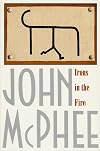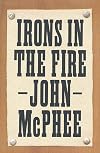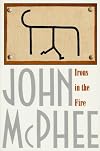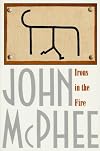
Irons in the Fire
by John McPhee
On This Page
Description
The differing contents of this book reflect the variety in the overall span of master observer McPhee's work. Irons in the Fire concerns catlle rustling in contemporary Nevada. The Gravel Page is about forensic geology--a science used to help solve major crimes and puzzles on an even greater scale. Rinard at Manheim is an experimental story about an auction of exotic cars. Items as unlikely as a virgin forest in central New Jersey and a mountain of forty-four million scrap tires in show more California shape the scenes and substance of other pieces. Not to mention Plymouth Rock: Travels of the Rock, about a day when the State of Massachusetts had to call in a mason to repair the nation's most hallowed lithic relic, is a blend of colonial history, paleogeography, radiometric dating, societal drift, tectonic theory, schoolkids, and Mayflower descendants in leather jackets and one-way shades.--From publisher description. show lessTags
Recommendations











Member Reviews
I have a strong bias, but John McPhee’s Irons in the Fire is a masterful rendition of narrative nonfiction; richly textured stories shaped by McPhee’s insatiable curiosity and meticulous reporting. With his signature blend of literary and journalistic precision, McPhee crafts essays that act as a reminder that even the most overlooked stories can reveal unexpected depth and meaning.
The title essay centers on a brand inspector in Nevada, a figure who might seem anachronistic but proves deeply relevant in the modern West. McPhee immerses readers in the gritty, sun-scorched terrain of contemporary ranching, where cattle rustling remains a real and evolving crime. He evokes the rhythms of life on remote ranches, capturing the isolation, show more the dust and heat, the camaraderie among the crew, and the quiet authority of the inspector, who reads brands like a second language.
A standout essay explores forensic geology. McPhee introduces readers to pioneering FBI geologists who use soil and rock evidence with remarkable precision. He recounts how mineral grains found on a car’s undercarriage helped identify the killer of beer magnate Adolph Coors, and how another geologist played a key role in solving the murder of DEA agent Enrique Salazar in Mexico, despite resistance from corrupt officials. McPhee traces the field’s origins to early European cases, including Georg Popp’s groundbreaking work in 1904, where soil layers on a suspect’s clothing helped reconstruct a murder scene. These geologists act as detectives, decoding the earth’s subtle clues to uncover truths hidden beneath the surface. Even a single grain of sand can become a key witness. In one particularly compelling case study, McPhee recounts the history of Japan’s World War II balloon bombing campaign. These hydrogen-filled paper balloons, carried across the Pacific by the jet stream, were designed to ignite forest fires and create panic in the American West. Though largely ineffective, one balloon tragically killed six civilians in Oregon in 1945, marking the only enemy-inflicted fatalities on the U.S. mainland during the war. McPhee uses this episode to illustrate how forensic geologists helped trace the origin of the sand ballast used in the balloons, identifying its Japanese source and helping unravel the mystery behind the attacks.
Other essays in the collection offer equally engaging perspectives. One provides a brief but thoughtful look into the parole system, highlighting the human complexities behind institutional processes. McPhee presents this story with quiet empathy, avoiding sensationalism and focusing instead on the lived realities of justice and rehabilitation. In another, he shifts to one of the last untouched forests in New Jersey, reflecting on conservation and the subtle power of wilderness. His reverence for nature and its cultural significance comes through in this compact meditation. McPhee also investigates environmental hazards, focusing on the disposal of used tires, he examines how tire piles pose fire dangers, scar landscapes, and challenge both regulators and industry to find sustainable solutions. Another essay offers a colorful account of an exotic car auction in Pennsylvania, where personalities and passions collide in a spectacle of nostalgia and mechanical beauty. And in a particularly memorable piece, McPhee blends history, geology, and cultural commentary to trace the physical and symbolic journey of Plymouth Rock, exploring how landscapes and artifacts shape national identity.
Throughout Irons in the Fire, McPhee’s writing is clear, thoughtful, and observant. He approaches his subjects (cowboys, scientists, parolees, auctioneers) with respect and curiosity, letting their stories unfold without embellishment. The collection shows how much depth can be found in everyday lives and places when viewed with attention and care. show less
The title essay centers on a brand inspector in Nevada, a figure who might seem anachronistic but proves deeply relevant in the modern West. McPhee immerses readers in the gritty, sun-scorched terrain of contemporary ranching, where cattle rustling remains a real and evolving crime. He evokes the rhythms of life on remote ranches, capturing the isolation, show more the dust and heat, the camaraderie among the crew, and the quiet authority of the inspector, who reads brands like a second language.
A standout essay explores forensic geology. McPhee introduces readers to pioneering FBI geologists who use soil and rock evidence with remarkable precision. He recounts how mineral grains found on a car’s undercarriage helped identify the killer of beer magnate Adolph Coors, and how another geologist played a key role in solving the murder of DEA agent Enrique Salazar in Mexico, despite resistance from corrupt officials. McPhee traces the field’s origins to early European cases, including Georg Popp’s groundbreaking work in 1904, where soil layers on a suspect’s clothing helped reconstruct a murder scene. These geologists act as detectives, decoding the earth’s subtle clues to uncover truths hidden beneath the surface. Even a single grain of sand can become a key witness. In one particularly compelling case study, McPhee recounts the history of Japan’s World War II balloon bombing campaign. These hydrogen-filled paper balloons, carried across the Pacific by the jet stream, were designed to ignite forest fires and create panic in the American West. Though largely ineffective, one balloon tragically killed six civilians in Oregon in 1945, marking the only enemy-inflicted fatalities on the U.S. mainland during the war. McPhee uses this episode to illustrate how forensic geologists helped trace the origin of the sand ballast used in the balloons, identifying its Japanese source and helping unravel the mystery behind the attacks.
Other essays in the collection offer equally engaging perspectives. One provides a brief but thoughtful look into the parole system, highlighting the human complexities behind institutional processes. McPhee presents this story with quiet empathy, avoiding sensationalism and focusing instead on the lived realities of justice and rehabilitation. In another, he shifts to one of the last untouched forests in New Jersey, reflecting on conservation and the subtle power of wilderness. His reverence for nature and its cultural significance comes through in this compact meditation. McPhee also investigates environmental hazards, focusing on the disposal of used tires, he examines how tire piles pose fire dangers, scar landscapes, and challenge both regulators and industry to find sustainable solutions. Another essay offers a colorful account of an exotic car auction in Pennsylvania, where personalities and passions collide in a spectacle of nostalgia and mechanical beauty. And in a particularly memorable piece, McPhee blends history, geology, and cultural commentary to trace the physical and symbolic journey of Plymouth Rock, exploring how landscapes and artifacts shape national identity.
Throughout Irons in the Fire, McPhee’s writing is clear, thoughtful, and observant. He approaches his subjects (cowboys, scientists, parolees, auctioneers) with respect and curiosity, letting their stories unfold without embellishment. The collection shows how much depth can be found in everyday lives and places when viewed with attention and care. show less
Ah, I'm a total sucker for McPhee. Another all-around winner.
I didn't have the patience for the longest one in the book at first (about gravel), but it turned out to be one of the most fascinating, in the end. I want to be a forensic geologist now....
I didn't have the patience for the longest one in the book at first (about gravel), but it turned out to be one of the most fascinating, in the end. I want to be a forensic geologist now....
"Work you never considered people might do" might be the theme of this essay collection. Or you might say the stories are unrelated. Interesting, but in the long run nothing life changing for me. McPhee manages to find people who are passionate about different things, & condenses his conversations into 7 essays. Sometimes, I think, these conversations intersect his own passion & he does some separate research that ties in eons and history--most notably in the geology of rocks mentioned in both the essay on forensic geology and the one on repairing Plymouth Rock. The wide-range of his interests shows in his ability to tie Sherlock Holmes to forensic geology and make interesting the story of how unique rocks can be.
The essay which show more intersected my own personal interest was on managing a piece of forest in NJ which has been uncut since (at least) the Dutch settled in 1701. I had read about the Hutcheson Forest in my studies. The second sentence is a wonderfully descriptive image of what "virgin forest" is. Being of German heritage myself, and also remembering old paintings of the American wilderness which only depicted nicely spaced large trunks, I appreciated the observation of how surprised German researchers were by the messiness of the virgin forest. And even tho I've studied forests for years, I learned new things about natural interrelationships. That "Spicebush and dogwood fruits are very high in lipids...[important for] birds getting ready for long migratory flights" (p.74) which tied in nicely with knowing that some of the more invasive bushes, like honeysuckle and buckthorn, have little food value & the seeds are spread as the food is basically undigested. Or that "Wild grapes are incapable of climbing the trunks of large trees. They are lifted by trees as the trees grow, and their bunches hang from the top of the canopy" (p.71). And I picked up a theory, which I will keep in mind as i observe the woods I hike through, that maybe plants make splotches of early color as a signal to birds that their bird-disseminated fruit is ready to be eaten (p.74). show less
The essay which show more intersected my own personal interest was on managing a piece of forest in NJ which has been uncut since (at least) the Dutch settled in 1701. I had read about the Hutcheson Forest in my studies. The second sentence is a wonderfully descriptive image of what "virgin forest" is. Being of German heritage myself, and also remembering old paintings of the American wilderness which only depicted nicely spaced large trunks, I appreciated the observation of how surprised German researchers were by the messiness of the virgin forest. And even tho I've studied forests for years, I learned new things about natural interrelationships. That "Spicebush and dogwood fruits are very high in lipids...[important for] birds getting ready for long migratory flights" (p.74) which tied in nicely with knowing that some of the more invasive bushes, like honeysuckle and buckthorn, have little food value & the seeds are spread as the food is basically undigested. Or that "Wild grapes are incapable of climbing the trunks of large trees. They are lifted by trees as the trees grow, and their bunches hang from the top of the canopy" (p.71). And I picked up a theory, which I will keep in mind as i observe the woods I hike through, that maybe plants make splotches of early color as a signal to birds that their bird-disseminated fruit is ready to be eaten (p.74). show less
Al Lehman In a land where a common saying is that no one eats his own beef, the Nevada brand inspector becomes crucial to civilization. Without one, There'd be a lot of dead bodies." Rustling in the 1990's is still an occupational hazard where ranches are measured in tens of thousands of acres. John McPhee, a favorite writer of mine, has recently published a new collection of essays entitled, Irons in the Fire. The title essay is his investigation of brands and their history. The brand inspector's job is to keep everyone honest and the ranchers accept this and approve. The inspector also has to be part cop, part private investigator, part, Indian tracker, and have a whole lot of knowledge and instinct for the people and the country in show more order to recognize hundreds of brands and how they might be changed.
In another essay, McPhee writes about the virgin forest, particularly a spot near Brunswick New Jersey where the suburbs grow so fast that animals are often trapped between motels. The land had originally belonged to the Van Liew family who had acquired it in 1701 and farmed all but sixty-five acres they set aside. In the 1950s they consulted a sawyer and discovered that the value of some of the white oaks that dated to the 17th century was "expressible in ducats." Making their desire to sell public, all sorts of organizations came out of the woodwork :-)) to prevent the felling of these trees. Not enough money was raised until the Carpenters' Union bought the land and gave it to Rutgers University in 1955. The restriction on Rutgers were that only a small path could be maintained along one edge. They could not enter or change anything else on the sixty-five acres – just study it from a distance. There are only a few other areas of virgin forest left in the United States – one in Illinois along the Wabash. The Hutcheson Memorial Forest owned by Rutgers is perhaps the most famous. It has supported the research for hundreds of advanced degrees including thirty-six Ph.D.s. "So many articles, papers, theses, and other research publications have come out of Hutcheson Forest that – as the old saw goes – countless trees have been cleared elsewhere just in order to print them." show less
In another essay, McPhee writes about the virgin forest, particularly a spot near Brunswick New Jersey where the suburbs grow so fast that animals are often trapped between motels. The land had originally belonged to the Van Liew family who had acquired it in 1701 and farmed all but sixty-five acres they set aside. In the 1950s they consulted a sawyer and discovered that the value of some of the white oaks that dated to the 17th century was "expressible in ducats." Making their desire to sell public, all sorts of organizations came out of the woodwork :-)) to prevent the felling of these trees. Not enough money was raised until the Carpenters' Union bought the land and gave it to Rutgers University in 1955. The restriction on Rutgers were that only a small path could be maintained along one edge. They could not enter or change anything else on the sixty-five acres – just study it from a distance. There are only a few other areas of virgin forest left in the United States – one in Illinois along the Wabash. The Hutcheson Memorial Forest owned by Rutgers is perhaps the most famous. It has supported the research for hundreds of advanced degrees including thirty-six Ph.D.s. "So many articles, papers, theses, and other research publications have come out of Hutcheson Forest that – as the old saw goes – countless trees have been cleared elsewhere just in order to print them." show less
The story about cattle rustling is best. Also the kidnapping one. Tepidly recommended, except for my dad, who might really like it.
cattle rustlers to blind writer to tree collection in california to plate tectonics--typical McPhee
Ratings
Members
- Recently Added By
Lists

Geology
24 works; 2 members
Author Information

McPhee was born in Princeton, New Jersey, and educated at Princeton University and Cambridge University. His writing career began at Time magazine and led to his long association with the New Yorker, where he has been a staff writer since 1965. That same year he published his first book, A Sense of Where You Are, with FSG, and soon followed with show more The Headmaster (1966), Oranges (1967), The Pine Barrens (1968), A Roomful of Hovings and Other Profiles (collection, 1969), The Crofter and the Laird (1969), Levels of the Game (1970), Encounters with the Archdruid (1972), The Deltoid Pumpkin Seed (1973), The Curve of Binding Energy (1974), Pieces of the Frame (collection, 1975), and The Survival of the Bark Canoe (1975). Both Encounters with the Archdruid and The Curve of Binding Energy were nominated for National Book Awards in the category of science Since 1977, the year in which McPhee received the Award in Literature from the American Academy of Arts and Letters and The John McPhee Reader and the bestselling Coming into the Country appeared in print, Farrar, Straus and Giroux has published Giving Good Weight (collection, 1979), Basin and Range (1981), In Suspect Terrain (1983), La Place de la Concorde Suisse (1984), Table of Contents (collection, 1985), Rising from the Plains (1986), Heirs of General Practice (in a paperback edition, 1986), The Control of Nature (1989), Looking for a Ship (1990), Assembling California (1993), The Ransom of Russian Art (1994), The Second John McPhee Reader (1996), and Irons in the Fire (1997). Annals of the Former World was published in 1998 and was awarded the Pulitzer Prize in 1999. McPhee has taught at Princeton as Ferris Professor since 1975. (Bowker Author Biography) show less
Some Editions
Common Knowledge
- Original publication date
- 1998
- Dedication
- Laura
- First words
- I Princeton, New Jersey, where I live, I was having lunch not long ago with a friend just home from Nevada.
In Lancaster, Pennsylvania, some years ago, I met a pure humanist whose spirit had prospered with the rise of technology.
In virgin forest, the ground is uneven, dimpled with mounds and adjacent pits.
For sixteen years, I have had on my desk petri dishes full of Platte River pebbles.
The world's largest pile of scrap tires is not visible from Interstate 5, in Stanislaus County, California.
Most dealers don't need exotics in their lots. (show all 7)
Plymouth Rock is a glacial erratic at rest in exotic terrane.
Classifications
- Genres
- Nonfiction, General Nonfiction, Science & Nature
- DDC/MDS
- 081 — Computer science, information & general works Anthologies and Quotations General collections in American English
- LCC
- AC8 .M417 — General Works Collections. Series. Collected works Collections. Series. Collected works Collections of monographs, essays, etc. American and English
- BISAC
Statistics
- Members
- 406
- Popularity
- 76,738
- Reviews
- 6
- Rating
- (3.96)
- Languages
- English
- Media
- Paper, Audiobook, Ebook
- ISBNs
- 5
- ASINs
- 4