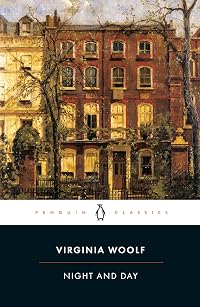
Night and Day
by Virginia Woolf
On This Page
Description
A bold experiment in modernist fiction, Virginia Woolf's novel Night and Day is a study in contrasts. The narrative ricochets between the lives and thoughts of two friends, Katharine Hilbery and Mary Datchet, using the stark differences and points of similarity between them to construct an engrossingly complex and detailed portrait and social commentary..
Tags
Recommendations












Member Reviews
“Her words... were set down as gently and cautiously and exactly as the feet of a Persian cat stepping among china ornaments.”
Woolf, writing about Katherine, could just as easily have been describing her own novel.
Choices - What does it mean to be a woman today?
Are love and marriage inextricably linked - and what sort of love: platonic, passionate, or both? Can men and women be intimate friends without being sexually intimate, or sexually intimate with someone they are not married to? (When Harry Met Sally came to mind.)
“To be engaged to marry some one with whom you are not in love is an inevitable step in a world where the existence of passion is only a traveller’s story brought from the heart of deep forests and told so show more rarely that wise people doubt whether the story can be true.”
Where do career ambitions fit? Does wedlock confine us to conventionality and stymie opportunities outside the home? Must wives submit to their husbands (as exhorted in Ephesians 5:2)? What about less orthodox relationships? How independent can a single woman be?
This was written, and mostly set, in London, almost exactly a century ago, at a time of great social upheaval and uncertainty. The questions the characters agonise over are still valid, though the answers slightly different today.
Although war isn’t even hinted it, this was written during WW1 and finished days after the Armistice in November 1918. Queen Victoria had died less than twenty years earlier, (some) women aged 30 and over had been given the vote in February 1918, and the importance of religion was something that could be questioned, gently.
In this climate of shifting social mores, five single people in their late twenties and early thirties, in overlapping (but not equal) social circles, consider their futures. All are crippled by indecision. Uncertainty about how, when, why, who, and whether to marry, how they feel about the changing roles of men and women, issues of independence versus family obligations (as provider, or as wife and possible mother), the appeal of or need to work, and literature versus science (specifically, the secret vice of “unwomanly” maths and astronomy).
“No work can equal in importance, or be so exciting as, the work of making other people do what you want them to do.”
Then again, that could include the “work” of raising a child.
Night and Day, Inner and Outer
“A feeling of contempt and liking combine very naturally in the mind of one to whom another has just spoken unpremeditatedly, revealing rather more of his private feelings than he intended to reveal.”
The title has no direct bearing on the story, but is indicative of the contrasts within: platonic versus passionate love, career and independence versus commitment and family, town versus country, moneyed versus not, and past versus future.
There is a clear narrative, but much is revealed through inner thoughts (though Mrs Hilberry has a natural antipathy to introspection and Ralph Denham has no use for dreams). These insights are witty, sometimes caustic, and invariably enlightening - though more so to the reader than the person concerned. Outer actions are not necessarily clearly correlated with inner ideals.
Proxies for Passion
Although they are broad-minded for the period (a single woman visiting a man in his rooms at night arouses no angst, and cohabitation and three-way relationships are mooted), statues, gloves, handbag contents, flowers, and flames are also used as proxies for real feelings. Outer manifestations are sometimes veiled. Some passages were strongly reminiscent of DH Lawrence:
Examples hidden for brevity; no plot spoilers.
• “The very trees and the green merging into the blue distance became symbols of the vast external world which recks so little of the happiness, of the marriages or deaths of individuals… When he saw Katharine among the orchids, her beauty strangely emphasized by the fantastic plants, which seemed to peer and gape at her from striped hoods and fleshy throats, his ardor for botany waned, and a more complex feeling replaced it. She fell silent. The orchids seemed to suggest absorbing reflections. In defiance of the rules she stretched her ungloved hand and touched one… He looked at her taking in one strange shape after another with the contemplative, considering gaze of a person who sees not exactly what is before him, but gropes in regions that lie beyond it… Her still look, standing among the orchids in that hot atmosphere, strangely illustrated some scene that he had imagined in his room at home.”
• “So secure did she feel with these silent shapes that she almost yielded to an impulse to say ‘I am in love with you’ aloud. The presence of this immense and enduring beauty [the Elgin Marbles] made her almost alarmingly conscious of her desire, and at the same time proud of a feeling which did not display anything like the same proportions when she was going about her daily work.”
• "But he persuaded her into a broken statement, beautiful to him, charged with extreme excitement as she spoke of the dark red fire, and the smoke twined round it, making him feel that he had stepped over the threshold into the faintly lit vastness of another mind, stirring with shapes, so large, so dim, unveiling themselves only in flashes, and moving away again into the darkness, engulfed by it."
Biography as Metaphor
While the younger generation try to make sense of the future, Mrs Hilberry tries to make sense of the past by writing a biography of her father, a famous poet. She is assisted by her daughter, Katherine, who sees the book as repayment to the world for their privileged position. But it means that, like Titus Groan, who was “suckled on shadows”, much of Katherine’s time is “spent in imagination with the dead”. But then again, perhaps the act of reading this is time spent in imagination with the dead?
It is a Sisyphean and disorganised project, with difficult and unresolved decisions about what to include and what to omit, not just in terms of length and relevance, but also of privacy and propriety.
The rambling draft includes:
“Twenty pages upon her grandfather’s taste in hats, an essay upon contemporary china, a long account of a summer day’s expedition into the country, when they had missed their train, together with fragmentary visions of all sorts of famous men and women, which seemed to be partly imaginary and partly authentic.”
Indecision - Theirs and Mine
This is carefully, insightfully, and beautifully written (see quotes), but I became increasingly exasperated at the endless overwrought indecision, and even the frequency of popping in for tea began to feel clichéd.
People fall in and out of love ludicrously quickly, and yet it’s painfully strung out too. They ponder the meaning and necessity of love, and whether their (current) love object is same as their imagined, idealised version of them: passion is greater in absence than reality. Some wonder about mere happiness or whether to settle for being less unhappy. They also flip-flop decisions about where to live, what job to do, and whether to go for tea.
Woolf turned me into Lady Bracknell, as I recalled her comment in The Importance of Being Earnest (see my review here) about Bunbury needing to make up his mind whether he was going to live or to die: “This shilly-shallying with the question is absurd.”
Woolf created indecision in me: I loved the first third of this book: exquisite social comedy (comedy is too strong, but I’m not sure of a better word). I enjoyed the second third. But the final third was hugely disappointing: often farcical, with people behind curtains and furniture accidentally hearing crucial information. And then it redeemed itself in the final two or three pages. Hurrah for ambiguity.
QUOTES
Reading this was often like walking alongside a bubbling brook on a sunny day: sparking prose catching my eye at every turn. The descriptions of place (London, and people’s rooms) are especially immersive.
General Quotes
Hidden for brevity; no plot spoilers.
• “One can’t help believing gentlemen with Roman noses, even if one meets them in omnibuses.”
• “He was amused and gratified to find that he had the power to annoy his oblivious, supercilious hostess, if he could not impress her; though he would have preferred to impress her.”
• “There are some books that live... They are young with us, and they grow old with us.”
• “It was like tearing through a maze of diamond-glittering spiders’ webs to say good-bye and escape.”
• "She pressed her eyeballs until they struck stars and suns into her darkness. She convinced herself that she was stirring among ashes."
• "Why, you're nothing at all without it [marriage]; you're only half alive; using only half your faculties." Said to a woman, of course.
• A “Frown of well-simulated annoyance, which presently dissolved in a kind of half-humorous, half-surly shrug, as of a large dog tormented by children who shakes his ears.”
• “One of those martyred spirits to whom literature is at once a source of divine joy and of almost intolerable irritation.”
• “Mary felt, at last, that she was the centre ganglion of a very fine network of nerves which fell over England, and one of these days, when she touched the heart of the system, would begin feeling and rushing together and emitting their splendid blaze of revolutionary fireworks—for some such metaphor represents what she felt about her work, when her brain had been heated by three hours of application.”
• “She was much inclined to sit on into the night, spinning her light fabric of thoughts until she tired of their futility, and went to her mathematics.”
• “Never are voices so beautiful as on a winter’s evening, when dusk almost hides the body, and they seem to issue from nothingness with a note of intimacy seldom heard by day.”
• “Much as a literary person in like circumstances would begin, absent-mindedly, pulling out volume after volume, so she stepped into the garden in order to have the stars at hand, even though she did not look at them.”
• “The first signs of spring, even such as make themselves felt towards the middle of February, not only produce little white and violet flowers in the more sheltered corners of woods and gardens, but bring to birth thoughts and desires comparable to those faintly coloured and sweetly scented petals in the minds of men and women. Lives frozen by age, so far as the present is concerned, to a hard surface, which neither reflects nor yields, at this season become soft and fluid, reflecting the shapes and colours of the present, as well as the shapes and colours of the past. In the case of Mrs. Hilbery, these early spring days were chiefly upsetting inasmuch as they caused a general quickening of her emotional powers, which, as far as the past was concerned, had never suffered much diminution. But in the spring her desire for expression invariably increased. She was haunted by the ghosts of phrases. She gave herself up to a sensual delight in the combinations of words. She sought them in the pages of her favourite authors.”
• “For the more she looked into the confusion of lives which, instead of running parallel, had suddenly intersected each other, the more distinctly she seemed to convince herself that there was no other light on them than was shed by this strange illumination, and no other path save the one upon which it threw its beams.”
• “She needed nothing that he could give her.”
• “He wished to keep this distance between them—the distance which separates the devotee from the image in the shrine.”
• “There were ghosts in the room, and one, strangely and sadly, was the ghost of herself.”
Edwardian London - Quotes
Hidden for brevity; no plot spoilers.
• “Breathing raw fog, and in contact with unpolished people who only wanted their share of the pavement.”
• “They looked… first at the hard silver moon, stationary among a hurry of little grey-blue clouds, and then down the roofs of London, with all their upright chimneys, and then below them at the empty moonlit pavement of the street, upon which the joint of each paving-stone was clearly marked out.”
• “When the traffic thins away, the walker becomes conscious of the moon in the street, as if the curtains of the sky had been drawn apart, and the heaven lay bare, as it does in the country.”
• “London, in the first days of spring, has buds that open and flowers that suddenly shake their petals—white, purple, or crimson—in competition with the display in the garden beds, although these city flowers are merely so many doors flung wide in Bond Street and the neighbourhood, inviting you to look at a picture, or hear a symphony, or merely crowd and crush yourself among all sorts of vocal, excitable, brightly coloured human beings. But, all the same, it is no mean rival to the quieter process of vegetable florescence. Whether or not there is a generous motive at the root, a desire to share and impart, or whether the animation is purely that of insensate fervour and friction, the effect, while it lasts, certainly encourages those who are young, and those who are ignorant, to think the world one great bazaar, with banners fluttering and divans heaped with spoils from every quarter of the globe for their delight.”
• “The blend of daylight and of lamplight made her an invisible spectator, just as it gave the people who passed her a semi-transparent quality, and left the faces pale ivory ovals in which the eyes alone were dark. They tended the enormous rush of the current—the great flow, the deep stream, the unquenchable tide. She stood unobserved and absorbed, glorying openly in the rapture that had run subterraneously all day.”
People Revealed by their Rooms - Quotes
Hidden for brevity; no plot spoilers.
• “The room of a person [Rodney] who cherishes a great many personal tastes, guarding them from the rough blasts of the public with scrupulous attention.”
• “The room, with its combination of luxury and bareness, its silk dressing-gowns and crimson slippers, its shabby carpet and bare walls, had a powerful air of Katharine herself.”
• "Cassandra began to take down the books which stood in a row upon the shelf above the bed. In most houses this shelf is the ledge upon which the last relics of religious belief lodge themselves as if, late at night, in the heart of privacy, people, sceptical by day, find solace in sipping one draught of the old charm for such sorrows or perplexities as may steal from their hiding-places in the dark. But there was no hymn-book here. "
• “The unsparing light revealed more ugliness than Katharine had seen in one room for a very long time. It was the ugliness of enormous folds of brown material, looped and festooned, of plush curtains, from which depended balls and fringes, partially concealing bookshelves swollen with black school-texts.”
Key Characters
Hidden for brevity; no plot spoilers.There are five main, intertwined protagonists.
Katherine Hilberry is very self-contained, something of a loner, yet she is the flame to which the other characters are repeatedly drawn. She is loosely based on Woolf’s sister, Vanessa Bell.
She is contrasted with her Lincolnshire cousin, Cassandra Otway, who is younger, but more Victorian. Whereas Katherine is an only child, Cassandra is one of a dozen, and though her father is titled, they are no longer wealthy. “Where Katharine was simple, Cassandra was complex; where Katharine was solid and direct, Cassandra was vague and evasive. In short, they represented very well the manly and the womanly sides of the feminine nature.”
The men are Ralph Denham and William Rodney. The former is a young lawyer of “eccentric” hobbies (bulldogs, wildflowers, and heraldry), supporting his widowed mother and siblings. The latter is a stuffier, wealthier (though not hugely successful) writer of plays and poems.
And among them all is Mary Datchet, a Lincolnshire vicar’s daughter, living alone in London, passionately committed to her work for a women’s suffrage campaign.
Image Sources
• Woman considering options: http://w4wn.com/wp-content/uploads/2014/07/Decision-Making-300x193.jpg
• London in the style of (Victorian) artist Atkinson Grimshaw, by William Dudley: http://gerrie-thefriendlyghost.blogspot.co.uk/2012/01/around-antwerpen-school-of....
Tl;dnr
As Apatt suggests in a comment below, this is a feminist novel, but it's not a strident or preachy one. It predates common use of the term, but all the main characters are reassessing the evolving roles of women and men.
There is no simple answer to the dilemma of marriage and domesticity versus independence, but if Woolf is to be believed, literature (especially Shakespeare) and tea will fix most things. show less
Woolf, writing about Katherine, could just as easily have been describing her own novel.
Choices - What does it mean to be a woman today?
Are love and marriage inextricably linked - and what sort of love: platonic, passionate, or both? Can men and women be intimate friends without being sexually intimate, or sexually intimate with someone they are not married to? (When Harry Met Sally came to mind.)
“To be engaged to marry some one with whom you are not in love is an inevitable step in a world where the existence of passion is only a traveller’s story brought from the heart of deep forests and told so show more rarely that wise people doubt whether the story can be true.”
Where do career ambitions fit? Does wedlock confine us to conventionality and stymie opportunities outside the home? Must wives submit to their husbands (as exhorted in Ephesians 5:2)? What about less orthodox relationships? How independent can a single woman be?
This was written, and mostly set, in London, almost exactly a century ago, at a time of great social upheaval and uncertainty. The questions the characters agonise over are still valid, though the answers slightly different today.
Although war isn’t even hinted it, this was written during WW1 and finished days after the Armistice in November 1918. Queen Victoria had died less than twenty years earlier, (some) women aged 30 and over had been given the vote in February 1918, and the importance of religion was something that could be questioned, gently.
In this climate of shifting social mores, five single people in their late twenties and early thirties, in overlapping (but not equal) social circles, consider their futures. All are crippled by indecision. Uncertainty about how, when, why, who, and whether to marry, how they feel about the changing roles of men and women, issues of independence versus family obligations (as provider, or as wife and possible mother), the appeal of or need to work, and literature versus science (specifically, the secret vice of “unwomanly” maths and astronomy).
“No work can equal in importance, or be so exciting as, the work of making other people do what you want them to do.”
Then again, that could include the “work” of raising a child.
Night and Day, Inner and Outer
“A feeling of contempt and liking combine very naturally in the mind of one to whom another has just spoken unpremeditatedly, revealing rather more of his private feelings than he intended to reveal.”
The title has no direct bearing on the story, but is indicative of the contrasts within: platonic versus passionate love, career and independence versus commitment and family, town versus country, moneyed versus not, and past versus future.
There is a clear narrative, but much is revealed through inner thoughts (though Mrs Hilberry has a natural antipathy to introspection and Ralph Denham has no use for dreams). These insights are witty, sometimes caustic, and invariably enlightening - though more so to the reader than the person concerned. Outer actions are not necessarily clearly correlated with inner ideals.
Proxies for Passion
Although they are broad-minded for the period (a single woman visiting a man in his rooms at night arouses no angst, and cohabitation and three-way relationships are mooted), statues, gloves, handbag contents, flowers, and flames are also used as proxies for real feelings. Outer manifestations are sometimes veiled. Some passages were strongly reminiscent of DH Lawrence:
Examples hidden for brevity; no plot spoilers.
• “The very trees and the green merging into the blue distance became symbols of the vast external world which recks so little of the happiness, of the marriages or deaths of individuals… When he saw Katharine among the orchids, her beauty strangely emphasized by the fantastic plants, which seemed to peer and gape at her from striped hoods and fleshy throats, his ardor for botany waned, and a more complex feeling replaced it. She fell silent. The orchids seemed to suggest absorbing reflections. In defiance of the rules she stretched her ungloved hand and touched one… He looked at her taking in one strange shape after another with the contemplative, considering gaze of a person who sees not exactly what is before him, but gropes in regions that lie beyond it… Her still look, standing among the orchids in that hot atmosphere, strangely illustrated some scene that he had imagined in his room at home.”
• “So secure did she feel with these silent shapes that she almost yielded to an impulse to say ‘I am in love with you’ aloud. The presence of this immense and enduring beauty [the Elgin Marbles] made her almost alarmingly conscious of her desire, and at the same time proud of a feeling which did not display anything like the same proportions when she was going about her daily work.”
• "But he persuaded her into a broken statement, beautiful to him, charged with extreme excitement as she spoke of the dark red fire, and the smoke twined round it, making him feel that he had stepped over the threshold into the faintly lit vastness of another mind, stirring with shapes, so large, so dim, unveiling themselves only in flashes, and moving away again into the darkness, engulfed by it."
Biography as Metaphor
While the younger generation try to make sense of the future, Mrs Hilberry tries to make sense of the past by writing a biography of her father, a famous poet. She is assisted by her daughter, Katherine, who sees the book as repayment to the world for their privileged position. But it means that, like Titus Groan, who was “suckled on shadows”, much of Katherine’s time is “spent in imagination with the dead”. But then again, perhaps the act of reading this is time spent in imagination with the dead?
It is a Sisyphean and disorganised project, with difficult and unresolved decisions about what to include and what to omit, not just in terms of length and relevance, but also of privacy and propriety.
The rambling draft includes:
“Twenty pages upon her grandfather’s taste in hats, an essay upon contemporary china, a long account of a summer day’s expedition into the country, when they had missed their train, together with fragmentary visions of all sorts of famous men and women, which seemed to be partly imaginary and partly authentic.”
Indecision - Theirs and Mine
This is carefully, insightfully, and beautifully written (see quotes), but I became increasingly exasperated at the endless overwrought indecision, and even the frequency of popping in for tea began to feel clichéd.
People fall in and out of love ludicrously quickly, and yet it’s painfully strung out too. They ponder the meaning and necessity of love, and whether their (current) love object is same as their imagined, idealised version of them: passion is greater in absence than reality. Some wonder about mere happiness or whether to settle for being less unhappy. They also flip-flop decisions about where to live, what job to do, and whether to go for tea.
Woolf turned me into Lady Bracknell, as I recalled her comment in The Importance of Being Earnest (see my review here) about Bunbury needing to make up his mind whether he was going to live or to die: “This shilly-shallying with the question is absurd.”
Woolf created indecision in me: I loved the first third of this book: exquisite social comedy (comedy is too strong, but I’m not sure of a better word). I enjoyed the second third. But the final third was hugely disappointing: often farcical, with people behind curtains and furniture accidentally hearing crucial information. And then it redeemed itself in the final two or three pages. Hurrah for ambiguity.
QUOTES
Reading this was often like walking alongside a bubbling brook on a sunny day: sparking prose catching my eye at every turn. The descriptions of place (London, and people’s rooms) are especially immersive.
General Quotes
Hidden for brevity; no plot spoilers.
• “One can’t help believing gentlemen with Roman noses, even if one meets them in omnibuses.”
• “He was amused and gratified to find that he had the power to annoy his oblivious, supercilious hostess, if he could not impress her; though he would have preferred to impress her.”
• “There are some books that live... They are young with us, and they grow old with us.”
• “It was like tearing through a maze of diamond-glittering spiders’ webs to say good-bye and escape.”
• "She pressed her eyeballs until they struck stars and suns into her darkness. She convinced herself that she was stirring among ashes."
• "Why, you're nothing at all without it [marriage]; you're only half alive; using only half your faculties." Said to a woman, of course.
• A “Frown of well-simulated annoyance, which presently dissolved in a kind of half-humorous, half-surly shrug, as of a large dog tormented by children who shakes his ears.”
• “One of those martyred spirits to whom literature is at once a source of divine joy and of almost intolerable irritation.”
• “Mary felt, at last, that she was the centre ganglion of a very fine network of nerves which fell over England, and one of these days, when she touched the heart of the system, would begin feeling and rushing together and emitting their splendid blaze of revolutionary fireworks—for some such metaphor represents what she felt about her work, when her brain had been heated by three hours of application.”
• “She was much inclined to sit on into the night, spinning her light fabric of thoughts until she tired of their futility, and went to her mathematics.”
• “Never are voices so beautiful as on a winter’s evening, when dusk almost hides the body, and they seem to issue from nothingness with a note of intimacy seldom heard by day.”
• “Much as a literary person in like circumstances would begin, absent-mindedly, pulling out volume after volume, so she stepped into the garden in order to have the stars at hand, even though she did not look at them.”
• “The first signs of spring, even such as make themselves felt towards the middle of February, not only produce little white and violet flowers in the more sheltered corners of woods and gardens, but bring to birth thoughts and desires comparable to those faintly coloured and sweetly scented petals in the minds of men and women. Lives frozen by age, so far as the present is concerned, to a hard surface, which neither reflects nor yields, at this season become soft and fluid, reflecting the shapes and colours of the present, as well as the shapes and colours of the past. In the case of Mrs. Hilbery, these early spring days were chiefly upsetting inasmuch as they caused a general quickening of her emotional powers, which, as far as the past was concerned, had never suffered much diminution. But in the spring her desire for expression invariably increased. She was haunted by the ghosts of phrases. She gave herself up to a sensual delight in the combinations of words. She sought them in the pages of her favourite authors.”
• “For the more she looked into the confusion of lives which, instead of running parallel, had suddenly intersected each other, the more distinctly she seemed to convince herself that there was no other light on them than was shed by this strange illumination, and no other path save the one upon which it threw its beams.”
• “She needed nothing that he could give her.”
• “He wished to keep this distance between them—the distance which separates the devotee from the image in the shrine.”
• “There were ghosts in the room, and one, strangely and sadly, was the ghost of herself.”
Edwardian London - Quotes
Hidden for brevity; no plot spoilers.
• “Breathing raw fog, and in contact with unpolished people who only wanted their share of the pavement.”
• “They looked… first at the hard silver moon, stationary among a hurry of little grey-blue clouds, and then down the roofs of London, with all their upright chimneys, and then below them at the empty moonlit pavement of the street, upon which the joint of each paving-stone was clearly marked out.”
• “When the traffic thins away, the walker becomes conscious of the moon in the street, as if the curtains of the sky had been drawn apart, and the heaven lay bare, as it does in the country.”
• “London, in the first days of spring, has buds that open and flowers that suddenly shake their petals—white, purple, or crimson—in competition with the display in the garden beds, although these city flowers are merely so many doors flung wide in Bond Street and the neighbourhood, inviting you to look at a picture, or hear a symphony, or merely crowd and crush yourself among all sorts of vocal, excitable, brightly coloured human beings. But, all the same, it is no mean rival to the quieter process of vegetable florescence. Whether or not there is a generous motive at the root, a desire to share and impart, or whether the animation is purely that of insensate fervour and friction, the effect, while it lasts, certainly encourages those who are young, and those who are ignorant, to think the world one great bazaar, with banners fluttering and divans heaped with spoils from every quarter of the globe for their delight.”
• “The blend of daylight and of lamplight made her an invisible spectator, just as it gave the people who passed her a semi-transparent quality, and left the faces pale ivory ovals in which the eyes alone were dark. They tended the enormous rush of the current—the great flow, the deep stream, the unquenchable tide. She stood unobserved and absorbed, glorying openly in the rapture that had run subterraneously all day.”
People Revealed by their Rooms - Quotes
Hidden for brevity; no plot spoilers.
• “The room of a person [Rodney] who cherishes a great many personal tastes, guarding them from the rough blasts of the public with scrupulous attention.”
• “The room, with its combination of luxury and bareness, its silk dressing-gowns and crimson slippers, its shabby carpet and bare walls, had a powerful air of Katharine herself.”
• "Cassandra began to take down the books which stood in a row upon the shelf above the bed. In most houses this shelf is the ledge upon which the last relics of religious belief lodge themselves as if, late at night, in the heart of privacy, people, sceptical by day, find solace in sipping one draught of the old charm for such sorrows or perplexities as may steal from their hiding-places in the dark. But there was no hymn-book here. "
• “The unsparing light revealed more ugliness than Katharine had seen in one room for a very long time. It was the ugliness of enormous folds of brown material, looped and festooned, of plush curtains, from which depended balls and fringes, partially concealing bookshelves swollen with black school-texts.”
Key Characters
Hidden for brevity; no plot spoilers.
Katherine Hilberry is very self-contained, something of a loner, yet she is the flame to which the other characters are repeatedly drawn. She is loosely based on Woolf’s sister, Vanessa Bell.
She is contrasted with her Lincolnshire cousin, Cassandra Otway, who is younger, but more Victorian. Whereas Katherine is an only child, Cassandra is one of a dozen, and though her father is titled, they are no longer wealthy. “Where Katharine was simple, Cassandra was complex; where Katharine was solid and direct, Cassandra was vague and evasive. In short, they represented very well the manly and the womanly sides of the feminine nature.”
The men are Ralph Denham and William Rodney. The former is a young lawyer of “eccentric” hobbies (bulldogs, wildflowers, and heraldry), supporting his widowed mother and siblings. The latter is a stuffier, wealthier (though not hugely successful) writer of plays and poems.
And among them all is Mary Datchet, a Lincolnshire vicar’s daughter, living alone in London, passionately committed to her work for a women’s suffrage campaign.
Image Sources
• Woman considering options: http://w4wn.com/wp-content/uploads/2014/07/Decision-Making-300x193.jpg
• London in the style of (Victorian) artist Atkinson Grimshaw, by William Dudley: http://gerrie-thefriendlyghost.blogspot.co.uk/2012/01/around-antwerpen-school-of....
Tl;dnr
As Apatt suggests in a comment below, this is a feminist novel, but it's not a strident or preachy one. It predates common use of the term, but all the main characters are reassessing the evolving roles of women and men.
There is no simple answer to the dilemma of marriage and domesticity versus independence, but if Woolf is to be believed, literature (especially Shakespeare) and tea will fix most things. show less
An odd book with a mixed critical history. It's very slow and spends a great deal of time being entirely conventional, sort of a George Eliot novel, but in pre-war Edwardian London. Eventually it begins to press the convention with some stream-of-conscious takes, the most obvious a scene of that state of mind of being in love. It works through a lot of different ideas in some complex ways, many coming from Bloomsbury Group interests - looking at the nature of love, skeptically, and of happiness, and maybe of reality. It does not, however, have much of a plot drive. I liked all the characters, but I had to push through.
The story looks at Katharine Hilbery, that second 'a' a pointed refence to Katharine in Shakespeare's [Taming of the show more Shrew]. She is the granddaughter of a famous poet, the family's most prized possession. They have a sort of family niche dedicated to him. And she's helping her mother writer his biography, which hasn't made much progress in ten years of effort. The house is literary, but Katharine is not. She is a terribly poet's granddaughter. She isn't formally educated and doesn't like to read, and she's ice cold, happiest when spending time working on her private mathematical obsession. But she's beautiful, and pursued by a good marriage match, the well-educated William Rodney. Katharine, as she puts it, loves William, but is not in love with him. They are discussing essentially an ice-cold marriage.
This isn't kitten love and hate. They are both near 30, and they are not Victorian characters. Their awareness, self-awareness, and style of thinking is of a different style, one that seems far more like us today, than anyone in Middlemarch. (I say 'today', but I mean more like when I was young then actually 'today'.) Katharine's closest friend, Mary, works for women's suffrage. There is also a visitor, poor Ralph Denham, son of widow, who supports his mother and his "six or seven" siblings as a solicitor. Ralph falls for Katharine too. Actually, he will worship her. Completing the love triangle, Mary is in love with Ralph.
All these characters have real-life counterparts, Katharine from Virginia Woolf's sister Vanessa Bell. William partly from Lytton Strachey, who had proposed to Woolf, then Virginia Stephen, and who she initially accepted and then rejected. Ralph Denham is based on Leonard Woolf, Virginia's husband.
----
For all the deadness in my review so far, the book left me with a lot to think about, and I did some quick research, finding a wonderful analysis on the book by [[Laura Groff]] in the Paris Review*. The general analysis says the 1st half is conventional and the second half is more like we might expect of Woolf, and also more feminist, more about a woman trying to determine what she wants. Trying to develop a more equal relationship, while questioning tradition and marriage.
Ever criticism divides the book into halves, but I feel it's important to note that is not exactly how it comes across. It lays itself out in a traditional form, echoing Austen and George Eliot, a book of manners, and then creates some tension against that. But it never breaks the mold laid out in the 1st couple hundred pages. As it develops and Katharine stumbles towards finding what she wants, there is a sense of tension, but within traditional lines - cultural and literary. And feminist. But nothing is radical here.
But something odd does happen. Cold Katherine falls in love and has a long moment of love-insanity, and that stream of consciousness comes out - but naturally and un-radically. But she questions what she wants. Her love interest, Ralph, also fights against his feelings, trying to think them through. They both are pondering what is love, what is happiness, what do they want. And - here’s the odd part - I think she channels this into what is reality; what is existence. It’s subtle. Something to do with life as a series of lampposts in the dark. For all the apparent love in the book, I mostly came away with their skepticism of the feeling. I wasn't convinced the author believed her own assertions of love. I began to doubt the whole feeling.
'Night and Day', the title, has several meanings - traditional-vs-not, inside her (cold) head-vs-reality, also being-vs-nonbeing.
Laura Groff just taught me that Woolf saw daily life responsibilities as 'non-being'. And real self-awareness or working on that, exploring ourselves (writing?) as 'being'. And Groff taught me Woolf tried to capture both here in Katharine. And Woolf felt she failed. And Groff says she was being too humble in feeling that. But this is an interesting statement, both feminist and universal - the apparent divergence that we in general don't split in our lives, but that has some validity worth thinking a lot about.
Anyway, 'being' in this sense means thinking about what love is, what life is, what reality is.
---
This was an exhausting and interesting read. Flat and slow. Yes, I'm glad I know it. I really liked these characters, and these ideas as I was able to grasp them. May I never visit them again.
*Laura Groff's Paris Review essay: https://www.theparisreview.org/blog/2019/07/09/virginia-woolfs-pivotal-sophomore...
2026
https://www.librarything.com/topic/378447#9185271 show less
The story looks at Katharine Hilbery, that second 'a' a pointed refence to Katharine in Shakespeare's [Taming of the show more Shrew]. She is the granddaughter of a famous poet, the family's most prized possession. They have a sort of family niche dedicated to him. And she's helping her mother writer his biography, which hasn't made much progress in ten years of effort. The house is literary, but Katharine is not. She is a terribly poet's granddaughter. She isn't formally educated and doesn't like to read, and she's ice cold, happiest when spending time working on her private mathematical obsession. But she's beautiful, and pursued by a good marriage match, the well-educated William Rodney. Katharine, as she puts it, loves William, but is not in love with him. They are discussing essentially an ice-cold marriage.
This isn't kitten love and hate. They are both near 30, and they are not Victorian characters. Their awareness, self-awareness, and style of thinking is of a different style, one that seems far more like us today, than anyone in Middlemarch. (I say 'today', but I mean more like when I was young then actually 'today'.) Katharine's closest friend, Mary, works for women's suffrage. There is also a visitor, poor Ralph Denham, son of widow, who supports his mother and his "six or seven" siblings as a solicitor. Ralph falls for Katharine too. Actually, he will worship her. Completing the love triangle, Mary is in love with Ralph.
All these characters have real-life counterparts, Katharine from Virginia Woolf's sister Vanessa Bell. William partly from Lytton Strachey, who had proposed to Woolf, then Virginia Stephen, and who she initially accepted and then rejected. Ralph Denham is based on Leonard Woolf, Virginia's husband.
----
For all the deadness in my review so far, the book left me with a lot to think about, and I did some quick research, finding a wonderful analysis on the book by [[Laura Groff]] in the Paris Review*. The general analysis says the 1st half is conventional and the second half is more like we might expect of Woolf, and also more feminist, more about a woman trying to determine what she wants. Trying to develop a more equal relationship, while questioning tradition and marriage.
Ever criticism divides the book into halves, but I feel it's important to note that is not exactly how it comes across. It lays itself out in a traditional form, echoing Austen and George Eliot, a book of manners, and then creates some tension against that. But it never breaks the mold laid out in the 1st couple hundred pages. As it develops and Katharine stumbles towards finding what she wants, there is a sense of tension, but within traditional lines - cultural and literary. And feminist. But nothing is radical here.
But something odd does happen. Cold Katherine falls in love and has a long moment of love-insanity, and that stream of consciousness comes out - but naturally and un-radically. But she questions what she wants. Her love interest, Ralph, also fights against his feelings, trying to think them through. They both are pondering what is love, what is happiness, what do they want. And - here’s the odd part - I think she channels this into what is reality; what is existence. It’s subtle. Something to do with life as a series of lampposts in the dark. For all the apparent love in the book, I mostly came away with their skepticism of the feeling. I wasn't convinced the author believed her own assertions of love. I began to doubt the whole feeling.
'Night and Day', the title, has several meanings - traditional-vs-not, inside her (cold) head-vs-reality, also being-vs-nonbeing.
Laura Groff just taught me that Woolf saw daily life responsibilities as 'non-being'. And real self-awareness or working on that, exploring ourselves (writing?) as 'being'. And Groff taught me Woolf tried to capture both here in Katharine. And Woolf felt she failed. And Groff says she was being too humble in feeling that. But this is an interesting statement, both feminist and universal - the apparent divergence that we in general don't split in our lives, but that has some validity worth thinking a lot about.
Anyway, 'being' in this sense means thinking about what love is, what life is, what reality is.
---
This was an exhausting and interesting read. Flat and slow. Yes, I'm glad I know it. I really liked these characters, and these ideas as I was able to grasp them. May I never visit them again.
*Laura Groff's Paris Review essay: https://www.theparisreview.org/blog/2019/07/09/virginia-woolfs-pivotal-sophomore...
2026
https://www.librarything.com/topic/378447#9185271 show less
Complex in its multiple scenes and points of view, frustrating when its characters confusingly, constantly change their minds and aspirations without obvious reason, Night and Day is still a great read.
This is Woolf's second novel, predating the 1920s and before her move into modernism, but still is a Woolf novel. It follows four characters, two young men and two young women from similar layers of the upper-middle classes in London, each confused about what they want from their life and each entangled in the lives, loves, and aspirations of the other three.
On one level, they are upper class twits nattering on about their own problems, but on the other hand, they are taking on modern life during a period of great change and trying to show more find their own way in it.
The story could have been told in fewer words, but the plot and characters kept me happily taking in the words so I could find out how they solved their problems and how some of them came together at the end. show less
This is Woolf's second novel, predating the 1920s and before her move into modernism, but still is a Woolf novel. It follows four characters, two young men and two young women from similar layers of the upper-middle classes in London, each confused about what they want from their life and each entangled in the lives, loves, and aspirations of the other three.
On one level, they are upper class twits nattering on about their own problems, but on the other hand, they are taking on modern life during a period of great change and trying to show more find their own way in it.
The story could have been told in fewer words, but the plot and characters kept me happily taking in the words so I could find out how they solved their problems and how some of them came together at the end. show less
Described as Woolf's attempt at a classic British romance, this story of a five-way love triangle in pre-War London is a lot weirder and more Woolfy than it initially seems after you dip down under the surface. Katherine Hilbery is wealthy, beautiful, secretly mathematical, and addicted to loneliness. She is engaged to Willam Rodney, a self-conscious but passionate lover of literature with one of the best introduction scenes in all of noveldom. And, although she isn't aware of it, Ralph Denham, the striving, intense, and awkward young lawyer who has stopped by her parents' house for tea is out of control in love with the idea of her. But maybe not with the actual her. To top things off, Mary Datchet, who works for the suffrage movement show more and hosts rollicking salons in her flat, realizes that she has fallen in love with her friend, Ralph. Plus Cassandra! There is a lot going on here, but Woolf keeps all the threads moving and gives us a slow-starting but effective meditation on what love is exactly, on family, on class, on literature, and on friendship. And I haven't even gotten to Katherine's mother (one of my favorite characters) and the archival implications of her lifelong project of organizing the papers of her famous literary father and turning them into a definitive biography. Right after she goes to visit Shakespeare's grave. Woolf hasn't hit her stride yet with this one, but she is getting there, and it's a fascinating second novel after the emotional explosion of The Voyage Out. show less
Night and Day is Woolf's second novel and is her most conventional in subject, form, and style. This is a love "pentagon" involving the wealthy Katharine Hilbery and her decision on whether to marry William Rodney or Ralph Denham. William would be the more traditional (wealthy) choice, but Denham also has a respectable job in the law. Then there is Mary Datchet, the independent woman who works for women's suffrage and has feelings for Denham. Katharine and Rodney get engaged and both immediately regret it - Katharine feeling claustrophobic and Rodney falling in love with Cassandra, who is much more enamored of him.
Being Woolf, there is more to this traditional marriage novel; there is definitely an exploration of what a woman gives up show more when she decides to marry and thoughts about where (if anywhere) a woman's power lies. Also, Katharine's rather untraditional interest in mathematics and disinterest in the arts makes for a slightly untraditional heroine. But in the end, this is a pretty conventional novel in the Victorian tradition.
As a musician, I was often taught early on in my studies that if I wanted to play something rubato (varying the tempo) or make a musical decision contrary to what was written on the page, I needed to first be able to perform the piece "correctly" as written, only then earning the right to branch out. I kept thinking about that with this novel. This struck me as Woolf proving that she could write a good novel in the tradition of other British novelists before she struck out with her highly experimental subsequent novels.
I liked this but didn't find it as interesting as her later works. show less
Being Woolf, there is more to this traditional marriage novel; there is definitely an exploration of what a woman gives up show more when she decides to marry and thoughts about where (if anywhere) a woman's power lies. Also, Katharine's rather untraditional interest in mathematics and disinterest in the arts makes for a slightly untraditional heroine. But in the end, this is a pretty conventional novel in the Victorian tradition.
As a musician, I was often taught early on in my studies that if I wanted to play something rubato (varying the tempo) or make a musical decision contrary to what was written on the page, I needed to first be able to perform the piece "correctly" as written, only then earning the right to branch out. I kept thinking about that with this novel. This struck me as Woolf proving that she could write a good novel in the tradition of other British novelists before she struck out with her highly experimental subsequent novels.
I liked this but didn't find it as interesting as her later works. show less
Oh Virginia Woolf, there is so much to say but will be left unsaid because that’s how things seem to work in your world. Things left unsaid.
For that seems to be how it is in Night and Day. In this London society where cupid’s arrows seem to have flown haphazardly. For Mary loves Ralph who loves Katherine who doesn’t love William who might love Cassandra and not Katherine (his fiancée).
And signals are crossed or missed entirely. And hands are wrung, sighs are sighed, walks are walked and lots of tea is made.
Things sort themselves out eventually and all seems fine and dandy except that there is an odd number in this equation. And that is poor Mary, who devotes her life to causes and who sort of becomes the reluctant counselor to show more all these lovelorn folks. Of course she herself is caught up in this love-line (so not a triangle or even a square or a circle because no one seems to love her back….awwww!) so she is the maker of tea and her flat the convenient drop-in place for the lovelorn and the confused. It is hard not to like her (especially her family and their amusing initial shyness with Ralph) and I just wish she were treated better.
As for Katherine, I was quite determined to boo and hiss at her, since I’m on Mary’s side and all that. But Woolf sneaks in these bits about how K has this secret love. An unspeakable atrocity as she is the granddaughter of some famous (now deceased) poet (who has a kind of cult status that has visitors calling at the house to see his writing desk and manuscripts).
"When she was rid of the pretense of paper and pen, phrase-making and biography, she turned her attention in a more legitimate direction, though, strangely enough, she would rather have confessed her wildest dreams of hurricane and prairie than the fact that, upstairs, alone in her room, she rose early in the morning or sat up late at night to…work at mathematics."
Yes, a secret love for mathematics. That makes me want to forgive all her faults – and she has many. But it is hard because of Mary and her fondness for Ralph, who’s in love with Katherine. And Katherine is one who believes that love should be:
“Splendid as the waters that drop with resounding thunder from high ledges of rock, and plunge downwards into the blue depths of night, was the presence of love she dream, drawing into it every drop of the force of life, and dashing them all asunder in the superb catastrophe in which everything was surrendered, and nothing might be reclaimed. The man too, was some magnanimous hero, riding a great horse by the shore of the sea. They rode through forests together, they galloped the rim of the sea."
As for the male characters, I didn’t think much of them. William is written as too silly and pompous a character. And Ralph too angsty.
"At one moment he exulted in the thought that Mary loved him; at the next, it seemed that he was without feeling for her; her love was repulsive to him. Now he felt urged to marry her at once; now to disappear and never see her again."
Night and Day might not be one of Woolf’s more lauded books but it was quite a treat to read. show less
For that seems to be how it is in Night and Day. In this London society where cupid’s arrows seem to have flown haphazardly. For Mary loves Ralph who loves Katherine who doesn’t love William who might love Cassandra and not Katherine (his fiancée).
And signals are crossed or missed entirely. And hands are wrung, sighs are sighed, walks are walked and lots of tea is made.
Things sort themselves out eventually and all seems fine and dandy except that there is an odd number in this equation. And that is poor Mary, who devotes her life to causes and who sort of becomes the reluctant counselor to show more all these lovelorn folks. Of course she herself is caught up in this love-line (so not a triangle or even a square or a circle because no one seems to love her back….awwww!) so she is the maker of tea and her flat the convenient drop-in place for the lovelorn and the confused. It is hard not to like her (especially her family and their amusing initial shyness with Ralph) and I just wish she were treated better.
As for Katherine, I was quite determined to boo and hiss at her, since I’m on Mary’s side and all that. But Woolf sneaks in these bits about how K has this secret love. An unspeakable atrocity as she is the granddaughter of some famous (now deceased) poet (who has a kind of cult status that has visitors calling at the house to see his writing desk and manuscripts).
"When she was rid of the pretense of paper and pen, phrase-making and biography, she turned her attention in a more legitimate direction, though, strangely enough, she would rather have confessed her wildest dreams of hurricane and prairie than the fact that, upstairs, alone in her room, she rose early in the morning or sat up late at night to…work at mathematics."
Yes, a secret love for mathematics. That makes me want to forgive all her faults – and she has many. But it is hard because of Mary and her fondness for Ralph, who’s in love with Katherine. And Katherine is one who believes that love should be:
“Splendid as the waters that drop with resounding thunder from high ledges of rock, and plunge downwards into the blue depths of night, was the presence of love she dream, drawing into it every drop of the force of life, and dashing them all asunder in the superb catastrophe in which everything was surrendered, and nothing might be reclaimed. The man too, was some magnanimous hero, riding a great horse by the shore of the sea. They rode through forests together, they galloped the rim of the sea."
As for the male characters, I didn’t think much of them. William is written as too silly and pompous a character. And Ralph too angsty.
"At one moment he exulted in the thought that Mary loved him; at the next, it seemed that he was without feeling for her; her love was repulsive to him. Now he felt urged to marry her at once; now to disappear and never see her again."
Night and Day might not be one of Woolf’s more lauded books but it was quite a treat to read. show less
Night and Day – Virginia Woolf’s second novel is a social comedy and a love story but also a subtle examination of women’s roles. The narrative, like that of The Voyage Out – which I read last year – is much more conventional than her later modernist novels To the Lighthouse, and Mrs Dalloway that I read in January. Although a little over four hundred pages it is a novel with a very simple plot – it is however, the complex, changing relationships between the central characters, which give the novel its depth. I enjoyed it enormously – it isn’t a difficult read, and these were characters I liked spending time with.
Night and Day is a slightly longer novel than I associate with Woolf, I confess on a busy tiring week it took show more me the whole week to read. The prose is less poetic than To the Lighthouse for example and Orlando which I read last year. The structure of the novel and the narrative are tighter – more so even, I think than her first novel, which had a more meandering quality at times. Woolf uses several recurring motifs throughout the novel, the sky, stars the River Thames and walking – especially through London recur time and again. Women’s suffrage and the question of whether love and marriage can co-exist are explored in this novel through the fortunes of four main characters. Set in the very early twentieth century before or around the First World War – this is a society on the brink of change – Victorian attitudes still abound in many quarters – while a younger generation look toward the future. It has been suggested that Woolf’s fragile mental state during this period can account for her not making any reference to the wider political world, or the war – the reports of which had severely traumatised her.
Katharine Hilbery is beautiful and privileged, her family one of the foremost in the country – her mother the daughter of a famous poet. Uncertain of her future, frequently restless, Katharine must choose between two men. The first; William Rodney is a poet and dramatist; he is attracted to Katharine fascinated by the stories of her grandfather. Margaret – Katharine’s mother spends much of her time trying to organise documents and her own recollections of her famous unconventional father into a biography. Mrs Hilbery counts on Katharine’s help, and Katharine quietly submits to helping her mother.
William Rodney seems the obvious choice – he is certainly more of Katharine’s class. At the tea party which is in full swing as the novel opens, Ralph Denham is captivated by Katharine of whom he says to himself when alone following their first meeting;
“She’ll do …Yes, Katharine Hilbery’ll do… I’ll take Katharine Hilbery.”
Ralph is a middle class lawyer – obliged to earn his living – he must also support his mother and several younger siblings. Contributing the occasional article for Katharine’s father’s journal, Ralph has vague aspirations to living in a cottage and writing a history book. From the moment Ralph leaves the Hilbery house in Cheyne Walk after that tea party he is in pursuit of Katharine.
Mary Datchet is the daughter of a country vicar – living independently in London Mary chooses to work rather than having to. Mary works for an organisation campaigning for Women’s suffrage. In her office – realistically portrayed by Woolf – we meet Mr Clacton and Sally Seal who Mary works alongside. Mary is a friend of both Katharine and Ralph, frequently the person they each, separately run to confide in over tea in her rooms. Mary falls in love with Ralph, dreams of a future with him in the country cottage he sometimes speaks of, but when Ralph does recklessly propose (frustrated in his own romantic hopes) Mary senses his insincerity – and backs away. Mary was definitely my personal favourite of the characters – I would have liked to have much more of her in the novel.
Unsurprisingly Katharine does become engaged to William Rodney. Katharine is not always convinced of the need of marriage – she is less shocked than others by news of a cousin living with a woman out of wedlock. It is Katharine who first has doubts – but shocked by William’s distress when she begins to talk to him – she allows the engagement to stand. There remains a coolness between the couple, and when it seems their marriage must be delayed for several months – neither of them seems very concerned.
“…to be engaged to marry someone with whom you are not in love is an inevitable step in a world where the existence of passion is only a traveller’s story brought from the heart of deep forests and told so rarely that wise people doubt whether the story can be true.”
William believes that it is only with marriage that a woman’s existence can be truly validated; he rather resents any signs of Katharine’s independence. During the Christmas holidays, spent at the country home of Katharine’s relatives William had met Cassandra Otway – a cousin of Katharine’s – Cassandra is very representative of Victorian womanhood – a good sweet kind of girl, she’s not as clever as Katharine; who studies mathematics in secret. Now back in London, William begins to wonder what his own feelings are after all. Katharine, Ralph and Mary each represent the changing attitudes, new ideas and modernism.
“Why, she reflected, should there be this perpetual disparity between the thought and the action, between the life of solitude and the life of society, this astonishing precipice on one side of which the soul was active and broad daylight, on the other side of which it was contemplative and dark as night? Was it not possible to step from one to the other, erect, and without essential change? Was this not the chance he offered her – the rare and wonderful chance of friendship.”
Ralph sees Katharine from time to time, discouraged by her engagement, feeling she will soon be lost to him forever; Ralph takes to following Katharine through the streets – standing outside her home hoping to catch a glimpse. This all makes Ralph sound rather more sinister – he isn’t – though he is an intense young man, a man of ideas, and frustrations, he sits brooding in his room at the top of his family home with a tame rook for company – gazing out over London from his window.
As other people may be reading this for phase two of #Woolfalong in the next few weeks I’ll stop short of saying anything about the ending. Night and Day is very beautifully written, the characters fully fleshed out, it’s probably Woolf’s most conventional novel, as well as her longest, and so I have read somewhere, the one she came to like least. I liked it very much indeed. In a way Night and Day is one of those perfect English novels, although it might not be the kind of novel we associate with Virginia Woolf. show less
Night and Day is a slightly longer novel than I associate with Woolf, I confess on a busy tiring week it took show more me the whole week to read. The prose is less poetic than To the Lighthouse for example and Orlando which I read last year. The structure of the novel and the narrative are tighter – more so even, I think than her first novel, which had a more meandering quality at times. Woolf uses several recurring motifs throughout the novel, the sky, stars the River Thames and walking – especially through London recur time and again. Women’s suffrage and the question of whether love and marriage can co-exist are explored in this novel through the fortunes of four main characters. Set in the very early twentieth century before or around the First World War – this is a society on the brink of change – Victorian attitudes still abound in many quarters – while a younger generation look toward the future. It has been suggested that Woolf’s fragile mental state during this period can account for her not making any reference to the wider political world, or the war – the reports of which had severely traumatised her.
Katharine Hilbery is beautiful and privileged, her family one of the foremost in the country – her mother the daughter of a famous poet. Uncertain of her future, frequently restless, Katharine must choose between two men. The first; William Rodney is a poet and dramatist; he is attracted to Katharine fascinated by the stories of her grandfather. Margaret – Katharine’s mother spends much of her time trying to organise documents and her own recollections of her famous unconventional father into a biography. Mrs Hilbery counts on Katharine’s help, and Katharine quietly submits to helping her mother.
William Rodney seems the obvious choice – he is certainly more of Katharine’s class. At the tea party which is in full swing as the novel opens, Ralph Denham is captivated by Katharine of whom he says to himself when alone following their first meeting;
“She’ll do …Yes, Katharine Hilbery’ll do… I’ll take Katharine Hilbery.”
Ralph is a middle class lawyer – obliged to earn his living – he must also support his mother and several younger siblings. Contributing the occasional article for Katharine’s father’s journal, Ralph has vague aspirations to living in a cottage and writing a history book. From the moment Ralph leaves the Hilbery house in Cheyne Walk after that tea party he is in pursuit of Katharine.
Mary Datchet is the daughter of a country vicar – living independently in London Mary chooses to work rather than having to. Mary works for an organisation campaigning for Women’s suffrage. In her office – realistically portrayed by Woolf – we meet Mr Clacton and Sally Seal who Mary works alongside. Mary is a friend of both Katharine and Ralph, frequently the person they each, separately run to confide in over tea in her rooms. Mary falls in love with Ralph, dreams of a future with him in the country cottage he sometimes speaks of, but when Ralph does recklessly propose (frustrated in his own romantic hopes) Mary senses his insincerity – and backs away. Mary was definitely my personal favourite of the characters – I would have liked to have much more of her in the novel.
Unsurprisingly Katharine does become engaged to William Rodney. Katharine is not always convinced of the need of marriage – she is less shocked than others by news of a cousin living with a woman out of wedlock. It is Katharine who first has doubts – but shocked by William’s distress when she begins to talk to him – she allows the engagement to stand. There remains a coolness between the couple, and when it seems their marriage must be delayed for several months – neither of them seems very concerned.
“…to be engaged to marry someone with whom you are not in love is an inevitable step in a world where the existence of passion is only a traveller’s story brought from the heart of deep forests and told so rarely that wise people doubt whether the story can be true.”
William believes that it is only with marriage that a woman’s existence can be truly validated; he rather resents any signs of Katharine’s independence. During the Christmas holidays, spent at the country home of Katharine’s relatives William had met Cassandra Otway – a cousin of Katharine’s – Cassandra is very representative of Victorian womanhood – a good sweet kind of girl, she’s not as clever as Katharine; who studies mathematics in secret. Now back in London, William begins to wonder what his own feelings are after all. Katharine, Ralph and Mary each represent the changing attitudes, new ideas and modernism.
“Why, she reflected, should there be this perpetual disparity between the thought and the action, between the life of solitude and the life of society, this astonishing precipice on one side of which the soul was active and broad daylight, on the other side of which it was contemplative and dark as night? Was it not possible to step from one to the other, erect, and without essential change? Was this not the chance he offered her – the rare and wonderful chance of friendship.”
Ralph sees Katharine from time to time, discouraged by her engagement, feeling she will soon be lost to him forever; Ralph takes to following Katharine through the streets – standing outside her home hoping to catch a glimpse. This all makes Ralph sound rather more sinister – he isn’t – though he is an intense young man, a man of ideas, and frustrations, he sits brooding in his room at the top of his family home with a tame rook for company – gazing out over London from his window.
As other people may be reading this for phase two of #Woolfalong in the next few weeks I’ll stop short of saying anything about the ending. Night and Day is very beautifully written, the characters fully fleshed out, it’s probably Woolf’s most conventional novel, as well as her longest, and so I have read somewhere, the one she came to like least. I liked it very much indeed. In a way Night and Day is one of those perfect English novels, although it might not be the kind of novel we associate with Virginia Woolf. show less
Members
- Recently Added By
Lists

20th Century Literature
1,161 works; 55 members

Best Books Set in London
157 works; 42 members

Books Read in 2014
2,344 works; 86 members

Woolf ranked
9 works; 3 members

Books Read in 2022
5,226 works; 115 members

Schwob Nederland
207 works; 2 members

Books referenced in A Very Great Profession: The Woman's Novel 1914-39
199 works; 6 members
Author Information

657+ Works 119,410 Members
Virginia Woolf was born in London, England on January 25, 1882. She was the daughter of the prominent literary critic Leslie Stephen. Her early education was obtained at home through her parents and governesses. After death of her father in 1904, her family moved to Bloomsbury, where they formed the nucleus of the Bloomsbury Group, a circle of show more philosophers, writers, and artists. During her lifetime, she wrote both fiction and non-fiction works. Her novels included Jacob's Room, Mrs. Dalloway, To the Lighthouse, Orlando, and Between the Acts. Her non-fiction books included The Common Reader, A Room of One's Own, Three Guineas, The Captain's Death Bed and Other Essays, and The Death of the Moth and Other Essays. Having had periods of depression throughout her life and fearing a final mental breakdown from which she might not recover, Woolf drowned herself on March 28, 1941 at the age of 59. Her husband published part of her farewell letter to deny that she had taken her life because she could not face the terrible times of war. (Bowker Author Biography) show less
Some Editions
Awards and Honors
Notable Lists
Series
Belongs to Publisher Series
Work Relationships
Is contained in
Is abridged in
Common Knowledge
- Canonical title
- Night and Day
- Original title
- Night and Day
- Original publication date
- 1919
- People/Characters
- Katharine Hilbery; Ralph Denham; William Rodney; Mary Datchet; Cassandra Otway
- Important places
- London, England, UK; England, UK
- Dedication
- TO
VANESSA BELL
BUT, LOOKING FOR A PHRASE,
I FOUND NONE TO STAND
BESIDE YOUR NAME - First words
- It was a Sunday evening in October, and in common with many other young ladies of her class, Katharine Hilbery was pouring out tea.
Virginia Woolf was born Adeline Virginia Stephen on 25 January 1882 at 22 Hyde Park Gate, Kensington. (Biographical Preface)
Virginia Woolf dedicated her second novel, Night and Day (1919), to her sister. (Introduction) - Quotations
- They had materials for one of the greatest biographies that has ever been written. Shelves and boxes bulged with the precious stuff. The most private lives of the most interesting people lay furled in yellow bundles of close-... (show all)written manuscript.
Ideas came to her chiefly when she was in motion. She liked to perambulate the room with a duster in her hand, with which she stopped to polish the backs of already lustrous books, musing and romancing as she did so. Suddenly... (show all) the right phrase or the penetrating point would suggest itself, and she would drop her duster and write ecstatically for a few breathless moments; and then the mood would pass away, and the duster would be sought for, and the old books polished again. - Last words
- (Click to show. Warning: May contain spoilers.)'Good night,' she murmured back to him.
(Click to show. Warning: May contain spoilers.)In fact she had 'gobbled' her father's books to a higher purpose than he could have understood. (Biographical Preface)
(Click to show. Warning: May contain spoilers.)In Night and Day, with its slightly tentative optimism, Virginia Woolf was preparing herself to do just that. (Introduction) - Original language
- English
Classifications
Statistics
- Members
- 2,185
- Popularity
- 9,325
- Reviews
- 28
- Rating
- (3.71)
- Languages
- 12 — Dutch, English, Finnish, French, German, Hebrew, Italian, Polish, Spanish, Swedish, Turkish, Portuguese (Portugal)
- Media
- Paper, Audiobook, Ebook
- ISBNs
- 177
- ASINs
- 57