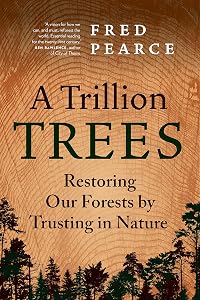
A Trillion Trees: Restoring Our Forests by Trusting in Nature
by Fred Pearce
On This Page
Description
"Natural history and adventure travel collide in this powerful book about the decline and recovery of the world's forests--with a provocative argument for their survival. In A Trillion Trees, veteran environmental journalist Fred Pearce takes readers on a whirlwind journey through some of the most spectacular forests around the world. Along the way, he charts the extraordinary pace of forest destruction, and explores why some are beginning to recover. With vivid, observant reporting, Pearce show more transports readers to the remote cloud forests of Ecuador, the swamps of Indonesia, the remains of a forest civilization in Nigeria, a mystifying mountain peak in the middle of the Atlantic Ocean. And he interviews the people who traditionally live and depend on these lands: Indigenous Amazonians, Nepalese hill dwellers, Kenyan farmers, and West African sawyers. They show him that forests are as much human landscapes as they are natural paradises. The lives of humans are now imprinted in forest ecology. At the heart of Pearce's investigation is a provocative argument: planting more trees isn't the answer to declining forests. If given room and left to their own devices, forests and the people who live in them will fight back to restore their own domain."-- show lessTags
Recommendations













Member Recommendations
Member Reviews
I will admit, the subtitle of this one almost made me give it a pass. "Restoring our forests by trusting in nature" made it sound like I might be in for something over-sentimental and over-simplistic. Well, the reality of this book was nothing of the sort. In fact, one of the major impressions it leaves me with is the sense of just how incredibly complicated everything about forests, the role they play in Earth's environment, and humanity's interactions with them are. Scientists, it turns out, have bitter arguments over the exact relationship between trees and rainfall. Forests are great absorbers of carbon and they're extremely useful for combating global warming... except in circumstances where they don't and aren't. Planting trees is show more great, except sometimes it maybe turns out to be counterproductive. And so on. On a large scale, the critical importance of forests in resisting climate change and preserving biodiversity is unquestionable, but boy do the details get messy.
Some of those details are also extremely depressing. The chapters in the middle of the book paint some incredibly bleak pictures, featuring companies claiming to be "green" when their practices are really anything but, as well as forest being rapidly destroyed by land speculators (who often don't even end up using the land they've clear-cut) and massive logging operations, both legal and illegal.
But ultimately the author has a fair amount of optimism on the subject, and sees several approaches he thinks can make a difference. In summary, I think there are basically three main points here. 1) Forests are remarkably good at reclaiming land if given the opportunity, and allowing them to do so naturally is generally a better strategy than deliberate replanting. 2) Efforts should not rest entirely on preserving "pristine," "untouched" forests (of which there may not actually be much, anyway, especially if you're using a strict definition), but should also take into account ways in which humans and trees can coexist in the same spaces to the benefit of both. Something, it should be noted, that does not include monoculture tree plantations! And 3) indigenous peoples who've been living in forests for centuries or millennia are generally very good at knowing how to manage those forests, and governments and conservationists should work with, rather than against them.
It's all very interesting stuff, and quite informative, and while I lack the expertise to evaluate Pearce's conclusions personally, they are clearly explained and decently argued, and do seem reasonable. show less
Some of those details are also extremely depressing. The chapters in the middle of the book paint some incredibly bleak pictures, featuring companies claiming to be "green" when their practices are really anything but, as well as forest being rapidly destroyed by land speculators (who often don't even end up using the land they've clear-cut) and massive logging operations, both legal and illegal.
But ultimately the author has a fair amount of optimism on the subject, and sees several approaches he thinks can make a difference. In summary, I think there are basically three main points here. 1) Forests are remarkably good at reclaiming land if given the opportunity, and allowing them to do so naturally is generally a better strategy than deliberate replanting. 2) Efforts should not rest entirely on preserving "pristine," "untouched" forests (of which there may not actually be much, anyway, especially if you're using a strict definition), but should also take into account ways in which humans and trees can coexist in the same spaces to the benefit of both. Something, it should be noted, that does not include monoculture tree plantations! And 3) indigenous peoples who've been living in forests for centuries or millennia are generally very good at knowing how to manage those forests, and governments and conservationists should work with, rather than against them.
It's all very interesting stuff, and quite informative, and while I lack the expertise to evaluate Pearce's conclusions personally, they are clearly explained and decently argued, and do seem reasonable. show less
 This review was written for LibraryThing Early Reviewers.
Fred Pearce’s A Trillion Trees: Restoring Our Forests by Trusting in Nature is a surprisingly engaging book that explores the science of how forests work and how vital trees are to the ecological stability and welfare of the Earth’s ecosystem. Pearce’s narrative skills make the material understandable for the layman. This is scientific and ecological/environmental nature writing at its finest. In Section One of the book, Pearce presents one illuminating example after another, in which we learn of the precise meteorological forces, beholden to forests and trees, that keep our planet in balance. Each chapter can be seen as another intriguing adventure, illustrating a particular facet of the trees’ biochemical processes at work. show more Section Two proceeds to chronicle the various ways in which man has systematically encroached on the world’s forestry. Section Three discusses recent successes in reforestation and natural regeneration. And Section Four discusses perhaps the last best hope of maintaining what’s left of many of the world’s great forests: the indigenous caretakers - the defenders of the forest commons who often are more acutely attuned to the trees’ needs than the foresters, environmentalists and other outsiders. In his fitting postscript, the author provides the relatively small but significant nineteenth century case of Wandsworth Common in London, a thousand year old park space owned by the Spensers, an aristocratic family who wanted to sell the land to speculators for housing. The public outcry and mass protest was such that the Spensers scuttled the plan with Wandsworth Common remaining common land for the common use of the common people in perpetuity. If this example of the preserving common spaces on a small scale is meaningful, then the importance of retaining our woodlands cannot be overstated. show less
This review was written for LibraryThing Early Reviewers.A Trillion Trees is an on-the-ground account of the effort to preserve the forests of the earth. The author reports from wide ranging locations such as Uganda, Brazil, Russia and Canada. The preservation efforts are complicated by politics, weather, geography and economics but Pearce shows us that nature can restore itself if given a chance.
I’m reminded of the Chernobyl nuclear plant disaster. The area around the plant was off limits for more than 30 years and in that time both the forests and the animals survived and even thrived without any human intervention.
So there are details of destruction and despair in this book but also glimmers of hope. Jair Bolsonaro recently lost his election to Luiz Inacio Lula de Silva and that is a show more win for the Brazilian rain forests. This is an uphill battle but Pearce presents it on a very personal and approachable level and shows the reader that letting nature rebound on its own can be an important part of the solution. show less
I’m reminded of the Chernobyl nuclear plant disaster. The area around the plant was off limits for more than 30 years and in that time both the forests and the animals survived and even thrived without any human intervention.
So there are details of destruction and despair in this book but also glimmers of hope. Jair Bolsonaro recently lost his election to Luiz Inacio Lula de Silva and that is a show more win for the Brazilian rain forests. This is an uphill battle but Pearce presents it on a very personal and approachable level and shows the reader that letting nature rebound on its own can be an important part of the solution. show less
This review was written for LibraryThing Early Reviewers.A Trillion Trees presents a fascinating look at the state of the world's forests. And while Pearce highlights the increasing destruction we have seen in the past, he also shows how and why he thinks things may not be all gloom and doom. Especially as he points out that forests have a way of regenerating themselves if they are left to their own devices. He presents a host of case studies that show how much the forest creates weather patterns by creating "flying rivers" that move rain to areas far beyond the forests.
What may come as a surprise to many readers is the fact that forests like those in the Amazon or deep in the Congo are not as old or pristine as we often think. Instead, they are regrowth forests from previous civilizations. show more Pearce argues that indigenous communities today are still at the forefront regarding caring for and protecting some of these forests. Throughout the book, he recounts his fascinating journeys and the interviews he's had with scientists, farmers, and others interested in the health and welfare of our forests. And while all might not be doom and gloom, there is still the continued threat of destruction, especially in developing areas where there is a continued focus on expanding cattle ranching and the mono-cropping of soybeans, palm oil, and other cash crops. But, Pearce argues that simply planting more trees to offset those lost may not be the best answer. Instead, he believes that, if allowed, the forests will heal and regrow on their own.
I think this book is a must-read for anyone interested in not just trees and forests but the wonderful world of nature that we inhabit.
Thanks to LibraryThing and Greystone Books for allowing me to read this book in exchange for an honest review.
More reviews at www.susannesbooklist.com show less
What may come as a surprise to many readers is the fact that forests like those in the Amazon or deep in the Congo are not as old or pristine as we often think. Instead, they are regrowth forests from previous civilizations. show more Pearce argues that indigenous communities today are still at the forefront regarding caring for and protecting some of these forests. Throughout the book, he recounts his fascinating journeys and the interviews he's had with scientists, farmers, and others interested in the health and welfare of our forests. And while all might not be doom and gloom, there is still the continued threat of destruction, especially in developing areas where there is a continued focus on expanding cattle ranching and the mono-cropping of soybeans, palm oil, and other cash crops. But, Pearce argues that simply planting more trees to offset those lost may not be the best answer. Instead, he believes that, if allowed, the forests will heal and regrow on their own.
I think this book is a must-read for anyone interested in not just trees and forests but the wonderful world of nature that we inhabit.
Thanks to LibraryThing and Greystone Books for allowing me to read this book in exchange for an honest review.
More reviews at www.susannesbooklist.com show less
This review was written for LibraryThing Early Reviewers.Forests are a lovely thing. They (re)generate rainfall and enrich the soil. They provide food, timber and more for people, while providing prime habitat for other living things. Forests moderate the local weather and help stabilize the climate, but we’ve destroyed vast areas of forest, and so we get initiatives to plant more trees. In this book. Fred Pearce argues against that approach. What’s needed instead is to let the forests regrow themselves, and empower the indigenous peoples who live there manage them. The book is his evidence for that argument.
I enjoyed this book. The early chapters taught me things I didn’t know about forests, including some archaeological evidence that contradicts what history taught about major show more forests, including the Amazon rainforest (not the untouched state of nature that we thought). It gets into complexities of deforestation, including some that has nothing to do with using the land that is cleared. Later chapters compare the performance of government- and NGO-sponsored forest preserves to that of the actively managed forests of indigenous peoples. It seems that removing the population and declaring a protected area hasn’t done of great job of protecting remaining forests, especially compared to the husbandry of forest-dwelling cultures.
There’s a lot in this book, but Pearce’s writing style makes for pleasant reading. If you have any interest in the topic, I think you’ll enjoy this book. show less
I enjoyed this book. The early chapters taught me things I didn’t know about forests, including some archaeological evidence that contradicts what history taught about major show more forests, including the Amazon rainforest (not the untouched state of nature that we thought). It gets into complexities of deforestation, including some that has nothing to do with using the land that is cleared. Later chapters compare the performance of government- and NGO-sponsored forest preserves to that of the actively managed forests of indigenous peoples. It seems that removing the population and declaring a protected area hasn’t done of great job of protecting remaining forests, especially compared to the husbandry of forest-dwelling cultures.
There’s a lot in this book, but Pearce’s writing style makes for pleasant reading. If you have any interest in the topic, I think you’ll enjoy this book. show less
This review was written for LibraryThing Early Reviewers.Fred Pearce's A Trillion Trees is great eye-opening education on the action and importance of trees and forests in the Earth's overall biosphere and hydrosphere, the practices and policies that threaten that importance (contributing to local and possibly global climate changes), plus plenty of high-profile plans mitigate or reverse the damage that don't seem to work so well and some quieter ones that do.
There's a lot in there, and it can feel like a lot to absorb, but it's all woven together nicely and presented in a story-telling style that I found easy to read and follow. Even if I don't remember every event and concept presented, I did come away with a significantly expanded understanding of the important role trees and forests play show more in Earth's climate, how the effects of that role has changed over time in response to extensive logging and deforesting, replanting projects, and both government and indigenous approaches to land and forest management.
If you're interested in and/or concerned about Earth's climate and water cycles, how they've changed over time, and what we might be doing to them, A Trillion Trees feels like a must-read. show less
There's a lot in there, and it can feel like a lot to absorb, but it's all woven together nicely and presented in a story-telling style that I found easy to read and follow. Even if I don't remember every event and concept presented, I did come away with a significantly expanded understanding of the important role trees and forests play show more in Earth's climate, how the effects of that role has changed over time in response to extensive logging and deforesting, replanting projects, and both government and indigenous approaches to land and forest management.
If you're interested in and/or concerned about Earth's climate and water cycles, how they've changed over time, and what we might be doing to them, A Trillion Trees feels like a must-read. show less
This review was written for LibraryThing Early Reviewers.A Trillion Trees - Restoring Our Forests by Trusting in Nature by Fred Pearce is one of the most important books I've read this year. Much has been made in recent years of the catastrophe of the destruction of the rain forests in Brazil as well as the loss of large intact forests in Asia and around the world. A Trillion Trees goes into depth about the state of forest cover around the world and what that means for Earth's climate as a whole and for the local effects of forest loss.
The book is divided into four parts. Part one explores some of the science of how trees affect the weather, climate, and land health in a very readable and enjoyable way. The author tells a good story in such a way that it's easy to understand a complex show more subject.
Part two goes into the history and current state of deforestation around the world, while part three is titled Rewilding which discusses the more hopeful and intricate questions around planting trees. If I have any complaint about this book it is that part two was so disheartening that I had a very difficult time continuing to read it. My life, and I think the state of the world we live in right now, is complicated and scary if you care at all about the environment and politics. It is difficult to willingly read more bad news. The good news comes in part three. I would have appreciated perhaps a blending of the two parts in such a way that the information is still clearly there but easier to feel hopeful about.
Part four discusses the cultural and societal uses of forests and makes some excellent points about the wisdom inherent in nature and also in traditional cultures who have lived within forests for ages. This is one place the book really shines. Moving forward into our collective future is going to require some rethinking about how we manage Earth's resources. Continually being honest and pragmatic about what actually improves the health of the environment and all of the people on the planet is going to be more and more important as we try to counteract the effects of industrialization, etc. I think the ideas in this book need to be continually tested and treated with the urgency that they deserve and I thank Fred Pearce for writing this book. show less
The book is divided into four parts. Part one explores some of the science of how trees affect the weather, climate, and land health in a very readable and enjoyable way. The author tells a good story in such a way that it's easy to understand a complex show more subject.
Part two goes into the history and current state of deforestation around the world, while part three is titled Rewilding which discusses the more hopeful and intricate questions around planting trees. If I have any complaint about this book it is that part two was so disheartening that I had a very difficult time continuing to read it. My life, and I think the state of the world we live in right now, is complicated and scary if you care at all about the environment and politics. It is difficult to willingly read more bad news. The good news comes in part three. I would have appreciated perhaps a blending of the two parts in such a way that the information is still clearly there but easier to feel hopeful about.
Part four discusses the cultural and societal uses of forests and makes some excellent points about the wisdom inherent in nature and also in traditional cultures who have lived within forests for ages. This is one place the book really shines. Moving forward into our collective future is going to require some rethinking about how we manage Earth's resources. Continually being honest and pragmatic about what actually improves the health of the environment and all of the people on the planet is going to be more and more important as we try to counteract the effects of industrialization, etc. I think the ideas in this book need to be continually tested and treated with the urgency that they deserve and I thank Fred Pearce for writing this book. show less
This review was written for LibraryThing Early Reviewers.Members
- Recently Added By
Lists

Books We Discovered On LibraryThing
530 works; 130 members

Science: Earth
109 works; 1 member
Author Information

45+ Works 1,779 Members
Fred Pearce was born and educated in the UK. He studied Geography at Cambridge University and has since reported on environment, science and development issues from 54 countries. He is a regular broadcaster on radio and TV, with interview credits from Today to Richard and Judy to the Open University. Fred is married with two children and lives in show more London. show less
Awards and Honors
Common Knowledge
- Canonical title
- A Trillion Trees: Restoring Our Forests by Trusting in Nature
- Dedication
- To the memories of Don Hinrichsen
and Conrad Gorinsky, pioneers both - First words
- Introduction
Myth and Magic
My first real experience of the wonder of tropical forests cam in the Andean Mountains of Ecuador. It had been a long drive from Quito and evening was drawing on as we climbed into for... (show all)ests shrouded in clouds—clouds whose coverage was so extensive and permanent that no cartographers had ever mapped the terrain, and no satellites had ever observed the surface beneath. Breathing the sopping-wet air and peering into the gloom, I could understand why people occasionally showed up here believing that the trees hid an El Dorado of gold buried by the Inca half a millennium ago. - Blurbers
- Rawlence, Ben
Classifications
- Genres
- Science & Nature, Nonfiction, Economics, General Nonfiction, Politics and Government
- DDC/MDS
- 333.75 — Society, government, & culture Economics Economics of land and energy Conservation, Alternative Energy Sources Forests & Rainforests
- LCC
- SD411 .P43 — Agriculture Forestry. Arboriculture. Silviculture Forestry Conservation and protection
- BISAC
Statistics
- Members
- 60
- Popularity
- 514,399
- Reviews
- 32
- Rating
- (4.37)
- Languages
- English
- Media
- Paper, Ebook
- ISBNs
- 2
- ASINs
- 1