Devil House
by John Darnielle
On This Page
Description
"Gage Chandler is descended from kings. That's what his mother always told him when he was a child. Years later, he is a true crime writer, with one grisly success--and a movie adaptation--to his name, along with a series of subsequent less notable efforts. But now he is being offered the chance for the big break: to move into the house where a pair of briefly notorious murders occurred, apparently the work of disaffected teens during the Satanic Panic of the 1980s. Chandler finds himself in show more Milpitas, California, a small town whose name rings a bell--his closest childhood friend lived there, once upon a time. He begins his research into the murders with diligence and enthusiasm, but soon the story leads him into a puzzle he never expected--back into his own work and what it means, back to the very core of what he does and who he is"--Dust jacket flap. show lessTags
Recommendations





Member Recommendations
by anonymous user
by anonymous user
Member Reviews
I don't totally get this novel, but it seems to be about a true crime author who is reckoning with the reality of his profession and at a deeper level about how a story can be factually accurate without being true. There's no such thing as objective storytelling. The author has to pick sides---protagonist, antagonist, villain, hero---which is by definition not objective. There's also something vulnerable here about how we've all been children.
It's not classic horror and it's not what I expected, but it's definitely unsettling.
It's not classic horror and it's not what I expected, but it's definitely unsettling.
The audiobook was very well done. I was drawn to it because John Darnielle, the author and a member of the Mountain Goats, narrates the book and there were bits of music throughout by another Mountain Goats member. Darnielle did as good a job - if not better - than most audiobook narrators I've listened to, and it was great experiencing the book as he himself imagined it.
I consume a lot of true crime media, so obviously I liked the idea of a story about a true crime author immersing himself in his work, but what I appreciated most was the way Darnielle addresses the effect that true crime media has on the victims families and communities. There's a part in the book that includes a letter from the mother of a murder victim from a case show more the protagonist wrote about, and it really highlights how important it is to respect the people we read about in true crime stories, to remember that they were people with families and loved ones, and their involvement in the crime, be it victim or perpetrator, is a tragedy that those loved ones may never recover from.
I will say the last section of the book really threw me for a loop, and I would have been fine with it if it hadn't been quite so open ended. ButI guess there's some symmetry of the protagonist's manuscript ending mid sentence and the book ending with the final narrator just standing in his backyard thinking about everything. I don't know...
This is the first of John Darnielle's books that I've read, and I'm definitely planning on checking out his older works (probably Universal Harvester next), but I'm also looking forward to what he'll write next. show less
I consume a lot of true crime media, so obviously I liked the idea of a story about a true crime author immersing himself in his work, but what I appreciated most was the way Darnielle addresses the effect that true crime media has on the victims families and communities. There's a part in the book that includes a letter from the mother of a murder victim from a case show more the protagonist wrote about, and it really highlights how important it is to respect the people we read about in true crime stories, to remember that they were people with families and loved ones, and their involvement in the crime, be it victim or perpetrator, is a tragedy that those loved ones may never recover from.
I will say the last section of the book really threw me for a loop, and I would have been fine with it if it hadn't been quite so open ended. But
This is the first of John Darnielle's books that I've read, and I'm definitely planning on checking out his older works (probably Universal Harvester next), but I'm also looking forward to what he'll write next. show less
How true is true crime writing, really? This book is written in the voice of a true crime author named Gage Chandler, who, at the suggestion of his editor, finds the subject of his next book/story by purchasing the renovated house where a gruesome unsolved double murder was committed, fleshing out the story by portraying in great detail what each person -- victim, attacker -- might have thought and felt. For all the reasons I cannot read true crime or watch criminal reenactment shows, the sections of this book describing murders as they happen was hard for me to listen to. The violence isn't gratuitous, though, because the visceral feelings it evokes are part of the truth that the author (both the fictional one and the real one) is show more trying to get the reader to think about.
The audiobook is read by the author, and it is one of the best readings by an author I have heard. I gave it five stars, but couldn't list it as a favorite because of the true crime subject. I'm curious about how this book has been received among readers who like true crime. show less
The audiobook is read by the author, and it is one of the best readings by an author I have heard. I gave it five stars, but couldn't list it as a favorite because of the true crime subject. I'm curious about how this book has been received among readers who like true crime. show less
True crime stories are having a bit of a moment right now, with dozens of documentaries, podcasts, and books offering detailed analysis of famous crimes, especially unsolved ones, and especially murder. Who isn’t drawn in by mystery, the morbid fascination of a well ordered world interrupted by random, unexplained violence? Especially when, like any good campfire tale, the “killer might still be out there!” Of course, this curiosity can bring with it a dark side as well, a voyeuristic quality, as real people’s lives and tragedies are reduced to chilling real-life whodunits. Our desire for the titillation of danger, safely removed, reduces the complex, ambiguous worlds of the victims of crime and their perpetrators into safely show more consumable cautionary tales or horror stories.
This is the rich vein that John Darnielle explores in his third novel, Devil House. Devil House shares a labyrinthine structure with his previous books, drawing the reader into an intricate maze of compelling scenes that evolve into a patchwork of narration we, like true crime writer Gage Chandler, must struggle to make meaning of. But this piecing together of elements, seeking out the connections and throughlines of the story as it unfolds, allows Darnielle to question and celebrate both our enjoyment of true crime and our need to solve life’s mysteries.
Chandler, a successful but conscientious writer known for his breakthrough work on the case of a murderous teacher known as the “White Witch of Morrow Bay,” which even spawned a movie, feels ambivalent about his role as chronicler of such stories for popular consumption. Still, he finds himself drawn to them and it pays the bills, so when an acquaintance passes him the story of the “Devil House,” a mysterious double murder by broad sword during the height of the Satanic Panic 1980s, he is intrigued and makes it the subject of his next book. Moving into the murder site itself, a former porn store in the San Jose suburb of Milpitas, California, he sets to work on researching the case using his own idiosyncratic writing methods, attempting to exactly recreate the vibes of the mid ‘80s as the teenage suspects of the case would have experienced it.
As Gage muses on his career and digs up whatever he can on Milipitas, we drift in time and perspective across the true crime that he has become entwined with, its victims its perpetrators, the places where those distinctions blur, and those left behind all making their presences known, with Gage himself, in some ways, becoming the haunted house of all the tragedy he works with. From the mother of one of the teenagers killed by the White Witch to a long passage of faux-Medieval Arthurian prose reiterating ideas of a home being a castle and harkening to the types of stuff the kids who hung out in the Devil House prior to the murders would like, snatches of narration and meaning float through the novel.
As more details, more sides of the story, are revealed we are forced to question just how these narratives are crafted and whom they serve, even for so seemingly thoughtful a crime writer of Chandler. All in all, I feel that Devil House was the most enigmatic work of fiction Darnielle has written so far, making it a little less accessible than Wolf in White Van or Universal Harvester, though many of the same themes exist here too. I feel another reading of the work will be valuable to fully immerse myself in the themes, knowing more of the complex web the novel creates. show less
This is the rich vein that John Darnielle explores in his third novel, Devil House. Devil House shares a labyrinthine structure with his previous books, drawing the reader into an intricate maze of compelling scenes that evolve into a patchwork of narration we, like true crime writer Gage Chandler, must struggle to make meaning of. But this piecing together of elements, seeking out the connections and throughlines of the story as it unfolds, allows Darnielle to question and celebrate both our enjoyment of true crime and our need to solve life’s mysteries.
Chandler, a successful but conscientious writer known for his breakthrough work on the case of a murderous teacher known as the “White Witch of Morrow Bay,” which even spawned a movie, feels ambivalent about his role as chronicler of such stories for popular consumption. Still, he finds himself drawn to them and it pays the bills, so when an acquaintance passes him the story of the “Devil House,” a mysterious double murder by broad sword during the height of the Satanic Panic 1980s, he is intrigued and makes it the subject of his next book. Moving into the murder site itself, a former porn store in the San Jose suburb of Milpitas, California, he sets to work on researching the case using his own idiosyncratic writing methods, attempting to exactly recreate the vibes of the mid ‘80s as the teenage suspects of the case would have experienced it.
As Gage muses on his career and digs up whatever he can on Milipitas, we drift in time and perspective across the true crime that he has become entwined with, its victims its perpetrators, the places where those distinctions blur, and those left behind all making their presences known, with Gage himself, in some ways, becoming the haunted house of all the tragedy he works with. From the mother of one of the teenagers killed by the White Witch to a long passage of faux-Medieval Arthurian prose reiterating ideas of a home being a castle and harkening to the types of stuff the kids who hung out in the Devil House prior to the murders would like, snatches of narration and meaning float through the novel.
As more details, more sides of the story, are revealed we are forced to question just how these narratives are crafted and whom they serve, even for so seemingly thoughtful a crime writer of Chandler. All in all, I feel that Devil House was the most enigmatic work of fiction Darnielle has written so far, making it a little less accessible than Wolf in White Van or Universal Harvester, though many of the same themes exist here too. I feel another reading of the work will be valuable to fully immerse myself in the themes, knowing more of the complex web the novel creates. show less
I can't say that I loved this, but I found it really interesting, and in a subversively quiet way, provocative. It is a prolonged meditation on the ethics of true-crime media, how the complicated lives of real people and real events are transformed and flattened into the digestible stories and recognizable archetypes that are necessary to fit the narratives we expect and demand. It is here where I found the strongest elements of the book: a deep empathy and a determination to tell people's real stories, even the parts that are hard to make sense of, the randomness and chaos of even the most straightforward lives and deaths, our inability to fully appreciate or understand the messy truths of others. I read this as an audiobook, and there show more were numerous lines and phrases that stood out in the moment, where I wish I'd been able to highlight them for later reflection. Quite enjoyable, and thought-provoking. show less
Gage is a true crime writer, who after one big hit (and movie tie-in) and several other works, has developed His System. He researchers, scours online auctions for artifacts linked to his case, interviews, and does his best to immerse himself in the time and place of the crime he is researching.
Now, he finds himself researching the Milpitas "satanic murders" of 1986. he has bought Devil House, and is trying to recreate the scenes in crime photos. He has purchased notebooks from the scene, and interviewed all the the players he can find.
But is this novel really about true crime and the life of the author? Kind of. It is about storytelling, what the reader wants and what the author should give. It is about fact vs fiction, truth vs half show more truth vs lies vs filling in the unknown. It is about what a storyteller writing about real people owes to those people and those left behind.
-----
SPOILERS BELOW
-----
I have huge issues with real people being used as fictional characters, and the total lack of respect so many authors show to them and their families (by using their relatives). I don't mean royalty and politicians, military leaders, or ancient personages that must be featured in some way when writing about certain events. I mean entertainers, business people, scientists, whatever--people who grew up in standard homes of some kind (some more privileged than others) and went on to fairly regular (if sometimes very successful) lives. So I LOVE seeing this topic discussed in fiction! show less
Now, he finds himself researching the Milpitas "satanic murders" of 1986. he has bought Devil House, and is trying to recreate the scenes in crime photos. He has purchased notebooks from the scene, and interviewed all the the players he can find.
But is this novel really about true crime and the life of the author? Kind of. It is about storytelling, what the reader wants and what the author should give. It is about fact vs fiction, truth vs half show more truth vs lies vs filling in the unknown. It is about what a storyteller writing about real people owes to those people and those left behind.
-----
SPOILERS BELOW
-----
I have huge issues with real people being used as fictional characters, and the total lack of respect so many authors show to them and their families (by using their relatives). I don't mean royalty and politicians, military leaders, or ancient personages that must be featured in some way when writing about certain events. I mean entertainers, business people, scientists, whatever--people who grew up in standard homes of some kind (some more privileged than others) and went on to fairly regular (if sometimes very successful) lives. So I LOVE seeing this topic discussed in fiction! show less
Devil House is John Darnielle’s (JD) 3rd novel and 4th work of fiction. JD is best known as the singer, songwriter, and lyricist for the Mountain Goats, a band largely known for its outstandingly good lyricism. But, in my opinion, JD’s preceding works of fiction (Master of Reality, Wolf in White Van, and Universal Harvester) have all been inferior to his lyrics with the band. He has shown some promise, especially in the realm of pathos and in his depth of understanding of grief, but his prose style is not my favorite and I have finished his other works wishing they had offered a bigger or more universal “point.” They focused a lot on the small stuff, but all that small stuff never seemed to come together as synecdoche for show more something broader.
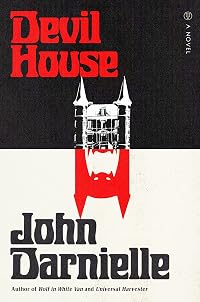
This work, Devil House, still retains some of the flaws of JD’s earlier work. The prose is not very smooth or beautiful, and a lot of metaphors seem clunky or unhip. The first half of this novel dragged at times because of its focus on the particulars. But oh well, every author has their style. On the whole, Devil House is definitely the most impressive thing JD has written so far. Its aims are ambitious and clear, and I think it basically nails them. The meta-fictional elements toward the end of the story are set up well, and the payoff is huge—it isn’t stiff or overly intellectual like a lot of that stuff is. The “setting” for this book—the story of a true-crime writer—is usually entertaining and sometimes enlightening (about the work of writing). Emotionally, this book is at times devastating. I’m thinking especially of Chapter 6 here. I’m actually really surprised how high of a level this book reaches by the end; Universal Harvester seemed to dangle some promise of greatness, but it was always very obscured, and I never felt like the waiting paid off. Well, this time it did, and I’m very impressed. Last thing before the plot synopsis with spoilers: as everyone else has said, the cover art is ridiculously great. Massive props to Alex Metro for designing such a sleek and beautiful piece.
Synopsis (SPOILERS): Devil House is broken into 7 mirroring chapters: Chandler (1st chapter and 7th), The White Witch (2nd and 6th), Devil House (3rd and 5th), and Song of Gorbonian (4th). The central narrative thread connecting chapters 1, 2, 3, 5, 6, and 7 is the true-crime writer Gage Chandler. (I’m going to ignore chapter 4 for now.)
Chapter 1 introduces Gage Chandler. Chandler is a storyteller who makes his money writing (successful) books about bloody real-life tragedies, doing serious in-depth archival research on all the involved places and people. He had his big break writing “The White Witch,” about a high school teacher from his hometown who killed two students and chopped up their bodies. This got sold off for a movie deal, and I think he subsequently wrote a few more true-crime books, again to relative success.
Chapter 2 tells the story of the White Witch in a straightforward true-crime style: details about the teacher, the two kids, the events leading up to the killings, the killings, the aftermath, etc.
Chapter 3 is about Chandler’s next story—many years after his first— is about the “Devil House,” a double-murder cold case which had taken place in an abandoned porno store that’d been dressed up by squatters with all sorts of satanic and mystical imagery and symbolism. Chandler moves into the long-since vacant “Devil House” to get a better feel for the scene of the crime, all the while uncovering old evidence from the case and conducting interviews with relevant parties. He focuses on four high school aged teenagers: Derrick, an ex-employee of the porno store who let his friends hang out in the abandoned place; Seth, a hyperactive, good hearted kid who can’t find his footing academically, and who largely instigates and leads the redecoration of the porno shop into the Devil House; Alex, a victim of the foster care system who had been a homeless drifter for a while and happened to stop back by his hometown, and who was sleeping in the relative security of the Devil House; and Angela, a sort of nondescript friend who also helps redecorate the place.
The story we are told is that the teenagers had turned the vacant porno store into a sort of clubhouse, and for Alex, a shelter. They felt attachment to and ownership over the store, and when they found out its lawful owner planned to resell it, they decided to freak her out and litter the place with crazy Satanic imagery. Later, when the landlord comes by to tour the place with a prospective buyer, both of them are slaughtered brutally with a sword, presumably by Alex, who then splits town. However, the case is never resolved, the police have no solid evidence against the three teens (they don’t even know about Alex), nobody is charged, and decades later, the case of the Devil House is still cold. This is all according to Chandler.
Chapter 5 mostly entails Chandler tracking down Angela, Seth, and Derrick as adults and interviewing about the case. He says he was unable to track down Alex. There’s a lot of stuff about how no matter how hard Chandler tries, no matter how much evidence he tracks down, he will never know what it was like to be there, why these things happened, what was at stake.
Chapter 6 is a special one. Its setting is Chandler still at work on his Devil House book, living in the Devil House, connecting old threads, etc. While working, he receives a lengthy letter from the mother of one of the teenaged victims from his first book, “The White Witch.” Basically, she is grieved at how Chandler depicted her boy (Jesse). To Chandler, Jesse was only a pawn in his book, someone he animated to go this way and that, imbued with superficial motivations and characteristics that somehow, inevitably, led him to his slaughter. What Chandler didn’t know—what he could NEVER know—is the true depth of the life he shamelessly used for his story. Jesse’s mother relates a story of Jesse’s life in painful, heartbreaking detail: about how Jesse’s circumstances stopped him from growing into what he could have been, about how her husband was so violent and so mean, about how he had so much trouble making friends, about how he grew from a baby into a young man, about how she had given up on her own life and invested her everything into him, and about how one day, senselessly and without warning, it all came crashing down. Life wasn’t fair for her, and it wasn’t fair for Jesse, and they just had to deal with it as best as they could, and then it was all over. Chandler had made a caricature of the most important thing in her life, of a life ITSELF, and how could he not have? All the infinite inner workings of Jesse, all the networks of meaning and purpose related to him, all that summed up in a few pages of grisly characterization. Chandler never knew the story of Jesse, and he never would. A long passage:
“… your final view of him that of a handsome young man who might have been headed down the wrong path, but didn’t everybody have the right to make mistakes sometimes, a handsome young man only a few steps away from a future in which he might finally have been free—free to be the sweet person you knew lived within him, he whose sweetness had been a comfort in a cold world, he who only ten years before he got cut to pieces and taken down to the ocean to be dumped into the tides had still been your baby, you said, so desperate for help that he told his teachers his father was a bully, so lonely that anyone who showed him kindness became his favorite person in the world, so hungry for friendship that he was a sitting duck for a boy like Gene Cupp. Did I really think ten years was a long time, you said. It’s not. It’s nothing when you are his mother. It is the blink of an eye during a commercial break, you said. That’s how short a time you got to know your son before she took him from you. But you knew, you said. You knew how short a time ten years is, and how easy it was for me to make that whole time, so precious to you, look ugly, worthless, pointless. But Jesse’s life had been good sometimes, it had value and he deserved to live and you deserved to still have a son and I didn’t care, I only cared about the bad parts, how could I, how could I, did I understand at last what I had done to you, twisting a knife that had been stuck in your stomach since the day your son was killed, how could I.” (pp. 350-351)
One other sort of extra-textual thing is that this chapter revealed a lot about JD’s own life. He has written before about the abuse he and his family suffered at the hands of his own stepfather (see: The Sunset Tree), but the depth he goes into here is the sort of stuff you can only get from experience. It’s heartbreaking and emotionally powerful. How horrifying, that our lives can be reduced to only hope and waiting by the cruelty of others.
Chapter 7 is probably the next-most important chapter of the book. We switch narrators here to an unnamed boyhood friend of Chandler’s, with whom he reconnects later in life, after Devil House is all the way written and Chandler vacates the old place. Chandler gives an old draft of Devil House to the narrator to read over, and as he does, we learn that the entire story of these crimes is a fictional imagining [within a fictional novel]. There were never any people named Derrick, Seth, Alex, and Angela. The only people who ever occupied that abandoned porno store were some faceless, forgotten homeless people. True, the store was decorated with Satanic imagery, true, there was a double murder that was never solved, but none of the people involved in the story ever existed. Pure fictional imagining. The truth [within the universe of the fictional novel] was concealed by Chandler. Note, this deception wasn’t revealed within the book Chandler wrote; it is a secret known only to Chandler and the unnamed narrator. It seems that Chandler took cue from the mother of the White Witch victim and realized that his true crime writing was no better than invaders plundering a people’s homelands to display their artifacts in a museum back home. So what can Chandler do now: stop writing? No, he instead opts for the fictional.
This is where the work becomes really meta-fictional. Who are we to take as the narrator here? Is it a fictionalized JD? The unnamed narrator is a “performer,” he lived in Durham, NC at some point, he has a wife and two boys. I guess “it could be anyone,” but I think here we have [a fictionalized] JD writing straight to us as himself. A lot of the reviews on Goodreads take this novel as an indictment of true crime, particularly how it warps and diminishes REAL people for the sake of a story, but I think JD is not making such a narrow point. When we tell stories of any kind—fiction or nonfiction—we inevitably borrow from the lives of real people. I am of the opinion that no work of fiction can avoid stealing from the lives of the author and the people the author knows. So, all of storytelling seems to be guilty of this same sin: distorting reality, showing only fragments of real life, reducing infinitely complex characters to only caricatures, pawns in a story. Real people, people with value, whose lives all have worth, are made little by an author playing God in their little universe. JD seems to take over as narrator at the end of this novel to tell us, “yes, it’s me, I’m the author, I have crafted this distorted world, full of fictions and glimpses of reality. I am every bit as guilty as Chandler, and I know it. But what am I to do? Stop writing?”
As for Chapter 4, “Song of Gorbonian,” I am still unsure what to make of it. Right in the middle of the book, the actual font changes to something gothic or medieval and we are told a story (in archaic language) about a young prince whose father is killed and who vows to avenge the latter’s death. The prince-turned-king wants his tale of vengeance to be passed down through generations, making legendary his bravery and honor. Then, the chapter ends mid-sentence. Is this meant to be an allegory for the Devil House situation, somehow? Something about the subjects of a story taking control of how that story will later be told? Maybe I missed something. I’d like to see a smarter interpretation of this part. Regardless, it was a lot more entertaining than I’d think. show less
This work, Devil House, still retains some of the flaws of JD’s earlier work. The prose is not very smooth or beautiful, and a lot of metaphors seem clunky or unhip. The first half of this novel dragged at times because of its focus on the particulars. But oh well, every author has their style. On the whole, Devil House is definitely the most impressive thing JD has written so far. Its aims are ambitious and clear, and I think it basically nails them. The meta-fictional elements toward the end of the story are set up well, and the payoff is huge—it isn’t stiff or overly intellectual like a lot of that stuff is. The “setting” for this book—the story of a true-crime writer—is usually entertaining and sometimes enlightening (about the work of writing). Emotionally, this book is at times devastating. I’m thinking especially of Chapter 6 here. I’m actually really surprised how high of a level this book reaches by the end; Universal Harvester seemed to dangle some promise of greatness, but it was always very obscured, and I never felt like the waiting paid off. Well, this time it did, and I’m very impressed. Last thing before the plot synopsis with spoilers: as everyone else has said, the cover art is ridiculously great. Massive props to Alex Metro for designing such a sleek and beautiful piece.
Synopsis (SPOILERS): Devil House is broken into 7 mirroring chapters: Chandler (1st chapter and 7th), The White Witch (2nd and 6th), Devil House (3rd and 5th), and Song of Gorbonian (4th). The central narrative thread connecting chapters 1, 2, 3, 5, 6, and 7 is the true-crime writer Gage Chandler. (I’m going to ignore chapter 4 for now.)
Chapter 1 introduces Gage Chandler. Chandler is a storyteller who makes his money writing (successful) books about bloody real-life tragedies, doing serious in-depth archival research on all the involved places and people. He had his big break writing “The White Witch,” about a high school teacher from his hometown who killed two students and chopped up their bodies. This got sold off for a movie deal, and I think he subsequently wrote a few more true-crime books, again to relative success.
Chapter 2 tells the story of the White Witch in a straightforward true-crime style: details about the teacher, the two kids, the events leading up to the killings, the killings, the aftermath, etc.
Chapter 3 is about Chandler’s next story—many years after his first— is about the “Devil House,” a double-murder cold case which had taken place in an abandoned porno store that’d been dressed up by squatters with all sorts of satanic and mystical imagery and symbolism. Chandler moves into the long-since vacant “Devil House” to get a better feel for the scene of the crime, all the while uncovering old evidence from the case and conducting interviews with relevant parties. He focuses on four high school aged teenagers: Derrick, an ex-employee of the porno store who let his friends hang out in the abandoned place; Seth, a hyperactive, good hearted kid who can’t find his footing academically, and who largely instigates and leads the redecoration of the porno shop into the Devil House; Alex, a victim of the foster care system who had been a homeless drifter for a while and happened to stop back by his hometown, and who was sleeping in the relative security of the Devil House; and Angela, a sort of nondescript friend who also helps redecorate the place.
The story we are told is that the teenagers had turned the vacant porno store into a sort of clubhouse, and for Alex, a shelter. They felt attachment to and ownership over the store, and when they found out its lawful owner planned to resell it, they decided to freak her out and litter the place with crazy Satanic imagery. Later, when the landlord comes by to tour the place with a prospective buyer, both of them are slaughtered brutally with a sword, presumably by Alex, who then splits town. However, the case is never resolved, the police have no solid evidence against the three teens (they don’t even know about Alex), nobody is charged, and decades later, the case of the Devil House is still cold. This is all according to Chandler.
Chapter 5 mostly entails Chandler tracking down Angela, Seth, and Derrick as adults and interviewing about the case. He says he was unable to track down Alex. There’s a lot of stuff about how no matter how hard Chandler tries, no matter how much evidence he tracks down, he will never know what it was like to be there, why these things happened, what was at stake.
Chapter 6 is a special one. Its setting is Chandler still at work on his Devil House book, living in the Devil House, connecting old threads, etc. While working, he receives a lengthy letter from the mother of one of the teenaged victims from his first book, “The White Witch.” Basically, she is grieved at how Chandler depicted her boy (Jesse). To Chandler, Jesse was only a pawn in his book, someone he animated to go this way and that, imbued with superficial motivations and characteristics that somehow, inevitably, led him to his slaughter. What Chandler didn’t know—what he could NEVER know—is the true depth of the life he shamelessly used for his story. Jesse’s mother relates a story of Jesse’s life in painful, heartbreaking detail: about how Jesse’s circumstances stopped him from growing into what he could have been, about how her husband was so violent and so mean, about how he had so much trouble making friends, about how he grew from a baby into a young man, about how she had given up on her own life and invested her everything into him, and about how one day, senselessly and without warning, it all came crashing down. Life wasn’t fair for her, and it wasn’t fair for Jesse, and they just had to deal with it as best as they could, and then it was all over. Chandler had made a caricature of the most important thing in her life, of a life ITSELF, and how could he not have? All the infinite inner workings of Jesse, all the networks of meaning and purpose related to him, all that summed up in a few pages of grisly characterization. Chandler never knew the story of Jesse, and he never would. A long passage:
“… your final view of him that of a handsome young man who might have been headed down the wrong path, but didn’t everybody have the right to make mistakes sometimes, a handsome young man only a few steps away from a future in which he might finally have been free—free to be the sweet person you knew lived within him, he whose sweetness had been a comfort in a cold world, he who only ten years before he got cut to pieces and taken down to the ocean to be dumped into the tides had still been your baby, you said, so desperate for help that he told his teachers his father was a bully, so lonely that anyone who showed him kindness became his favorite person in the world, so hungry for friendship that he was a sitting duck for a boy like Gene Cupp. Did I really think ten years was a long time, you said. It’s not. It’s nothing when you are his mother. It is the blink of an eye during a commercial break, you said. That’s how short a time you got to know your son before she took him from you. But you knew, you said. You knew how short a time ten years is, and how easy it was for me to make that whole time, so precious to you, look ugly, worthless, pointless. But Jesse’s life had been good sometimes, it had value and he deserved to live and you deserved to still have a son and I didn’t care, I only cared about the bad parts, how could I, how could I, did I understand at last what I had done to you, twisting a knife that had been stuck in your stomach since the day your son was killed, how could I.” (pp. 350-351)
One other sort of extra-textual thing is that this chapter revealed a lot about JD’s own life. He has written before about the abuse he and his family suffered at the hands of his own stepfather (see: The Sunset Tree), but the depth he goes into here is the sort of stuff you can only get from experience. It’s heartbreaking and emotionally powerful. How horrifying, that our lives can be reduced to only hope and waiting by the cruelty of others.
Chapter 7 is probably the next-most important chapter of the book. We switch narrators here to an unnamed boyhood friend of Chandler’s, with whom he reconnects later in life, after Devil House is all the way written and Chandler vacates the old place. Chandler gives an old draft of Devil House to the narrator to read over, and as he does, we learn that the entire story of these crimes is a fictional imagining [within a fictional novel]. There were never any people named Derrick, Seth, Alex, and Angela. The only people who ever occupied that abandoned porno store were some faceless, forgotten homeless people. True, the store was decorated with Satanic imagery, true, there was a double murder that was never solved, but none of the people involved in the story ever existed. Pure fictional imagining. The truth [within the universe of the fictional novel] was concealed by Chandler. Note, this deception wasn’t revealed within the book Chandler wrote; it is a secret known only to Chandler and the unnamed narrator. It seems that Chandler took cue from the mother of the White Witch victim and realized that his true crime writing was no better than invaders plundering a people’s homelands to display their artifacts in a museum back home. So what can Chandler do now: stop writing? No, he instead opts for the fictional.
This is where the work becomes really meta-fictional. Who are we to take as the narrator here? Is it a fictionalized JD? The unnamed narrator is a “performer,” he lived in Durham, NC at some point, he has a wife and two boys. I guess “it could be anyone,” but I think here we have [a fictionalized] JD writing straight to us as himself. A lot of the reviews on Goodreads take this novel as an indictment of true crime, particularly how it warps and diminishes REAL people for the sake of a story, but I think JD is not making such a narrow point. When we tell stories of any kind—fiction or nonfiction—we inevitably borrow from the lives of real people. I am of the opinion that no work of fiction can avoid stealing from the lives of the author and the people the author knows. So, all of storytelling seems to be guilty of this same sin: distorting reality, showing only fragments of real life, reducing infinitely complex characters to only caricatures, pawns in a story. Real people, people with value, whose lives all have worth, are made little by an author playing God in their little universe. JD seems to take over as narrator at the end of this novel to tell us, “yes, it’s me, I’m the author, I have crafted this distorted world, full of fictions and glimpses of reality. I am every bit as guilty as Chandler, and I know it. But what am I to do? Stop writing?”
As for Chapter 4, “Song of Gorbonian,” I am still unsure what to make of it. Right in the middle of the book, the actual font changes to something gothic or medieval and we are told a story (in archaic language) about a young prince whose father is killed and who vows to avenge the latter’s death. The prince-turned-king wants his tale of vengeance to be passed down through generations, making legendary his bravery and honor. Then, the chapter ends mid-sentence. Is this meant to be an allegory for the Devil House situation, somehow? Something about the subjects of a story taking control of how that story will later be told? Maybe I missed something. I’d like to see a smarter interpretation of this part. Regardless, it was a lot more entertaining than I’d think. show less
Members
- Recently Added By
Lists

Books Set in California
112 works; 15 members

Top Five Books of 2022
736 works; 272 members

Books published and read in 2022
82 works; 5 members

Houses and Buildings as Characters in Fiction
182 works; 29 members

Writers as Characters in Fiction
120 works; 18 members

Books Read in 2022
5,168 works; 114 members

Anticipated 2022 & Early 2023 Releases
209 works; 4 members

2022
17 works; 1 member

Main Character is aged 10-19
362 works; 6 members

I Could Live There
185 works; 12 members

Fiction Published in 2022
21 works; 1 member

Which house?
423 works; 16 members

Reading Group 2023
5 works; 1 member
Author Information

8+ Works 4,161 Members
John Darnielle is a writer, composer, guitarist, and vocalist for the band the Mountain Goats. He has also written several books including Black Sabbath's Master of Reality and Wolf in White Van: A Novel. (Bowker Author Biography)
Awards and Honors
Awards
Distinctions
Common Knowledge
- Canonical title
- Devil House
- Original publication date
- 2022
- Important places
- Milpitas, California, USA
- First words
- Mom called yesterday to ask if I was ready to come home yet; I went directly to San Francisco from college, and I've been in Milpitas for five years now, but she holds fast to her theory that eventually I'm coming back to San... (show all) Luis Obispo.
- Last words
- (Click to show. Warning: May contain spoilers.)I remembered, and I stayed with this vision for what seemed like quite a while out there, on the back porch, in the dark.
Classifications
Statistics
- Members
- 1,001
- Popularity
- 26,094
- Reviews
- 29
- Rating
- (3.48)
- Languages
- English, French, Spanish
- Media
- Paper, Audiobook, Ebook
- ISBNs
- 15
- ASINs
- 3