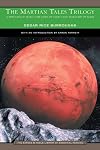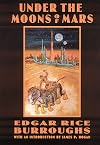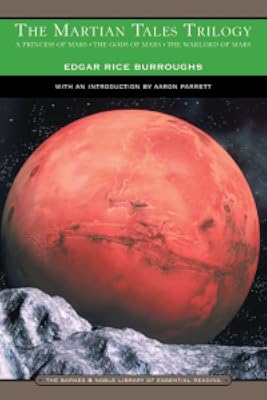
The Martian Tales Trilogy: A Princess of Mars / The Gods of Mars / The Warlord of Mars
by Edgar Rice Burroughs
Barsoom (Collections and Selections — 1-3)
On This Page
Description
Book One of the John Carter of Mars collections, this edition contains the original text from the first, second, and third of Edgar Rice Burrough's world-famous novels. Originally published from 1917 and 1919, A Princess of Mars, The Gods of Mars, and The Warlord of Mars are science-fiction classics, and the origin of Burroughs's legendary series.Tags
Recommendations



















Member Reviews
Is there life on Mars? And if so is everyone naked except for a leather harness? According to Burroughs the answer is a resounding yes.
The legendary Barsoom series, the thing that inspired all your favorite sci fi authors and also one of the biggest movie flops in history. So is it actually worth reading? Well if you are interested in sci fi history and can stand cliched storylines then yes. But if you’re looking for some undiscovered Star Wars that’s stood the test of time this ain’t it.
This volume contains the first three Barsoom novels. Book one tells of John Carters inexplicable transportation to Mars, his acclamation to Martian culture, and his romance with the Martian princess Dejah Thoris. Adventure ensues. While it’s show more not exactly up to date in the science department it definitely still fits the sci fi category. There’s aliens, advanced technology, a dying planet, and flying vessels.
In the second book John Carter returns to Mars, wakes up in Martian Mt. Olympus, discovers the Martian religion is a total sham, has to escape from Sky pirates and evil bald dudes. Adventure really ensues. The first book established the world, then this book takes the established world throws in a bunch of new aliens, new settings, and cranks the daring-do to 11. Make no mistake all three books are action packed, but this one really lays it on.
In the third book some minor character John Carter clocked in the last book kidnaps his girl and Johnny chases him round the globe. Adventure kinda ensues. Even by the second book the story beats get repetitive and this book feels like a greatest hits of the first two books. Still if you’ve made it through the first two books might as well finish this one as it has an ending despite the 8 books that followed.
There’s quite a bit of good in these. Adventure abounds. The Martian world is pretty enticing and the aliens are memorable. Through the trilogy John Carter gains a literally colorful crew of allies. His romance with the Martian princess is cheesy but endearing. There’s a lot of memorable settings such as the abandoned ancient cities, underwater cities, and a mryiad of underground labyrinths.
I think Burroughs settings work so well because he gives the reader just enough to get the sense of what it’s like but much of it is left to the reader’s imagination. I’m not a very imaginative reader but it was easy to conjure the Martian world, and probably everyone who’s read this over the past 100 years has imagined it a little different.
Now to the bad. As mentioned earlier the stories are repetitive. The action is especially repetitive as John is either fighting one guy and Burroughs says “He was the best swordsman I’ve ever faced and he almost had me” or when there’s a big battle he says “It was a big bloody battle and lots of people had died and I was fighting really hard.” Rinse and repeat. The books are not particularly gory or detailed but they are filled with constant bloodshed.
Also the series is definitely a product of its time with racist and sexist attitudes. The second book almost seems to have an anti-racist allegory but maybe I read too much into it or it was an accident on Burroughs part.
At its best it’s explosively imaginative, adventurous, and action packed. At its worst it’s outdated, repetitive, and shallow. There’s a reason these books have stayed influential for 100 years, but no one is going to read them and not realize it’s old. show less
The legendary Barsoom series, the thing that inspired all your favorite sci fi authors and also one of the biggest movie flops in history. So is it actually worth reading? Well if you are interested in sci fi history and can stand cliched storylines then yes. But if you’re looking for some undiscovered Star Wars that’s stood the test of time this ain’t it.
This volume contains the first three Barsoom novels. Book one tells of John Carters inexplicable transportation to Mars, his acclamation to Martian culture, and his romance with the Martian princess Dejah Thoris. Adventure ensues. While it’s show more not exactly up to date in the science department it definitely still fits the sci fi category. There’s aliens, advanced technology, a dying planet, and flying vessels.
In the second book John Carter returns to Mars, wakes up in Martian Mt. Olympus, discovers the Martian religion is a total sham, has to escape from Sky pirates and evil bald dudes. Adventure really ensues. The first book established the world, then this book takes the established world throws in a bunch of new aliens, new settings, and cranks the daring-do to 11. Make no mistake all three books are action packed, but this one really lays it on.
In the third book some minor character John Carter clocked in the last book kidnaps his girl and Johnny chases him round the globe. Adventure kinda ensues. Even by the second book the story beats get repetitive and this book feels like a greatest hits of the first two books. Still if you’ve made it through the first two books might as well finish this one as it has an ending despite the 8 books that followed.
There’s quite a bit of good in these. Adventure abounds. The Martian world is pretty enticing and the aliens are memorable. Through the trilogy John Carter gains a literally colorful crew of allies. His romance with the Martian princess is cheesy but endearing. There’s a lot of memorable settings such as the abandoned ancient cities, underwater cities, and a mryiad of underground labyrinths.
I think Burroughs settings work so well because he gives the reader just enough to get the sense of what it’s like but much of it is left to the reader’s imagination. I’m not a very imaginative reader but it was easy to conjure the Martian world, and probably everyone who’s read this over the past 100 years has imagined it a little different.
Now to the bad. As mentioned earlier the stories are repetitive. The action is especially repetitive as John is either fighting one guy and Burroughs says “He was the best swordsman I’ve ever faced and he almost had me” or when there’s a big battle he says “It was a big bloody battle and lots of people had died and I was fighting really hard.” Rinse and repeat. The books are not particularly gory or detailed but they are filled with constant bloodshed.
Also the series is definitely a product of its time with racist and sexist attitudes. The second book almost seems to have an anti-racist allegory but maybe I read too much into it or it was an accident on Burroughs part.
At its best it’s explosively imaginative, adventurous, and action packed. At its worst it’s outdated, repetitive, and shallow. There’s a reason these books have stayed influential for 100 years, but no one is going to read them and not realize it’s old. show less
These books are very much a product of their time. Swashbuckling, formulaic, and rigidly misogynistic, it can only be enjoyed as a guilty pleasure or an interesting window into another time.
A Princess of Mars - This covers the arrival of John Carter on Mars, his infiltration and mastery of the Martian races and his romantic alliance with the first (and possibly only) female red Martian he sees. The book ends with his last minute attempt to save Mars from its failing atmosphere. Passing out from lack of oxygen he awakens on Earth again without knowing if his actions saved the people he loved.
The Gods of Mars - In this installment, John Carter returns to Mars (nevermind how), and is thwarted at every turn as he attempts to locate his wife show more and child. He meets up with old friends on their way to the underworld. Tars Tarkas believes that John Carter must be dead so he has set off to paradise to look for him. But John Carter and Co. will soon learn that the Martian afterlife is anything but. Rather, the land is ruled by a cruel old witch who has set herself up as a goddess. All Martians that journey down the river Iss are either killed or enslaved. John Carter must fight all the legions of hell to find his love again.
As cruel fate will have it, John Carter only finds Dejah Thoris in time to bid her a tearful goodbye. She as well as two other women have been locked in a tower to die by the faux goddess Issus. The tower's doors only open once a year, and just as it was closing, the women began to fight over John Carter (nevermind why). Oh the drama!!! Whatever shall befall??
The Warlords of Mars - John Carter continues in his quest to recover his lost love Dejah Thoris. Ever since the day she was sealed within the sun tower he has searched far and wide for a way to free her. When he overhears a plot by several thugs to retrieve her in secret he follows in hopes of rescuing her. Alas he arrives too late and the chase is on. The pursuit of his wife will lead him on a wild chase all over the strange and warlike landscape of Mars. show less
A Princess of Mars - This covers the arrival of John Carter on Mars, his infiltration and mastery of the Martian races and his romantic alliance with the first (and possibly only) female red Martian he sees. The book ends with his last minute attempt to save Mars from its failing atmosphere. Passing out from lack of oxygen he awakens on Earth again without knowing if his actions saved the people he loved.
The Gods of Mars - In this installment, John Carter returns to Mars (nevermind how), and is thwarted at every turn as he attempts to locate his wife show more and child. He meets up with old friends on their way to the underworld. Tars Tarkas believes that John Carter must be dead so he has set off to paradise to look for him. But John Carter and Co. will soon learn that the Martian afterlife is anything but. Rather, the land is ruled by a cruel old witch who has set herself up as a goddess. All Martians that journey down the river Iss are either killed or enslaved. John Carter must fight all the legions of hell to find his love again.
As cruel fate will have it, John Carter only finds Dejah Thoris in time to bid her a tearful goodbye. She as well as two other women have been locked in a tower to die by the faux goddess Issus. The tower's doors only open once a year, and just as it was closing, the women began to fight over John Carter (nevermind why). Oh the drama!!! Whatever shall befall??
The Warlords of Mars - John Carter continues in his quest to recover his lost love Dejah Thoris. Ever since the day she was sealed within the sun tower he has searched far and wide for a way to free her. When he overhears a plot by several thugs to retrieve her in secret he follows in hopes of rescuing her. Alas he arrives too late and the chase is on. The pursuit of his wife will lead him on a wild chase all over the strange and warlike landscape of Mars. show less
In the first place, I picked this book up because my book group has some old-line ERB enthusiasts and it seemed like a good idea to revisit these stories on the arrival of the movie. This is not to mention that I had never actually read any Burroughs and wanted to get some sense of what the fuss was all about.
So; what to say about a one-time classic? Trying to put myself in the Golden Age of Science Fiction (about twelve years of age), Burroughs’ creative imagination is still quite impressive and he should get points for giving the genre pretty much its first post-holocaust society. There is also the not-insignificant matter of how these stories are still a great piece of wish fulfillment for the disappointed, a state Burroughs show more inhabited when he started writing; one should never sneer at real conviction.
That said, even if one cuts Burroughs every break for writing in 1912 and further considers how the sort of science romance he was writing has a new lease on life in the form of Steam Punk, I still found putting myself in the right frame of mind to read these stories tough. It may simply come down to the matter that John Carter is just too damn virtuous for his own good; a little character development would go a long way.
There is also the small matter that the further I got into this the more I started thinking of ways to satirize the proceedings; not a good sign. show less
So; what to say about a one-time classic? Trying to put myself in the Golden Age of Science Fiction (about twelve years of age), Burroughs’ creative imagination is still quite impressive and he should get points for giving the genre pretty much its first post-holocaust society. There is also the not-insignificant matter of how these stories are still a great piece of wish fulfillment for the disappointed, a state Burroughs show more inhabited when he started writing; one should never sneer at real conviction.
That said, even if one cuts Burroughs every break for writing in 1912 and further considers how the sort of science romance he was writing has a new lease on life in the form of Steam Punk, I still found putting myself in the right frame of mind to read these stories tough. It may simply come down to the matter that John Carter is just too damn virtuous for his own good; a little character development would go a long way.
There is also the small matter that the further I got into this the more I started thinking of ways to satirize the proceedings; not a good sign. show less
Great stories, although they get a little repetitive. John Carter is so thoroughly badass that it is hard to ever really feel tension at the danger he is in. It's a little like watching an old Arnold Schwarzenegger action flick; no matter how many bullets and explosions there are, you know Arnie will come out on top just fine. Still, rollicking and fast-paced entertainment.
A word of warning though about its datedness. Since we now know much better what Mars is like, the ideas of swashbuckling green dudes, vast beds of yellow moss, and vicious white apes might strike you as pretty silly. I suggest that you just take it in stride and think of these stories more as wholesale fantasy, rather than science fiction.
A note about this show more particular Barnes & Noble omnibus volume: the editing is a bit crummy. There are many typos, and you will often find yourself re-reading nonsense sentences before realizing that "fat" should be "far" or somesuch. show less
A word of warning though about its datedness. Since we now know much better what Mars is like, the ideas of swashbuckling green dudes, vast beds of yellow moss, and vicious white apes might strike you as pretty silly. I suggest that you just take it in stride and think of these stories more as wholesale fantasy, rather than science fiction.
A note about this show more particular Barnes & Noble omnibus volume: the editing is a bit crummy. There are many typos, and you will often find yourself re-reading nonsense sentences before realizing that "fat" should be "far" or somesuch. show less
The Martian Tales Trilogy is, as described, actually three books, now combined into a single volume. Comprised of A Princess of Mars, The Gods of Mars, and The Warlord of Mars, all written by Edgar Rice Burroughs. Burroughs is responsible for other classics such as Tarzan of the Apes.
Since the books in The Martian Tales Trilogy were published nearly a century ago, there's nothing I could write that most likely hasn't already been said. It is my intention therefore, to put my own thoughts down, for the purpose of this review.
Though written long ago, I was impressed by the language within. Other novels written in older timeframes are often fairly hard to read, since the language often is quite different from modern publications and style. show more During the course of the novels, the prose does seem to affect some type unusual phrasing, but it's still immensely readable.
The story of John Carter is nothing if impossible, but that doesn't detract from the enjoyment of the story, as it sweeps from pole to pole of Mars, known as Barsoom to its inhabitants. Once you put aside what we currently know about our red neighbor, the story captures the imagination of the reader. When the story was first published, back in 1914, one can only imagine what readers were capable of believing. Very little was known about Mars at that time in history.
Throughout the three novels of the Trilogy, John Carter's heroics are chronicled, as he strives to rescue his Martian wife from the evil clutches of numerous creatures. Written in first-person, from John Carter's view, it does grow a tad tiresome to hear his boasts of swordsmanship and courage, when his story describes no such skills while he's on Earth. Of course, the facts of his magical appearances on Mars, and his seemingly immortal character is also so fantastical that one can only accept it as part of the story.
In all, I thoroughly enjoyed the stories, and was mildly disappointed to reach the end. Certainly, Burroughs could have written much more about the events surrounding John Carter, and continued those marvelous adventures, but alas he did not.
The Martian Tales Trilogy can be described as one of the first science-fiction novels, in a new and upcoming genre of that area. Though I had my doubts about the story before beginning, I quickly cast aside my preconceptions and enjoyed the work.
It's a marvel that this was never turned into a movie or series of films. I highly recommend it for fans of all literature--not just science-fiction. It's more of a fantasy than science-fiction and it does not disappoint. show less
Since the books in The Martian Tales Trilogy were published nearly a century ago, there's nothing I could write that most likely hasn't already been said. It is my intention therefore, to put my own thoughts down, for the purpose of this review.
Though written long ago, I was impressed by the language within. Other novels written in older timeframes are often fairly hard to read, since the language often is quite different from modern publications and style. show more During the course of the novels, the prose does seem to affect some type unusual phrasing, but it's still immensely readable.
The story of John Carter is nothing if impossible, but that doesn't detract from the enjoyment of the story, as it sweeps from pole to pole of Mars, known as Barsoom to its inhabitants. Once you put aside what we currently know about our red neighbor, the story captures the imagination of the reader. When the story was first published, back in 1914, one can only imagine what readers were capable of believing. Very little was known about Mars at that time in history.
Throughout the three novels of the Trilogy, John Carter's heroics are chronicled, as he strives to rescue his Martian wife from the evil clutches of numerous creatures. Written in first-person, from John Carter's view, it does grow a tad tiresome to hear his boasts of swordsmanship and courage, when his story describes no such skills while he's on Earth. Of course, the facts of his magical appearances on Mars, and his seemingly immortal character is also so fantastical that one can only accept it as part of the story.
In all, I thoroughly enjoyed the stories, and was mildly disappointed to reach the end. Certainly, Burroughs could have written much more about the events surrounding John Carter, and continued those marvelous adventures, but alas he did not.
The Martian Tales Trilogy can be described as one of the first science-fiction novels, in a new and upcoming genre of that area. Though I had my doubts about the story before beginning, I quickly cast aside my preconceptions and enjoyed the work.
It's a marvel that this was never turned into a movie or series of films. I highly recommend it for fans of all literature--not just science-fiction. It's more of a fantasy than science-fiction and it does not disappoint. show less
This is a great omnibus edition of the first 3 John Carter books. These books were the first of the Mars swords-and-guns style fantasy/science fiction and Burroughs is still the best. After 100 years the stories are still interesting and the 'science' still out there. True, these are massively dated now - no computers, no spacechips (wait, we still can't get to Mars...) but there are still flying boats and complex weather machines. ray guhs, etc. What really makes these good though are the characters. Great stuff!
The Martian Tales Trilogy is, as described, actually three books, now combined into a single volume. Comprised of A Princess of Mars, The Gods of Mars, and The Warlord of Mars, all written by Edgar Rice Burroughs. Burroughs is responsible for other classics such as Tarzan of the Apes.
Since the books in The Martian Tales Trilogy were published nearly a century ago, there's nothing I could write that most likely hasn't already been said. It is my intention therefore, to put my own thoughts down, for the purpose of this review.
Though written long ago, I was impressed by the language within. Other novels written in older timeframes are often fairly hard to read, since the language often is quite different from modern publications and style. show more During the course of the novels, the prose does seem to affect some type unusual phrasing, but it's still immensely readable.
The story of John Carter is nothing if impossible, but that doesn't detract from the enjoyment of the story, as it sweeps from pole to pole of Mars, known as Barsoom to its inhabitants. Once you put aside what we currently know about our red neighbor, the story captures the imagination of the reader. When the story was first published, back in 1914, one can only imagine what readers were capable of believing. Very little was known about Mars at that time in history.
Throughout the three novels of the Trilogy, John Carter's heroics are chronicled, as he strives to rescue his Martian wife from the evil clutches of numerous creatures. Written in first-person, from John Carter's view, it does grow a tad tiresome to hear his boasts of swordsmanship and courage, when his story describes no such skills while he's on Earth. Of course, the facts of his magical appearances on Mars, and his seemingly immortal character is also so fantastical that one can only accept it as part of the story.
In all, I thoroughly enjoyed the stories, and was mildly disappointed to reach the end. Certainly, Burroughs could have written much more about the events surrounding John Carter, and continued those marvelous adventures, but alas he did not.
The Martian Tales Trilogy can be described as one of the first science-fiction novels, in a new and upcoming genre of that area. Though I had my doubts about the story before beginning, I quickly cast aside my preconceptions and enjoyed the work.
It's a marvel that this was never turned into a movie or series of films. I highly recommend it for fans of all literature--not just science-fiction. It's more of a fantasy than science-fiction and it does not disappoint. show less
Since the books in The Martian Tales Trilogy were published nearly a century ago, there's nothing I could write that most likely hasn't already been said. It is my intention therefore, to put my own thoughts down, for the purpose of this review.
Though written long ago, I was impressed by the language within. Other novels written in older timeframes are often fairly hard to read, since the language often is quite different from modern publications and style. show more During the course of the novels, the prose does seem to affect some type unusual phrasing, but it's still immensely readable.
The story of John Carter is nothing if impossible, but that doesn't detract from the enjoyment of the story, as it sweeps from pole to pole of Mars, known as Barsoom to its inhabitants. Once you put aside what we currently know about our red neighbor, the story captures the imagination of the reader. When the story was first published, back in 1914, one can only imagine what readers were capable of believing. Very little was known about Mars at that time in history.
Throughout the three novels of the Trilogy, John Carter's heroics are chronicled, as he strives to rescue his Martian wife from the evil clutches of numerous creatures. Written in first-person, from John Carter's view, it does grow a tad tiresome to hear his boasts of swordsmanship and courage, when his story describes no such skills while he's on Earth. Of course, the facts of his magical appearances on Mars, and his seemingly immortal character is also so fantastical that one can only accept it as part of the story.
In all, I thoroughly enjoyed the stories, and was mildly disappointed to reach the end. Certainly, Burroughs could have written much more about the events surrounding John Carter, and continued those marvelous adventures, but alas he did not.
The Martian Tales Trilogy can be described as one of the first science-fiction novels, in a new and upcoming genre of that area. Though I had my doubts about the story before beginning, I quickly cast aside my preconceptions and enjoyed the work.
It's a marvel that this was never turned into a movie or series of films. I highly recommend it for fans of all literature--not just science-fiction. It's more of a fantasy than science-fiction and it does not disappoint. show less
Members
- Recently Added By
Author Information

768+ Works 65,273 Members
Edgar Rice Burroughs was born on September 1, 1875, in Chicago. His father, George Tyler was a distiller and a battery manufacturer. Early in life Burroughs attempted to support his family in a variety of occupations, including railroad policeman, business partner, and miner. None of these proved successful. However, Burroughs had always enjoyed show more reading adventure fiction and decided to try his hand at writing. His first attempt, written under the pseudonym Normal Bean, sold very quickly and Burroughs' career took off. Although critics and educators have not always been supportive of Burroughs' writing, the characters in his stories have entertained readers for many years. Tarzan was the most popular, earning Burroughs enough money to start his own publishing house and a motion picture company. Another character, John Carter, is the hero of Burroughs' Mars adventure series. The continuing popularity of these characters has led some critics to reconsider the value of Burroughs' writing and to acknowledge significant themes in his stories. Burroughs died on March 19, 1950. (Bowker Author Biography) show less
Awards and Honors
Notable Lists
Series

Belongs to Publisher Series
Work Relationships
Is contained in
Contains
Has as a reference guide/companion
Common Knowledge
- Canonical title
- The Martian Tales Trilogy: A Princess of Mars / The Gods of Mars / The Warlord of Mars
- Alternate titles
- The First Barsoom Omnibus: A Princess of Mars; The Gods of Mars; Warlord of Mars; Under the Moons of Mars
- People/Characters
- John Carter; Dejah Thoris; Tars Tarkas
- First words
- I am a very old man; how old I do not know.
To the Reader of this Work: In submitting Captain Carter's strange manuscript to you in book form, I believe that a few words relative to this remarkable personality will be of interest. - Last words
- (Click to show. Warning: May contain spoilers.)Before them all I drew my wife close to me and kissed her upon the lips.
Classifications
Statistics
- Members
- 982
- Popularity
- 26,804
- Reviews
- 13
- Rating
- (3.96)
- Languages
- English, Italian
- Media
- Paper, Ebook
- ISBNs
- 25
- ASINs
- 10