On This Page
Description
The Gods of Mars is the second novel in Burroughs' Barsoom series. The setting is an inhabited, dying Mars, where the different races fight over dwindling resources. It is a frontier world full of honor, glory and desperation; lost cities and ancient secrets provide the landscape for heroic adventures.Tags
Recommendations
















Member Recommendations
Claire5555 Brilliant science fiction Novel, pre-dates the TV series.
02

Claire5555 This is an old book, but if you like Mars and our solar system for adventure then you will really enjoy this book
Member Reviews
There's virtually no preamble, Burroughs just catapults Carter into the heart of the adventure and you, dear reader, better catch your breath and try to keep up with the mightiest warrior Mars has ever known!
The previous book ended on a cliffhanger and, fair warning, so does this one: best have the first three books gathered together if this is your initial voyage to the dead sea bottoms of Barsoom.
Amidst the adventure is a moral, that organised religions are often not to be trusted as they become vehicles for corruption, exploitation, abuse and self-aggrandisement. Who knew?
The previous book ended on a cliffhanger and, fair warning, so does this one: best have the first three books gathered together if this is your initial voyage to the dead sea bottoms of Barsoom.
Amidst the adventure is a moral, that organised religions are often not to be trusted as they become vehicles for corruption, exploitation, abuse and self-aggrandisement. Who knew?
While I enjoyed the first novel in this series, Princess of Mars, it didn't blow me away and I expected more of the same from The Gods of Mars. However, a couple of chapters in I knew I would love this book. John Carter finds himself returned to Barsoom (Mars) at the beginning of this novel. He's landed in what many Barsoomians imagine to be heaven, but it's more like a hell on Mars. The entire book is basically John Carter's journey to reunite with his Princess / Wife / Baby Mama Deja and it is so glorious.
This book feels like the song The Boys Are Back in Town by Thin Lizzy. Every few chapters or so John Carter finds himself in a dangerous situation, turns around and is surprised to find one of his old friends from the last novel show more there just in time to help him save the day. It's so improbable and ridiculous, but you end up loving it because the boys are back in town and they're about to kick some ass.
As fun as this novel is it also does a great examination of religion. This is science fiction at its best, an out of this world story to examine very real world issues. Gods of Mars examines how so many different cultures believe their religion or faith is the "right" faith without deeply exploring and examining it or what else exists in the world.
Gods of Mars also examines how religion is used to justify the demeaning and degradation of others. I think this is an especially important theme because John Carter is a confederate soldier. White Christians in his time and before his time used Christianity to justify their "owning" of black slaves. Burroughs reverses the races (in my mind to make this story more comfortable for the white Americans he wrote this for) but his point is hammered home in a very light and fun way.
I love a good fun book with a message. 5/5 all the way. show less
This book feels like the song The Boys Are Back in Town by Thin Lizzy. Every few chapters or so John Carter finds himself in a dangerous situation, turns around and is surprised to find one of his old friends from the last novel show more there just in time to help him save the day. It's so improbable and ridiculous, but you end up loving it because the boys are back in town and they're about to kick some ass.
As fun as this novel is it also does a great examination of religion. This is science fiction at its best, an out of this world story to examine very real world issues. Gods of Mars examines how so many different cultures believe their religion or faith is the "right" faith without deeply exploring and examining it or what else exists in the world.
Gods of Mars also examines how religion is used to justify the demeaning and degradation of others. I think this is an especially important theme because John Carter is a confederate soldier. White Christians in his time and before his time used Christianity to justify their "owning" of black slaves. Burroughs reverses the races (in my mind to make this story more comfortable for the white Americans he wrote this for) but his point is hammered home in a very light and fun way.
I love a good fun book with a message. 5/5 all the way. show less
John Carter is ridiculous, deliciously, hysterically, entertainingly ridiculous. He is the manliest man who ever manned. Never was one so noble, so brave, so lucky, so good-hearted, so epically lucky and such an idiot. This is not a spoiler: the boy is your son. He's your son, you massive nuff nuff. And yet, all the time I was yelling 'he's your son' I was gripped by the adventure.
Dejah Thoris manages to be offstage for the entire novel, plunging into distress towards the end. Thuvia, on the other hand, is truly awesome, from the first moment we meet her when she begins to rescue John Carter and Tars Tarkas while still chained to a wall. She continued awesome as she shoots down the guy who had enslaved her as soon as she sees him with show more a weapon in her hand. No conversation, no hesitation, bam! You're dead. She is hardcore and deserves many adventures. Let there be more Thuvia.
This book ends in a massive cliffhanger. Onward to Warlord of Mars. show less
Dejah Thoris manages to be offstage for the entire novel, plunging into distress towards the end. Thuvia, on the other hand, is truly awesome, from the first moment we meet her when she begins to rescue John Carter and Tars Tarkas while still chained to a wall. She continued awesome as she shoots down the guy who had enslaved her as soon as she sees him with show more a weapon in her hand. No conversation, no hesitation, bam! You're dead. She is hardcore and deserves many adventures. Let there be more Thuvia.
This book ends in a massive cliffhanger. Onward to Warlord of Mars. show less
I know I said that I probably wouldn't read any more of these books, but I can't just leave a series hanging. The Gods of Mars was interesting. I thought that the religious aspect of traveling down the river to what the people of Mars/Barsoom consider to be Heaven only to find hatred and corruption was interesting. However yet again, I found the idea of this main character setting himself above the entire world. He finds a race of black Martians who are either evil, or ignorant and need to be educated by the Virginian slave owner. Not only that, but I found the portrayal of women thus-far to be quite offensive. I think that there was a good idea under all of the ignorance, but found it hard to enjoy the book, and impossible to feel for show more the main character. show less
...and I have officially given up on John Carter of Mars.
This book was simply awful. From the ridiculous string of coincidences that open the book, the battles that continually pit John and one other person against hundreds, all the way to the seemingly utter lack of conflict that occurs throughout. John needs to meet a someone to move the next plot point. So, shockingly, he happens to stumble into the exact right room to find them. And they get along like they've been old friends for years. And obstacles? Yeah, they're not really obstacles.
I was really hoping the series might get a touch more grit as it went on, but this was terrible.
And I'm done.
This book was simply awful. From the ridiculous string of coincidences that open the book, the battles that continually pit John and one other person against hundreds, all the way to the seemingly utter lack of conflict that occurs throughout. John needs to meet a someone to move the next plot point. So, shockingly, he happens to stumble into the exact right room to find them. And they get along like they've been old friends for years. And obstacles? Yeah, they're not really obstacles.
I was really hoping the series might get a touch more grit as it went on, but this was terrible.
And I'm done.
Gods of Mars by Edgar Rice Burroughs
Written 1912 Published 1913 All Story Magazine
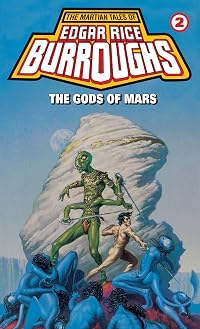
Cover by Michael Whelan
This reflection starts out with a confession. Having listened to the book a few years back I wasn’t going to re-read it when giving my reflections. As I pulled it off the shelf for a quick skim, I realized that I didn’t really remember much of the story. I have to say I am very glad I chose to read it again.
This was the book that sold me on Edgar Rice Burroughs more than any other. Mind you I devoured anything Tarzan, TV, movies, comics but I didn’t connect Tarzan with ERB per se. Tarzan was Tarzan. But this second appearance of John Carter of Mars stayed in my psyche. It must have been the first that I read since the ending show more stuck in my head all these years. Enough that I would confuse it with the ending of A Princess of Mars.
Gods of Mars is Burroughs unleashed, his imagination going places further than Princess. Reading the first chapter, visualizing the plant men with their kangaroo attack mode with the spade like tails had me spinning. Here ERB creates and deconstructs the religion of Barsoom (Mars). In some ways making his own thoughts about religion clear. In the desert world of Barsoom, he envisions an oasis at the bottom of the planet.
The geography boggles my mind. Here we have a sea at the bottom of the world with another sea underneath it. Immense caverns with parts of the city emerging above ground to be in the upper sea. My mind still reels thinking about it but also I realize that Burroughs had it mapped out in his mind. The action shifts from the civilizations at the bottom of Barsoom to an ancient city to the halls of Helium in typical Burroughs whirlwind fashion but it holds together.
ERB is hitting his stride here with daring feats of battle by John Carter to naval fleets in wide scale aerial battle. We have individual fights, rebellions and armies meeting all in 190 pages. I’ve accused Burroughs of being the master of coincidence and happenstance but in this story it works. Burroughs has his tropes that he uses but in Gods, they aren’t his tropes, this is ERB exploring the ideas for the first time. There is an energy and enthusiasm to this novel that caused me to embrace the works of Edgar Rice Burroughs.
I read the Del Rey edition with a cover by Michael Whelan. Whelan captures the craziness of the first chapter of the novel while giving us not just John Carter but his faithful companion Tars Tarkas as well.
Looking at Burrough's next novel I find that although Tarzan of the Apes and Princess of Mars introduced the iconic characters, it is with their second novels that Burroughs solidified the characters and established the true wonders of the world they exist in. show less
Written 1912 Published 1913 All Story Magazine
Cover by Michael Whelan
This reflection starts out with a confession. Having listened to the book a few years back I wasn’t going to re-read it when giving my reflections. As I pulled it off the shelf for a quick skim, I realized that I didn’t really remember much of the story. I have to say I am very glad I chose to read it again.
This was the book that sold me on Edgar Rice Burroughs more than any other. Mind you I devoured anything Tarzan, TV, movies, comics but I didn’t connect Tarzan with ERB per se. Tarzan was Tarzan. But this second appearance of John Carter of Mars stayed in my psyche. It must have been the first that I read since the ending show more stuck in my head all these years. Enough that I would confuse it with the ending of A Princess of Mars.
Gods of Mars is Burroughs unleashed, his imagination going places further than Princess. Reading the first chapter, visualizing the plant men with their kangaroo attack mode with the spade like tails had me spinning. Here ERB creates and deconstructs the religion of Barsoom (Mars). In some ways making his own thoughts about religion clear. In the desert world of Barsoom, he envisions an oasis at the bottom of the planet.
The geography boggles my mind. Here we have a sea at the bottom of the world with another sea underneath it. Immense caverns with parts of the city emerging above ground to be in the upper sea. My mind still reels thinking about it but also I realize that Burroughs had it mapped out in his mind. The action shifts from the civilizations at the bottom of Barsoom to an ancient city to the halls of Helium in typical Burroughs whirlwind fashion but it holds together.
ERB is hitting his stride here with daring feats of battle by John Carter to naval fleets in wide scale aerial battle. We have individual fights, rebellions and armies meeting all in 190 pages. I’ve accused Burroughs of being the master of coincidence and happenstance but in this story it works. Burroughs has his tropes that he uses but in Gods, they aren’t his tropes, this is ERB exploring the ideas for the first time. There is an energy and enthusiasm to this novel that caused me to embrace the works of Edgar Rice Burroughs.
I read the Del Rey edition with a cover by Michael Whelan. Whelan captures the craziness of the first chapter of the novel while giving us not just John Carter but his faithful companion Tars Tarkas as well.
Looking at Burrough's next novel I find that although Tarzan of the Apes and Princess of Mars introduced the iconic characters, it is with their second novels that Burroughs solidified the characters and established the true wonders of the world they exist in. show less
The Gods of Mars is the second book of the eleven books in Edgar Rice Burroughs' Mars series and the second of three books in the initial trilogy of adventures that begins the series. It was originally published in 1913 and 1914 as a serial in an adventure magazine and then in 1918 as a novel. It is a continuation of one of the greatest swashbuckling adventures ever written set in the chivalrous tradition of the knights of King Arthur's Table, but taking place on the dying planet Mars. I recommend that you begin with Princess of Mars before tackling this one as that book sets John Carter on Mars and introduces a host of other characters very important to the story, such as his best friend Tars Tarkas, the mighty green warrior, and the show more princess, Dejah Thoris. Although the Mars of the John Carter books has some advanced technology such as flying ships and ray guns, the people of this world prefer to do battle with swords and thus John Carter, the greatest swordsman of two worlds, is every fighting foe after foe.
"The Gods of Mars" is not just a sword and planet adventure, however. It is a story where Burroughs lifts the veil off of what is behind the Martian religion and what really goes on in Valley Dor where Martians make their pilgirmage after they tire of centuries of life. It is thus a satire about organized religion. Burroughs also satirizes racial differences and, buried within this adventure tale, is a strong argument against racial and ethnic divisions with Carter convincing his fellow warriors finally that they are all alike whether Black, White, Red, or Green. Burroughs uses this book to show how ridiculous the institution of slavery was. In many ways, given the strong arguments hidden in here against organized religions or cults making fools out of its disciples and its arguments against racial divisions and ethnic superiority, this book was decades ahead of its time.
Most of all, however, "The Gods of Mars," as all of the John Carter books are, is part of the greatest story of swords and chivalry ever written. No one before or since has written a better adventure story than Burroughs. show less
"The Gods of Mars" is not just a sword and planet adventure, however. It is a story where Burroughs lifts the veil off of what is behind the Martian religion and what really goes on in Valley Dor where Martians make their pilgirmage after they tire of centuries of life. It is thus a satire about organized religion. Burroughs also satirizes racial differences and, buried within this adventure tale, is a strong argument against racial and ethnic divisions with Carter convincing his fellow warriors finally that they are all alike whether Black, White, Red, or Green. Burroughs uses this book to show how ridiculous the institution of slavery was. In many ways, given the strong arguments hidden in here against organized religions or cults making fools out of its disciples and its arguments against racial divisions and ethnic superiority, this book was decades ahead of its time.
Most of all, however, "The Gods of Mars," as all of the John Carter books are, is part of the greatest story of swords and chivalry ever written. No one before or since has written a better adventure story than Burroughs. show less
Members
- Recently Added By
Lists

Top Five Books of 2015
811 works; 241 members

Books Read By artturnerjr - 2015
27 works; 1 member

Books Read in 2014
2,344 works; 89 members

Books Read in 2019
4,052 works; 108 members
Author Information

769+ Works 65,534 Members
Edgar Rice Burroughs was born on September 1, 1875, in Chicago. His father, George Tyler was a distiller and a battery manufacturer. Early in life Burroughs attempted to support his family in a variety of occupations, including railroad policeman, business partner, and miner. None of these proved successful. However, Burroughs had always enjoyed show more reading adventure fiction and decided to try his hand at writing. His first attempt, written under the pseudonym Normal Bean, sold very quickly and Burroughs' career took off. Although critics and educators have not always been supportive of Burroughs' writing, the characters in his stories have entertained readers for many years. Tarzan was the most popular, earning Burroughs enough money to start his own publishing house and a motion picture company. Another character, John Carter, is the hero of Burroughs' Mars adventure series. The continuing popularity of these characters has led some critics to reconsider the value of Burroughs' writing and to acknowledge significant themes in his stories. Burroughs died on March 19, 1950. (Bowker Author Biography) show less
Some Editions
Series

Belongs to Publisher Series
Work Relationships
Is contained in
The Martian Tales Trilogy: A Princess of Mars / The Gods of Mars / The Warlord of Mars by Edgar Rice Burroughs
Pulp Tales Presents #35: Under the Moons of Mars and Carter of the Red Planet by Edgar Rice Burroughs (indirect)
The John Carter Trilogy of Edgar Rice Burroughs: A Princess of Mars; The Gods of Mars; A Warlord of Mars by Edgar Rice Burroughs (indirect)
The Ultimate Science Fiction Mega Collection: 24 of the Best Sci-Fi Books of All Time: A Journey to the Center of the Earth, 20,000 Leagues Under the Sea, Around the World in 80 Days, John Carter of Mars Trilogy, The War of the Worlds, The Time Machine, Frankenstein, Dr. Jekyll and Mr. Hyde, 3 Ray Bradbury Stories, Flatland, & More by Jules Verne
Common Knowledge
- Canonical title
- The Gods of Mars
- Original title
- The Gods of Mars
- Alternate titles*
- Prinsessan av Mars befrias (1925) (1925)
- Original publication date
- 1913-01; 1913-02; 1913-03; 1913-04; 1913-05
- People/Characters
- John Carter; Thuvia; Xodar; Dejah Thoris; Tars Tarkas; Carthoris (show all 15); Issus; Phaidor; Kantos Kan; Zat Arrras; Hor Vastus; Parthak; Gur Tus; Djor Kantos; Thurid
- Important places
- Mars; Barsoom; River Iss, Barsoom; Valley Dor, Barsoom; Lost Sea of Korus, Barsoom; Otz Mountains, Barsoom (show all 10); Omean, Barsoom; Shador, Omean, Barsoom; Helium, Barsoom; Temple of the Sun, Valley Dor, Barsoom
- First words
- Twelve years had passed since I had laid the body of my great-uncle, Captain John Carter, of Virginia, away from the sight of men in that strange mausoleum in the old cemetery at Richmond. (Foreword)
As I stood upon the bluff before my cottage on that clear cold night in the early part of March, 1886, the noble Hudson flowing like the grey and silent spectre of a dead river below me, I felt again the strange, compelling i... (show all)nfluence of the mighty god of war, my beloved Mars, which for ten long and lonesome years I had implored with outstretched arms to carry me back to my lost love. - Last words
- (Click to show. Warning: May contain spoilers.)But whether the assassin's dagger reached one fair bosom or another, only time will divulge.
- Original language
- English
- Canonical DDC/MDS
- 813.087626
*Some information comes from Common Knowledge in other languages. Click "Edit" for more information.
Classifications
- Genres
- Science Fiction, Fiction and Literature
- DDC/MDS
- 813.087626 — Literature & rhetoric American literature in English American fiction in English By type Genre fiction Adventure fiction Speculative fiction Science fiction Planetary romance
- LCC
- PS3503 .U687 — Language and Literature American literature American literature Individual authors 1900-1960
- BISAC
Statistics
- Members
- 2,274
- Popularity
- 8,848
- Reviews
- 46
- Rating
- (3.60)
- Languages
- 13 — Czech, Dutch, English, Estonian, Finnish, French, German, Greek, Hungarian, Italian, Russian, Spanish, Swedish
- Media
- Paper, Audiobook, Ebook
- ISBNs
- 192
- ASINs
- 81