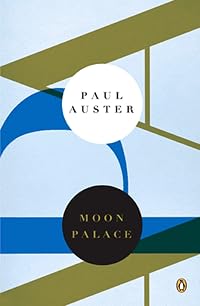
Moon Palace
by Paul Auster
On This Page
Description
The "beautiful and haunting" (San Francisco Chronicle) tale of an orphan's search for love, for his unknown father, and for the key to the elusive riddle of his fate, from the author of the forthcoming 4 3 2 1: A Novel Marco Stanley Fogg is an orphan, a child of the sixties, a quester tirelessly seeking the key to his past, the answers to the ultimate riddle of his fate. As Marco journeys from the canyons of Manhattan to the deserts of Utah, he encounters a gallery of characters and a show more series of events as rich and surprising as any in modern fiction. Beginning during the summer that men first walked on the moon, and moving backward and forward in time to span three generations, Moon Palace is propelled by coincidence and memory, and illuminated by marvelous flights of lyricism and wit. Here is the most entertaining and moving novel yet from an author well known for his breathtaking imagination. From New York Times-bestselling author Paul Auster (The New York Trilogy). show lessTags
Recommendations













Member Reviews
I came to Auster through a whole lot of coincidences; a few friends independently recommended him to me in the space of a few weeks and finding this in a second hand bookshop felt like destiny. Coincidence plays a large part in the unravelling of this story; characters are bound together by an unlikely web of threads and in consequence this world feels a touch smaller than it otherwise might have.
It feels like an attempt to write the Great American Novel, covering a grand sweep and attempting to define the culture, people and changes over that time – the story runs from the late nineteenth century to the 1980s and from New York to California and plenty of points in between. Auster’s prose is sumptuous and lithe, often providing the show more odd memorable phrase but overall enchanting the reader. It’s much needed too as the lead character, named for no less than three explorers which Auster points out in a very postmodern style, reminds me of an amalgam of my worst characteristics, a selfish dreamer who ultimately pushes the rest of the world away from him in one way or the other. M S Fogg’s selfishness renders him entirely believable but makes him deeply unattractive as a lead. Added to that the novel’s tremendously downbeat, with most characters suffering fairly gruelling ordeals and any happiness is fleeting. Still, despite the characters being unlovable and the acts of attempting to fulfil your dreams and discover yourself being painted as futile, Auster’s words and his ability to wring sympathy from Fogg and company mean I look forward to making his acquaintance again. show less
It feels like an attempt to write the Great American Novel, covering a grand sweep and attempting to define the culture, people and changes over that time – the story runs from the late nineteenth century to the 1980s and from New York to California and plenty of points in between. Auster’s prose is sumptuous and lithe, often providing the show more odd memorable phrase but overall enchanting the reader. It’s much needed too as the lead character, named for no less than three explorers which Auster points out in a very postmodern style, reminds me of an amalgam of my worst characteristics, a selfish dreamer who ultimately pushes the rest of the world away from him in one way or the other. M S Fogg’s selfishness renders him entirely believable but makes him deeply unattractive as a lead. Added to that the novel’s tremendously downbeat, with most characters suffering fairly gruelling ordeals and any happiness is fleeting. Still, despite the characters being unlovable and the acts of attempting to fulfil your dreams and discover yourself being painted as futile, Auster’s words and his ability to wring sympathy from Fogg and company mean I look forward to making his acquaintance again. show less
"It was the summer that men first walked on the moon. I was very young back then, but I did not believe there would ever be a future. I wanted to live dangerously, to push myself as far as I could go, and then see what happened to me when I got there. As it turned out, I nearly did not make it. "
The overriding theme of this novel is redemption. Can someone who has sunk so low as that they have eat other peoples' discarded food ever make a life for themselves.
Marco Stanley Fogg is a child of the sixties, and has had a tough start in life, no known father and a mother who was killed by a bus when he was a young boy, brought up by an uncle who lived a hand to mouth existence as a musician. This novel covers the early years in Fogg's life, show more a life steeped in tragedy and loss. Beginning during 'the summer that men first walked on the moon', and moving backward and forward in time to span three generations propelled by coincidence and memory.
In fact Auster rather than trying to shy away from coincidences makes a feature of them, deliberately stretching the reader's credulity to the limit. The book centres around three characters, who through accidents of birth are blood relatives and yet no one knows about it until its far too late.
Fogg is a dreamer drifting through life, directionless with no ambitions and unable to properly manage his money. I really liked how Fogg uses his uncles boxes of books as furniture when he first moves to Manhattan and as he reads the books so his furniture slowly disappears, " each time I opened another box, I simultaneously destroyed another piece of furniture. My bed was dismantled, my chairs shrank and disappeared, my desk atrophied into empty space. My life had become a gathering zero, and it was a thing I could actually see: a palpable, burgeoning emptiness. Each time I ventured into my uncle’s past, it produced a physical result, an effect in the real world. The consequences were therefore always before my eyes, and there was no way to escape them.”
Moon Palace is such a great mix of sadness and humour. There were a lot of witty and sardonic sections, everything about this book is such a mix of contradictions and my mood swung along with it. Overall I found it a witty novel, filled with many unexpected coincidences that is also remarkably easy to read. show less
The overriding theme of this novel is redemption. Can someone who has sunk so low as that they have eat other peoples' discarded food ever make a life for themselves.
Marco Stanley Fogg is a child of the sixties, and has had a tough start in life, no known father and a mother who was killed by a bus when he was a young boy, brought up by an uncle who lived a hand to mouth existence as a musician. This novel covers the early years in Fogg's life, show more a life steeped in tragedy and loss. Beginning during 'the summer that men first walked on the moon', and moving backward and forward in time to span three generations propelled by coincidence and memory.
In fact Auster rather than trying to shy away from coincidences makes a feature of them, deliberately stretching the reader's credulity to the limit. The book centres around three characters, who through accidents of birth are blood relatives and yet no one knows about it until its far too late.
Fogg is a dreamer drifting through life, directionless with no ambitions and unable to properly manage his money. I really liked how Fogg uses his uncles boxes of books as furniture when he first moves to Manhattan and as he reads the books so his furniture slowly disappears, " each time I opened another box, I simultaneously destroyed another piece of furniture. My bed was dismantled, my chairs shrank and disappeared, my desk atrophied into empty space. My life had become a gathering zero, and it was a thing I could actually see: a palpable, burgeoning emptiness. Each time I ventured into my uncle’s past, it produced a physical result, an effect in the real world. The consequences were therefore always before my eyes, and there was no way to escape them.”
Moon Palace is such a great mix of sadness and humour. There were a lot of witty and sardonic sections, everything about this book is such a mix of contradictions and my mood swung along with it. Overall I found it a witty novel, filled with many unexpected coincidences that is also remarkably easy to read. show less
Free Will and Blind Luck
I find it very difficult to review a book I am so emotionally attached to. Even after a third read, I still feel so strongly that rational words struggle to reach the surface. I confessed this to GR friend, Violeta the other day. She is an Auster fan and wanted to read my thoughts on this one. Perhaps, a few personal touches and anecdotes will help get me from point A to B in this review.
Then I read an essay that explains how no scholar believes in free will anymore. Free Will is an illusion. Basically, our choices are predetermined by so many factors, neurology, the laws of physics, genes etc. Of course this upsets our sense of ourselves as agents of our destiny, perhaps we are more likely pushed into the show more choices we seem to think belong to us alone.
I pause while writing this to make my son dinner after he came home from coaching 12 year olds on our coldest wettest day so far. I am predetermined to do this even though I know he is 20 years old and capable of doing it himself. He of course is doing what I was doing for him 8 years ago, that is coaching a 12-year-old soccer team (his as it happens) and so it goes on.
This lead me to Moon Palace and the problem of chance. Chance events are the building blocks of the novel. Chance determines everything, but in a fatalistic way, except that fate isn't predestiny but a story written by an author at his typewriter following the permutations and combinations of the character's possibilities. Fogg, the narrator came from a family of immigrants whose name was changed on arrival at Ellis island from Fogelman. Fogg’s mother dies in an accident when he is nine. His uncle Victor adores him as the only family he has left. When he departs this world, he wills nephew Fogg with 1492 books, which he starts reading in a completely random way, box by box to honour his last family member, and stick to a predetermined path. This fatalism overwhelms Fogg and almost kills him since he gives himself over completely to chance and nearly starves to death. These elements would be spoilers if only the book was poorly written. But it is so beautifully done, you don’t care about the number of books corresponding to the year of Columbus’ discovery or any one of the many details that Fogg is clueless about his past. You stop caring about chance, time and destiny when you are in self-destructive mode. The past Fogg is about to encounter contains the big sprawling story of America – as big as the wild west and manifest destiny or the rise and fall of corporate empires. Chance encounters, experiences, events, signs and symbols act as the narrative glue in this story. How Auster pulls off the plausibility of the events is the spectacle. Fogg just happens to be in the middle of it all trying to see it all.
Personal anecdote spoiler: Books were randomly assigned to me as a child, since my parents could not read English. Even to poorly educated people like my parents, books still contained mystery and wonder. How did I come by books? My father worked in various jobs at a hospital. Books were left about in either the emergency department or outpatient appointment waiting room. Everyone knows to bring a book, or perhaps the nuns who originally ran this hospital believed it right to put books out for people to read, perhaps as a distraction from the anxiety of waiting for bad news. My father, perhaps realising his limitations as a reader and provider of educational support brought some of them home with him once in a while. So books randomly appeared at our home some mornings after one of my father’s night shifts. I got Gogol’s Dead Souls, David Copperfield, Vol 2, Anna Karenina Vol 1, War and Peace among many others like these as a twelve-year-old. Luck, chance, fathers. That’s what Moon Palace is all about. Lost fathers in novels are like lost fathers on night shifts.
Chance in an Auster novel is like a secret language of the universe. Without it, there is no meaning to the random elements of the lives of its characters. A bit like a novel, eh! I only read this book by chance too. I hung around in my 20s with a bunch of people who we’d now call geeks. These friends all loved Auster’s New York Trilogy. I didn’t. Perhaps it was the way they dissected it like a sci-fi movie hunt for George Lucas’ cultish hidden fanboy tributes that bothered me. Anyway, one day at a friend’s place I was bored and found Moon Palace on the shelf and started reading it. The friend said he didn’t like it and gave it to me. I lend it out often and it never seems to come back, requiring me to find a replacement copy every so often.
I like Auster’s take on America’s foundational myths, too. It’s full of stories of people setting off to find their destiny, down on luck, seeking truth, the Pacific Ocean, dramatic western vistas, enduring, surviving, left for dead, defying the odds. Only this time, the story involves one of the recent generation from a boatload of immigrants telling the story rather than some robber baron, plantation owning, corporate magnate with a string of newspapers.
Character isn’t Auster’s strong point. No one is deeply drawn. The old man Effing, who Fogg goes to work for is easily recognisable as any old rich easterner, cantankerous, moody, self-important mostly an a***hole. At times he seems to hold the destiny of young Fogg in his hands. Effing believes he is an agent of his own destiny, defying chance after a freak fall as he journeys across the continent seeking the aesthetic of the old west as a painter. Chance drives Effing’s own story, but he chooses to tell Fogg he has the mythical power of telekinesis. Old men of wealth will believe in their own power over life. This can only be a counterpoint to the element of chance, an irony of the passing of the old. Voice is a character in American fiction. I am convinced of it. So much so, that an American voiced character can only behave like an American. And Auster does something very interesting here, he reminds that this fast talking self-determining being is none other than a victim of chance, too. But you want to hear his story first. After all, even Odysseus was an a***hole at times.
By the end of it, each character in this book loses everyone they are close to. More like a melodrama than an earnest piece of literature. Fogg’s mother and uncle, eventually his father and even the grandfather he didn’t know about. He loses his lover Kitty Wu (three reads and I still will them to continue) and Zimmerman his old college buddy who saved his life when he went homeless. Loss is inevitable, like chance. The only point of loss is that it is a point along the way in a story that leads to another. Like a refutation of free will, there are elements at work leading from one point to the next that we cannot fully know until they are revealed. show less
I find it very difficult to review a book I am so emotionally attached to. Even after a third read, I still feel so strongly that rational words struggle to reach the surface. I confessed this to GR friend, Violeta the other day. She is an Auster fan and wanted to read my thoughts on this one. Perhaps, a few personal touches and anecdotes will help get me from point A to B in this review.
Then I read an essay that explains how no scholar believes in free will anymore. Free Will is an illusion. Basically, our choices are predetermined by so many factors, neurology, the laws of physics, genes etc. Of course this upsets our sense of ourselves as agents of our destiny, perhaps we are more likely pushed into the show more choices we seem to think belong to us alone.
I pause while writing this to make my son dinner after he came home from coaching 12 year olds on our coldest wettest day so far. I am predetermined to do this even though I know he is 20 years old and capable of doing it himself. He of course is doing what I was doing for him 8 years ago, that is coaching a 12-year-old soccer team (his as it happens) and so it goes on.
This lead me to Moon Palace and the problem of chance. Chance events are the building blocks of the novel. Chance determines everything, but in a fatalistic way, except that fate isn't predestiny but a story written by an author at his typewriter following the permutations and combinations of the character's possibilities. Fogg, the narrator came from a family of immigrants whose name was changed on arrival at Ellis island from Fogelman. Fogg’s mother dies in an accident when he is nine. His uncle Victor adores him as the only family he has left. When he departs this world, he wills nephew Fogg with 1492 books, which he starts reading in a completely random way, box by box to honour his last family member, and stick to a predetermined path. This fatalism overwhelms Fogg and almost kills him since he gives himself over completely to chance and nearly starves to death. These elements would be spoilers if only the book was poorly written. But it is so beautifully done, you don’t care about the number of books corresponding to the year of Columbus’ discovery or any one of the many details that Fogg is clueless about his past. You stop caring about chance, time and destiny when you are in self-destructive mode. The past Fogg is about to encounter contains the big sprawling story of America – as big as the wild west and manifest destiny or the rise and fall of corporate empires. Chance encounters, experiences, events, signs and symbols act as the narrative glue in this story. How Auster pulls off the plausibility of the events is the spectacle. Fogg just happens to be in the middle of it all trying to see it all.
Personal anecdote spoiler: Books were randomly assigned to me as a child, since my parents could not read English. Even to poorly educated people like my parents, books still contained mystery and wonder. How did I come by books? My father worked in various jobs at a hospital. Books were left about in either the emergency department or outpatient appointment waiting room. Everyone knows to bring a book, or perhaps the nuns who originally ran this hospital believed it right to put books out for people to read, perhaps as a distraction from the anxiety of waiting for bad news. My father, perhaps realising his limitations as a reader and provider of educational support brought some of them home with him once in a while. So books randomly appeared at our home some mornings after one of my father’s night shifts. I got Gogol’s Dead Souls, David Copperfield, Vol 2, Anna Karenina Vol 1, War and Peace among many others like these as a twelve-year-old. Luck, chance, fathers. That’s what Moon Palace is all about. Lost fathers in novels are like lost fathers on night shifts.
Chance in an Auster novel is like a secret language of the universe. Without it, there is no meaning to the random elements of the lives of its characters. A bit like a novel, eh! I only read this book by chance too. I hung around in my 20s with a bunch of people who we’d now call geeks. These friends all loved Auster’s New York Trilogy. I didn’t. Perhaps it was the way they dissected it like a sci-fi movie hunt for George Lucas’ cultish hidden fanboy tributes that bothered me. Anyway, one day at a friend’s place I was bored and found Moon Palace on the shelf and started reading it. The friend said he didn’t like it and gave it to me. I lend it out often and it never seems to come back, requiring me to find a replacement copy every so often.
I like Auster’s take on America’s foundational myths, too. It’s full of stories of people setting off to find their destiny, down on luck, seeking truth, the Pacific Ocean, dramatic western vistas, enduring, surviving, left for dead, defying the odds. Only this time, the story involves one of the recent generation from a boatload of immigrants telling the story rather than some robber baron, plantation owning, corporate magnate with a string of newspapers.
Character isn’t Auster’s strong point. No one is deeply drawn. The old man Effing, who Fogg goes to work for is easily recognisable as any old rich easterner, cantankerous, moody, self-important mostly an a***hole. At times he seems to hold the destiny of young Fogg in his hands. Effing believes he is an agent of his own destiny, defying chance after a freak fall as he journeys across the continent seeking the aesthetic of the old west as a painter. Chance drives Effing’s own story, but he chooses to tell Fogg he has the mythical power of telekinesis. Old men of wealth will believe in their own power over life. This can only be a counterpoint to the element of chance, an irony of the passing of the old. Voice is a character in American fiction. I am convinced of it. So much so, that an American voiced character can only behave like an American. And Auster does something very interesting here, he reminds that this fast talking self-determining being is none other than a victim of chance, too. But you want to hear his story first. After all, even Odysseus was an a***hole at times.
By the end of it, each character in this book loses everyone they are close to. More like a melodrama than an earnest piece of literature. Fogg’s mother and uncle, eventually his father and even the grandfather he didn’t know about. He loses his lover Kitty Wu (three reads and I still will them to continue) and Zimmerman his old college buddy who saved his life when he went homeless. Loss is inevitable, like chance. The only point of loss is that it is a point along the way in a story that leads to another. Like a refutation of free will, there are elements at work leading from one point to the next that we cannot fully know until they are revealed. show less
First sentence: "It was the summer that men first walked on the moon. I was very young then, but I did not believe there would ever be a future."
This opening utterly drew me in, as I, too, well remember the summer of 1969 (which I spent in Singapore) when men first walked on the moon.
Marco Stanley Fogg (MS) lost his mother in a tragic bus accident when he was 11 and never knew his father. His uncle, a traveling musician, raised him, and when he died left MS enough money to get through college. When the novel opens in 1969 as his graduation from college approaches, MS is mentally paralyzed and unable to do anything to move his life forward. After being evicted from his apartment, he sleeps in Central Park and eats food foraged from show more garbage cans until a couple of his friends rescue him, and nurse him back to a semblance of mental health.
MS is able to get a job as a companion to an elderly eccentric former artist, Thomas Effing. The focus of the novel then shifts to Effing, as he narrates the story of his life to MS (ostensibly so that MS can write his obituary), spanning the 20th century and moving from the Wild West to turn of the century San Francisco to Europe in the 1920's and back to New York City.
The overriding theme of the novel is that Effing has lost a son, as MS has lost (or never known) a father. Although the facts of the story Auster tells frequently seem incredible and there are several highly unlikely coincidences, Auster almost makes it work--almost, but not quite. I just couldn't wrap my head around some of the more unlikely coincidences in the stories of MS and Effing. One Amazon reviewer said there were "enough improbably coincidences to make Dickens blush." Despite this, I do have to say I enjoyed reading most of the story. And at least I've knocked off another book on the 1001 list.
2 1/2 stars show less
This opening utterly drew me in, as I, too, well remember the summer of 1969 (which I spent in Singapore) when men first walked on the moon.
Marco Stanley Fogg (MS) lost his mother in a tragic bus accident when he was 11 and never knew his father. His uncle, a traveling musician, raised him, and when he died left MS enough money to get through college. When the novel opens in 1969 as his graduation from college approaches, MS is mentally paralyzed and unable to do anything to move his life forward. After being evicted from his apartment, he sleeps in Central Park and eats food foraged from show more garbage cans until a couple of his friends rescue him, and nurse him back to a semblance of mental health.
MS is able to get a job as a companion to an elderly eccentric former artist, Thomas Effing. The focus of the novel then shifts to Effing, as he narrates the story of his life to MS (ostensibly so that MS can write his obituary), spanning the 20th century and moving from the Wild West to turn of the century San Francisco to Europe in the 1920's and back to New York City.
The overriding theme of the novel is that Effing has lost a son, as MS has lost (or never known) a father. Although the facts of the story Auster tells frequently seem incredible and there are several highly unlikely coincidences, Auster almost makes it work--almost, but not quite. I just couldn't wrap my head around some of the more unlikely coincidences in the stories of MS and Effing. One Amazon reviewer said there were "enough improbably coincidences to make Dickens blush." Despite this, I do have to say I enjoyed reading most of the story. And at least I've knocked off another book on the 1001 list.
2 1/2 stars show less
Marcus Stanley Fogg was raised by his Uncle Victor, a bachelor and itinerant clarinetist. When Marcus went off to university at Columbia, Victor sent him off with over 1,000 books, all packed in boxes. Books that Marcus had no use for, but which Victor felt were his legacy to him.
Suddenly, Victor died. Things started to slide for Marcus. Money was running out, and although he did manage to graduate, he soon found himself living in Central Park. The books were gone, sold off for a pittance; the last one gone the day of the first American moon landing in 1969. Marcus too was almost gone. Malnutrition and disease were doing him in, until one day the mysterious Kitty Wu took him home.
So begins a strange cyclical life of ups and downs as show more Marcus searches for his way in the world, often guided by older men, not quite father like figures, but figures of authority all the same.
The tale is narrated by Marcus, who appears to be influenced strongly by the nineteenth century authors Victor had left him: Verne, Stevenson, and Dickens. There is humour here too. Bits of The Big Lebowski kept flashing through my mind, Most of all, there is "the quest": for a younger more hopeful United States, for better lives, and for better people including Marcus himself.
Paul Auster has always been one of those people I’ve felt I should read, but for some reason, I never had. I think I was somewhat intimidated by all the praise directed at him. After all, someone of the stature of Don DeLillo said of him “This is a writer whose work shines with intelligence and originality”, blending modern surfaces with 19th century interiors. Then I read that Auster had said of Moon Palace ''In some sense, this is my first novel, but I wrote it later.’’ That’s probably the best summation of its style there is: fresh, yet polished. show less
Suddenly, Victor died. Things started to slide for Marcus. Money was running out, and although he did manage to graduate, he soon found himself living in Central Park. The books were gone, sold off for a pittance; the last one gone the day of the first American moon landing in 1969. Marcus too was almost gone. Malnutrition and disease were doing him in, until one day the mysterious Kitty Wu took him home.
So begins a strange cyclical life of ups and downs as show more Marcus searches for his way in the world, often guided by older men, not quite father like figures, but figures of authority all the same.
The tale is narrated by Marcus, who appears to be influenced strongly by the nineteenth century authors Victor had left him: Verne, Stevenson, and Dickens. There is humour here too. Bits of The Big Lebowski kept flashing through my mind, Most of all, there is "the quest": for a younger more hopeful United States, for better lives, and for better people including Marcus himself.
Paul Auster has always been one of those people I’ve felt I should read, but for some reason, I never had. I think I was somewhat intimidated by all the praise directed at him. After all, someone of the stature of Don DeLillo said of him “This is a writer whose work shines with intelligence and originality”, blending modern surfaces with 19th century interiors. Then I read that Auster had said of Moon Palace ''In some sense, this is my first novel, but I wrote it later.’’ That’s probably the best summation of its style there is: fresh, yet polished. show less
I'd give this book one star only, but I feel maybe (though I'm not thoroughly convinced) that somewhere under all the awful, pretentious drivel there's a kernel of something interesting. I mean - by itself - the plot elements have the makings of something to pique the interest of even a casual reader; curious characters, strange happenings, wordplay and symbolism. And maybe I'm missing something others can see in this book. Apparently it's pretty well received overall. I feel, however, that this book is flawed, if not just outright bad.
One problem is that despite Auster's attempts to imbue his characters with interesting characteristics, he fails miserably at expounding on these qualities in the actual narrative. Let me elaborate: he show more doesn't describe people through their actions or interactions. Not even through dialogue. He just whips up an adjective and expects you to buy it. Sol has great "wit and charm", Auster (or rather, Fogg) informs us, but I cannot recall a single instance of this wit or charm actually occurring in the book. It feels stumblingly awkward, and on several occasions exasperatingly lazy.
Halfway through the book I actually threw up my head and groaned loudly at the quality of the writing. I think it was during introduction of Kitty - a character and plot line so weak you could use it to dilute water. She's probably the least believable female stereotype I've ever had the misfortune to encounter. And also so obviously the writers personal fantasy that's it's embarrassing. At one point Auster (oops, I mean Fogg) candidly tells us "I pulled down Kitty's jeans and panties and brought her to orgasm with my tounge". I would have winced but for the sad inadequacy of the text at producing arousal of any kind.
And it's not just the ennui of the sex scenes or the morbidly one-dimensional characters either. The way he writes dialogue is just astoundingly bad. Not a single one of his characters has a unique voice, they all sound like the same person when they speak. He might as well have skipped the dialogue all together, as it only functions to forward plot, and often only in only the most rudimentary way.
Another huge problem is that the protagonist is not only a shallow, self absorbed sociopath with no redeeming qualities whatsoever, he's not even interesting. I had absolutely no interest in finding out anything about his intentions or plans, motives or history. I didn't care one way or another about whether he starved or got laid or found out who his father was. He leaves this Kitty character and then wallows in misery like it's somehow not his own fault. He shows no empathy or interest towards anyone apart from himself.
Apart from these things Auster writes OK. He's never brilliant, often adequate, sometimes quite awful. There's a lot of symbolism, mainly revolving (ha!) around the moon. But it doesn't feel significant to the story, and it fails to deliver anything more than shallow connections and musings on the themes of the book - much like the characters, the setting and the dialogue. I had no idea what this book was trying to tell me, and I would venture to say that neither does Auster.
I finished Moon Palace on principle, because I don't like to judge a book unless I've read the whole thing. And for sure, there are some qualities in this book, particularly the story about Effing in the desert and the cave. But the qualities of the main story are sadly buried underneath a heap of purple prose, anemic characterization and bland dialogue. I was recommended this book, but I will sadly not be recommending it to anyone, ever. show less
One problem is that despite Auster's attempts to imbue his characters with interesting characteristics, he fails miserably at expounding on these qualities in the actual narrative. Let me elaborate: he show more doesn't describe people through their actions or interactions. Not even through dialogue. He just whips up an adjective and expects you to buy it. Sol has great "wit and charm", Auster (or rather, Fogg) informs us, but I cannot recall a single instance of this wit or charm actually occurring in the book. It feels stumblingly awkward, and on several occasions exasperatingly lazy.
Halfway through the book I actually threw up my head and groaned loudly at the quality of the writing. I think it was during introduction of Kitty - a character and plot line so weak you could use it to dilute water. She's probably the least believable female stereotype I've ever had the misfortune to encounter. And also so obviously the writers personal fantasy that's it's embarrassing. At one point Auster (oops, I mean Fogg) candidly tells us "I pulled down Kitty's jeans and panties and brought her to orgasm with my tounge". I would have winced but for the sad inadequacy of the text at producing arousal of any kind.
And it's not just the ennui of the sex scenes or the morbidly one-dimensional characters either. The way he writes dialogue is just astoundingly bad. Not a single one of his characters has a unique voice, they all sound like the same person when they speak. He might as well have skipped the dialogue all together, as it only functions to forward plot, and often only in only the most rudimentary way.
Another huge problem is that the protagonist is not only a shallow, self absorbed sociopath with no redeeming qualities whatsoever, he's not even interesting. I had absolutely no interest in finding out anything about his intentions or plans, motives or history. I didn't care one way or another about whether he starved or got laid or found out who his father was. He leaves this Kitty character and then wallows in misery like it's somehow not his own fault. He shows no empathy or interest towards anyone apart from himself.
Apart from these things Auster writes OK. He's never brilliant, often adequate, sometimes quite awful. There's a lot of symbolism, mainly revolving (ha!) around the moon. But it doesn't feel significant to the story, and it fails to deliver anything more than shallow connections and musings on the themes of the book - much like the characters, the setting and the dialogue. I had no idea what this book was trying to tell me, and I would venture to say that neither does Auster.
I finished Moon Palace on principle, because I don't like to judge a book unless I've read the whole thing. And for sure, there are some qualities in this book, particularly the story about Effing in the desert and the cave. But the qualities of the main story are sadly buried underneath a heap of purple prose, anemic characterization and bland dialogue. I was recommended this book, but I will sadly not be recommending it to anyone, ever. show less
Mi primera incursión en el universo «Paul Auster», y debo reconocer que ha resultado de mi agrado.
Me ha gustado el estilo en que está escrito, sumamente fluído. Se hace difícil dejar el libro de lado si uno no tiene un reloj a mano. En general es bastante accesible, aunque de tanto en tanto tira frases magistrales que lo dejan a uno pensando: ¿podría Auster ser un maestro contemporáneo del aforismo?
Son de destacar las "historias dentro de la historia", tal como la biografía de Thomas Effing o la novela de Solomon Barber. Puntos extra por las referencias a pintores relativamente oscuros, al menos para lectores de estas latitudes.
Sin embargo, dista mucho de ser la novela perfecta. Hubo momentos que me resultaron insoportables, show more como la sumamente improbable serie de coincidencias familiares o el personaje despreocupadamente cliché de Kitty Wu.
En el balance general, no obstante, queda un saldo positivo. De hecho, ya hasta he conseguido una copia de [b:La trilogía de Nueva York|36511006|La trilogía de Nueva York|Paul Auster|https://i.gr-assets.com/images/S/compressed.photo.goodreads.com/books/1509477014l/36511006._SY75_.jpg|2343071], así que seguiré con Paulito por un rato más. show less
Members
- Recently Added By
Lists

1001 Books You Must Read Before You Die
1,448 works; 1,132 members

1980s
356 works; 23 members

1,001 BYMRBYD Concensus
723 works; 27 members
American Lit for Eng 11 Research Project
368 works; 6 members

I Could Live There
185 works; 12 members

My TBR
371 works; 3 members
Author Information

101+ Works 64,808 Members
Paul Auster was born on February 3, 1947, in Newark, New Jersey. He received a B.A. and a M.A. in English and Comparative Literature from Columbia University. In addition to his career as a writer, Auster has been a census taker, tutor, merchant seaman, little-league baseball coach, and a telephone operator. He started his writing career as a show more translator. He soon gained popularity for the detective novels that make up his New York Trilogy. His other works include The Invention of Solitude; Leviathan; Moon Palace; Facing the Music; In the Country of Last Things; The Music of Chance; Mr. Vertigo; and The Brooklyn Follies. His latest novels are entitled, Invisible and Sunset Park. In addition to his novels, Auster has written screenplays and directed several films. He is the recipient of a fellowship from the National Endowment for the Arts and a French Prix Medicis for Foreign Literature. (Bowker Author Biography) show less
Some Editions
Awards and Honors
Series
Belongs to Publisher Series
Work Relationships
Is contained in
Common Knowledge
- Canonical title
- Moon Palace
- Original title
- Moon Palace
- Original publication date
- 1989
- People/Characters
- Marco Stanley Fogg ("MS" Fogg); Kitty Wu; Thomas Effing (formerly Julian Barber); Solomon Barber; Emily Fogg; Victor Fogg (Uncle Victor) (show all 9); David Zimmer; Orlando; Mrs Hume
- Important places
- New York, New York, USA
- Epigraph
- Nothing can astound an American.
– Jules Verne - Dedication
- for Norman Schiff –
in memory - First words
- It was the summer that men first walked on the moon.
- Last words
- (Click to show. Warning: May contain spoilers.)I kept my eyes on it as it rose in the dark sky, not turning away until it had found its place in the darkness.
- Original language
- English
Classifications
Statistics
- Members
- 3,674
- Popularity
- 4,378
- Reviews
- 60
- Rating
- (3.88)
- Languages
- 23 — Catalan, Danish, Dutch, English, Finnish, French, German, Greek, Hebrew, Hungarian, Italian, Japanese, Korean, Norwegian (Bokmål), Norwegian, Farsi/Persian, Polish, Portuguese, Romanian, Serbian, Spanish, Swedish, Turkish
- Media
- Paper, Audiobook, Ebook
- ISBNs
- 94
- ASINs
- 17