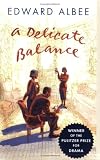
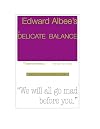
A Delicate Balance
by Edward Albee
On This Page
Description
A drama which examines the lives and values of two middle-aged couples and two younger women.Tags
Recommendations














Member Reviews
This was a Pulitzer Prize winning play and I expected a little more from Albee, having read Who's Afraid of Virginia Woolf. The play was a family drama, first and foremost, that explores themes through its characters relating to friendship, intimacy, and loneliness. Edna is a character who moves along the focus of the book, and Tobias becomes a megaphone for the main ideas that Albee attempts to illustrate through the play. Overall, it was not a bad play, but I expected much better considering the awards and accolades that were bestowed on this work.
3 stars.
3 stars.
Very good writing. I disliked all the characters. I didn't know what the play was about, which is OK, but a critic's blurb on the cover stated it was about the nothingness in our lives. It did have that 60's, nihilistic, hopelessness feel to it, which I often like (Heller, Vonnegut), but these characters annoyed the crap out of me and made me want to suggest they get hobbies or go for a bike ride. Something.
A strange play that didn’t feel very realistic to me. The plot wasn’t believable and left me feeling skeptical. A middle-aged couple has their life thrown into turmoil when their best friends up here and decide to move in because of an unnamed terror that is making them anxious. Toss in an alcoholic sister and an adult daughter on her fourth marriage who wants to move back home as well and watch the conflict ensue.
Edward Albee's follow-up to "Who's Afraid of Virginia Woolf", and it may be better than that play. A fine study of alienation and emptiness in marriage and family. It's been too long a time to remember the plot, but I remember thinking that what Jules Feiffer did in his cartoons, Edward Albee did in his plays.
Amazon: A DELICATE BALANCE is one of Albee's Pulitzer winners; anyone who cares about theatre will love this. In performance an electrifying evening, it is also a darn good read--again and again. A tragedy at times hilarious, the stylized piece is an examination of friendship contrasted with family, in which the playwright creates six delicous characters--roles actors especially love and often perform brilliantly. Katherine Hepburn's filmed version comes to mind--a near perfect expression of the matriarch Agnes, who has several problems: her alcoholic sister is drinking in the living room, her daughter is coming home after a failed 4th marriage, and her friends Edna and Harry have decided to move in because they are "afraid" of show more something. Agnes's husband Tobias is polite, detached, and reasonable. Against bristling tension, the author uses drunken Claire as comic counterpoint to brilliant effect, giving her an accordion (of all things) as prop with which to accent and poke fun. (There's a wonderful sight gag near the end where this character, who isn't supposed to have one drink, is discovered holding two.) We also smile when mousy Edna tries to re-decorate Agnes's home and speaks to the divorcing Julia as if she were her own daughter. (How easily shyness moves to assertiveness, then imperceptibly to cruelty.) So we laugh to keep from crying--but laugh we do! And although Agnes is unforgettable, nevertheless it is Tobias who gets the climactic "aria," an attempt to put his house in order. The dramatist calls our bluff on what we mean by "friends," fusing big ideas in three elegant acts, crystallizing mysterious beauty from carefully chosen words. The result is a theatrical touchstone, one of Edward Albee's many masterpieces, a magnificent gem of a play. (Tom White) show less
In A Delicate Balance, a well-to-do Connecticut family is upended when the grown daughter's godparents, seized by a nameless terror, decide to come live with them.
The film's part captivating, part nonsensical rambling twaddle, in one location and uneventful. Almost unbearable early on, with it seems their days and nights spend drinking. It is clearly intruding by their friends, they could've just asked to stay there for a while and it would've been fine. Them telling the daughter what to do is altogether another story, you have no place doing that. The conclusion's pretty weak, something that would simply negate the whole thing given a little thought.
The film's part captivating, part nonsensical rambling twaddle, in one location and uneventful. Almost unbearable early on, with it seems their days and nights spend drinking. It is clearly intruding by their friends, they could've just asked to stay there for a while and it would've been fine. Them telling the daughter what to do is altogether another story, you have no place doing that. The conclusion's pretty weak, something that would simply negate the whole thing given a little thought.
Jan 5, 2026English (UK)
O cenário é uma casa de classe alta em Connecticut. Os moradores, um velho casal, a cujo casamento falta principalmente sexo; uma irmã alcoólatra; uma filha casada; e um par de vizinhos irritantes que, por causa de um ataque de ansiedade, se mudou para perto dos amigos. O texto é inteligente e perspicaz, mas não contém uma única ideia original.
May 21, 2016Portuguese
Members
- Recently Added By
Lists

Plays I Like
230 works; 31 members

Alberto Manguel's 100 Favorite Books
10 works; 1 member
My Play Collection
769 works; 3 members

Next Plays / 2025
352 works; 1 member
Author Information

105+ Works 11,156 Members
Edward Albee was born in Virginia on March 12, 1928. His first produced play, The Zoo Story, opened in Berlin in 1959 before playing at the Provincetown Playhouse in Greenwich Village the following year. In 1960, it won the Vernon Rice Memorial Award. In 1962, his Broadway debut, Who's Afraid of Virginia Woolf?, won a Tony Award for best play. It show more was adapted into a film starring Richard Burton and Elizabeth Taylor in 1966. He wrote about 30 plays during his lifetime including The Sandbox, The American Dream, The Death of Bessie Smith, All Over, and The Play About the Baby. He won the Pulitzer Prize three times for A Delicate Balance in 1966, Seascape in 1975, and Three Tall Women in 1991. Three Tall Women also received Best Play awards from the New York Drama Critics Circle and Outer Critics Circle. He won another Tony Award for The Goat, or Who Is Sylvia? and a Lifetime Achievement Tony Award in 2005. He had died after a short illness on September 16, 2016 at the age of 88. (Bowker Author Biography) show less
Some Editions
Awards and Honors
Awards
Distinctions
Notable Lists
Series
Belongs to Publisher Series
Work Relationships
Is contained in
Has as a student's study guide
Common Knowledge
- Canonical title*
- In wankel evenwicht
- Original title
- A Delicate Balance
- Original publication date
- 1966
- Related movies
- A Delicate Balance (1973 | IMDb)
- Dedication
- For John Steinbeck, Affection and Admiration
- First words
- (In the library living room. Agnes in a chair, Tobias at a shelf looking at cordial bottles.) Agnes (speaks usually softly, with a tiny hint of a smile on her face: not sardonic, not sad...wistful, maybe): What I find most as... (show all)tonishing -- aside from that belief of mine, which never ceases to surprise me by the very fact of its surprising lack of unpleasantness, the belief that I might very easily -- as they say -- lose my mind one day, not that I suspect I am about to, or am even... nearby...
- Original language
- English
*Some information comes from Common Knowledge in other languages. Click "Edit" for more information.
Classifications
Statistics
- Members
- 541
- Popularity
- 55,154
- Reviews
- 7
- Rating
- (3.87)
- Languages
- Dutch, English, French, Spanish
- Media
- Paper, Ebook
- ISBNs
- 13
- ASINs
- 14