On This Page
Description
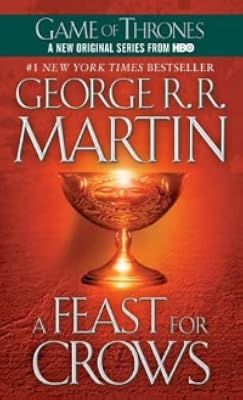
Martin delivers the long-awaited fourth book of his landmark series, as a kingdom torn asunder finds itself at last on the brink of peace ... only to be launched on an even more terrifying course of destruction. It seems too good to be true. After centuries of bitter strife and fatal treachery, the seven powers dividing the land have decimated one another into an uneasy truce. Or so it appears ... With the death of the monstrous King Joffrey, Cersei is ruling as regent in King's Landing. show more Robb Stark's demise has broken the back of the Northern rebels, and his siblings are scattered throughout the kingdom like seeds on barren soil. Few legitimate claims to the once desperately sought Iron Throne still exist--or they are held in hands too weak or too distant to wield them effectively. The war, which raged out of control for so long, has burned itself out. But as in the aftermath of any climactic struggle, it is not long before the survivors, outlaws, renegades, and carrion eaters start to gather, picking over the bones of the dead and fighting for the spoils of the soon-to-be dead. Now in the Seven Kingdoms, as the human crows assemble over a banquet of ashes, daring new plots and dangerous new alliances are formed, while surprising faces--some familiar, others only just appearing--are seen emerging from an ominous twilight of past struggles and chaos to take up the challenges ahead. It is a time when the wise and the ambitious, the deceitful and the strong will acquire the skills, the power, and the magic to survive the stark and terrible times that lie before them. It is a time for nobles and commoners, soldiers and sorcerers, assassins and sages to come together and stake their fortunes ... and their lives. For at a feast for crows, many are the guests--but only a few are the survivors. show lessTags
Recommendations


Member Recommendations
swampygirl Reading this book made me feel like I was rereading all of Pierce's books over again, and this one probably matches up the most closely.
21
Sandwich76 Something ludicrous to cleanse the palate
16

Member Reviews
I've put off writing this review for awhile, and it probably would be a lot more negative if I was not already most of the way through A Dance with Dragons, the substantively superior follow-up to A Fest for Crows. I'll have a bit to say about where this particular volume falls short, but the scope of those failings can only be understood in light of the more general issues with the series.
Martin made a decision in this novel which is probably the right one. As the plot has expanded, the number of characters we need to follow has increased significantly. Following all of these plots would really fragment the narrative and we would either skip too quickly through them, or not get very far. The decision was probably the right one, and it show more pays off in the next volume which picks up the stories of Daenerys, Jon, Bran, Tyrion and others.
The problem in this work, however, is that the plots we follow are simply much less interesting than in either A Storm of Swords or A Dance with Dragons. Cersei is finally made a POV character, and this simply affirms that she is as awful as we have long suspected. We do see her motivations, which are two fold. First, she is driven (like Catelyn) to protect her children at all costs, and second, to succeed as a powerful woman in a world of men. The first is dull, and reductive in the same way it was with Catelyn (reducing her identity to her motherhood). Her ambitions are more interesting, and are the germ of an interesting plot. However, it is consistently overwhelmed by her cruelty and ignorance.
Brienne is the most interesting character to be a main POV in this novel, but her plot is repetitive, moving from one danger on her quest for Sansa to another with only marginal growth of her character (which is also repeated over and over again). Other than a few bits here and there (the plot in Dorne gets interesting eventually and Arya's story is intriguing), it simply lacks the excitement and driving narrative to keep the reader engaged.
In some cases, this might be more easily forgiven. Martin is constructing a massive tale, and there are bound to be some slower portions. The trouble I had with this novel, however, is that when it slows down, it merely casts more light on the deeper problems. The work is brutal - violent and deeply misogynstic. This does not necessarily imply that Martin is misogynstic, whether implicitly or not. He clearly aims at a brutal world, and in this he is quite successful.
It forces us, however, to reflect on the difference between realism and voyeurism. Just about every chapter involves actual sexual assault, fantasies about sexual assault, or threats of sexual assault. One might, with some plausibility, simply say that Martin is accurately reflecting how sex is used as a weapon in patriarchical societies. The novels are frequently praised for their `realism' in that they refuse to show a world of virtue and a tale of heroic conquest. This might simply be an example of that. The world, as Martin sees it, is bleak and unrelenting, and so too is the world of Westeros.
I have trouble, however, telling the difference between realistic portrayals of sexual assualt and a reveling in it. Is the aim for us to be consistently horrified by almost every character in the novels? Or is the novel simply asking us to take a secretive thrill in it? It is unclear to me that having sexual violence occur so pervasively, and so frequently, adds to the realism of the novel. While reading, I could not but take the feeling that the novel expects us to take some pleasure in the sexual humiliation of Cersei (whom we have been passing moral judgment on for three books), or to be titillated by the frequent (and frequently abusive) sex scenes.
This underbelly of the novel (which has been present in every single volume) is more easily ellided over when you are caught up in the plot. When the plot slows down, and you are forced to focus more clearly on the true ugliness of this story, the novel becomes a much harder one to enjoy. show less
Martin made a decision in this novel which is probably the right one. As the plot has expanded, the number of characters we need to follow has increased significantly. Following all of these plots would really fragment the narrative and we would either skip too quickly through them, or not get very far. The decision was probably the right one, and it show more pays off in the next volume which picks up the stories of Daenerys, Jon, Bran, Tyrion and others.
The problem in this work, however, is that the plots we follow are simply much less interesting than in either A Storm of Swords or A Dance with Dragons. Cersei is finally made a POV character, and this simply affirms that she is as awful as we have long suspected. We do see her motivations, which are two fold. First, she is driven (like Catelyn) to protect her children at all costs, and second, to succeed as a powerful woman in a world of men. The first is dull, and reductive in the same way it was with Catelyn (reducing her identity to her motherhood). Her ambitions are more interesting, and are the germ of an interesting plot. However, it is consistently overwhelmed by her cruelty and ignorance.
Brienne is the most interesting character to be a main POV in this novel, but her plot is repetitive, moving from one danger on her quest for Sansa to another with only marginal growth of her character (which is also repeated over and over again). Other than a few bits here and there (the plot in Dorne gets interesting eventually and Arya's story is intriguing), it simply lacks the excitement and driving narrative to keep the reader engaged.
In some cases, this might be more easily forgiven. Martin is constructing a massive tale, and there are bound to be some slower portions. The trouble I had with this novel, however, is that when it slows down, it merely casts more light on the deeper problems. The work is brutal - violent and deeply misogynstic. This does not necessarily imply that Martin is misogynstic, whether implicitly or not. He clearly aims at a brutal world, and in this he is quite successful.
It forces us, however, to reflect on the difference between realism and voyeurism. Just about every chapter involves actual sexual assault, fantasies about sexual assault, or threats of sexual assault. One might, with some plausibility, simply say that Martin is accurately reflecting how sex is used as a weapon in patriarchical societies. The novels are frequently praised for their `realism' in that they refuse to show a world of virtue and a tale of heroic conquest. This might simply be an example of that. The world, as Martin sees it, is bleak and unrelenting, and so too is the world of Westeros.
I have trouble, however, telling the difference between realistic portrayals of sexual assualt and a reveling in it. Is the aim for us to be consistently horrified by almost every character in the novels? Or is the novel simply asking us to take a secretive thrill in it? It is unclear to me that having sexual violence occur so pervasively, and so frequently, adds to the realism of the novel. While reading, I could not but take the feeling that the novel expects us to take some pleasure in the sexual humiliation of Cersei (whom we have been passing moral judgment on for three books), or to be titillated by the frequent (and frequently abusive) sex scenes.
This underbelly of the novel (which has been present in every single volume) is more easily ellided over when you are caught up in the plot. When the plot slows down, and you are forced to focus more clearly on the true ugliness of this story, the novel becomes a much harder one to enjoy. show less
The quiet after the carnage.
I finished A Storm of Swords feeling like I had survived a disaster. My favorite characters were dead or scattered. My heart was in pieces. And I desperately needed to know what happened next.
Then I opened A Feast for Crows and discovered that half the characters I cared about were missing. No Tyrion. No Daenerys. No Jon Snow. No Bran. No Davos. Martin had split the narrative into two books: A Feast for Crows covers the south (King's Landing, the riverlands, the Iron Islands, Dorne), and A Dance with Dragons (published five years later) returns to the north and the east.
I was furious. For about a hundred pages. Then I realized: this book is not a continuation. It is a requiem.
What it is:
The War of the Five show more Kings is effectively over. The winners are exhausted. The losers are dead or in hiding. But the war has left behind a landscape of rubble, orphans, and broken lords. In King's Landing, the Lannisters try to consolidate their power; but without Tywin, without Tyrion, without anyone who knows how to rule. In the riverlands, Brienne wanders the ruins, searching for a missing Stark girl. In the Iron Islands, a kingsmoot (a rare election for a new king) unleashes old rivalries and a terrifying new plan. In Dorne, the ruling family has been nursing a grudge for seventeen years, and they are ready to act.
And somewhere in the Vale, Sansa Stark, still calling herself Alayne Stone learns the art of politics from the most dangerous man in the Seven Kingdoms.
There is no battle of Blackwater here. No Red Wedding. Instead, there is a funeral, a trial, a poisoning, a long walk through a burning riverlands, and a final chapter that will make you want to throw the book across the room; not because it is shocking, but because it is quiet. And quiet, Martin shows you, can be more devastating than any sword.
Why it works (even though it hurt to leave my favorites behind):
1. The focus on the aftermath. The first three books were about the war itself. A Feast for Crows is about the cost. We see villages that have been burned and abandoned. We meet widows, orphans, and broken soldiers. We watch the powerful try to pretend that everything is normal while the foundations rot beneath them. This is the most anti‑war book in the series, and it is necessary.
2. Cersei Lannister becomes a point‑of‑view character. Finally. After three books of hearing about her through Tyrion and Sansa and Ned, we get inside her head. And it is terrifying. Not because she is a monster. She is, but because she is also stupid. She thinks she is Tywin with teats. She is not. Her chapters are a slow‑motion train wreck. You will cringe, you will laugh, and you will feel a strange pity for her as she destroys everything her father built.
3. Brienne's quest is the soul of the book. She is searching for Sansa, but the search is an excuse. What Martin actually gives us is a tour of the broken riverlands. She meets a septon who has lost his faith, a grave digger who may be someone we knew, and a child with a name that will break your heart. Her final chapter, the chapter "The Fool" in some editions is one of the most beautiful and tragic things Martin has ever written.
4. The Iron Islands and Dorne add new flavors. The Ironborn chapters are savage, brutal, and unexpectedly compelling. The Dorne chapters are sun‑drenched, full of scheming and old grudges. These new characters: Asha, Victarion, Aeron, Arianne, the Sand Snakes are not as memorable as Tyrion or Arya, but they deepen the world and set up crucial events for the next books.
5. Sansa's arc is quiet and brilliant. She is no longer a pawn. She is learning to play the game, under the tutelage of Petyr Baelish. Her chapters are subtle: a comment here, a hesitation there, a moment of cold calculation. By the end, you realize she has become someone her younger self would not recognize. And you are proud of her.
6. The prose is richer. Without the need to juggle ten POVs across three continents, Martin slows down. He describes the autumn light on the river. He lingers on the smell of a feast gone cold. Some readers find this boring. I found it beautiful.
Where it stumbles (and why so many fans rank it lowest):
1. The missing characters are a genuine loss. I love Tyrion. I love Daenerys. I love Jon. Their absence is felt in every chapter. You will keep hoping for a glimpse of them. You will not get one. (They return in A Dance with Dragons, but even that book only covers half the timeline. The two books run in parallel, then diverge. It is confusing.)
2. The pacing is slow. Very slow. This is not a book for people who need plot momentum. There are long stretches of Brienne walking, Cersei scheming, and Samwell Tarly sailing. The famous "Sanderlanche" or "Martin avalanche" does not happen here. The climax is a series of small, bitter collapses, not one big explosion.
3. Too many new characters. The Iron Islands and Dorne introduce dozens of names: Greyjoys, Harlaws, Goodbrothers, Martells, Yronwoods, Daynes. The appendix becomes your lifeline. Some readers never warm to these new faces.
4. The book feels incomplete. It ends on several cliffhangers, and because A Dance with Dragons was delayed for five years, readers at the time were left hanging. Even now, reading them back‑to‑back, the split feels arbitrary. Martin himself has called it a mistake.
5. Cersei's chapters can be exhausting. She is paranoid, petty, and cruel. Watching her make one stupid decision after another is compelling at first, but by the tenth chapter of "Cersei hates Margaery, Cersei trusts a mad scientist, Cersei alienates her allies," you may feel like you are reading a satire of incompetence rather than a tragedy.
What it does better than any other book in the series:
1. Atmosphere. No other book in A Song of Ice and Fire captures the feeling of autumn so well. The leaves are falling. The days are shortening. Everyone knows winter is coming, but no one knows how to prepare. The melancholy is pervasive and deliberate.
2. The treatment of women. This book has the most female POV chapters in the series (Cersei, Brienne, Sansa, Arianne, Asha, Arya). They are not all heroic. They are not all likable. But they are real, with desires, fears, and agency. Martin does not flinch from the horrors they endure, but he also shows them fighting back.
3. The theme of legacy. Tywin Lannister is dead. His children are tearing apart everything he built. Doran Martell has waited seventeen years for revenge, and his plans are unraveling. The Ironborn are trying to revive a dead culture. A Feast for Crows asks: what do you leave behind? And the answer is rarely what you intended.
Who should read this:
Readers who have finished A Storm of Swords and are committed to the series.
Fans of character studies, slow burns, and thematic depth.
Anyone who wants to understand Cersei Lannister—truly understand her.
People who appreciate the quiet moments between the battles.
Who should skip it:
If you cannot tolerate the absence of Tyrion, Daenerys, and Jon for an entire book.
If slow pacing and minimal action frustrate you.
If you need a clear, satisfying resolution (this book ends on multiple cliffhangers).
Final verdict:
A Feast for Crows is the most misunderstood book in the series. It is not A Storm of Swords 2.0. It is a different animal entirely: slower, sadder, more introspective. It will not give you the adrenaline rush of the Red Wedding or the Battle of the Blackwater. It will give you a long, cold walk through a country that has been destroyed by war, guided by a broken knight, a paranoid queen, and a girl learning to be a snake.
Four stars. For Brienne's last word. For Cersei's walk. For the prince who waited too long. And for the quiet devastation of realizing that the war did not end. It just changed shape.
P.S. Read A Feast for Crows and A Dance with Dragons together if you can. There are online reading orders (the "Boiled Leather" order) that interleave the chapters chronologically. It is a better experience. But if you read them separately, start with Feast and know that your favorite characters will return. Eventually. show less
I finished A Storm of Swords feeling like I had survived a disaster. My favorite characters were dead or scattered. My heart was in pieces. And I desperately needed to know what happened next.
Then I opened A Feast for Crows and discovered that half the characters I cared about were missing. No Tyrion. No Daenerys. No Jon Snow. No Bran. No Davos. Martin had split the narrative into two books: A Feast for Crows covers the south (King's Landing, the riverlands, the Iron Islands, Dorne), and A Dance with Dragons (published five years later) returns to the north and the east.
I was furious. For about a hundred pages. Then I realized: this book is not a continuation. It is a requiem.
What it is:
The War of the Five show more Kings is effectively over. The winners are exhausted. The losers are dead or in hiding. But the war has left behind a landscape of rubble, orphans, and broken lords. In King's Landing, the Lannisters try to consolidate their power; but without Tywin, without Tyrion, without anyone who knows how to rule. In the riverlands, Brienne wanders the ruins, searching for a missing Stark girl. In the Iron Islands, a kingsmoot (a rare election for a new king) unleashes old rivalries and a terrifying new plan. In Dorne, the ruling family has been nursing a grudge for seventeen years, and they are ready to act.
And somewhere in the Vale, Sansa Stark, still calling herself Alayne Stone learns the art of politics from the most dangerous man in the Seven Kingdoms.
There is no battle of Blackwater here. No Red Wedding. Instead, there is a funeral, a trial, a poisoning, a long walk through a burning riverlands, and a final chapter that will make you want to throw the book across the room; not because it is shocking, but because it is quiet. And quiet, Martin shows you, can be more devastating than any sword.
Why it works (even though it hurt to leave my favorites behind):
1. The focus on the aftermath. The first three books were about the war itself. A Feast for Crows is about the cost. We see villages that have been burned and abandoned. We meet widows, orphans, and broken soldiers. We watch the powerful try to pretend that everything is normal while the foundations rot beneath them. This is the most anti‑war book in the series, and it is necessary.
2. Cersei Lannister becomes a point‑of‑view character. Finally. After three books of hearing about her through Tyrion and Sansa and Ned, we get inside her head. And it is terrifying. Not because she is a monster. She is, but because she is also stupid. She thinks she is Tywin with teats. She is not. Her chapters are a slow‑motion train wreck. You will cringe, you will laugh, and you will feel a strange pity for her as she destroys everything her father built.
3. Brienne's quest is the soul of the book. She is searching for Sansa, but the search is an excuse. What Martin actually gives us is a tour of the broken riverlands. She meets a septon who has lost his faith, a grave digger who may be someone we knew, and a child with a name that will break your heart. Her final chapter, the chapter "The Fool" in some editions is one of the most beautiful and tragic things Martin has ever written.
4. The Iron Islands and Dorne add new flavors. The Ironborn chapters are savage, brutal, and unexpectedly compelling. The Dorne chapters are sun‑drenched, full of scheming and old grudges. These new characters: Asha, Victarion, Aeron, Arianne, the Sand Snakes are not as memorable as Tyrion or Arya, but they deepen the world and set up crucial events for the next books.
5. Sansa's arc is quiet and brilliant. She is no longer a pawn. She is learning to play the game, under the tutelage of Petyr Baelish. Her chapters are subtle: a comment here, a hesitation there, a moment of cold calculation. By the end, you realize she has become someone her younger self would not recognize. And you are proud of her.
6. The prose is richer. Without the need to juggle ten POVs across three continents, Martin slows down. He describes the autumn light on the river. He lingers on the smell of a feast gone cold. Some readers find this boring. I found it beautiful.
Where it stumbles (and why so many fans rank it lowest):
1. The missing characters are a genuine loss. I love Tyrion. I love Daenerys. I love Jon. Their absence is felt in every chapter. You will keep hoping for a glimpse of them. You will not get one. (They return in A Dance with Dragons, but even that book only covers half the timeline. The two books run in parallel, then diverge. It is confusing.)
2. The pacing is slow. Very slow. This is not a book for people who need plot momentum. There are long stretches of Brienne walking, Cersei scheming, and Samwell Tarly sailing. The famous "Sanderlanche" or "Martin avalanche" does not happen here. The climax is a series of small, bitter collapses, not one big explosion.
3. Too many new characters. The Iron Islands and Dorne introduce dozens of names: Greyjoys, Harlaws, Goodbrothers, Martells, Yronwoods, Daynes. The appendix becomes your lifeline. Some readers never warm to these new faces.
4. The book feels incomplete. It ends on several cliffhangers, and because A Dance with Dragons was delayed for five years, readers at the time were left hanging. Even now, reading them back‑to‑back, the split feels arbitrary. Martin himself has called it a mistake.
5. Cersei's chapters can be exhausting. She is paranoid, petty, and cruel. Watching her make one stupid decision after another is compelling at first, but by the tenth chapter of "Cersei hates Margaery, Cersei trusts a mad scientist, Cersei alienates her allies," you may feel like you are reading a satire of incompetence rather than a tragedy.
What it does better than any other book in the series:
1. Atmosphere. No other book in A Song of Ice and Fire captures the feeling of autumn so well. The leaves are falling. The days are shortening. Everyone knows winter is coming, but no one knows how to prepare. The melancholy is pervasive and deliberate.
2. The treatment of women. This book has the most female POV chapters in the series (Cersei, Brienne, Sansa, Arianne, Asha, Arya). They are not all heroic. They are not all likable. But they are real, with desires, fears, and agency. Martin does not flinch from the horrors they endure, but he also shows them fighting back.
3. The theme of legacy. Tywin Lannister is dead. His children are tearing apart everything he built. Doran Martell has waited seventeen years for revenge, and his plans are unraveling. The Ironborn are trying to revive a dead culture. A Feast for Crows asks: what do you leave behind? And the answer is rarely what you intended.
Who should read this:
Readers who have finished A Storm of Swords and are committed to the series.
Fans of character studies, slow burns, and thematic depth.
Anyone who wants to understand Cersei Lannister—truly understand her.
People who appreciate the quiet moments between the battles.
Who should skip it:
If you cannot tolerate the absence of Tyrion, Daenerys, and Jon for an entire book.
If slow pacing and minimal action frustrate you.
If you need a clear, satisfying resolution (this book ends on multiple cliffhangers).
Final verdict:
A Feast for Crows is the most misunderstood book in the series. It is not A Storm of Swords 2.0. It is a different animal entirely: slower, sadder, more introspective. It will not give you the adrenaline rush of the Red Wedding or the Battle of the Blackwater. It will give you a long, cold walk through a country that has been destroyed by war, guided by a broken knight, a paranoid queen, and a girl learning to be a snake.
Four stars. For Brienne's last word. For Cersei's walk. For the prince who waited too long. And for the quiet devastation of realizing that the war did not end. It just changed shape.
P.S. Read A Feast for Crows and A Dance with Dragons together if you can. There are online reading orders (the "Boiled Leather" order) that interleave the chapters chronologically. It is a better experience. But if you read them separately, start with Feast and know that your favorite characters will return. Eventually. show less
Summary: A continuation of the epic fantasy series A Song of Ice and Fire. Now that King Joffrey is dead, his mother Cersei has taken over as regent but her reign only brings more unrest as the Seven Kingdoms are splintered further and characters fight for survival and victory.
Review: George RR Martin’s A Song of Ice and Fire series is an established favourite with me, so unless there is some massive upheaval like the kind that happen in the plot, I’m going to like it, nay, love it. A Feast for Crows continues the tradition of Martin’s brutal, realistic, gloriously vast imagination. His world isn’t safe — you can’t expect favourite characters to survive and you can’t expect happy endings — but that’s what makes reading show more him so satisfying. You may rage at his decisions (say the Hound isn’t dead. Say it isn’t so!), but you respect his willingness to take risks and present people in all their flawed complications. This is epic fantasy at its deepest and most human. This is what I would give to people who scoff at the genre.
A Feast for Crows is actually only half a book. It contains about half of the cast’s stories; Martin says in a note that originally it was meant to include all, but then it grew so large that he was forced to split the story in two. As such, A Feast for Crows isn’t quite as good as its predecessors because it always feels like half a story. Certainly its half includes some of my most-liked characters such as Sansa and Brienne, and I loved the venture into Dorne and the Martells, as well as the politics of the Greyjoy family, but it’s not the whole picture and sometimes I felt that loss.
Yet it’s still a fantastic book on its own. It opens a lot of doors for the rest of the series by continuing the stories of characters we’ve known, loved, or hated from the first three books, but it also introduces new characters to flesh out the struggle on all its sides.
Conclusion: Not the best in the series because it always feels incomplete, but come on. It’s A Song of Ice and Fire. It’s like preferring one van Gogh to another. In the end they’re all worthy of praise. show less
Review: George RR Martin’s A Song of Ice and Fire series is an established favourite with me, so unless there is some massive upheaval like the kind that happen in the plot, I’m going to like it, nay, love it. A Feast for Crows continues the tradition of Martin’s brutal, realistic, gloriously vast imagination. His world isn’t safe — you can’t expect favourite characters to survive and you can’t expect happy endings — but that’s what makes reading show more him so satisfying. You may rage at his decisions (say the Hound isn’t dead. Say it isn’t so!), but you respect his willingness to take risks and present people in all their flawed complications. This is epic fantasy at its deepest and most human. This is what I would give to people who scoff at the genre.
A Feast for Crows is actually only half a book. It contains about half of the cast’s stories; Martin says in a note that originally it was meant to include all, but then it grew so large that he was forced to split the story in two. As such, A Feast for Crows isn’t quite as good as its predecessors because it always feels like half a story. Certainly its half includes some of my most-liked characters such as Sansa and Brienne, and I loved the venture into Dorne and the Martells, as well as the politics of the Greyjoy family, but it’s not the whole picture and sometimes I felt that loss.
Yet it’s still a fantastic book on its own. It opens a lot of doors for the rest of the series by continuing the stories of characters we’ve known, loved, or hated from the first three books, but it also introduces new characters to flesh out the struggle on all its sides.
Conclusion: Not the best in the series because it always feels incomplete, but come on. It’s A Song of Ice and Fire. It’s like preferring one van Gogh to another. In the end they’re all worthy of praise. show less
Feast for Crows and Dance with Dragons were meant to be the same book, but it got too thick so GRRM divided it, and this one focuses on events in King's Landing (mostly) with chapters from Jaime, and Cersei.
That's right, you heard. While initially skeptical about new POV's, I kept an open mind, and was not disappointed as I learned more and more about these lovely twins and how they cope with the aftermath of their son's death. We get to see more of what motivates them, and I could not help but feel bad for Cersei at times for the discrimination she faces because of her sex. If I were her, I'd be mad too.
We also get to see POV's from Brienne and Samwell, and that was pretty nice too. In this way, GRRM expands the world of Westeros, show more using different POV's to do so. Still, I could not help but feel that the book dragged on in some parts, so I can only give this a (still pretty good) 4 out of 5 stars. show less
That's right, you heard. While initially skeptical about new POV's, I kept an open mind, and was not disappointed as I learned more and more about these lovely twins and how they cope with the aftermath of their son's death. We get to see more of what motivates them, and I could not help but feel bad for Cersei at times for the discrimination she faces because of her sex. If I were her, I'd be mad too.
We also get to see POV's from Brienne and Samwell, and that was pretty nice too. In this way, GRRM expands the world of Westeros, show more using different POV's to do so. Still, I could not help but feel that the book dragged on in some parts, so I can only give this a (still pretty good) 4 out of 5 stars. show less
How George R.R. Martin must rue the afterword he wrote for this book, which includes the line:
All the rest of the characters you love or love to hate will be along next year (I devoutly hope) in A Dance With Dragons.
In fact, A Dance With Dragons was only released this years, six years behind schedule, and Martin became a figure of bizarre, obsessive hate by many fans.
A Feast For Crows and Dance With Dragons were originally meant to be one book, but it grew so long that he was forced to make it two. Rather than chopping it in the middle, he opted to focus A Feast For Crows on some characters, and reserve A Dance With Dragons for the others. The two books take place chronologically at the same time.
The problem is that he left all the best show more characters for the follow-up. A Feast For Crows contains no Jon, no Davos, no Daenerys, no Bran and – worst of all – no Tyrion. Arya and Sansa are here, but have only a handful of chapters each. The vast majority of the book is devoted to Cersei and Jaime, with Brienne and Sam also getting a slice. There are also, unfortunately, a number of newly introduced characters in the Iron Islands and Dorne, who seemed to exist mostly to lay the groundwork for future plot lines and were always terribly uninteresting to read about. In retrospect these chapters were probably less than 10% of the book, but they felt like a lot more. I finished the book a few days ago and I’m honestly hard-pressed to remember any of the characters, power struggles and plot developments in either of these story threads.
Overall, the best option for Martin – rather than splitting the book in two – would have been to heavily trim and edit this one. In my review of A Game of Thrones I said that it was one of the best-paced 1000+ page books I’d ever read. Those days, sadly, are long gone. A Feast For Crows groans under the weight of unnecessary characters and meandering storylines.
It’s still a good book, but I doubt there’s a single reader of the series anywhere in the world that would call it their favourite. I’m particularly impressed with how Martin has managed to make Jaime – initially a villain that I utterly loathed and wanted to see brutally killed – into a relatively likeable hero, and the conclusion of events in King’s Landing is quite satisfying. Nonetheless, A Feast For Crows is a classic example of a mediocre book that serves merely as an iteration in a series, and hopefully A Dance With Dragons will be much better. show less
All the rest of the characters you love or love to hate will be along next year (I devoutly hope) in A Dance With Dragons.
In fact, A Dance With Dragons was only released this years, six years behind schedule, and Martin became a figure of bizarre, obsessive hate by many fans.
A Feast For Crows and Dance With Dragons were originally meant to be one book, but it grew so long that he was forced to make it two. Rather than chopping it in the middle, he opted to focus A Feast For Crows on some characters, and reserve A Dance With Dragons for the others. The two books take place chronologically at the same time.
The problem is that he left all the best show more characters for the follow-up. A Feast For Crows contains no Jon, no Davos, no Daenerys, no Bran and – worst of all – no Tyrion. Arya and Sansa are here, but have only a handful of chapters each. The vast majority of the book is devoted to Cersei and Jaime, with Brienne and Sam also getting a slice. There are also, unfortunately, a number of newly introduced characters in the Iron Islands and Dorne, who seemed to exist mostly to lay the groundwork for future plot lines and were always terribly uninteresting to read about. In retrospect these chapters were probably less than 10% of the book, but they felt like a lot more. I finished the book a few days ago and I’m honestly hard-pressed to remember any of the characters, power struggles and plot developments in either of these story threads.
Overall, the best option for Martin – rather than splitting the book in two – would have been to heavily trim and edit this one. In my review of A Game of Thrones I said that it was one of the best-paced 1000+ page books I’d ever read. Those days, sadly, are long gone. A Feast For Crows groans under the weight of unnecessary characters and meandering storylines.
It’s still a good book, but I doubt there’s a single reader of the series anywhere in the world that would call it their favourite. I’m particularly impressed with how Martin has managed to make Jaime – initially a villain that I utterly loathed and wanted to see brutally killed – into a relatively likeable hero, and the conclusion of events in King’s Landing is quite satisfying. Nonetheless, A Feast For Crows is a classic example of a mediocre book that serves merely as an iteration in a series, and hopefully A Dance With Dragons will be much better. show less
In the time between my attempt to read this book and eventually giving up because the library was going to fine me for having it too long, I read an entire 13-book series completely unrelated to ASOIAF rather than continue (Steven Brust's "Vlad Taltos" books, try them, they're amazing).
There are a lot of problems with Martin's books. The sexism, the racism, the sexual assault, the misogyny, the male centricism, the supposedly historically accurate but actually not aspects versus the makes up for it by being fantasy and really sucking at that, the sheer BLOAT of the writing, the slut-shaming, the very, very, bad writing...
This book is often attacked by coincidence of being largely "about" the female characters because they get lots of show more perspective chapters. It's one of the more hated books in the series even among die-hard fans, from what I understand, probably because a lot of fans are probably sexists. I don't mind it being from Cersei, Brienne, Sansa, Arya's or Dani's perspectives. In fact I LOVE that idea. I care a lot more about the story's female characters than I do about Sam, Jamie, Bran, Davos or really most of the male cast. It's hard to find any of them who actually consider women to be people rather than things to screw, cry, or birth babies and frankly seeing a purportedly "epic fantasy" series (is it though?) from the perspective of some female fantasy stereotypes is far more creative than from some dudebros. But it's Martin. Who can't write women.
I should love Brienne. She's badass and smart and passionate. Except almost EVERY SINGLE page of her perspective involves her reminding us that she is THE UGLIEST THING IN THE WORLD. Forget whatever you thought was the UGLIEST THING and replace it with Brienne LEST YOU FORGET when Martin reminded you just a few paragraphs ago that she is the UGLIEST THING IN THE WORLD. Because of COURSE women only become warriors when they are so TERRIBLY UGLY that no one wants to marry them. That is the ONLY alternative for ugly women. Was it when Brienne was told by her supervising officer whom we're apparently supposed to respect that Brienne deserved to be raped to show her her place that served as the last straw? Was it when Martin convinced people that he could make the term "wench" one of endearment? Was it when Jaimie invaded Brienne's privacy and personal space and explained that she shouldn't care because HE doesn't care, insulting her on multiple levels (lest we forget that Brienne is the UGLIEST creature in existence), throwing the concept of consent under the bus and reminding us that this series is about male centricism and male entitlement and we do or don't do things BECAUSE OF DUDES. I'm all for some enemies to lovers and hatesex, but good grief I saw no reason for Brienne to ever give Jamie the time of day between all his patronizing shite, let alone fall in love with him.
But it was the pagely "I'm so ugly" things that really did it. I have self-image issues. A lot of them. But women have been able to get by since before and after the purported period of time Martin is supposed to be writing about without getting married and without men - not that it was easy, mind you, but they got by - and wanting to be with a guy who cares about you and finds you pretty isn't a sin, I hope you find someone who is WORTHY of you, dear. And we don't think we're so ugly 30 times an hour, let alone a day. If there were more female warriors in the Manliest Rapefestoros to give us a range of characters and diversity because women have been warriors for VARIOUS reasons throughout history then maybe Brienne's CONSTANT self-image issue reminder wouldn't be as completely stupid as it is. But this is Martin and he can't write women so of course there aren't.
And then there's Gilly. The wildling survivor and recently mother from the Incestception family, yet another of Martin's truly brilliant ideas. She's with Sam on his sea voyage with her new baby and guess what, it's not her baby! She left hers behind, to probably get executed. Think about this for a second. This poor woman who has grown up in an abusive household where she doubtless has no comprehension of sex ed, consent, love, friendship, education, human decency or really family, has no usable skills save maybe cooking and cleaning with little to do that with, and has one thing in this world she cares about that makes her happy, which she loses. She's lost her home, any semblance of a family she once had, the life she knew, has no hope for what could happen to her and no idea how to feed herself or her baby without aid and she's stuck on a boat for the first time in a STORM no less with SOMEONE ELSE'S child who's apparently a little monster, knowing her child will die and she can't stop it. Plus everyone she meets probably thinks she's the scum of the Rapefesteros because not only is she the product of incestception, but the father of her child is also probably her father, grandfather, great-grandfather, uncle, great-uncle, and so on. Yet she has the SHEER AUDACITY to CRY about it. Not blab to anyone. Not attack people. CRY. This young woman who has less blood on her hands than any cast member, whose greatest "crime" is leaving behind her own child to die because people she trusted, who knew she lacked education and ability to fight back, told her it was for the greater good.
And the one person she trusts. The one person who has been kind to her (Jon stole her baby, that's hardly a kindness), the one person who she is familiar with in this insane situation, who himself has dealt with various fears and terrors of his own for most of the series and knows what it is to be victimized and in the middle of a horrible situation, thinks she's annoying. And we, thus, find her annoying because Sam is a Good Character. He's this chapter's LOTR reference. He's going to be Great Things is Sam. Gilly should just GET OVER IT and move on, after all, it's for the best. How DARE she be so whiny?
Great job on that one, Martin.
Thinking about Cersei's storyline just gives me a headache. I still care about Sansa. I want good things for her. Her crime is being the same thing as fans of this series: a believer in dragons and princes(ses) and fairy tales and the hope that she could be in the middle of a story one day. Unfortunately her greater crime is being female and a teenage female at that, so unlike other audience stand-ins, she gets screwed in every sense of the term.
Asha's story is disappointing. I love the idea of her - a warrior woman raised to essentially be a bedslave who throws that in the faces of her peers and becomes one of the most badass people to ever badass. I like that her people, unlike the others of her peers, are actually loyal to her because she's fierce and badass and loyal and she's notably LOADS smarter and better as a leader than her pompous brother, but she's a woman so of course her life is shit and she is the only woman among her group to be a fighter and she'll probably get killed off or assaulted and married off to someone before this story ends.
And lastly, the length. The sheer BLOAT of these books. I've read and enjoyed longer books. But those authors made GOOD USE of their length. They packed it with character interactions and interesting politics and good descriptions and plot developments. Not the same repetitive sexual assault, misogyny, pseudo historical accuracy and lack of imagination fantasy. I hear the excuse that "well, he's being historically accurate". No, he's not. The time period he's referencing was not a wall-to-wall rapefest. Women have done everything under the sun and there have been female warriors in all of history. We didn't just spend our time birthing babies, cooking and sleeping between satisfying male partners. Healers, artists, archaeologists, scholars, landowners, nobles... Not just prostitutes and bethrotheds. And at the end of the day WHAT is imaginative about this story that would make it "fantasy" rather than simply fiction? The dragons who seldom if ever appear except as status symbols? The snow zombies who also seldom if ever appear without explanation? The animal possession that is seldom used but also bad? I just don't care. It's a waste of time. There's a point where you realize that when there isn't at least one reference to sexual assault PER PAGE that you're just waiting for it to happen and you wince whenever a man and a woman step into a scene together and you realize that no. Like Sophia McDougall said, I can usually cope with sexual assault, but not as wallpaper. This series is terrible. Goodbye and good riddance. show less
There are a lot of problems with Martin's books. The sexism, the racism, the sexual assault, the misogyny, the male centricism, the supposedly historically accurate but actually not aspects versus the makes up for it by being fantasy and really sucking at that, the sheer BLOAT of the writing, the slut-shaming, the very, very, bad writing...
This book is often attacked by coincidence of being largely "about" the female characters because they get lots of show more perspective chapters. It's one of the more hated books in the series even among die-hard fans, from what I understand, probably because a lot of fans are probably sexists. I don't mind it being from Cersei, Brienne, Sansa, Arya's or Dani's perspectives. In fact I LOVE that idea. I care a lot more about the story's female characters than I do about Sam, Jamie, Bran, Davos or really most of the male cast. It's hard to find any of them who actually consider women to be people rather than things to screw, cry, or birth babies and frankly seeing a purportedly "epic fantasy" series (is it though?) from the perspective of some female fantasy stereotypes is far more creative than from some dudebros. But it's Martin. Who can't write women.
I should love Brienne. She's badass and smart and passionate. Except almost EVERY SINGLE page of her perspective involves her reminding us that she is THE UGLIEST THING IN THE WORLD. Forget whatever you thought was the UGLIEST THING and replace it with Brienne LEST YOU FORGET when Martin reminded you just a few paragraphs ago that she is the UGLIEST THING IN THE WORLD. Because of COURSE women only become warriors when they are so TERRIBLY UGLY that no one wants to marry them. That is the ONLY alternative for ugly women. Was it when Brienne was told by her supervising officer whom we're apparently supposed to respect that Brienne deserved to be raped to show her her place that served as the last straw? Was it when Martin convinced people that he could make the term "wench" one of endearment? Was it when Jaimie invaded Brienne's privacy and personal space and explained that she shouldn't care because HE doesn't care, insulting her on multiple levels (lest we forget that Brienne is the UGLIEST creature in existence), throwing the concept of consent under the bus and reminding us that this series is about male centricism and male entitlement and we do or don't do things BECAUSE OF DUDES. I'm all for some enemies to lovers and hatesex, but good grief I saw no reason for Brienne to ever give Jamie the time of day between all his patronizing shite, let alone fall in love with him.
But it was the pagely "I'm so ugly" things that really did it. I have self-image issues. A lot of them. But women have been able to get by since before and after the purported period of time Martin is supposed to be writing about without getting married and without men - not that it was easy, mind you, but they got by - and wanting to be with a guy who cares about you and finds you pretty isn't a sin, I hope you find someone who is WORTHY of you, dear. And we don't think we're so ugly 30 times an hour, let alone a day. If there were more female warriors in the Manliest Rapefestoros to give us a range of characters and diversity because women have been warriors for VARIOUS reasons throughout history then maybe Brienne's CONSTANT self-image issue reminder wouldn't be as completely stupid as it is. But this is Martin and he can't write women so of course there aren't.
And then there's Gilly. The wildling survivor and recently mother from the Incestception family, yet another of Martin's truly brilliant ideas. She's with Sam on his sea voyage with her new baby and guess what, it's not her baby! She left hers behind, to probably get executed. Think about this for a second. This poor woman who has grown up in an abusive household where she doubtless has no comprehension of sex ed, consent, love, friendship, education, human decency or really family, has no usable skills save maybe cooking and cleaning with little to do that with, and has one thing in this world she cares about that makes her happy, which she loses. She's lost her home, any semblance of a family she once had, the life she knew, has no hope for what could happen to her and no idea how to feed herself or her baby without aid and she's stuck on a boat for the first time in a STORM no less with SOMEONE ELSE'S child who's apparently a little monster, knowing her child will die and she can't stop it. Plus everyone she meets probably thinks she's the scum of the Rapefesteros because not only is she the product of incestception, but the father of her child is also probably her father, grandfather, great-grandfather, uncle, great-uncle, and so on. Yet she has the SHEER AUDACITY to CRY about it. Not blab to anyone. Not attack people. CRY. This young woman who has less blood on her hands than any cast member, whose greatest "crime" is leaving behind her own child to die because people she trusted, who knew she lacked education and ability to fight back, told her it was for the greater good.
And the one person she trusts. The one person who has been kind to her (Jon stole her baby, that's hardly a kindness), the one person who she is familiar with in this insane situation, who himself has dealt with various fears and terrors of his own for most of the series and knows what it is to be victimized and in the middle of a horrible situation, thinks she's annoying. And we, thus, find her annoying because Sam is a Good Character. He's this chapter's LOTR reference. He's going to be Great Things is Sam. Gilly should just GET OVER IT and move on, after all, it's for the best. How DARE she be so whiny?
Great job on that one, Martin.
Thinking about Cersei's storyline just gives me a headache. I still care about Sansa. I want good things for her. Her crime is being the same thing as fans of this series: a believer in dragons and princes(ses) and fairy tales and the hope that she could be in the middle of a story one day. Unfortunately her greater crime is being female and a teenage female at that, so unlike other audience stand-ins, she gets screwed in every sense of the term.
Asha's story is disappointing. I love the idea of her - a warrior woman raised to essentially be a bedslave who throws that in the faces of her peers and becomes one of the most badass people to ever badass. I like that her people, unlike the others of her peers, are actually loyal to her because she's fierce and badass and loyal and she's notably LOADS smarter and better as a leader than her pompous brother, but she's a woman so of course her life is shit and she is the only woman among her group to be a fighter and she'll probably get killed off or assaulted and married off to someone before this story ends.
And lastly, the length. The sheer BLOAT of these books. I've read and enjoyed longer books. But those authors made GOOD USE of their length. They packed it with character interactions and interesting politics and good descriptions and plot developments. Not the same repetitive sexual assault, misogyny, pseudo historical accuracy and lack of imagination fantasy. I hear the excuse that "well, he's being historically accurate". No, he's not. The time period he's referencing was not a wall-to-wall rapefest. Women have done everything under the sun and there have been female warriors in all of history. We didn't just spend our time birthing babies, cooking and sleeping between satisfying male partners. Healers, artists, archaeologists, scholars, landowners, nobles... Not just prostitutes and bethrotheds. And at the end of the day WHAT is imaginative about this story that would make it "fantasy" rather than simply fiction? The dragons who seldom if ever appear except as status symbols? The snow zombies who also seldom if ever appear without explanation? The animal possession that is seldom used but also bad? I just don't care. It's a waste of time. There's a point where you realize that when there isn't at least one reference to sexual assault PER PAGE that you're just waiting for it to happen and you wince whenever a man and a woman step into a scene together and you realize that no. Like Sophia McDougall said, I can usually cope with sexual assault, but not as wallpaper. This series is terrible. Goodbye and good riddance. show less
Wow. I am stunned at how much worse this book is than its predecessors. After the tremendous plot from the first three novels, the action here grinds to a halt. Worse than that, the storytelling technique is so different from before, so tedious. Most of the novel feels only like introspection, and much of the introspection is repetitive. I know that part of what I liked so well earlier in the series was the attention paid to each character, but that just doesn't work here. Earlier, we'd see great detail as characters would grow and change, but here, they are static, even stagnant. There isn't a character at the end of the novel who is substantially different from his/her portrayal at the start. In addition, Martin adds many new show more characters to the mix--new characters who don't seem to do much of anything. Sure, there are a few who shake things up, but most of the newcomers seem so trivial. They do little to impact the plot, nor do they provide a unique perspective. They are not a fresh voice; in fact, they don't even seem too different from the other characters or from each other Instead, they bog down the story and distract from the parts that are well-written. The introspection all seems to blur together, and many times, when returning to a character, Martin just repeats much of what the character was feeling in the last chapter. (In case I fell asleep, I guess, so I can know I didn't miss anything.)
The writing disappoints on many different levels. Unlike previous books, some of the chapters don't begin with a character's name. Instead, they have titles like "The Soiled Knight" or "The Princess in the Tower," which is confusing and gets old fast. There are many dangling threads, and there are so many cliffhangers and fakeouts that I want to scream. While the last book stopped characters' story arcs at a satisfying point, this book just throws characters into dangerous situations and leaves them there. Worse, so often the writing is so vague that I don't actually know what this imminent danger even is. (Some characters may have died! Or not! Or soon will, maybe! Do I even care, at this point?)
This book ends at under a thousand pages, which is more than a hundred less than book 3, but it feels three times as long. I am floored that someone could write a 900 page novel in which nothing happens. Ironically, there are some exciting events that, I'm sure, would deeply impact the characters who endure them, but these events happen offscreen, as it were. A character (say Sam, for example) will have a chapter of introspection, disappear for a hundred pages, and reappear for another chapter of vague speculations about the future or fond recollections of another character that we've already read about. By the way, a couple of exciting life-changing events have happened to him in the time between his chapters when we weren't following his story, but we will only learn about these things in passing, and the look into his thoughts will focus more on abstract themes than on any personal development.
The heart of the story still follows the same characters from the earlier novels, and half of those characters won't appear in this book at all. I know that Martin intends this book to cover the same time frame as book 5, which will leave these characters alone and tell the stories for the ones who are missing here. This leaves the reader with half a story, which is just exactly what it feels like. show less
The writing disappoints on many different levels. Unlike previous books, some of the chapters don't begin with a character's name. Instead, they have titles like "The Soiled Knight" or "The Princess in the Tower," which is confusing and gets old fast. There are many dangling threads, and there are so many cliffhangers and fakeouts that I want to scream. While the last book stopped characters' story arcs at a satisfying point, this book just throws characters into dangerous situations and leaves them there. Worse, so often the writing is so vague that I don't actually know what this imminent danger even is. (Some characters may have died! Or not! Or soon will, maybe! Do I even care, at this point?)
This book ends at under a thousand pages, which is more than a hundred less than book 3, but it feels three times as long. I am floored that someone could write a 900 page novel in which nothing happens. Ironically, there are some exciting events that, I'm sure, would deeply impact the characters who endure them, but these events happen offscreen, as it were. A character (say Sam, for example) will have a chapter of introspection, disappear for a hundred pages, and reappear for another chapter of vague speculations about the future or fond recollections of another character that we've already read about. By the way, a couple of exciting life-changing events have happened to him in the time between his chapters when we weren't following his story, but we will only learn about these things in passing, and the look into his thoughts will focus more on abstract themes than on any personal development.
The heart of the story still follows the same characters from the earlier novels, and half of those characters won't appear in this book at all. I know that Martin intends this book to cover the same time frame as book 5, which will leave these characters alone and tell the stories for the ones who are missing here. This leaves the reader with half a story, which is just exactly what it feels like. show less
Members
- Recently Added By
Published Reviews
ThingScore 100
In the wrong hands, a big ensemble like this can be deadly, but Martin is a tense, surging, insomnia-inflicting plotter and a deft and inexhaustible sketcher of personalities... this is as good a time as any to proclaim him the American Tolkien.
added by Shortride
Lists

Best Fantasy Novels
821 works; 361 members

NPRs your picks: top 100 Sci-Fi/Fantasy books
297 works; 80 members
Favorite Long Books
330 works; 42 members

Favourite Fantasy Books of the 21st Century
51 works; 6 members

Favourite Books
1,820 works; 308 members
Favourite High Fantasy Books
113 works; 22 members

Books Read in 2014
2,344 works; 86 members

Books I've Read More Than Once
602 works; 49 members

Books with Twins
175 works; 12 members
Animals in the Title
498 works; 11 members

Books Read in 2017
4,249 works; 129 members

Books Read in 2016
4,666 works; 197 members

Books Read in 2005
185 works; 7 members
Books Read in 2015
3,299 works; 126 members

LGBTQ+ Speculative Fiction
821 works; 51 members

Huxley's reading log 2017
45 works; 1 member

My Library
9 works; 1 member

Books Read in 2011
684 works; 19 members

Books Finished in 2024
12 works; 1 member

Books Read in 2012
816 works; 31 members
Put a Bird On It
75 works; 12 members

infjsarah's wishlist
408 works; 2 members

Books Read in 2012 (Numbered)
168 works; 6 members

Read in 2014
334 works; 11 members

el
1,139 works; 1 member

Here There Be Dragons
143 works; 23 members

2000s (the decade, not the century)
184 works; 11 members

Unread books
1,063 works; 83 members

Best 21st Century Books (So Far)
679 works; 86 members
Author Information

728+ Works 244,903 Members
George R. R. Martin was born on September 20, 1948 in Bayonne, New Jersey. He began writing at an early age, selling monster stories for pennies to neighborhood children. He received B.S. and M.S. degrees in Journalism from Northwestern University. In 1986, he worked as a story editor for the CBS series The Twilight Zone. He was also an executive show more story consultant, producer and co-supervising producer for CBS's Beauty and the Beast. In 1970, he sold the story The Hero to Galaxy magazine. Since becoming a full-time writer in 1979, he has written many novels, stories, and series including A Song for Lya, Portraits of His Children, The Pear-Shaped Man, and the Song of Ice and Fire series. He has won numerous awards including five Locus Awards, three Hugo Awards and two Nebula awards. In 2013 he made The New York Times Best Seller List with his titles A Dance with Dragons and A Game of Thrones: a Clash of Kings, a Storm of Swords, a Feast for Crows. His title's Rogues and The Ice Dragon made the New York Times List in 2014. Martin's title, A Knight of Seven Kingdoms, A Song of Fire and Ice novel, made the New York Times bestseller list in 2015. He is number 4 on the Hollywood Reporter's '25 Most Powerful Authors' 2016 list. (Bowker Author Biography) show less
Some Editions
Awards and Honors
Awards
Distinctions
Notable Lists
Series

Belongs to Publisher Series
Work Relationships
Is contained in
Contains
Has the adaptation
Has as a supplement
Common Knowledge
- Canonical title
- A Feast for Crows
- Original title
- A Feast for Crows
- Alternate titles*
- Il dominio della regina e L'ombra della profezia
- Original publication date
- 2005-11-08
- People/Characters
- Cersei Lannister; Jaime Lannister; Brienne of Tarth; Samwell Tarly; Arya Stark; Sansa Stark (show all 13); Aeron Greyjoy; Asha Greyjoy; Victarion Greyjoy; Areo Hotah; Arys Oakheart; Arianne Martell; Doran Martell
- Important places
- King's Landing, Westeros; Riverrun, The Riverlands, Westeros; Braavos, The Free Cities; The Eyrie, Vale of Arryn, Westeros; Iron Islands, Westeros; Sunspear, Dorne, Westeros (show all 11); Oldtown, The Reach, Westeros; Westeros (fictional); Seven Kingdoms; The Riverlands, Westeros; Dorne
- Important events
- War of the Five Kings
- Related movies
- Game of Thrones (2011 | IMDb)
- Dedication
- for Stephen Boucher wizard of Windows, dragon of DOS without whom this book would have been written in crayon
- First words
- "Dragons," said Mollander. He snatched a withered apple off the ground and tossed it hand to hand.
- Last words
- (Click to show. Warning: May contain spoilers.)"I'm Pate," the other said, "like the pig boy."
- Publisher's editor
- Groell, Anne Lesley
- Blurbers
- Jordan, Robert
- Original language
- English
- Canonical DDC/MDS
- 813.6
- Canonical LCC
- PS3563.A7239
*Some information comes from Common Knowledge in other languages. Click "Edit" for more information.
Classifications
Statistics
- Members
- 29,682
- Popularity
- 122
- Reviews
- 548
- Rating
- (3.98)
- Languages
- 21 — Catalan, Chinese, Czech, Danish, Dutch, English, Finnish, French, German, Greek, Hungarian, Italian, Japanese, Norwegian, Polish, Portuguese, Russian, Croatian, Slovenian, Spanish, Swedish
- Media
- Paper, Audiobook, Ebook
- ISBNs
- 132
- ASINs
- 81