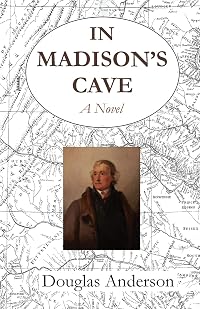
In Madison's Cave: A Novel
by Douglas Anderson
On This Page
Description
"We two ought not to die before we have explained ourselves to one another."John Adams wrote those words to Thomas Jefferson early in the long series of letters they exchanged near the end of their lives. In Madison's Cave is an imagined version of Jefferson's explanation, organized around four drawings that he hopes will map the route to a complete emancipation of human nature. The souls of men are demons, Jefferson begins, but he is convinced that he has built a verbal machine to exorcise show more them, a mechanism hidden in the pages of his notorious Notes on the State of Virginia.The key to the machine is the outline of a limestone cave (the "Madison's Cave" of the title) in the Shenandoah Valley; Jefferson made a sketch of it not long after the death of his wife and it captures, for him, the essence of the human underworld, its monsters, and its redemptive lessons. In a series of chapters that mimic those of his infamous book, he ushers Adams into that underworld. show lessTags
Member Reviews
A sort of apologia (fictional) for many of the inconsistencies of Jefferson’s character that have been in circulation since (and before) his death - a suggestion that the ‘Arch-Hypocrite’ may have been aware of them and intentional about his written defenses. Even though they’d be hard to detect.
Also a description of a series of drawings/maps serving as clues to this self-awareness and his ultimate goal : universal human emancipation.
Mostly, though, a long-form rumination on Jefferson’s thought and writings, with priority given to his ‘Notes on the State of Virginia’. Adams, as a participant in this written dialogue, is primarily a foil more than an equal participant in Jefferson’s meanderings.
There were many times when show more I wondered what compelled the author to write this. A lot of noodling, sometimes beautifully descriptive passages, but with no clear trajectory. Read it for the pleasure of the language and whatever else you take away from it is a bonus, I guess. show less
Also a description of a series of drawings/maps serving as clues to this self-awareness and his ultimate goal : universal human emancipation.
Mostly, though, a long-form rumination on Jefferson’s thought and writings, with priority given to his ‘Notes on the State of Virginia’. Adams, as a participant in this written dialogue, is primarily a foil more than an equal participant in Jefferson’s meanderings.
There were many times when show more I wondered what compelled the author to write this. A lot of noodling, sometimes beautifully descriptive passages, but with no clear trajectory. Read it for the pleasure of the language and whatever else you take away from it is a bonus, I guess. show less
 This review was written for LibraryThing Early Reviewers.
This is a short book at 167 pages or so, but it's still one I failed to finish after I had spent considerable time and effort trying to do so. The back blurb proposes it as an epistolary novel that scrutinizes Thomas Jefferson's Notes on the State of Virginia (for the most part). In the advertisement of the book (A term for forward adopted from the Notes) the author describes the Notes as "for many reasons unreadable. In places it is unbearable to read." But with this book, In Madison's Cave, it appears the author is trying in some sense to ape the spirit of that book, and ends up at the very least managing to repeat its errors. This book is very, very hard to read, and on a number of levels.
Firstly, as a conceit it is a little show more confused. The epistolary nature of it is isn't convincing, because between the two correspondents we don't have text that can be conceived as natural sounding correspondence. Thinking in the context of when Jefferson lived, the language isn't one of a letter, and the format seems to quickly realize it can't just have Jefferson rambling all the way through, so it interjects responses by John Adams in between lines, but in ways that might conceivably be natural in an email chain, but not in letters that require a day between responses. For example, Adams says something, Jefferson in the next paragraph "writes" "You are probably right," Adams replies "I know I am right," and then continues his thought. Where did this interjection come from? Did Jefferson send Adams a little slip with just that sentence and a post mark? In another exchange Jefferson says he is going for a walk, writes some more, Adams asks him if he's back so soon, and Jefferson's like, "Yup" and goes on with his rambling. So I can't really suspend disbelief here and accept the conceit.
If this were the only problem the book would be entirely passable. I'm fine with pretending two Founders of the country are just having some sort of weird psychic conversation with each other, but this is actually my most minor complaint.
Secondly, this book is essentially a fanfiction of Jefferson's Notes. That is, it is an immediate response to the notes and relies entirely on familiarity with Jefferson's work to have any meaning at all. Lucky me, I do know a little bit about that book, and have been to Jefferson's home in Virginia and seen his grave, so references to these things at least I understood. But I couldn't help but wonder to myself as I read, if this book is just talking about how the Notes do this and that, why don't I just put this down and read the Notes? And maybe that book is just as unreadable as Dr. Anderson claims. Having read a few pages of it myself I'm pretty sure he's right there. But we indulge Jefferson because he's Jefferson. We want to know something about the internal workings of a man like that and seek out his own words to do that. This book seems to mostly just repeat those words, but differently. And it really did remind me of a certain genre of fanfiction where the writer simply rehashes the same ground as the original material, point for point, but attempts maybe to speculate on the internal narrative of some character in the plot. Here the character is Jefferson and the author seems to be figuring out what he must have been thinking. It's even got an antiquated fandom trope in the "manes" - in this book some invisible demon that Jefferson seems to converse with at times - better known to fandom veterans as the muse. The association is maybe unkind to what Anderson was attempting here, but I couldn't stop myself from making it and it made the whole idea seem a little... affected. To put it concisely, this book reads like a meditation on something it doesn't ever truly make concrete. This is probably intentional since it also makes much of breadcrumbs and encouraging Jefferson's poor readers to go off and seek out what it is he means.
And lastly, I couldn't figure out if anything was being said. Have you ever had a conversation with someone who never ever says anything that doesn't seem like an attempt at a riddle? I have some poet friends like this. They waggle their eyebrows at you and say something that could be either completely devoid of meaning or quite profound, and then you have to go through the bother of trying to figure out if its one or the other. In person it's entertaining because you can poke and prod each other and come to an understanding, but reading such language in one massive block turns out to suck. And in this case it's hard to figure out if it's the author going ham or some of it is actually Jefferson's fault, since the book does hew so closely to its source material. I suppose Adams was meant to be a little bit of a palette cleanser, but it doesn't work because his few sections get in on the game immediately, sometimes going on his own tangents in ways that made me have to double check who it was that was supposed to be talking at that moment.
I don't like reviewing books I didn't finish, but I can't imagine finishing this. It felt like reading a difficult description of a difficult book. It's hard to imagine anyone but the most hardcore Jefferson fans being entertained by it. show less
Firstly, as a conceit it is a little show more confused. The epistolary nature of it is isn't convincing, because between the two correspondents we don't have text that can be conceived as natural sounding correspondence. Thinking in the context of when Jefferson lived, the language isn't one of a letter, and the format seems to quickly realize it can't just have Jefferson rambling all the way through, so it interjects responses by John Adams in between lines, but in ways that might conceivably be natural in an email chain, but not in letters that require a day between responses. For example, Adams says something, Jefferson in the next paragraph "writes" "You are probably right," Adams replies "I know I am right," and then continues his thought. Where did this interjection come from? Did Jefferson send Adams a little slip with just that sentence and a post mark? In another exchange Jefferson says he is going for a walk, writes some more, Adams asks him if he's back so soon, and Jefferson's like, "Yup" and goes on with his rambling. So I can't really suspend disbelief here and accept the conceit.
If this were the only problem the book would be entirely passable. I'm fine with pretending two Founders of the country are just having some sort of weird psychic conversation with each other, but this is actually my most minor complaint.
Secondly, this book is essentially a fanfiction of Jefferson's Notes. That is, it is an immediate response to the notes and relies entirely on familiarity with Jefferson's work to have any meaning at all. Lucky me, I do know a little bit about that book, and have been to Jefferson's home in Virginia and seen his grave, so references to these things at least I understood. But I couldn't help but wonder to myself as I read, if this book is just talking about how the Notes do this and that, why don't I just put this down and read the Notes? And maybe that book is just as unreadable as Dr. Anderson claims. Having read a few pages of it myself I'm pretty sure he's right there. But we indulge Jefferson because he's Jefferson. We want to know something about the internal workings of a man like that and seek out his own words to do that. This book seems to mostly just repeat those words, but differently. And it really did remind me of a certain genre of fanfiction where the writer simply rehashes the same ground as the original material, point for point, but attempts maybe to speculate on the internal narrative of some character in the plot. Here the character is Jefferson and the author seems to be figuring out what he must have been thinking. It's even got an antiquated fandom trope in the "manes" - in this book some invisible demon that Jefferson seems to converse with at times - better known to fandom veterans as the muse. The association is maybe unkind to what Anderson was attempting here, but I couldn't stop myself from making it and it made the whole idea seem a little... affected. To put it concisely, this book reads like a meditation on something it doesn't ever truly make concrete. This is probably intentional since it also makes much of breadcrumbs and encouraging Jefferson's poor readers to go off and seek out what it is he means.
And lastly, I couldn't figure out if anything was being said. Have you ever had a conversation with someone who never ever says anything that doesn't seem like an attempt at a riddle? I have some poet friends like this. They waggle their eyebrows at you and say something that could be either completely devoid of meaning or quite profound, and then you have to go through the bother of trying to figure out if its one or the other. In person it's entertaining because you can poke and prod each other and come to an understanding, but reading such language in one massive block turns out to suck. And in this case it's hard to figure out if it's the author going ham or some of it is actually Jefferson's fault, since the book does hew so closely to its source material. I suppose Adams was meant to be a little bit of a palette cleanser, but it doesn't work because his few sections get in on the game immediately, sometimes going on his own tangents in ways that made me have to double check who it was that was supposed to be talking at that moment.
I don't like reviewing books I didn't finish, but I can't imagine finishing this. It felt like reading a difficult description of a difficult book. It's hard to imagine anyone but the most hardcore Jefferson fans being entertained by it. show less
This review was written for LibraryThing Early Reviewers.Often I find that historians' attempts at fiction fall flat, but Anderson's musings between Jefferson and Adams in their later years made for an interesting and entertaining read. I'm not sure I would have subtitled it "a novel," though; perhaps "a fiction" would have been better? It is an epistolary contemplation on Jefferson's Notes in a similar style, which probably works best for those familiar with both Jefferson's work and who have also spent some time with the Jefferson-Adams correspondence. There are allusions and hints and links throughout, many of which I likely missed, let alone more casual readers.
This review was written for LibraryThing Early Reviewers.Interesting concept for a historical fiction. Loved the plot narrative and the short read. There's not any action here for those looking for something a bit more riveting that one might expect from a novel set during this time period. Could be an interesting play.
This review was written for LibraryThing Early Reviewers.I received this book via LibraryThing's Early Reviewer program.
I've not given this a starred review as I simply couldn't finish the book. I love reading about the American Revolution, our Founders, and our founding documents. So a novel written as letters between the aging Jefferson and Adams held appeal. But alas, maybe I'm just not much of a literature reader as I simply wasn't following what little story there seemed to be. The author, Douglas Anderson, does a fantastic job providing "dialogue" that would resemble the way both of these men wrote in the early 1800s. If you like working through many unfamiliar words and phrases, then this book may be for you. I read for pleasure and while the back and forth between our characters was show more interesting, I just couldn't get into it. show less
I've not given this a starred review as I simply couldn't finish the book. I love reading about the American Revolution, our Founders, and our founding documents. So a novel written as letters between the aging Jefferson and Adams held appeal. But alas, maybe I'm just not much of a literature reader as I simply wasn't following what little story there seemed to be. The author, Douglas Anderson, does a fantastic job providing "dialogue" that would resemble the way both of these men wrote in the early 1800s. If you like working through many unfamiliar words and phrases, then this book may be for you. I read for pleasure and while the back and forth between our characters was show more interesting, I just couldn't get into it. show less
This review was written for LibraryThing Early Reviewers.Requested this via the Early Reviewers program, because one interest of mine is Colonial Times/Revolutionary War/Founding Fathers and Mothers -- but even with that, this novel turned out to be too esoteric for me. I wasn't able to finish beyond the first chapter or so.
This review was written for LibraryThing Early Reviewers.With such careful editing that was done here, one could almost see these two distinguished gentlemen sitting before a fire in comfortable armchairs wiling away the hours with this wonderful dialogue.
It almost made me wish they could have been alive today and would have conducted their debate on Facetime instead of by letters that could take days or weeks to be delivered.
It almost made me wish they could have been alive today and would have conducted their debate on Facetime instead of by letters that could take days or weeks to be delivered.
This review was written for LibraryThing Early Reviewers.Members
- Recently Added By
Author Information
3 Works 93 Members
Common Knowledge
- Canonical title
- In Madison's Cave: A Novel
Classifications
Statistics
- Members
- 12
- Popularity
- 1,873,865
- Reviews
- 10
- Rating
- (2.92)
- Languages
- English
- Media
- Paper
- ISBNs
- 2