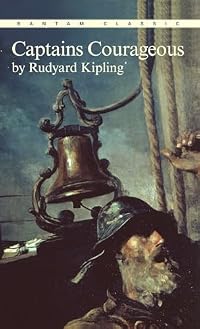
Captains Courageous
by Rudyard Kipling 
On This Page
Description
Rudyard Kipling's 1897 novel Captains Courageous follows the adventures and subsequent growth of the spoiled young son of a railroad tycoon. Aboard a fishing boat after being washed off his transatlantic steamship, Harvey Cheyne Jr. is unable to convince his rescuers to return him to shore. Instead the captain offers him a place in the crew and, given that he has no other choice, the boy accepts..
Tags
Recommendations




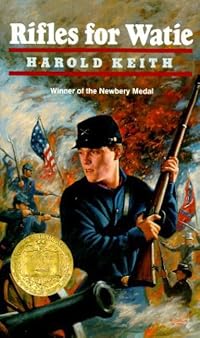

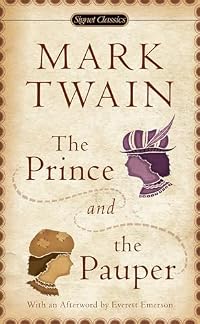
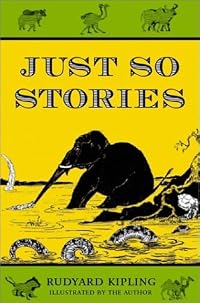
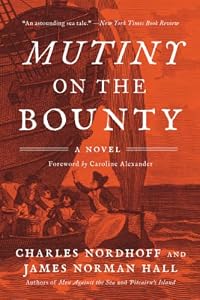

















Member Recommendations


Member Reviews
With the exception of the ubiquitous "Rikki-tikki-tavi," I think this is the first Kipling story I've read. I liked it a great deal. The plot concerns a spoiled rich kid who ends up on a fishing boat and learns the values of hard work. There's little of the philosophical baggage that weighed down London in The Sea Wolf; Kipling's only "message" is the promotion of an antediluvian vision of manly self-sufficiency, which is all par for the course in this genre.
The story is brisk and the characters are cheerful but my favorite part of the novel was the actual writing. Kipling's images are crisp and his words are a pleasure to say out loud. It's been too long since I read a book written with such a muscular joy in adverbs.
The story is brisk and the characters are cheerful but my favorite part of the novel was the actual writing. Kipling's images are crisp and his words are a pleasure to say out loud. It's been too long since I read a book written with such a muscular joy in adverbs.
Postponed reading this for years because I had this preconceived notion that it was a “children’s classic” – heavy on adventure, light on deeper meaning. Sure enough, the first 2/3rds of the tale are devoted to the adventures of Harvey, a spoiled, wealthy 13yr old boy travelling across the Atlantic on a ritzy ocean liner who falls overboard and is picked up by a cod-fishing trawler. Not believing his “high-falootin’” tales of wealth, the captain of the trawler refuses to interrupt his passage to drop Harvey ashore, instead putting him to work as part of the crew. In true Boy’s Life fashion, Harvey quickly learns the value of hard work and comes to respect the simple, honest, courageous crew of the trawler. So far so show more good, except that I defy any child alive to decipher this book in its original form which - Kipling proudly assures us in the forward - authentically reproduces the rich, idiosyncratic vocabulary of actual Gloucester fishermen, a dialect so obscure that it required all of my grown-up background knowledge and faculties to decipher. I can only assume that versions of this story actually intended for children are *heavily* edited to translate the almost indecipherable dialect into modern idiom.
My second mistake was forgetting that just because a book has a plot that happens to be accessible to children doesn’t necessarily imply that it is short of deeper meaning – as anyone who’s read The Prince and the Pauper, Tom Sawyer, or Gulliver’s Travels can attest. Just so with Captain’s Courageous, which over the course of the final chapters becomes a much bigger, broader exploration of what you might call “The Great American Origin Story” – that quaint yet resolute 19th century conviction that the U.S. is a land where any man not afraid of hard work and humility can rise to greatness. This part of the novel kicks off with a rather thrilling dash across the U.S. via train, evocative of the best chapters of 80 Days Around the World, and ends with Harvey discovering not just humility but also humanity. And because our author is Kipling, characters that we might have mistaken for caricatures early on suddenly deepen into richer, more fully realized humans, haunted by love and hope and tragedy.
I only hope that by sharing this, I may encourage other readers less patient than I not to jump to conclusions too soon. By all means enjoys the jolly sea-faring adventure while it lasts, but be sure to hang around for the poignant ending – you’ll be glad you did. show less
My second mistake was forgetting that just because a book has a plot that happens to be accessible to children doesn’t necessarily imply that it is short of deeper meaning – as anyone who’s read The Prince and the Pauper, Tom Sawyer, or Gulliver’s Travels can attest. Just so with Captain’s Courageous, which over the course of the final chapters becomes a much bigger, broader exploration of what you might call “The Great American Origin Story” – that quaint yet resolute 19th century conviction that the U.S. is a land where any man not afraid of hard work and humility can rise to greatness. This part of the novel kicks off with a rather thrilling dash across the U.S. via train, evocative of the best chapters of 80 Days Around the World, and ends with Harvey discovering not just humility but also humanity. And because our author is Kipling, characters that we might have mistaken for caricatures early on suddenly deepen into richer, more fully realized humans, haunted by love and hope and tragedy.
I only hope that by sharing this, I may encourage other readers less patient than I not to jump to conclusions too soon. By all means enjoys the jolly sea-faring adventure while it lasts, but be sure to hang around for the poignant ending – you’ll be glad you did. show less
A spoiled rich boy falls overboard from an ocean liner and is rescued by the crew of a fishing vessel. He demands to be returned home immediately, but the crew needs to make their livelihood first—so it’s off to the Grand Banks of Newfoundland with this lad. Over the course of the fishing season, young Harvey learns how to do manual labour, work together as a team, and pitch in for the good of the crew. It’s a salutary lesson for him, and the story is a heartwarming one. I personally enjoyed it so much that I read ahead in my Serial Reader to finish it off. There was plenty of sea-dog talk to keep this nautical enthusiast happy, and the cast of characters was lively. There were downsides: few meaningful roles for women, by virtue show more of the story being set on a fishing vessel; and the dialect could veer into stereotypes. But overall this is easily my favourite Kipling story. show less
Kipling is hard to figure. On the one hand is his notoriety as almost an apostle of imperialism. On the other stands the Kipling who spoke fluent Hindi, wrote virulent criticisms of British rule, & was even, for that very reason, politely shown the door from British India.
In that line it would be easy to claim that Captains Courageous - ostensibly a wholly *American* novel about the maturing of a spoiled Californian boy on a Massachusetts fishing ship - has nothing to do with anything British or imperial.
Nevertheless his familiar ideals, of self-reliance earned by strenuous, often manual endeavour, supervised by stern but benevolent mentors, animate Captains Courageous. But in this case, whether or not the reader endorses Kipling's show more message, he or she may easily abstract from it & enjoy a simply excellent story, beautifully written.
The novel opens as young Harvey falls overboard from his pampering mother & a luxury liner, almost into the arms of a Portuguese fisherman, part of a Captain Troop's crew. Harvey is soon forced to abandon his old brat antics. As Troop's son has quickly taken to this unexpected companion, he is gradually taught the wearisome, but organic team work required on a cod schooner. The practice of the time - individualistic only on appearance - was that each of a ship's fishermen would row out, from the anchored mother ship, in his personal little boat or "dory", & get his large catch with hooks & baits.
Later we learn how unimaginably dangerous this livelihood is, but what Harvey doesn't know doesn't hurt him, & he soon proves a very acceptable member of the crew.
The relation between Harvey & his own tycoon father is also explored, with spectacular richness & complexity. Cheyne Sr will prove fully equal to the frugal Captain Troop - or is he entirely equal? Either way, the story would be intolerable without Kipling's flair for minute details & dialogue, effectively "discovering" the New England cod schooner of the 19th Century. Just as Melville, with Moby Dick, immortalized the whaling ship of that age. show less
In that line it would be easy to claim that Captains Courageous - ostensibly a wholly *American* novel about the maturing of a spoiled Californian boy on a Massachusetts fishing ship - has nothing to do with anything British or imperial.
Nevertheless his familiar ideals, of self-reliance earned by strenuous, often manual endeavour, supervised by stern but benevolent mentors, animate Captains Courageous. But in this case, whether or not the reader endorses Kipling's show more message, he or she may easily abstract from it & enjoy a simply excellent story, beautifully written.
The novel opens as young Harvey falls overboard from his pampering mother & a luxury liner, almost into the arms of a Portuguese fisherman, part of a Captain Troop's crew. Harvey is soon forced to abandon his old brat antics. As Troop's son has quickly taken to this unexpected companion, he is gradually taught the wearisome, but organic team work required on a cod schooner. The practice of the time - individualistic only on appearance - was that each of a ship's fishermen would row out, from the anchored mother ship, in his personal little boat or "dory", & get his large catch with hooks & baits.
Later we learn how unimaginably dangerous this livelihood is, but what Harvey doesn't know doesn't hurt him, & he soon proves a very acceptable member of the crew.
The relation between Harvey & his own tycoon father is also explored, with spectacular richness & complexity. Cheyne Sr will prove fully equal to the frugal Captain Troop - or is he entirely equal? Either way, the story would be intolerable without Kipling's flair for minute details & dialogue, effectively "discovering" the New England cod schooner of the 19th Century. Just as Melville, with Moby Dick, immortalized the whaling ship of that age. show less
A thoroughly romantic and virtuous novel, this was a classic boy’s story all the way through. Kipling draws his readers into the beauty of justice, hard work, brotherhood, and maturity, just as he draws them into the beauty of the sea. He doesn’t strain too hard for realistic nuance (who ever heard of a spoiled brat reformed in a single confrontation?), though he deals with very real issues, such as neglectful and indulgent parents, and death. The last two chapters did stretch the ending a little awkwardly, but it was a great story nonetheless.
This book is not one that I read when I was young, but I wish I would have. This is another rip-roaring adventure written by none other than the great Rudyard Kipling. This book is an amazing sea story, but it is so much more. It is also a great coming-of-age story about a young 15 year-old boy by the name of Harvey Cheyne. Everything in Harvey's short life up to now is all opulence and excesses. His father is a multi-millionaire who denies his only child nothing. His life is like a fairy-tale, but it has taught Harvey nothing about being a man, having to work for a living, or how to get along with other men and boys and certainly not taught him to be unselfish and caring. When he falls overboard from a big ship into the Atlantic ocean, show more and then is picked up by a man who can hardly speak English and is taken to a fishing boat called the We're Here, Harvey's education begins. On this little fishing boat Harvey meets some life-long friends, and a captain who will teach him all he needs to know to be a man. So begins Harvey's life lessons. He will learn to "wet his salt" before the journey is done. The captain's son Don becomes Harvey's best friend and mentor, and in the three months he spends on the We're Here, he learns a heap about fishing off the Grand Banks of Newfoundland. And all is told in Rudyard Kipling's wonderful language and his beautiful descriptive writing. I have always been fond of all manner of sea stories, and loved to read about ships and boats throughout the ages, but I think I got to know the little We're Here better than in most of my sea stories. That is Rudyard Kipling's talent. He makes everything come alive in his stories. The local dialect was a bit difficult to grasp at first, but the men on board this little fishing boat came alive to me. It is so good to read an old classic once in a while. Nothing can bring me out of a reading slump like a book like this can. Perfect! show less
This classic seafaring coming-of-age tale takes place in 1897 in the North Atlantic. Harvey Cheyne, fifteen-year-old son of a millionaire railroad tycoon, is soft, rich and spoiled. While on vacation with his mother, he gets seasick and falls overboard the ocean liner. Coming to, he finds himself on a pile of dead fish in a fishing dory, saved by a Portuguese fisherman. He is brought to the We're Here, a Gloucester schooner. Captain Disko Troop doesn't believe his far-fetched tales of money and grandeur, instead thinking he hit his head when he fell and was crazy. With nothing but the clothes on his back, inadequate as they were for the job at hand, Harvey is forced to work for his food and passage until the fishing season ends and the show more ship returns home.
I loved this well-written classic tale, and the message it contains. The only thing about it to complain of is the ill-fitting title, which does not do the book justice. For the longest time before reading the book, I was under the impression it was about courageous captains, not a rich-boy learning what it's like to work. Five stars. show less
I loved this well-written classic tale, and the message it contains. The only thing about it to complain of is the ill-fitting title, which does not do the book justice. For the longest time before reading the book, I was under the impression it was about courageous captains, not a rich-boy learning what it's like to work. Five stars. show less
Members
- Recently Added By
Lists

Favorite Coming of Age Novels.
164 works; 51 members

water on the brain: maritime fiction
74 works; 18 members

Best Adventure Stories
66 works; 13 members

Unread books
1,063 works; 86 members

Best Young Adult
399 works; 101 members

Literature of Honor for Boys
91 works; 3 members

CCE 1000 Good Books List
1,033 works; 12 members

Books Read in 2024
4,623 works; 126 members

Recommended Reading : 600 Classics Reviewed, Editors of Salem Press, 2015
634 works; 6 members

Ambleside Year 5
55 works; 1 member

HMS: Make Your Child a Lover of Books, Ages 9 & up
111 works; 2 members

The Playful Pioneers
166 works; 1 member
Author Information

2,454+ Works 90,782 Members
Kipling, who as a novelist dramatized the ambivalence of the British colonial experience, was born of English parents in Bombay and as a child knew Hindustani better than English. He spent an unhappy period of exile from his parents (and the Indian heat) with a harsh aunt in England, followed by the public schooling that inspired his "Stalky" show more stories. He returned to India at 18 to work on the staff of the Lahore Civil and Military Gazette and rapidly became a prolific writer. His mildly satirical work won him a reputation in England, and he returned there in 1889. Shortly after, his first novel, The Light That Failed (1890) was published, but it was not altogether successful. In the early 1890s, Kipling met and married Caroline Balestier and moved with her to her family's estate in Brattleboro, Vermont. While there he wrote Many Inventions (1893), The Jungle Book (1894-95), and Captains Courageous (1897). He became dissatisfied with life in America, however, and moved back to England, returning to America only when his daughter died of pneumonia. Kipling never again returned to the United States, despite his great popularity there. Short stories form the greater portion of Kipling's work and are of several distinct types. Some of his best are stories of the supernatural, the eerie and unearthly, such as "The Phantom Rickshaw," "The Brushwood Boy," and "They." His tales of gruesome horror include "The Mark of the Beast" and "The Return of Imray." "William the Conqueror" and "The Head of the District" are among his political tales of English rule in India. The "Soldiers Three" group deals with Kipling's three musketeers: an Irishman, a Cockney, and a Yorkshireman. The Anglo-Indian Tales, of social life in Simla, make up the larger part of his first four books. Kipling wrote equally well for children and adults. His best-known children's books are Just So Stories (1902), The Jungle Books (1894-95), and Kim (1901). His short stories, although their understanding of the Indian is often moving, became minor hymns to the glory of Queen Victoria's empire and the civil servants and soldiers who staffed her outposts. Kim, an Irish boy in India who becomes the companion of a Tibetan lama, at length joins the British Secret Service, without, says Wilson, any sense of the betrayal of his friend this actually meant. Nevertheless, Kipling has left a vivid panorama of the India of his day. In 1907, Kipling became England's first Nobel Prize winner in literature and the only nineteenth-century English poet to win the Prize. He won not only on the basis of his short stories, which more closely mirror the ambiguities of the declining Edwardian world than has commonly been recognized, but also on the basis of his tremendous ability as a popular poet. His reputation was first made with Barrack Room Ballads (1892), and in "Recessional" he captured a side of Queen Victoria's final jubilee that no one else dared to address. (Bowker Author Biography) show less
Rudyard Kipling has a Legacy Library. Legacy libraries are the personal libraries of famous readers, entered by LibraryThing members from the Legacy Libraries group.
Some Editions
Awards and Honors
Awards
Notable Lists
Series
Belongs to Publisher Series
The Pocket Kipling (Macmillan)
List-Bücher (85)
Laurel-Leaf Library (1050)
Bantam Pathfinder Edition (FP10)
Grandes Novelas de Aventuras (XLVI)
Airmont Classics (27)
El País Aventuras (44)
Tus libros (130)
Nuorten toivekirjasto (102)
dtv (1201)
Gallimard, Folio (354)
Work Relationships
Is contained in
Is retold in
Has the adaptation
Is abridged in
Inspired
Common Knowledge
- Canonical title*
- Capitanes intrépidos
- Original title
- “Captains Courageous”: A Story of the Grand Banks
- Original publication date
- 1896: Serialised; 1897: Book
- People/Characters
- Harvey Cheyne; Disco Troop; Dan Troop
- Important places
- Grand Banks, Newfoundland, Canada; Gloucester, Massachusetts, USA
- Important events
- Blessing of the Fleet in Gloucester, Massachusetts, USA
- Related movies
- Captains Courageous (1937 | IMDb)
- Epigraph
- I ploughed the land with horses,
But my heart was ill at ease,
For the old sea-faring men
Came to me now and then,
With their sagas of the seas,
Longfellow. - Dedication
- TO
JAMES CONLAND, M. D.,
Brattleboro, Vermont - First words
- The weather door of the smoking-room had been left open to the North Atlantic fog, as the big liner rolled and lifted, whistling to warn the fishing-fleet.
- Quotations
- Like many other unfortunate young people, Harvey had never in all his life received a direct order—never, at least, without long, and sometimes tearful, explanations of the advantages of obedience and the reasons for the re... (show all)quest.
- Last words
- (Click to show. Warning: May contain spoilers.)"Me too," quoth Harvey Cheyne.
- Original language*
- Inglés
*Some information comes from Common Knowledge in other languages. Click "Edit" for more information.
Classifications
Statistics
- Members
- 5,661
- Popularity
- 2,323
- Reviews
- 56
- Rating
- (3.64)
- Languages
- 15 — Catalan, Czech, Danish, Dutch, English, Finnish, French, German, Hungarian, Italian, Norwegian (Bokmål), Romanian, Spanish, Swedish, Turkish
- Media
- Paper, Audiobook, Ebook
- ISBNs
- 421
- UPCs
- 2
- ASINs
- 254