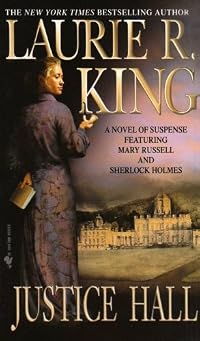
Justice Hall
by Laurie R. King 
Mary Russell (6), Mary Russell: Chronological Order (November-December 1923)
On This Page
Description
Only hours after Holmes and Russell return from solving one murky riddle on the moor, another knocks on their front door...literally. It's a mystery that begins during the Great War, when Gabriel Hughenfort died amidst scandalous rumors that have haunted the family ever since. But it's not until Holmes and Russell arrive at Justice Hall, a home of unearthly perfection set in a garden modeled on Paradise, that they fully understand the irony echoed in the family motto, Justicia fortitudo mea show more est.A trail of ominous clues comprise a mystery that leads from an English hamlet to the city of Paris to the wild prairie of the New World. The trap is set, the game is afoot; but can Holmes and Russell catch an elusive killer, or has the murderer caught them? show lessTags
Recommendations








Member Recommendations

Member Reviews
Holmes and Russell have just returned home after their adventures on Dartmoor and are hoping for some quiet time when a knock at the door brings an old friend with a huge problem. Holmes and Russell met Ali Hazr in Palestine four years earlier. Now they are seeing him in his other identity as Alistair Hughenfort.
Ali has come to beg for their help in rescuing his brother Mahmoud from a future that he doesn't want. As the second son of the Duke of Beauville, he wasn't expected to ever inherit the dukedom and the tremendous responsibility and the weight of family tradition. However, his brother's heir nineteen-year-old Gabriel died during World War I and his brother died soon after.
Ali wants Sherlock and Mary to c.onvince Marsh Hughehfort show more to abdicate in favor of another heir so that they can resume their lives in Palestine as Mycroft's agents. Marsh is not happy with his new responsibilities. In fact, Mary likens him to a man who is just waiting to die. But his long family history won't let him abandon those who depend on him. He does have questions though. Was his nephew executed for some sort of military crime? And if he was, who engineered his death? And, did his brother Lionel really marry and have a child who could be a new heir?
As Mary and Sherlock investigate Gabriel's death, they discover all sorts of questionable things from missing records to unexplained transfers. As they dig deeper it becomes clear that someone engineered young Gabriel's death. And, after a hunting accident that could have killed Marsh, it is clear that the manipulator isn't finished with his crimes.
This story ranges from Justice Hall to London to Paris and to a small town outside of Toronto as Mary and Sherlock investigate this complex conspiracy. The setting and time period are so well drawn that they feel real. The aristocratic lifestyle of Justice Hall is already showing some cracks as the results of World War I and the loss of so many young men are making for great changes in the culture.
The descriptions were so detailed both for Justice Hall and for Ali's home. The characters were complex. Although we don't ever meet Gabriel we get to know him through the memories of those who did know him and through his diaries and letters. There are many secrets and startling revelations in this story which adds to the excitement and to the mystery. It was a compelling story both as a mystery and as a window into a time long gone. show less
Ali has come to beg for their help in rescuing his brother Mahmoud from a future that he doesn't want. As the second son of the Duke of Beauville, he wasn't expected to ever inherit the dukedom and the tremendous responsibility and the weight of family tradition. However, his brother's heir nineteen-year-old Gabriel died during World War I and his brother died soon after.
Ali wants Sherlock and Mary to c.onvince Marsh Hughehfort show more to abdicate in favor of another heir so that they can resume their lives in Palestine as Mycroft's agents. Marsh is not happy with his new responsibilities. In fact, Mary likens him to a man who is just waiting to die. But his long family history won't let him abandon those who depend on him. He does have questions though. Was his nephew executed for some sort of military crime? And if he was, who engineered his death? And, did his brother Lionel really marry and have a child who could be a new heir?
As Mary and Sherlock investigate Gabriel's death, they discover all sorts of questionable things from missing records to unexplained transfers. As they dig deeper it becomes clear that someone engineered young Gabriel's death. And, after a hunting accident that could have killed Marsh, it is clear that the manipulator isn't finished with his crimes.
This story ranges from Justice Hall to London to Paris and to a small town outside of Toronto as Mary and Sherlock investigate this complex conspiracy. The setting and time period are so well drawn that they feel real. The aristocratic lifestyle of Justice Hall is already showing some cracks as the results of World War I and the loss of so many young men are making for great changes in the culture.
The descriptions were so detailed both for Justice Hall and for Ali's home. The characters were complex. Although we don't ever meet Gabriel we get to know him through the memories of those who did know him and through his diaries and letters. There are many secrets and startling revelations in this story which adds to the excitement and to the mystery. It was a compelling story both as a mystery and as a window into a time long gone. show less
Holy crap, this was wonderful. I both lost it laughing and actually wept, and I haven't cried at a book in ages. Happily, I was completely unspoiled for this, and I'm so glad for it. I think what I loved most is that this is a book about families and secrets and love FAR more than it's a whodunnit. The mystery itself is well-done, but so many mysteries -- especially in the Holmes genre -- are exercises in "ha-ha, look how clever the detective is!" This book is great because Russell and Holmes aren't at all aloof from everyone else involved. They care deeply, and as a reader, you get invested in all of them, so that even if you do figure out who did it by the midway point (or earlier), the emotional payoff of the end is completely worth show more the journey.
I love this SO HARD, OMG.
tag notes:
glbt interest tag: 1. awesome lesbian major character (Iris) in a 20-year relationship with a woman (Dan, short for Danielle)
2. and this exchange:
He [Holmes] smiled to himself. "It is a rather interesting variation on a marriage, is it not?"
[Russell:] "Do you mean Marsh and Iris, or all three of them?" [Meaning Mahmoud/Marsh, Iris, and Ali]
But his smile only deepened.
disability tag: minor character (Ben O'Meary) - positive portrayal, if brief.
Canada: transatlantic sideline to rural Ontario! (The geeky part of my brain that digs setting so hard was so, so happy.)
*happy sigh*
This book is, effectively, a dozen of my favorite things on a platter: mystery! strong female protagonist! Holmes! Mycroft! revisiting characters from earlier in the series -- continuity yay! gorgeously drawn settings! secret passages! ancient ruins! war story! awesome non-anachronistic women! queer people! friendly nontraditional marriages! hilariously-dealt with nosy children (without a shred of smarm)! nefarious intrigue both for ill and for justice! ancient scholarly library! creepy Biblical references! Action plots demanding action and travel and people thinking on their feet instead of sitting in chairs and thinking for 300 pages! And, like I said, a whole book full of people to get personally invested in! (Er, that's a bit more than a dozen. Yay? *g*) show less
I love this SO HARD, OMG.
tag notes:
glbt interest tag: 1. awesome lesbian major character (Iris) in a 20-year relationship with a woman (Dan, short for Danielle)
2. and this exchange:
He [Holmes] smiled to himself. "It is a rather interesting variation on a marriage, is it not?"
[Russell:] "Do you mean Marsh and Iris, or all three of them?" [Meaning Mahmoud/Marsh, Iris, and Ali]
But his smile only deepened.
disability tag: minor character (Ben O'Meary) - positive portrayal, if brief.
Canada: transatlantic sideline to rural Ontario! (The geeky part of my brain that digs setting so hard was so, so happy.)
*happy sigh*
This book is, effectively, a dozen of my favorite things on a platter: mystery! strong female protagonist! Holmes! Mycroft! revisiting characters from earlier in the series -- continuity yay! gorgeously drawn settings! secret passages! ancient ruins! war story! awesome non-anachronistic women! queer people! friendly nontraditional marriages! hilariously-dealt with nosy children (without a shred of smarm)! nefarious intrigue both for ill and for justice! ancient scholarly library! creepy Biblical references! Action plots demanding action and travel and people thinking on their feet instead of sitting in chairs and thinking for 300 pages! And, like I said, a whole book full of people to get personally invested in! (Er, that's a bit more than a dozen. Yay? *g*) show less
Beautiful. Just beautiful.
In the combined desire to reread the Holmes/Russell series and still hurry to get to Pirate King, I skipped two books: Letter of Mary I did not have, and O Jerusalem was a departure of setting and plotline, and took place a step out of time in the series, so that I felt safe leaving it out for the time being. (I will get back to it before long.) Such is the beauty of this series that it was perfectly possible to do so and still happily read this sixth book, which not only opens hours after Holmes and Russell return home from the adventures of the fourth book but also picks up the threads of the fifth book, which took place in the middle of the first.
I know, but it really does make perfect sense. The timing show more and placement of the books in the series is actually quite brilliant planning, if planned it was – and if it wasn't, perhaps it's even more brilliant.
Once again, Holmes and Russell have only the briefest of respites from their travels before they are haled off on another urgent undertaking, to help another old friend in desperate need. Not a need for himself, but that of his closest friend, his all-but brother, who has found himself with no honorable choice but to leave the work he has loved and lived for for decades in the Middle-east to come back to England to play lord of the manor in his family seat, Justice Hall. It's a variation on a theme often played in historical and fantasy novels: the man who never expected to be heir. Marsh Hughenfort was the younger son, and his elder brother had a son – but upon the relatively early death of the brother and the mysterious death of the nephew somewhere on the frontlines of WWI, the title is his. The problem is that his near-brother believes it will kill him, and he wants Holmes and Russell to come and convince him he should shirk his duty and return to the desert. With a sigh (and some grumbling from Russell), the pair heed the call to investigate the nephew's death and, making no promises, to see what they can do in the matter of convincing Marsh to cede the title that will leave him a virtual zombie.
I loved this book. I loved the double lives – not only of the "guest" protagonists, but of Holmes and Russell (for nearly every case necessitates some degree of false face) and also of others in the cast. I loved the house, and its character; I blunder through that a little more below, but it takes a special gift for a writer to successfully depict a setting with personality without drifting into a fantasy lane. And most of all I loved the people, familiar and new (or altered), living and dead, who filled the story. Setting and characters are all imbued with their own lives and thoughts and business, into which the reader is privileged to be given a brief glimpse.
Justice Hall is an elegy to all that WWI destroyed – the innocence, the security, a generation of youth and promise gone or broken or soured to cynicism. At this distance of space and time it's hard to grasp the gaping wound the Great War left on England – hard, that is, without reading something like this. Here it all becomes much clearer – the chaos and the pain, and the ruination of so many lives. The waste.
I'm not sure this is going to come out as I want it to, but here goes. The book is also a testimony to what a lord should be, the classic ideal of the feudal establishment – the protector and pillar of his people. By this I don't mean shiny-faced happy peasants with their mattocks on their shoulders pulling forelocks to their lord and master as he rides haughtily by on his hunter, and later he sits down to a feast in his lofty hall while they eat their gruel in their hovel. That's not a model of anything except bad cliché. As such, as it is so often seen in fiction (and fact): the system is rife with abuse and advantage-takers, unfair to everyone except the "nobles" at the top of the pyramid. But here the reader is given a glimpse of a platonic ideal in which the family born to power respects it as well as those in its care, and uses the power and wealth of its position to ease life not only for its own immediate members but for its dependents. No one starves on the lands overseen by Justice Hall. The Hughenforts care for and look after their people, and their people in turn are proud of their allegiance to the Hughenforts – it's a beautiful symbiotic relationship. I wonder how often (if ever) this ideal was ever achieved in reality.
It is right and just that this is how it is here – because without the strength and desirability of the estate, there would be no conflict about its inheritance. The draw of Justice Hall is much more than simply familial duty or nostalgia for a childhood home. This book is a love story, on many levels … There is the unorthodox love between Russell and Holmes, of course. There is the filial love between the cousins, which will not allow Alastair to see Marsh core out the heart of him even for Justice Hall. Love of country – which is part of what has kept Marsh and Alastair away from England for so long, and why their nephew went willingly to his death, and why so many, one way or another, lost the lives they had before the war. And duty, that rare sort of duty not performed through mere obligation.
And, not least of all, there is the love that Laurie R. King has for her characters and her work. You can't produce something like this without loving what you do, and caring about the people who will read it. That makes itself felt. And is very much appreciated. show less
In the combined desire to reread the Holmes/Russell series and still hurry to get to Pirate King, I skipped two books: Letter of Mary I did not have, and O Jerusalem was a departure of setting and plotline, and took place a step out of time in the series, so that I felt safe leaving it out for the time being. (I will get back to it before long.) Such is the beauty of this series that it was perfectly possible to do so and still happily read this sixth book, which not only opens hours after Holmes and Russell return home from the adventures of the fourth book but also picks up the threads of the fifth book, which took place in the middle of the first.
I know, but it really does make perfect sense. The timing show more and placement of the books in the series is actually quite brilliant planning, if planned it was – and if it wasn't, perhaps it's even more brilliant.
Once again, Holmes and Russell have only the briefest of respites from their travels before they are haled off on another urgent undertaking, to help another old friend in desperate need. Not a need for himself, but that of his closest friend, his all-but brother, who has found himself with no honorable choice but to leave the work he has loved and lived for for decades in the Middle-east to come back to England to play lord of the manor in his family seat, Justice Hall. It's a variation on a theme often played in historical and fantasy novels: the man who never expected to be heir. Marsh Hughenfort was the younger son, and his elder brother had a son – but upon the relatively early death of the brother and the mysterious death of the nephew somewhere on the frontlines of WWI, the title is his. The problem is that his near-brother believes it will kill him, and he wants Holmes and Russell to come and convince him he should shirk his duty and return to the desert. With a sigh (and some grumbling from Russell), the pair heed the call to investigate the nephew's death and, making no promises, to see what they can do in the matter of convincing Marsh to cede the title that will leave him a virtual zombie.
I loved this book. I loved the double lives – not only of the "guest" protagonists, but of Holmes and Russell (for nearly every case necessitates some degree of false face) and also of others in the cast. I loved the house, and its character; I blunder through that a little more below, but it takes a special gift for a writer to successfully depict a setting with personality without drifting into a fantasy lane. And most of all I loved the people, familiar and new (or altered), living and dead, who filled the story. Setting and characters are all imbued with their own lives and thoughts and business, into which the reader is privileged to be given a brief glimpse.
Justice Hall is an elegy to all that WWI destroyed – the innocence, the security, a generation of youth and promise gone or broken or soured to cynicism. At this distance of space and time it's hard to grasp the gaping wound the Great War left on England – hard, that is, without reading something like this. Here it all becomes much clearer – the chaos and the pain, and the ruination of so many lives. The waste.
I'm not sure this is going to come out as I want it to, but here goes. The book is also a testimony to what a lord should be, the classic ideal of the feudal establishment – the protector and pillar of his people. By this I don't mean shiny-faced happy peasants with their mattocks on their shoulders pulling forelocks to their lord and master as he rides haughtily by on his hunter, and later he sits down to a feast in his lofty hall while they eat their gruel in their hovel. That's not a model of anything except bad cliché. As such, as it is so often seen in fiction (and fact): the system is rife with abuse and advantage-takers, unfair to everyone except the "nobles" at the top of the pyramid. But here the reader is given a glimpse of a platonic ideal in which the family born to power respects it as well as those in its care, and uses the power and wealth of its position to ease life not only for its own immediate members but for its dependents. No one starves on the lands overseen by Justice Hall. The Hughenforts care for and look after their people, and their people in turn are proud of their allegiance to the Hughenforts – it's a beautiful symbiotic relationship. I wonder how often (if ever) this ideal was ever achieved in reality.
It is right and just that this is how it is here – because without the strength and desirability of the estate, there would be no conflict about its inheritance. The draw of Justice Hall is much more than simply familial duty or nostalgia for a childhood home. This book is a love story, on many levels … There is the unorthodox love between Russell and Holmes, of course. There is the filial love between the cousins, which will not allow Alastair to see Marsh core out the heart of him even for Justice Hall. Love of country – which is part of what has kept Marsh and Alastair away from England for so long, and why their nephew went willingly to his death, and why so many, one way or another, lost the lives they had before the war. And duty, that rare sort of duty not performed through mere obligation.
And, not least of all, there is the love that Laurie R. King has for her characters and her work. You can't produce something like this without loving what you do, and caring about the people who will read it. That makes itself felt. And is very much appreciated. show less
This is the sixth book in Laurie R. King's Mary Russell/Sherlock Holmes series. King has accomplished a very unusual feat amongst mystery series authors; each of her books is better than the last.
Chronologically, this book follows the fourth one (The Moor), but it makes perfect sense to read this book immediately following O, Jerusalem. I'd recommend reading those two back to back (not something I normally do with a series).
This one also shows off Ms. King's fascination with architecture. I can picture Justice Hall perfectly from her excellent descriptions.
I'll admit that I figured out the "surprise" in this one quite early on, but it was still great fun to read. Holmes is in good hands with Ms. King, and Russell is as entertaining as show more Holmes himself. I'm eagerly looking forward to reading the next book in this series (The Game), but I intend to read Rudyard Kipling's Kim first since he's a major character in that book. show less
Chronologically, this book follows the fourth one (The Moor), but it makes perfect sense to read this book immediately following O, Jerusalem. I'd recommend reading those two back to back (not something I normally do with a series).
This one also shows off Ms. King's fascination with architecture. I can picture Justice Hall perfectly from her excellent descriptions.
I'll admit that I figured out the "surprise" in this one quite early on, but it was still great fun to read. Holmes is in good hands with Ms. King, and Russell is as entertaining as show more Holmes himself. I'm eagerly looking forward to reading the next book in this series (The Game), but I intend to read Rudyard Kipling's Kim first since he's a major character in that book. show less
I do try to be sparring in handing out five stars--and I've read some really fine books lately. But this series is a favorite of mine, and this might be my favorite of the books yet. For those who don't know, the Mary Russell series is a Sherlock Holmes pastiche. King created a female counterpart and partner for Sherlock Holmes--a much younger, feminist Jewish American partner. Oh, so many ways it could have gone wrong! But I loved the first Mary Russell book I picked up in the middle of the series, A Letter of Mary, and eventually made my way to the first, The Beekeeper's Apprentice and made my way back up to this, the sixth book. It's been a while since I've read one of these--this is actually something of a direct sequel to the last, show more O, Jerusalem, and two characters central there, Ali and Mahmoud Hazr, are also central here.
It might have been best to read the books back to back, but I didn't feel like I'd missed a step. You know why I felt I had to give this five stars? Because from the first words I couldn't stop reading to the end and finished the same day. Because from the beginning I felt as if I had stepped into a bath and felt warmth suffuse through my body as I read the descriptions of Mary returning with Holmes. There are just so many elements done right. Sherlock Holmes is a delight to read, a highlight whenever he appears. The historical fiction side is convincing--this is set in 1923 and deals with World War I and its aftermath. I loved the theological and thematic elements woven in--in particular into "Justice Hall" one of those fictional great estates, like Pemberly or Manderley, that dominate a narrative, that is a character in a story. And the mystery--not brilliant in a Christie or Tey twist sort of way--but satisfying. And the book never insults your intelligence. I enjoyed the Stephanie Plum book I read, but soon decided she wouldn't wear well on me--too stupid to live characters don't amuse me. But the so very sharp Holmes and Russell, ah that's a great pleasure. show less
It might have been best to read the books back to back, but I didn't feel like I'd missed a step. You know why I felt I had to give this five stars? Because from the first words I couldn't stop reading to the end and finished the same day. Because from the beginning I felt as if I had stepped into a bath and felt warmth suffuse through my body as I read the descriptions of Mary returning with Holmes. There are just so many elements done right. Sherlock Holmes is a delight to read, a highlight whenever he appears. The historical fiction side is convincing--this is set in 1923 and deals with World War I and its aftermath. I loved the theological and thematic elements woven in--in particular into "Justice Hall" one of those fictional great estates, like Pemberly or Manderley, that dominate a narrative, that is a character in a story. And the mystery--not brilliant in a Christie or Tey twist sort of way--but satisfying. And the book never insults your intelligence. I enjoyed the Stephanie Plum book I read, but soon decided she wouldn't wear well on me--too stupid to live characters don't amuse me. But the so very sharp Holmes and Russell, ah that's a great pleasure. show less
Holmes and Russell have just returned home after their adventures on Dartmoor and are hoping for some quiet time when a knock at the door brings an old friend with a huge problem. Holmes and Russell met Ali Hazr in Palestine four years earlier. Now they are seeing him in his other identity as Alistair Hughenfort.
Ali has come to beg for their help in rescuing his brother Mahmoud from a future that he doesn't want. As the second son of the Duke of Beauville, he wasn't expected to ever inherit the dukedom and the tremendous responsibility and the weight of family tradition. However, his brother's heir nineteen-year-old Gabriel died during World War I and his brother died soon after.
Ali wants Sherlock and Mary to c.onvince Marsh Hughehfort show more to abdicate in favor of another heir so that they can resume their lives in Palestine as Mycroft's agents. Marsh is not happy with his new responsibilities. In fact, Mary likens him to a man who is just waiting to die. But his long family history won't let him abandon those who depend on him. He does have questions though. Was his nephew executed for some sort of military crime? And if he was, who engineered his death? And, did his brother Lionel really marry and have a child who could be a new heir?
As Mary and Sherlock investigate Gabriel's death, they discover all sorts of questionable things from missing records to unexplained transfers. As they dig deeper it becomes clear that someone engineered young Gabriel's death. And, after a hunting accident that could have killed Marsh, it is clear that the manipulator isn't finished with his crimes.
This story ranges from Justice Hall to London to Paris and to a small town outside of Toronto as Mary and Sherlock investigate this complex conspiracy. The setting and time period are so well drawn that they feel real. The aristocratic lifestyle of Justice Hall is already showing some cracks as the results of World War I and the loss of so many young men are making for great changes in the culture.
The descriptions were so detailed both for Justice Hall and for Ali's home. The characters were complex. Although we don't ever meet Gabriel we get to know him through the memories of those who did know him and through his diaries and letters. There are many secrets and startling revelations in this story which adds to the excitement and to the mystery. It was a compelling story both as a mystery and as a window into a time long gone. show less
Ali has come to beg for their help in rescuing his brother Mahmoud from a future that he doesn't want. As the second son of the Duke of Beauville, he wasn't expected to ever inherit the dukedom and the tremendous responsibility and the weight of family tradition. However, his brother's heir nineteen-year-old Gabriel died during World War I and his brother died soon after.
Ali wants Sherlock and Mary to c.onvince Marsh Hughehfort show more to abdicate in favor of another heir so that they can resume their lives in Palestine as Mycroft's agents. Marsh is not happy with his new responsibilities. In fact, Mary likens him to a man who is just waiting to die. But his long family history won't let him abandon those who depend on him. He does have questions though. Was his nephew executed for some sort of military crime? And if he was, who engineered his death? And, did his brother Lionel really marry and have a child who could be a new heir?
As Mary and Sherlock investigate Gabriel's death, they discover all sorts of questionable things from missing records to unexplained transfers. As they dig deeper it becomes clear that someone engineered young Gabriel's death. And, after a hunting accident that could have killed Marsh, it is clear that the manipulator isn't finished with his crimes.
This story ranges from Justice Hall to London to Paris and to a small town outside of Toronto as Mary and Sherlock investigate this complex conspiracy. The setting and time period are so well drawn that they feel real. The aristocratic lifestyle of Justice Hall is already showing some cracks as the results of World War I and the loss of so many young men are making for great changes in the culture.
The descriptions were so detailed both for Justice Hall and for Ali's home. The characters were complex. Although we don't ever meet Gabriel we get to know him through the memories of those who did know him and through his diaries and letters. There are many secrets and startling revelations in this story which adds to the excitement and to the mystery. It was a compelling story both as a mystery and as a window into a time long gone. show less
I continue to enjoy the team of Mary Russell and Sherlock Holmes. Called to help old friends, they find out that Ali and Mahmoud were not who they appeared to be. A lovely, complex and suspenseful plot with twists and turns - another enjoyable read.
Members
- Recently Added By
Lists

Crime and Mysteries to Read
746 works; 31 members

Female Author
1,235 works; 67 members

British Mystery
469 works; 14 members

Books Read in 2012 (Numbered)
168 works; 6 members

Detective Stories
343 works; 5 members

Books Read in 2016
4,666 works; 197 members
Author Information

80+ Works 46,784 Members
Laurie R. King is the bestselling author of "A Darker Place," four contemporary novels featuring Kate Martinelli, and five acclaimed Mary Russell mysteries. She lives in northern California. Her newest book is the ninth one in the Mary Russell mystery series, The Language of Bees. (Publisher Provided) Laurie R. King is a mystery writer, who holds show more a bachelor's degree and a master's degree in theology. Her first novel, Grave Talent, was published in 1993 and won the Edgar Award for Best First Novel. Since then, she has written over twenty books including the Mary Russell Mysteries series, the Stuyvesant and Grey series, the Kate Martinelli Mystery series, A Darker Place, Folly, and Keeping Watch. She has also co-authored a number of nonfiction works and anthologies including Crime Writing, The Grand Game, and Studies in Sherlock. Laurie's title, Dreaming Spies, is a 2015 New York Times Bestseller. (Bowker Author Biography) show less
Laurie R. King is a LibraryThing Author, an author who lists their personal library on LibraryThing.
Some Editions
Series


Work Relationships
Common Knowledge
- Canonical title
- Justice Hall
- Original publication date
- 2002
- People/Characters
- Mary Russell; Sherlock Holmes; Ali Hazr; Mahmoud Hazr; Sidney Darling; Phillida Darling (show all 11); Ivo Hughenfort; Gabriel Hughenfort; Phillippa O'Meary; Iris Sutherland; Mycroft Holmes
- Important places
- Berkshire, England, UK; London, England, UK; Sussex, England, UK
- Epigraph
- Let justice roll down like the waters, and righteousness like an everflowing stream.
—Amos 5:24 - Dedication
- For my family (you know who you are) Familia fortitudo mea est.
- First words
- Home, my soul sighed.
- Last words
- (Click to show. Warning: May contain spoilers.)And in England, no more was seen of Mahmoud Hazr and his cousin Ali.
- Original language
- English
Classifications
Statistics
- Members
- 2,252
- Popularity
- 8,854
- Reviews
- 61
- Rating
- (4.11)
- Languages
- English, Finnish, German, Croatian
- Media
- Paper, Audiobook, Ebook
- ISBNs
- 29
- UPCs
- 1
- ASINs
- 7