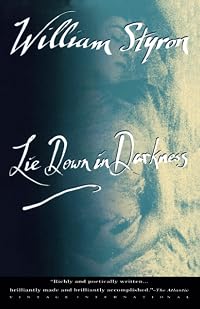
Lie Down in Darkness
by William Styron
On This Page
Description
This portrait of a Southern family's downfall was the literary debut of the #1 New York Times–bestselling author of Sophie's Choice.A finalist for the National Book Award, Lie Down in Darkness centers on the Loftis family—Milton and Helen and their daughters, Peyton and Maudie. The story, told through a series of flashbacks on the day of Peyton's funeral, is a powerful depiction of a family doomed by its failure to forget and its inability to love.
Written in masterful prose that show more "achieves real beauty" (The Washington Post), William Styron's debut novel offers unflinching insight into the ineradicable bonds of place and family. The story of Milton, Helen, and their children reveals much about life's losses and disappointments.
Lie Down in Darkness, poignant and compelling, is a classic of modern American literature from the author who went on to earn high critical acclaim—with a Pulitzer Prize for The Confessions of Nat Turner and a National Book Award for Sophie's Choice—and a place at the top of the New York Times bestseller list.
This ebook features a new illustrated biography of William Styron, including original letters, rare photos, and never-before-seen documents from the Styron family and the Duke University Archives.
. show less
Tags
Recommendations









































Member Reviews
William Styron’s debut novel, Lie Down in Darkness, is the careful dissection of a family in the process of disintegrating. I found it surprisingly Faulknerian in both style and content, and quite unlike my memories of Sophie’s Choice.
There is nothing uplifting or hopeful about this novel. The characters are bruised, beaten and self-destructive. More than once, I would have liked to reach out and slap these parents soundly. There is more than one character who would make a study in how too much alcohol consumption can ruin a life, and I won’t even hint at the corruption of the human spirit underlying these familial relationships.
The hurt and damage has gone deep, and who, finally, lest it be God himself, could know where the show more circle, composed as it was of such tragic suspicions and misunderstandings, began, and where it ended? Where indeed! There is surely enough sadness, blame and deserved recrimination to go around.
There is a sense of place that permeates the novel as well, the summer is hot and sticky, the sweat pours from brows, the stench of alcohol and sweat is everywhere. This is the tidewater and unmistakably Southern.
you don’t have to be a camp-follower of reaction but always remember where you came from, the ground is bloody and full of guilt where you were born and you must tread a long narrow path toward your destiny. If the crazy sideroads start to beguile you, son, take at least a backward glance at Monticello.
The book opens with the suicide of the Lortis’ young daughter, Peyton, and as the story unfolds we get glimpses of what has led her to this drastic action. Peyton is the only character that stirred any sympathy in me and it felt sad to know her ultimate fate and that she would not find enough backbone to put her family behind her. Her own self-destruction occurs in the shadow of the bombing of Hiroshima and I wondered if Styron was intentionally juxtaposing the death of the individual against the death of the thousands and asking if either meant anything to us beyond the moment of occurence. show less
There is nothing uplifting or hopeful about this novel. The characters are bruised, beaten and self-destructive. More than once, I would have liked to reach out and slap these parents soundly. There is more than one character who would make a study in how too much alcohol consumption can ruin a life, and I won’t even hint at the corruption of the human spirit underlying these familial relationships.
The hurt and damage has gone deep, and who, finally, lest it be God himself, could know where the show more circle, composed as it was of such tragic suspicions and misunderstandings, began, and where it ended? Where indeed! There is surely enough sadness, blame and deserved recrimination to go around.
There is a sense of place that permeates the novel as well, the summer is hot and sticky, the sweat pours from brows, the stench of alcohol and sweat is everywhere. This is the tidewater and unmistakably Southern.
you don’t have to be a camp-follower of reaction but always remember where you came from, the ground is bloody and full of guilt where you were born and you must tread a long narrow path toward your destiny. If the crazy sideroads start to beguile you, son, take at least a backward glance at Monticello.
The book opens with the suicide of the Lortis’ young daughter, Peyton, and as the story unfolds we get glimpses of what has led her to this drastic action. Peyton is the only character that stirred any sympathy in me and it felt sad to know her ultimate fate and that she would not find enough backbone to put her family behind her. Her own self-destruction occurs in the shadow of the bombing of Hiroshima and I wondered if Styron was intentionally juxtaposing the death of the individual against the death of the thousands and asking if either meant anything to us beyond the moment of occurence. show less
Just back from a Vacation and I am glad I did not read this one on the beach
William Styron's debut novel published in 1951 looks backwards rather than forwards. It is a depressing social history of an upper middle class Southern American family trapped by religion, alcoholism and an inward looking viewpoint that not even the atomic bombs of the second world war can shake them from their downward spiral. It is a long and exhausting read because Styron lays on the neurosis in thick wads of writing that veers between an omniscient point of view and a stream of consciousness technique. My main criticism of the book is that he attempts to pack in too much into this novel, but there is no doubt that he succeeds in creating an atmosphere of show more cloying dysfunctionalism that damages everyone associated with the Loftis family
The funeral of the Loftis family's daughter Peyton provides the narrative platform for the story, mainly told in flashbacks. Helen Loftis mother of Peyton is too depressed to go to the funeral and her estranged husband Milton pleads with her to stir herself out of a seemingly terminal lethargy. He only manages to invoke a stream of invective that threatens to re-ignite the embers of an underlying family tragedy. Milton himself is barely able to function and the funeral cortège is beset with mechanical failures as the old funeral vehicles struggle to cope with the heat of a summers day in the State of Virginia. Styron uses Milton's point of view to tell much of the early story. He is typical of his social set in that he relies too much on alcohol and the Country club social whirl to get him through life, but his life is more challenging than most. His first born daughter Maudie was born crippled and mentally retarded and she sucked up all her mothers love and devotion. His second daughter Peyton starved of her mothers love turned to Milton for affection. She developed into a beautiful teenager who soon learn't the art of seduction and her relationship with Milton bordered on the incestuous. Milton becomes an alcoholic and he encourages Peyton to drink along with him, meanwhile Helen turns back towards the religion of her upbringing, using her local pastor and friend: Carey Car for psychological help. Milton Loftis dominates this book his characteristic weaknesses seem to add fuel to the fire of the wrath that is inherent in his family. His dependency on alcohol, his perverted need for Peyton and his struggles with Helen who holds the purse strings. He is Styron's best creation.
The day of Peyton's funeral brings back the tragic incidents of the Loftis families existence and we see these through the memories of Helen and Milton. There was the death of Maudie in a clinic which Milton missed in a drunken haze while searching for Peyton who was intent on following a hedonistic life of her own, there is the relationship of Milton with his long suffering mistress Dolly and there is Helen's psychosomatic illnesses and a search for redemption through religion. There are flash backs also to Peyton's own tragically short life, whose own estrangement from her family seemed to have set her on a course for her own destruction. There are also periods of attempted reconciliation between family members, but the jealousies and the inability to forgive, result in a hatred that pushes them further apart.
Styron has created a family group against a historical backdrop of a Southern American town between the world wars. The town to all intents and purposes is segregated. The family members all refer to the black community as nigger town and they employ black women and men as servants and gardeners. This is an accepted fact of the backdrop to the novel. The involvement of America in the second world war impinges on peripheral family members, but the self centred individuals of the immediate family hardly give it a thought. The introspection is intense and the main characters cannot lift their heads out of their inborn prejudices. The halting procession of the funeral cortège seems to reflect the Loftis families own stumbling path to destruction. The novel ends with the black community celebrating a riverside baptism, their own particular religious enthusiasm contrasting with the crabbed religious belief of Helen Loftis. It is perhaps the only positive note in the whole book.
There is little doubt that Styron's aim was to create a literary novel and his observations and descriptions are redolent of how the reader might imagine a Southern American town and its middle class society: from the writing of someone like F Scott Fitzgerald. However his books were describing an America some 20-30 years earlier and Styron's characters do not seem to have moved on from that. Even the decrepit automobiles of the funeral cortege seem to belong perhaps to another era. This is why the book gives me an impression of looking backwards rather than forwards. Styron perhaps has nothing new to say, he is more interested in re-dressing the past and he does this at some length. Towards the end of the novel there is a long stream of consciousness section which portrays the last days of Peyton's short life and it is a sort of tour de force, brilliantly carried off, but it could quite easily belong to another novel. In its defence it does however fit in with the destructive, depressing and somnolent atmosphere of all that has gone before and brings the story to a logical conclusion. Reading this novel was like taking an unpleasantly warm bath in someone else's misery and I was pleased to be able to put it down, even if the experience was intoxicating at times. 4 stars. show less
William Styron's debut novel published in 1951 looks backwards rather than forwards. It is a depressing social history of an upper middle class Southern American family trapped by religion, alcoholism and an inward looking viewpoint that not even the atomic bombs of the second world war can shake them from their downward spiral. It is a long and exhausting read because Styron lays on the neurosis in thick wads of writing that veers between an omniscient point of view and a stream of consciousness technique. My main criticism of the book is that he attempts to pack in too much into this novel, but there is no doubt that he succeeds in creating an atmosphere of show more cloying dysfunctionalism that damages everyone associated with the Loftis family
The funeral of the Loftis family's daughter Peyton provides the narrative platform for the story, mainly told in flashbacks. Helen Loftis mother of Peyton is too depressed to go to the funeral and her estranged husband Milton pleads with her to stir herself out of a seemingly terminal lethargy. He only manages to invoke a stream of invective that threatens to re-ignite the embers of an underlying family tragedy. Milton himself is barely able to function and the funeral cortège is beset with mechanical failures as the old funeral vehicles struggle to cope with the heat of a summers day in the State of Virginia. Styron uses Milton's point of view to tell much of the early story. He is typical of his social set in that he relies too much on alcohol and the Country club social whirl to get him through life, but his life is more challenging than most. His first born daughter Maudie was born crippled and mentally retarded and she sucked up all her mothers love and devotion. His second daughter Peyton starved of her mothers love turned to Milton for affection. She developed into a beautiful teenager who soon learn't the art of seduction and her relationship with Milton bordered on the incestuous. Milton becomes an alcoholic and he encourages Peyton to drink along with him, meanwhile Helen turns back towards the religion of her upbringing, using her local pastor and friend: Carey Car for psychological help. Milton Loftis dominates this book his characteristic weaknesses seem to add fuel to the fire of the wrath that is inherent in his family. His dependency on alcohol, his perverted need for Peyton and his struggles with Helen who holds the purse strings. He is Styron's best creation.
The day of Peyton's funeral brings back the tragic incidents of the Loftis families existence and we see these through the memories of Helen and Milton. There was the death of Maudie in a clinic which Milton missed in a drunken haze while searching for Peyton who was intent on following a hedonistic life of her own, there is the relationship of Milton with his long suffering mistress Dolly and there is Helen's psychosomatic illnesses and a search for redemption through religion. There are flash backs also to Peyton's own tragically short life, whose own estrangement from her family seemed to have set her on a course for her own destruction. There are also periods of attempted reconciliation between family members, but the jealousies and the inability to forgive, result in a hatred that pushes them further apart.
Styron has created a family group against a historical backdrop of a Southern American town between the world wars. The town to all intents and purposes is segregated. The family members all refer to the black community as nigger town and they employ black women and men as servants and gardeners. This is an accepted fact of the backdrop to the novel. The involvement of America in the second world war impinges on peripheral family members, but the self centred individuals of the immediate family hardly give it a thought. The introspection is intense and the main characters cannot lift their heads out of their inborn prejudices. The halting procession of the funeral cortège seems to reflect the Loftis families own stumbling path to destruction. The novel ends with the black community celebrating a riverside baptism, their own particular religious enthusiasm contrasting with the crabbed religious belief of Helen Loftis. It is perhaps the only positive note in the whole book.
There is little doubt that Styron's aim was to create a literary novel and his observations and descriptions are redolent of how the reader might imagine a Southern American town and its middle class society: from the writing of someone like F Scott Fitzgerald. However his books were describing an America some 20-30 years earlier and Styron's characters do not seem to have moved on from that. Even the decrepit automobiles of the funeral cortege seem to belong perhaps to another era. This is why the book gives me an impression of looking backwards rather than forwards. Styron perhaps has nothing new to say, he is more interested in re-dressing the past and he does this at some length. Towards the end of the novel there is a long stream of consciousness section which portrays the last days of Peyton's short life and it is a sort of tour de force, brilliantly carried off, but it could quite easily belong to another novel. In its defence it does however fit in with the destructive, depressing and somnolent atmosphere of all that has gone before and brings the story to a logical conclusion. Reading this novel was like taking an unpleasantly warm bath in someone else's misery and I was pleased to be able to put it down, even if the experience was intoxicating at times. 4 stars. show less
William Styron's first novel is often overlooked because "Sophie's Choice" is, without doubt, his flagship; however, his style in "Lie Down in Darkness" is as melancholy and forceful as it was in each of his subsequent novels. No reader can leave these pages unmoved by the depth of suffering, both self-imposed and due to other forces, of its principal characters. The family unit is rife with undercurrents and has no opportunity to become functional because the parents are so deeply involved with their own problems. I disliked Helen the most. Her passive aggressive martyrdom fueled her husband's neuroses and alcoholism until their relationship became Faulknerian in its dysfunction. Styron's well-known bouts of depression obviously show more inspired much of the insights into mental illness. The pain of these characters is palpable throughout the book. show less
I recently managed to make it all the way through Sophie's Choice, a book I had attempted to read in college and hadn't had the maturity to finish. I loved it on my recent read so I thought I should return to Lie Down in Darkness, another book I hadn't been able to complete.
This is a very good, if not great, novel. It is also very depressing. I remember it being so depressing that I just couldn't get through it the first time (and my memory was good). All the same, the writing is beautiful and the characterizations clear and sad. In a sense, this novel is a lyrical essay on Tolstoy's quote about unhappy families from Anna Karenina: "Happy families are all alike; every unhappy family is unhappy in its own way."
The novel opens on Peyton show more Loftis' body returning to her family on the train from New York after her suicide. Styron ranges back and forth in time and point of view throughout the novel in presenting the causes of Peyton's depression and suicide.
Peyton Loftis is the template for a particular kind of doomed Southern girl - beautiful with Daddy issues and a dozen bad habits, the kind of girl certain kinds of boys fall in love with but never marry. She is in some ways a very old-fashioned character - very much of her own generation. Reading her will make you grateful that our mothers' generation fought the feminist battles and gave us options beyond attending Sweet Briar and marrying the first fraternity boy that crossed our path. I think it's a wonder more intelligent and creative women didn't cut their own throats in the public square out of sheer boredom.
I'd like to say that all the changes in the status of women in the last 50 or so years have made the Peyton Loftises of the world obsolete, but that would be untrue. There are still plenty of boxes for both women and men to be confined to and political and societal change don't necessarily eliminate them.
I'm glad I made it through this one this time. It is, as I said, a good novel. I can strongly relate to all the flavors of despair that Styron depicts and truly felt the presence of his own depression throughout the novel. Styron is wonderfully flamboyant with language and character, even when weighed down with his own demons. show less
This is a very good, if not great, novel. It is also very depressing. I remember it being so depressing that I just couldn't get through it the first time (and my memory was good). All the same, the writing is beautiful and the characterizations clear and sad. In a sense, this novel is a lyrical essay on Tolstoy's quote about unhappy families from Anna Karenina: "Happy families are all alike; every unhappy family is unhappy in its own way."
The novel opens on Peyton show more Loftis' body returning to her family on the train from New York after her suicide. Styron ranges back and forth in time and point of view throughout the novel in presenting the causes of Peyton's depression and suicide.
Peyton Loftis is the template for a particular kind of doomed Southern girl - beautiful with Daddy issues and a dozen bad habits, the kind of girl certain kinds of boys fall in love with but never marry. She is in some ways a very old-fashioned character - very much of her own generation. Reading her will make you grateful that our mothers' generation fought the feminist battles and gave us options beyond attending Sweet Briar and marrying the first fraternity boy that crossed our path. I think it's a wonder more intelligent and creative women didn't cut their own throats in the public square out of sheer boredom.
I'd like to say that all the changes in the status of women in the last 50 or so years have made the Peyton Loftises of the world obsolete, but that would be untrue. There are still plenty of boxes for both women and men to be confined to and political and societal change don't necessarily eliminate them.
I'm glad I made it through this one this time. It is, as I said, a good novel. I can strongly relate to all the flavors of despair that Styron depicts and truly felt the presence of his own depression throughout the novel. Styron is wonderfully flamboyant with language and character, even when weighed down with his own demons. show less
I waded through Styron's stereotypical prose about his Black caricatures because of my interest in the fully developed white characters. The fried chicken and watermelon meal at the religious revival in the last chapter knocked a star from my rating.
I finished it. Where's my medal?
It's not that it's a bad book, it certainly is not. It's not that I wasn't interested in the characters, I was. But 50-ish pages without a paragraph or dialogue or pause of what kind whatsoever?
I thought I was losing my mind along with Peyton, so there, mission accomplished, the writing really does it's job, but it's just not the kind of writing I enjoy.
Bottomline: I'm not smart enough for this. But I finished it, I got it and I'm sort of happy I read it.
It's not that it's a bad book, it certainly is not. It's not that I wasn't interested in the characters, I was. But 50-ish pages without a paragraph or dialogue or pause of what kind whatsoever?
I thought I was losing my mind along with Peyton, so there, mission accomplished, the writing really does it's job, but it's just not the kind of writing I enjoy.
Bottomline: I'm not smart enough for this. But I finished it, I got it and I'm sort of happy I read it.
Sometimes three stars means a novel was a good experience. Sometimes it means there was great and not great mixed together. I have previously read Styron's [b:The Confessions of Nat Turner|577283|The Confessions of Nat Turner|William Styron|https://i.gr-assets.com/images/S/compressed.photo.goodreads.com/books/1406138384l/577283._SY75_.jpg|1607259] and [b:Sophie's Choice|228560|Sophie's Choice|William Styron|https://i.gr-assets.com/images/S/compressed.photo.goodreads.com/books/1356714742l/228560._SY75_.jpg|2912834]. Neither was an easy read, but they were remarkable and memorable, and in many ways, enjoyable. Reading [b:Lie Down in Darkness|180630|Lie Down in Darkness|William show more Styron|https://i.gr-assets.com/images/S/compressed.photo.goodreads.com/books/1341104962l/180630._SY75_.jpg|14245] was a painful experience. The writing itself was quite beautiful. The structure of the novel was unique and worked to support the story. It is very hard to imagine this a first novel. The craft seems so advanced.To love a novel I need something more than story. But I still need a story that grabs me. I don't have to like the characters, but I need to feel something about them.The story of Loftis, Helen and Peyton is foretold in the first few pages of the novel. There was no story to be told. Only explanations. I didn't like the characters or strongly dislike them. I felt sorry for them, but mostly I didn't care. I looked at a piece of art, was amazed at the abilities of the artist but didn't enjoy the art. show less
Members
- Recently Added By
Lists

Novels from The Guardian's Great American Novelist Tournament
148 works; 24 members

National Book Award Finalists - Fiction
377 works; 12 members
Best of American Literature
146 works; 9 members

Books Read in 2023
5,638 works; 147 members

to get
244 works; 2 members
Author Information

47+ Works 16,101 Members
William Clark Styron was born in Newport News, Virginia on June 11, 1925. He attended Duke University and took courses at the New School for Social Research in New York City, which started him on his writing career. He was a Marine lieutenant during World War II and while serving during the Korean War, was recalled from active duty because of show more faulty eyesight. After leaving the service, he helped start a magazine called the Paris Review and remained as an advisory editor. His first novel, Lie Down in Darkness, was published in 1951. His other books include The Long March and Set This House on Fire. He won several awards including the Pulitzer Prize for The Confessions of Nat Turner and the American Book Award for Sophie's Choice, which was made into a movie in 1982. His short story, A Tidewater Morning, was the basis for the movie Shadrach, which Styron wrote the screenplay for with his daughter. He also wrote several nonfiction books including The Quiet Dust and Other Writings and Darkness Visible: A Memoir of Madness. He died on November 1, 2006 at the age of 81. (Bowker Author Biography) show less
Some Editions
Awards and Honors
Awards
Distinctions
Notable Lists
Series
Belongs to Publisher Series
Work Relationships
Is contained in
Contains
Is an adaptation of
Has the adaptation
Common Knowledge
- Original publication date
- 1951
- Publisher's editor
- Hiram Haydn
Classifications
Statistics
- Members
- 1,007
- Popularity
- 26,041
- Reviews
- 15
- Rating
- (3.69)
- Languages
- 7 — Czech, English, French, German, Hungarian, Italian, Spanish
- Media
- Paper, Ebook
- ISBNs
- 27
- ASINs
- 33