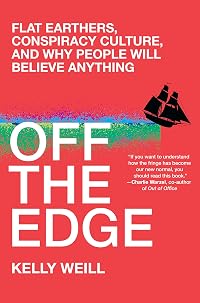
Off the Edge: Flat Earthers, Conspiracy Culture, and Why People Will Believe Anything
by Kelly Weill
On This Page
Description
"A history of the Flat Earth movement and a look at the recent boom in conspiratorial thinking in America"--Tags
Recommendations



























Member Reviews
this is fascinating. i'm not sure the subtitle is totally accurate - do i better understand why people will believe anything? i don't think so? - but for sure this at least gets closer to that. she is a journalist and so goes pretty deep into the origins of the flat earth concept, and attends conventions and talks to people who believe it today, to show how, at least, once someone falls into this conspiracy trap, how hard it is to bring them out. and yes, of course she does relate this to trumpers and election deniers and jan 6 rioters. it doesn't fully explain how people get to that point, although the algorithm that youtube and twitter used to use, showing more and more radical videos to keep people watching, is definitely part of it. show more but i'd like to think that i could watch those videos and not believe this idiocy, and certainly she's immersed herself in this world for years and knows it's not true, so there's something else that is happening. if she had gotten that point, this would be 5 stars, as it is, though, it's still totally worth reading. show less
Off the Edge is about one of the more bizarre conspiracy theories circulating today: belief that the Earth isn’t a sphere but instead a disk. Author Kelly Weill traces the path of this conspiracy theory, from its birth to now, when the delusion is popular enough to justify annual “Flat-Earth” conferences. Belief in this conspiracy theory accelerated in 2014, but it started humbly 150 years before, when it was overwhelmingly greeted with what it should always be: laughter and dismissal.
Weill digs into her topic deeply. For research she attended the Flat-Earth conferences to interview attendees and to listen to various speakers. She observed Flat-Earth Facebook groups, watched Flat-Earth YouTube videos, and listened to Flat-Earth show more podcasts. She understands the conspiracy theory thoroughly and what makes believers tick.
Weill’s use of all that media is meaningful. A large chunk of Off the Edge speaks blisteringly of social media, a force whose unchecked promotion of conspiracy theories cannot be overstated. YouTube in particular is hugely responsible for indoctrination, thanks to an algorithm that encourages users to chain-watch videos on whichever topic they’re exploring. Facebook and Reddit groups, by enabling people to unite and encourage each other 24 hours a day, 7 days a week, cement the delusions. Under pressure to stop this, YouTube and Facebook have changed some things, and Reddit deletes pernicious groups in general, but conspiracy theorists are forceful and persistent.
This book is a critical look at the Flat-Earth conspiracy movement but not an unfair one. Weill explains the theory, including description of Flat Earthers’ alternative disk-model of Earth, and offers a full profile of the typical believer. She doesn’t misrepresent the conspiracy movement or use a mocking tone—not that she needs to. Believers’ statements, so littered with ignorance of certain aspects of physics and inability to recognize illogic, mock them all on their own. Weill shares the proofs for Earth’s spherical shape, proofs so easy to understand and observe that I was left thinking that people who hold firm to fanciful—inventive, really—conspiracy theories must do so because they just really want to.
Off the Edge emphasizes that stubborn adherence. Reasoning with conspiracy theorists is usually futile because they’re convinced that anyone outside their clique of belief is brainwashed by the government, the scientific community, or some other large entity. However, just as anyone can fall under the spell of a charismatic cult leader or be fooled by a scam, anyone can adopt conspiratorial thinking:
"Conspiratorial thinking is not a weird pathology, experienced by some and absent in others. It’s part of a mental process hardwired into all of us. [...] The same powers of abstraction that make humans good at detecting patterns (like anticipating storms when dark clouds gather) can make us imagine patterns where they don’t exist, especially when we’re feeling stressed or powerless. Rather than languish in the unknown, we tell ourselves stories about the secret causes of our troubles."
This is an essential point, both as a buttress for the adage “forewarned is forearmed” and for keeping smugness at bay. No one is so smart as to be immune to certain things.
Additionally, cults and conspiratorial movements are similar. Cult-exit psychologist Rachel Bernstein calls them cousins: “...their followers form insular sects. Followers of both cults and conspiracy theories often grow fiercely protective of their cliques [...] you’re either helping the movement, or actively hurting it.” This is particularly true of the Flat-Earth conspiracy theory. It lacks a central, controlling god-like figure like cults have; instead members monitor each other and quickly ostracize those who show unfaithfulness to the delusion. The more they isolate themselves from the outside world and band together (made so easy by groups on social media), the more deluded they become.
This is troubling, because to escape conspiratorial belief, maintaining a connection to the outside world, especially to nonbelievers, is vital. The book ends as many of these do now, fortunately: by highlighting solutions. Weill profiles two men who were able to extricate themselves from the cult of Flat-Earth belief, and what they have in common are “Globe-Earther” friends who called them out on their nonsense. Most conspiracy theorists, however, (understandably) lose friends, and often relationships with family members, too. (This solution seems simplistic, though. Countless friends and family members of conspiracy theorists can attest to repeatedly pointing out the falsehoods in a conspiracy theorist’s thinking yet getting nowhere. The two men Weill profiles probably never got rooted in their belief, in addition to being open to hearing criticism of it in the first place. Far too many conspiracy theorists are the opposite.)
Off the Edge is mostly about the Flat-Earth conspiracy movement, but Weill also talks about general conspiratorial belief. Right now a significant number of bored people can’t accept that life could possibly be as ordinary as it is and need to subscribe to notions befitting sci-fi or espionage novels. This isn’t simply kookiness; it’s dangerous. Widespread conspiratorial belief (and it is growing) contributes to societal instability. It isn’t hyperbolic to say that if a conspiracy theory is allowed to spread until it becomes the dominant belief, it threatens lives. The Department of Homeland Security labels white-supremacist extremism a domestic terror threat, and conspiratorial belief and extremism (especially antisemitism) tend to go hand in hand. We need books like Weill’s because the first step to solving a problem is to recognize it. On the personal level the first step to preventing a problem is to recognize it—everything about it. show less
Weill digs into her topic deeply. For research she attended the Flat-Earth conferences to interview attendees and to listen to various speakers. She observed Flat-Earth Facebook groups, watched Flat-Earth YouTube videos, and listened to Flat-Earth show more podcasts. She understands the conspiracy theory thoroughly and what makes believers tick.
Weill’s use of all that media is meaningful. A large chunk of Off the Edge speaks blisteringly of social media, a force whose unchecked promotion of conspiracy theories cannot be overstated. YouTube in particular is hugely responsible for indoctrination, thanks to an algorithm that encourages users to chain-watch videos on whichever topic they’re exploring. Facebook and Reddit groups, by enabling people to unite and encourage each other 24 hours a day, 7 days a week, cement the delusions. Under pressure to stop this, YouTube and Facebook have changed some things, and Reddit deletes pernicious groups in general, but conspiracy theorists are forceful and persistent.
This book is a critical look at the Flat-Earth conspiracy movement but not an unfair one. Weill explains the theory, including description of Flat Earthers’ alternative disk-model of Earth, and offers a full profile of the typical believer. She doesn’t misrepresent the conspiracy movement or use a mocking tone—not that she needs to. Believers’ statements, so littered with ignorance of certain aspects of physics and inability to recognize illogic, mock them all on their own. Weill shares the proofs for Earth’s spherical shape, proofs so easy to understand and observe that I was left thinking that people who hold firm to fanciful—inventive, really—conspiracy theories must do so because they just really want to.
Off the Edge emphasizes that stubborn adherence. Reasoning with conspiracy theorists is usually futile because they’re convinced that anyone outside their clique of belief is brainwashed by the government, the scientific community, or some other large entity. However, just as anyone can fall under the spell of a charismatic cult leader or be fooled by a scam, anyone can adopt conspiratorial thinking:
"Conspiratorial thinking is not a weird pathology, experienced by some and absent in others. It’s part of a mental process hardwired into all of us. [...] The same powers of abstraction that make humans good at detecting patterns (like anticipating storms when dark clouds gather) can make us imagine patterns where they don’t exist, especially when we’re feeling stressed or powerless. Rather than languish in the unknown, we tell ourselves stories about the secret causes of our troubles."
This is an essential point, both as a buttress for the adage “forewarned is forearmed” and for keeping smugness at bay. No one is so smart as to be immune to certain things.
Additionally, cults and conspiratorial movements are similar. Cult-exit psychologist Rachel Bernstein calls them cousins: “...their followers form insular sects. Followers of both cults and conspiracy theories often grow fiercely protective of their cliques [...] you’re either helping the movement, or actively hurting it.” This is particularly true of the Flat-Earth conspiracy theory. It lacks a central, controlling god-like figure like cults have; instead members monitor each other and quickly ostracize those who show unfaithfulness to the delusion. The more they isolate themselves from the outside world and band together (made so easy by groups on social media), the more deluded they become.
This is troubling, because to escape conspiratorial belief, maintaining a connection to the outside world, especially to nonbelievers, is vital. The book ends as many of these do now, fortunately: by highlighting solutions. Weill profiles two men who were able to extricate themselves from the cult of Flat-Earth belief, and what they have in common are “Globe-Earther” friends who called them out on their nonsense. Most conspiracy theorists, however, (understandably) lose friends, and often relationships with family members, too. (This solution seems simplistic, though. Countless friends and family members of conspiracy theorists can attest to repeatedly pointing out the falsehoods in a conspiracy theorist’s thinking yet getting nowhere. The two men Weill profiles probably never got rooted in their belief, in addition to being open to hearing criticism of it in the first place. Far too many conspiracy theorists are the opposite.)
Off the Edge is mostly about the Flat-Earth conspiracy movement, but Weill also talks about general conspiratorial belief. Right now a significant number of bored people can’t accept that life could possibly be as ordinary as it is and need to subscribe to notions befitting sci-fi or espionage novels. This isn’t simply kookiness; it’s dangerous. Widespread conspiratorial belief (and it is growing) contributes to societal instability. It isn’t hyperbolic to say that if a conspiracy theory is allowed to spread until it becomes the dominant belief, it threatens lives. The Department of Homeland Security labels white-supremacist extremism a domestic terror threat, and conspiratorial belief and extremism (especially antisemitism) tend to go hand in hand. We need books like Weill’s because the first step to solving a problem is to recognize it. On the personal level the first step to preventing a problem is to recognize it—everything about it. show less
Journalist Kelly Weill has spent much of the last decade covering the rebirth of the flat-earth movement, which has skyrocketed in the age of social media, where anyone can be a producer of films claiming anything imaginable. How on earth has such an easily disproven assertion attracted so many new adherents? Are flat-earthers automatically more prone to adopt other equally ludicrous beliefs? Weill provides here some history, background and insight into an alarming development.
Equal parts fascinating, depressing and infuriating, this book feels important in that it attempts to help us understand how people fall down the rabbit hole (a phrase used frequently by flat-earth interviewees) of conspiracy theories. That said, I'm not sure I'm show more much closer to understanding, from a psychological standpoint, how an otherwise intelligent person could deny not only what countless scientists who dedicate their entire lives to studying and researching conclude, with evidence, but also observations they can make (and personally have made) using their very own senses. It's heartening to learn that YouTube and other social media have modified their algorithms from directing maximum traffic to conspiracy channels, but it is clearly too late for a lot of folks out there. The cynic in me also can't help but wonder how many of the guys cashing in (merch, conferences, fundraising, etc.) on someone else's susceptibility to conspiracy theories actually believe themselves in what they are peddling. Wilbur Voliva sounds creepily and unsettlingly like Trump in speech, mannerisms and actions. show less
Equal parts fascinating, depressing and infuriating, this book feels important in that it attempts to help us understand how people fall down the rabbit hole (a phrase used frequently by flat-earth interviewees) of conspiracy theories. That said, I'm not sure I'm show more much closer to understanding, from a psychological standpoint, how an otherwise intelligent person could deny not only what countless scientists who dedicate their entire lives to studying and researching conclude, with evidence, but also observations they can make (and personally have made) using their very own senses. It's heartening to learn that YouTube and other social media have modified their algorithms from directing maximum traffic to conspiracy channels, but it is clearly too late for a lot of folks out there. The cynic in me also can't help but wonder how many of the guys cashing in (merch, conferences, fundraising, etc.) on someone else's susceptibility to conspiracy theories actually believe themselves in what they are peddling. Wilbur Voliva sounds creepily and unsettlingly like Trump in speech, mannerisms and actions. show less
I've read a lot of books on conspiracy theory, and a lot of conspiratorial books. This is one of the few I've read recently where I learned something new. Several things in fact, from the Indiana roots of the flat earth movement historically to a reasonable and cogent explanation of how conspiracies metastasize and recombine, sometimes into bizarre forms (one chapter is titled "Flat and Fascist").. I could quibble over a couple of minor points and over her rather tepid attempt at a solution to what I'm coming to believe is an unsolvable problem, but I won't. This tome deserves all five stars. Read it and laugh, then weep.
Before my review, a rant: While reading this history of a specific conspiracy theory, I was dismayed that there were no citations of sources backing up the narrative; sure, this all hangs together but the author could have made it up out of whole cloth, I thought. So imagine my surprise, when I reached the end of the book, to find that every chapter was bolstered by extensive notes detailing original sources after all! I read this in e-book form and there were no indications of footnotes in the text, so one would have to somehow remember to check for notes on every page. This is an extremely terrible choice on the part of the publisher; I apologize to the author for thinking badly of her because of their decision….That said, this is show more actually a very engaging story about how the concept of a “flat earth” evolved from its beginnings in early 19th Century Britain through to its resurgence via internet wormholes in modern times. Ms. Weill also discusses the merging of conspiracy theories, showing how, for example, many (though by no means all) flat earthers also subscribe to antisemetic ideas of world domination by the Jews, and how Trump and his acolytes built on the ready-made audience of conspiracy theory adherents to try to overthrow a legitimate election via new conspiracy theories ever-more divorced from reality. I would note that describing one early flat earth proponent’s action as being a “buzzkill” was highly anachronistic; on the other hand, the flat earthers’ decision to call the rest of us “globe earthers” is just lovely! Recommended; but demand that the publisher fix that citation problem mentioned above! show less
A look at Flat Earth beliefs in specific and conspiracy theories in general, and especially the ways in which they've spread in the age of the internet. The chapters about the history of the Flat Earth movement are interesting, and pretty informative. I'd say the stuff on conspiracy theories in general is slightly more scattershot, and it does read a bit sometimes as if the author is wavering back and forth between trying to maintain a journalistic detachment and wanting (very, very understandably) to just let loose and scream in frustration about the horrors of Holocaust denial and QAnon and people claiming that covid is a hoax. The result is not what I'd call a definitive treatment of the subject, but it does a pretty good job of show more calling attention to something that is a very real problem in the world today, and Weill outlines how social media has been a driving force for this stuff clearly and well. And depressingly. I still don't think I've quite recovered from the chapter on anti-antisemitism in conspiracy circles. show less
Off The Edge: Flat Earthers, Conspiracy Culture, and Why People Believe Anything by Kelly Weill is an Algonquin Books publication.
We’ve all seen multiple fringe conspiracy theories gain alarming traction over the past several years. One of the more curious and perplexing of those is the belief that the earth is flat. Kelly Weill, of ‘The Daily Beast’ has studied this phenomenon and its history for a long while now.
It would seem this belief has been around for ages, and while it has waned and gone through periods of dormancy, it is puzzlingly persistent. It was perhaps kept in the public eye to some extent because it was made fun of -sort of like our modern version of the ‘tin foil hat wearers’.
Today, though, conspiracy show more theories have become mainstream, largely thanks to the internet, and social media. YouTube and Facebook are the worst offenders, thanks to their algorithms, and reluctance to change said format because of how profitable these topics are.
Weill doesn’t take a disdainful approach, though. In fact, Weill legitimately listens to some of the believers and at times seems to genuinely feel for them.
Weill admits to having some conspiracy leaning tendencies, herself, on occasion, which caused me to stop and ask myself if I too had any such inclinations. Well, as it turns out, I do. While I grew up in a ‘no nonsense’ household, I had a relative who was very into the JFK assassination theories. As a young adult, I too began to study these various opinions, looking at the evidence, and the really weird occurrences that followed. I was probably the only person my age who checked out the Warren Report from the library along with Jim Garrison's 'On the Trail of the Assassins.'
That said, as I matured, I could easily weed out far-flung ‘Jim Marrs’ like ideas and took a much more critical approach- though, to this day, I remain unconvinced of the ‘lone gunman’ theory.
I never got into any other conspiracies- though occasionally, though I couldn’t understand why people couldn’t see through them, I found them entertaining or amusing- like the ‘Paul is Dead’ conspiracy, for example.
That attitude no longer applies as I see how very, very dangerous it can be, and how closely tied the psychology is to cult-like behavior- almost like cousins, if you will.
Because people really believe, without one iota of evidence, that celebrity elites are drinking the blood of children to retain their youth- perhaps websites, videos, etc., should be given a warning label or disclaimer- at the very least.
This book is fascinating- though over the past couple of years I have learned a little about this topic, on my own, such as how social media algorithms contribute to the problem, and about some of the psychology behind the conspiracy theory trends.
The author makes some very interesting points about demographics, and how the more prominent or well-known a theory is, the more followers it attracts, and about falling into or out of rabbit holes.
While the author sticks to her focused topic of flat-earthers, which of course is just one of many crazy theories that have nothing concrete to back them up, and plenty of real, hardcore truths to debunk it, Weill does tie in the newer issues at hand, like QAnon, among other popular movements, etc., as they tend to stem from some of the same social concerns, fears, and other factors that have kept flat-earthers alive and well.
Overall, the history of the flat earth theory is very interesting. I had no idea how far back it went, and I think Weill makes many valid points in this book about how these theories emerge, when they tend to be more prominent and why we are seeing such a huge growth in believers. The book is also quite chilling and is obviously very, deeply concerning…
4 stars show less
We’ve all seen multiple fringe conspiracy theories gain alarming traction over the past several years. One of the more curious and perplexing of those is the belief that the earth is flat. Kelly Weill, of ‘The Daily Beast’ has studied this phenomenon and its history for a long while now.
It would seem this belief has been around for ages, and while it has waned and gone through periods of dormancy, it is puzzlingly persistent. It was perhaps kept in the public eye to some extent because it was made fun of -sort of like our modern version of the ‘tin foil hat wearers’.
Today, though, conspiracy show more theories have become mainstream, largely thanks to the internet, and social media. YouTube and Facebook are the worst offenders, thanks to their algorithms, and reluctance to change said format because of how profitable these topics are.
Weill doesn’t take a disdainful approach, though. In fact, Weill legitimately listens to some of the believers and at times seems to genuinely feel for them.
Weill admits to having some conspiracy leaning tendencies, herself, on occasion, which caused me to stop and ask myself if I too had any such inclinations. Well, as it turns out, I do. While I grew up in a ‘no nonsense’ household, I had a relative who was very into the JFK assassination theories. As a young adult, I too began to study these various opinions, looking at the evidence, and the really weird occurrences that followed. I was probably the only person my age who checked out the Warren Report from the library along with Jim Garrison's 'On the Trail of the Assassins.'
That said, as I matured, I could easily weed out far-flung ‘Jim Marrs’ like ideas and took a much more critical approach- though, to this day, I remain unconvinced of the ‘lone gunman’ theory.
I never got into any other conspiracies- though occasionally, though I couldn’t understand why people couldn’t see through them, I found them entertaining or amusing- like the ‘Paul is Dead’ conspiracy, for example.
That attitude no longer applies as I see how very, very dangerous it can be, and how closely tied the psychology is to cult-like behavior- almost like cousins, if you will.
Because people really believe, without one iota of evidence, that celebrity elites are drinking the blood of children to retain their youth- perhaps websites, videos, etc., should be given a warning label or disclaimer- at the very least.
This book is fascinating- though over the past couple of years I have learned a little about this topic, on my own, such as how social media algorithms contribute to the problem, and about some of the psychology behind the conspiracy theory trends.
The author makes some very interesting points about demographics, and how the more prominent or well-known a theory is, the more followers it attracts, and about falling into or out of rabbit holes.
While the author sticks to her focused topic of flat-earthers, which of course is just one of many crazy theories that have nothing concrete to back them up, and plenty of real, hardcore truths to debunk it, Weill does tie in the newer issues at hand, like QAnon, among other popular movements, etc., as they tend to stem from some of the same social concerns, fears, and other factors that have kept flat-earthers alive and well.
Overall, the history of the flat earth theory is very interesting. I had no idea how far back it went, and I think Weill makes many valid points in this book about how these theories emerge, when they tend to be more prominent and why we are seeing such a huge growth in believers. The book is also quite chilling and is obviously very, deeply concerning…
4 stars show less
Members
- Recently Added By
Lists

Workman Publishing
38 works; 1 member

2024
34 works; 1 member
Author Information

1 Work 184 Members
Some Editions
Common Knowledge
- Original publication date
- 2022-02-22
- People/Characters
- Mike Hughes
- Dedication
- To J. and C., who were with me the whole way
- First words
- The summer before he fell from the sky, Mike Hughes was experimenting with amateur jet propulsion. It was going badly. (Prologue)
They were beggars and scholars and out-of-work lace makers, dreamers and drunkards, decent farmers and hopelessly bad ones. - Last words
- (Click to show. Warning: May contain spoilers.)Tomorrow morning, the sun will rise according to our various models, and the day will come again. Either way, at least for now, we'll have to share it.
- Publisher's editor
- Muller, Abby
- Blurbers
- Warzel, Charlie; Lavin, Talia; Merlan, Anna; Strevens, Michael
- Original language
- English
- Canonical DDC/MDS
- 001.98
- Canonical LCC
- HV6275
Classifications
- Genres
- Sociology, General Nonfiction, Nonfiction, History
- DDC/MDS
- 001.98 — Computer science, information & general works Computer science, knowledge & systems Knowledge and learning in general Aliens/UFOs Conspiracy theories
- LCC
- HV6275 — Social sciences Social pathology. Social and public welfare. Criminology Social pathology. Social and public welfare. Criminology Crimes and offenses
- BISAC
Statistics
- Members
- 184
- Popularity
- 178,028
- Reviews
- 13
- Rating
- (3.93)
- Languages
- English
- Media
- Paper, Audiobook, Ebook
- ISBNs
- 7
- ASINs
- 2