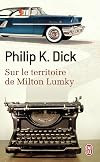
In Milton Lumky Territory
by Philip K. Dick
On This Page
Description
In The Novels of Philip K. Dick, Kim Stanley Robinson states that "In Milton Lumky Territory...is probably the best of Dick's realist novels aside from Confessions of a Crap Artist," and calls it a "bitter indictment of the effects of capitalism." Dick, on the other hand, says in his foreword, "This is actually a very funny book, and a good one, too." Milton Lumky territory is both an area of the western United States and a psychic terrain: the world and worldview of the traveling salesman. show more The story takes place in Boise, Idaho, with some extraordinary long-distance driving sequences in which our hero (young Bruce Stevens) drives from Boise to San Francisco, to Reno, to Pocatello, to Seattle, and back to Boise in search of a good deal on some wholesale typewriters. He falls under the spell of an attractive older woman (who used to be his school teacher) and Milton Lumky, a middle-aged paper salesman whose territory is the Northwest. And then Bruce and the others slowly sink into the whirlpool of Bruce's immature personal obsessions and misperceptions. A compassionate and ironic portrayal of three characters enmeshed in a sticky web of everyday events, in a tension between love and money, with a basic failure to communicate, In Milton Lumky Territory stands out among Dick's early works. show lessTags
Recommendations















Member Reviews
review of
Philip K. Dick's In Milton Lumky Territory
by tENTATIVELY, a cONVENIENCE - September 21, 2012
Philip K. Dick is a great writer. He's a writer that just about every aspiring fiction writer wd love to be. The prose is easy to understand, fluid, engaging, but not banal. The characters are idiosyncratic - they can be 'normal' w/o being stereotypical - they're the product of keen observation of humanity. Dick was married 5 times & one 'has to wonder' whether the marriage depicted here was similar to any of his.
I wasn't even that interested in reading this. I read almost everything by Dick in 1984 or thereabouts & was deeply impressed by him at the time.. but that was long ago & revisiting him is a bit too been-there-done-that. show more AND, since this is one of his realist novels, & not SF, I wasn't really that intrigued. It might be too much like Arthur Miller's Death of a Salesman or John Updike's Couples or some such. In other words, I'm not generally that curious about reading 20th century realism. THEN, I read the 1st sentence, "At sunset, acrid-smelling air from the lake puffed along the empty streets of Montario, Idaho", & I was hooked. It's not THAT brilliant of a sentence but it still did it for me.
As it turned out, I became completely engrossed in the plot - even tho it was about a traveling businessman & his dysfunctional marriage. All the neuroses of the characters are played just right. They're grand, they're annoying, they're subtle. No one's completely a villain or a hero, they're all 'normal' people trying to get by & generally fucking it up a bit here, pulling it off a bit there. The thought that Dick cdn't get this published in his lifetime is sickening. If a novel THIS GREAT cdn't get published, what unappreciated gems are out there languishing?! show less
Philip K. Dick's In Milton Lumky Territory
by tENTATIVELY, a cONVENIENCE - September 21, 2012
Philip K. Dick is a great writer. He's a writer that just about every aspiring fiction writer wd love to be. The prose is easy to understand, fluid, engaging, but not banal. The characters are idiosyncratic - they can be 'normal' w/o being stereotypical - they're the product of keen observation of humanity. Dick was married 5 times & one 'has to wonder' whether the marriage depicted here was similar to any of his.
I wasn't even that interested in reading this. I read almost everything by Dick in 1984 or thereabouts & was deeply impressed by him at the time.. but that was long ago & revisiting him is a bit too been-there-done-that. show more AND, since this is one of his realist novels, & not SF, I wasn't really that intrigued. It might be too much like Arthur Miller's Death of a Salesman or John Updike's Couples or some such. In other words, I'm not generally that curious about reading 20th century realism. THEN, I read the 1st sentence, "At sunset, acrid-smelling air from the lake puffed along the empty streets of Montario, Idaho", & I was hooked. It's not THAT brilliant of a sentence but it still did it for me.
As it turned out, I became completely engrossed in the plot - even tho it was about a traveling businessman & his dysfunctional marriage. All the neuroses of the characters are played just right. They're grand, they're annoying, they're subtle. No one's completely a villain or a hero, they're all 'normal' people trying to get by & generally fucking it up a bit here, pulling it off a bit there. The thought that Dick cdn't get this published in his lifetime is sickening. If a novel THIS GREAT cdn't get published, what unappreciated gems are out there languishing?! show less
So it might surprise folks that In Milton Lumky Territory, a very posthumously published piece of Philip K. Dick's literary fiction, is in many ways the strangest and most uncanny of his works I've ever read. Then again it might not; it's still Philip K. Dick, after all.
What makes it uncanny is the veneer of surreality -- if not unreality -- that the years have lain over its basic story of three characters whose neuroses get in the way of communicating, who are so worried about how they're coming across that they're not coming through. But it's not the characters or their strained, pained interactions (which are as beautifully and compellingly rendered as anything in highbrow White Male Narcissist literature) that make reading this show more novel so weird.
Its their world. Banal, ordinary, mundane, but also, through the action of time and economic upheaval, harder to believe could have ever been real than any Martian colony or post-apocalyptic California or urban techno-dystopia or tank full of humanoids engineered for another planet that Dick concocted.
In Milton Lumky Territory depicts an insignificant backwater in mid-century America, but its an America with a functioning manufacturing economy, in which it's quite possible for ordinary schmoes like PKD's typical barely competent boob-heroes to make a living, own a house, start or acquire a business, travel great distances by car just on the off-chance of maybe finding a warehouse full of newly-imported, as yet unknown and unmarketed Japanese typewriters* that can be bought cheap and sold in their downtown stores in places like Boise, Idaho not just for a profit but for enough to live on comfortably.
Fascinatingly and probably unintentionally also, In Milton Lumky Territory depicts the seeds of this economy's doom. One of the main characters, Bruce, starts off the novel working as a buyer for one of those newfangled discount houses, the ancestors to today's big box stores, before meeting Susan and letting himself be suckered into her dream of making something of her little two-bit typing and mimeographing business. There's also the aforementioned Japanese import typewriters Bruce is hankering to find and sell, the first wave of globalization and the downfall of an economy in which American businesses build durable and useful goods to be sold, used and repaired and used again in America.
It feels almost like PKD is taunting us, we who live in what can be argued is one version or another of his post-apocalyptic techno-dystopias he later created when he gave up on being a highbrow literary novelist and turned to science fiction and pulp to make his living. If only we'd been satisfied with what we had back then, maybe we wouldn't be in the mess we're in now. We could have lived in this novel, but instead, we had to break things and ruin things, let in globalization and inflation and deregulation and union-busting and general plutocracy.
But all this is just rich modern subtext to the experience of reading In Milton Lumky Territory. There is also the actual story, a soap opera plot in which Bruce and Susan meet (again**) and sort of back into deciding they're in love and should marry their fortunes together and encounter the title character, Milton Lumky, who is a traveling typewriter and typing supplies salesman (that there could be such a profession!), only to alienate him and then belatedly find they need him, for he perhaps holds the secret to finding the golden opportunity of Bruce's theoretical warehouse full of languishing game-changing Japanese machines. The characters' interactions bristle with tension, with misunderstanding, with neuroses, with the drama of miscommunication and buried intentions and revelations that seem more than a little creepy.
Which is to say that so many of the things we read PKD for are here, one does not miss the spaceships or the aliens or the revelation that the president is a robot.
I know this world existed once. My parents have vivid memories of it and I trust their accounts. Its relics can still be found all around us (myself, I have three wonderful old manual typewriters, one from 1926, that all still work beautifully because they've been lovingly cared for and used well and kindly over the years by people who respected them and expected them to last). Those empty storefronts in your city's downtown used to be occupied by businesses like Susan's; those factory buildings weren't always chic yuppie loft condos.
It's a lost world, and it's our own decisions, not a comet from space or a machine uprising or a nuclear misunderstanding that lost it for us. And that makes this the most poignant PKD of all.
*Dude. Typewriter fetishists take note. This story is about people who buy and sell and repair typewriters and paper and ribbons and carbons, and they talk about them a lot. It's pretty much heaven.
**Their original meeting lends all this a soap opera sudsiness that is good for too many guffaws to spoil here. show less
What makes it uncanny is the veneer of surreality -- if not unreality -- that the years have lain over its basic story of three characters whose neuroses get in the way of communicating, who are so worried about how they're coming across that they're not coming through. But it's not the characters or their strained, pained interactions (which are as beautifully and compellingly rendered as anything in highbrow White Male Narcissist literature) that make reading this show more novel so weird.
Its their world. Banal, ordinary, mundane, but also, through the action of time and economic upheaval, harder to believe could have ever been real than any Martian colony or post-apocalyptic California or urban techno-dystopia or tank full of humanoids engineered for another planet that Dick concocted.
In Milton Lumky Territory depicts an insignificant backwater in mid-century America, but its an America with a functioning manufacturing economy, in which it's quite possible for ordinary schmoes like PKD's typical barely competent boob-heroes to make a living, own a house, start or acquire a business, travel great distances by car just on the off-chance of maybe finding a warehouse full of newly-imported, as yet unknown and unmarketed Japanese typewriters* that can be bought cheap and sold in their downtown stores in places like Boise, Idaho not just for a profit but for enough to live on comfortably.
Fascinatingly and probably unintentionally also, In Milton Lumky Territory depicts the seeds of this economy's doom. One of the main characters, Bruce, starts off the novel working as a buyer for one of those newfangled discount houses, the ancestors to today's big box stores, before meeting Susan and letting himself be suckered into her dream of making something of her little two-bit typing and mimeographing business. There's also the aforementioned Japanese import typewriters Bruce is hankering to find and sell, the first wave of globalization and the downfall of an economy in which American businesses build durable and useful goods to be sold, used and repaired and used again in America.
It feels almost like PKD is taunting us, we who live in what can be argued is one version or another of his post-apocalyptic techno-dystopias he later created when he gave up on being a highbrow literary novelist and turned to science fiction and pulp to make his living. If only we'd been satisfied with what we had back then, maybe we wouldn't be in the mess we're in now. We could have lived in this novel, but instead, we had to break things and ruin things, let in globalization and inflation and deregulation and union-busting and general plutocracy.
But all this is just rich modern subtext to the experience of reading In Milton Lumky Territory. There is also the actual story, a soap opera plot in which Bruce and Susan meet (again**) and sort of back into deciding they're in love and should marry their fortunes together and encounter the title character, Milton Lumky, who is a traveling typewriter and typing supplies salesman (that there could be such a profession!), only to alienate him and then belatedly find they need him, for he perhaps holds the secret to finding the golden opportunity of Bruce's theoretical warehouse full of languishing game-changing Japanese machines. The characters' interactions bristle with tension, with misunderstanding, with neuroses, with the drama of miscommunication and buried intentions and revelations that seem more than a little creepy.
Which is to say that so many of the things we read PKD for are here, one does not miss the spaceships or the aliens or the revelation that the president is a robot.
I know this world existed once. My parents have vivid memories of it and I trust their accounts. Its relics can still be found all around us (myself, I have three wonderful old manual typewriters, one from 1926, that all still work beautifully because they've been lovingly cared for and used well and kindly over the years by people who respected them and expected them to last). Those empty storefronts in your city's downtown used to be occupied by businesses like Susan's; those factory buildings weren't always chic yuppie loft condos.
It's a lost world, and it's our own decisions, not a comet from space or a machine uprising or a nuclear misunderstanding that lost it for us. And that makes this the most poignant PKD of all.
*Dude. Typewriter fetishists take note. This story is about people who buy and sell and repair typewriters and paper and ribbons and carbons, and they talk about them a lot. It's pretty much heaven.
**Their original meeting lends all this a soap opera sudsiness that is good for too many guffaws to spoil here. show less
Wow. This was good.
My first impression of Philip K. Dick's non-sci-fi work was that he was much more readable with big sci-fi concepts to wrap your head around. His characters are often moody, selfish, cynical, and/or downright malicious. Without the robots and aliens and alternate realities, I found these characters tough to endure. That was how I felt about Confessions of a Crap Artist in particular.
But this one was really amazing. The two main characters were full of the same sort of flaws I mentioned, but not in a cartoonishly overdone way (as they are in some of his other works, sci-fi or not). I really liked how these characters (all three of them if you include Milt Lumky) were very different from each other, flawed in different show more ways and likable in other ways. In short, they were rounded and believable.
But my favorite part of the novel came at the end. I don't want to spoil anything, but I will say that PKD's lifelong fixation with alternate realities has a chance to come into play. And it's beautiful. show less
My first impression of Philip K. Dick's non-sci-fi work was that he was much more readable with big sci-fi concepts to wrap your head around. His characters are often moody, selfish, cynical, and/or downright malicious. Without the robots and aliens and alternate realities, I found these characters tough to endure. That was how I felt about Confessions of a Crap Artist in particular.
But this one was really amazing. The two main characters were full of the same sort of flaws I mentioned, but not in a cartoonishly overdone way (as they are in some of his other works, sci-fi or not). I really liked how these characters (all three of them if you include Milt Lumky) were very different from each other, flawed in different show more ways and likable in other ways. In short, they were rounded and believable.
But my favorite part of the novel came at the end. I don't want to spoil anything, but I will say that PKD's lifelong fixation with alternate realities has a chance to come into play. And it's beautiful. show less
In Milton Lumky Territory by Philip K. Dick is not what the author's readers have come to expect. Not exactly. Known for his paranoid science fiction dealing with alternate realities, Philip K. Dick began his career writing stories about ordinary workers trying to make a go of it in 1950's and 60's America. His early, realistic novels were not published during his lifetime, but have recently become available. For some reason, there seems to be a growing interest in Philip K. Dick these days.
In Milton Lumky Territory is free of science fiction elements and largely free of paranoia as well, but the characters should be familiar to long-time fans of Philip K. Dick. The hero, Bruce Stevens, is a small time businessman looking for a good show more deal on wholesale typewriters so he can make a go of it selling them in his new wife's shop in Idaho. Along the way he hooks up with Milton Lumky, a paper salesman and long time friend of his new wife. Bruce does not have an easy time finding a good deal on the typewriters and also has trouble convincing his wife that he is capable of running her shop. She was once his fifth grade teacher which does not make their marriage any easier.
This plot sounds remarkable close to that of The Man in the High Castle but there won't be any alternate reality surfacing to explain why Bruce Stevens can't get a break. Instead, the story stays firmly rooted in reality, but this is not a bad thing. The story is a portrayal of work which we don't get very often in contemporary fiction. How a businessman goes about his business without a murder, or a kidnapping, or an alien, coming along to spice up the storyline can actually make for an interesting tale as it does in In Milton Lumky Territory.
If you're a fan of Philip K. Dick, as I am, then reading these early novels offers several rewards. We can see the development of the archetypal Dick hero, the more-or-less ordinary Joe in over his head with the deck stacked against him. We can also see the beginnings of Dick's paranoid outlook on society. While there are no "forces" in In Milton Lumky Territory forces do seem to be aligned against the hero. Milton Lumky knows where Bruce can get a great deal on electric Japanese typewriters. (Remember when those were new.) But on the way to the warehouse in San Francisco, Lumky becomes ill and has to stay behind in a motel. Bruce can't get as good a deal without Lumky; in fact, he can barely get any deal at all he has so little money. Additional obstacles appear as Bruce keeps on trying to open his typewriter shop, so many that the novel begins to take on the paranoid tone of Dick's later science fiction novels.
I suspect that these early novels will laregly appeal to longtime fans of Philip K. Dick. One has to wonder what would have happened if he had been able to publish any of them. Would he have gone on to write the science fiction classics he did? I like to think that there is an alternate reality out there somewhere, one where Philip K. Dick went on to become a sort of Philip Roth, writing realistic stories about everyday people. Of course, one may ask if that reality is the real one or the alternate one? show less
In Milton Lumky Territory is free of science fiction elements and largely free of paranoia as well, but the characters should be familiar to long-time fans of Philip K. Dick. The hero, Bruce Stevens, is a small time businessman looking for a good show more deal on wholesale typewriters so he can make a go of it selling them in his new wife's shop in Idaho. Along the way he hooks up with Milton Lumky, a paper salesman and long time friend of his new wife. Bruce does not have an easy time finding a good deal on the typewriters and also has trouble convincing his wife that he is capable of running her shop. She was once his fifth grade teacher which does not make their marriage any easier.
This plot sounds remarkable close to that of The Man in the High Castle but there won't be any alternate reality surfacing to explain why Bruce Stevens can't get a break. Instead, the story stays firmly rooted in reality, but this is not a bad thing. The story is a portrayal of work which we don't get very often in contemporary fiction. How a businessman goes about his business without a murder, or a kidnapping, or an alien, coming along to spice up the storyline can actually make for an interesting tale as it does in In Milton Lumky Territory.
If you're a fan of Philip K. Dick, as I am, then reading these early novels offers several rewards. We can see the development of the archetypal Dick hero, the more-or-less ordinary Joe in over his head with the deck stacked against him. We can also see the beginnings of Dick's paranoid outlook on society. While there are no "forces" in In Milton Lumky Territory forces do seem to be aligned against the hero. Milton Lumky knows where Bruce can get a great deal on electric Japanese typewriters. (Remember when those were new.) But on the way to the warehouse in San Francisco, Lumky becomes ill and has to stay behind in a motel. Bruce can't get as good a deal without Lumky; in fact, he can barely get any deal at all he has so little money. Additional obstacles appear as Bruce keeps on trying to open his typewriter shop, so many that the novel begins to take on the paranoid tone of Dick's later science fiction novels.
I suspect that these early novels will laregly appeal to longtime fans of Philip K. Dick. One has to wonder what would have happened if he had been able to publish any of them. Would he have gone on to write the science fiction classics he did? I like to think that there is an alternate reality out there somewhere, one where Philip K. Dick went on to become a sort of Philip Roth, writing realistic stories about everyday people. Of course, one may ask if that reality is the real one or the alternate one? show less
Another of PKD's non-sf novels similar to "Voices in the Street." The main character, Bruce Stevens, is in sales too. This time it is traveling sales and the Milton Lumky of the title is another traveling salesman. Bruce works for a large discount chain in Reno and when he visits his home town in Idaho he meets a woman who inspires his dream of becoming his own businessman. The woman, Susan, owns a failing business and typewriting supply and transcription store that she wants to sell. Bruce moves in with Susan and wants to make the store profitable. Milton Lumky, of the title, sells paper products in the region and Susan is one of his customers.Milton tells Bruce about a batch of electric typewriters sitting in a warehouse and the plot show more revolves around Bruce's efforts to buy and sell them at a profit. Orbiting, or maybe actually the center of the plot's rotation, is Bruce and Susan's relationship. Bruce realizes Susan was his 5th grade teacher. They are passionate together and yet their past roles interfere. This book contains an alternate ending presented as a daydream of Bruce's. I liked the effect. First, the reality ending, and then the "Hollywood" ending. Both are happy endings depending on your own viewpoint and interpretation of the characters.Again I was fascinated by the contrast between that time and our own. Electric typewriters were expensive and just beginning to grow in popularity. They needed to be repaired and repair shops existed! In "Voices in the Streets" the formula was the same for TV sets. Retail and traveling sales were either considered worthy professions by PKD or merely a good story environment. Either way I enjoyed both books. show less
Another of PKD's non-sf novels similar to "Voices in the Street." The main character, Bruce Stevens, is in sales too. This time it is traveling sales and the Milton Lumky of the title is another traveling salesman. Bruce works for a large discount chain in Reno and when he visits his home town in Idaho he meets a woman who inspires his dream of becoming his own businessman. The woman, Susan, owns a failing business and typewriting supply and transcription store that she wants to sell. Bruce moves in with Susan and wants to make the store profitable. Milton Lumky, of the title, sells paper products in the region and Susan is one of his customers.Milton tells Bruce about a batch of electric typewriters sitting in a warehouse and the plot show more revolves around Bruce's efforts to buy and sell them at a profit. Orbiting, or maybe actually the center of the plot's rotation, is Bruce and Susan's relationship. Bruce realizes Susan was his 5th grade teacher. They are passionate together and yet their past roles interfere. This book contains an alternate ending presented as a daydream of Bruce's. I liked the effect. First, the reality ending, and then the "Hollywood" ending. Both are happy endings depending on your own viewpoint and interpretation of the characters.Again I was fascinated by the contrast between that time and our own. Electric typewriters were expensive and just beginning to grow in popularity. They needed to be repaired and repair shops existed! In "Voices in the Streets" the formula was the same for TV sets. Retail and traveling sales were either considered worthy professions by PKD or merely a good story environment. Either way I enjoyed both books. show less
I must have read quite a few Philip K. Dick novels in my science-fiction reading days, but had never heard of this short early story. Not sci-fi, but Dick's sci-fi sensibility comes through strongly, and I suppose you could read it as sci-fi, as a sort of time-travel/alternate reality story. The story and characters are one or two steps removed from reality, but Dick's evocation of the American west in the 1950s is strong, and reminds me a bit of Kerouac's On the Road.
Members
- Recently Added By
Lists

Forced Exposure
83 works; 1 member
Author Information

670+ Works 146,749 Members
Phillip Kindred Dick was an American science fiction writer best known for his psychological portrayals of characters trapped in illusory environments. Born in Chicago, Illinois, on December 16, 1928, Dick worked in radio and studied briefly at the University of California at Berkeley before embarking on his writing career. His first novel, Solar show more Lottery, was published in 1955. In 1963, Dick won the Hugo Award for his novel, The Man in the High Castle. He also wrote a series of futuristic tales about artificial creatures on the loose; notable of these was Do Androids Dream of Electric Sheep?, which was later adapted into film as Blade Runner. Dick also published several collections of short stories. He died of a stroke in Santa Ana, California, in 1982. (Bowker Author Biography) show less
Some Editions
Series
Belongs to Publisher Series
PKD composition order (1958)
Common Knowledge
- Canonical title
- In Milton Lumky Territory
- Original title
- In Milton Lumky Territory
- Original publication date
- 1958-10-08 (manuscript) (manuscript); 1985
- People/Characters
- Susan Faine; Bruce Stevens
- Important places
- Idaho, USA
- Original language
- English
Classifications
Statistics
- Members
- 402
- Popularity
- 77,275
- Reviews
- 8
- Rating
- (3.42)
- Languages
- English, French, Italian, Polish
- Media
- Paper, Audiobook, Ebook
- ISBNs
- 17
- UPCs
- 1
- ASINs
- 4