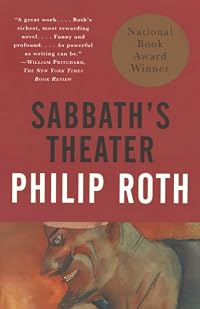
Sabbath's Theater
by Philip Roth
On This Page
Description
He is relentlessly defiant. He is exceedingly libidinous. His appetite for the outrageous is insatiable. He is Mickey Sabbath, the aging, raging powerhouse whose savage effrontery and mocking audacity are at the heart of Philip Roth's astonishing new novel. Sabbath's Theater tells Mickey's story in the wake of the death of his mistress, an erotic free spirit whose adulterous daring exceeds even his own. Once a scandalously inventive puppeteer, Mickey is now in his mid-sixties and besieged by show more ghosts - of his mother, his beloved brother, his vanished first wife, his mistress of thirteen years. Bereft and grieving, he embarks on a turbulent journey back into his past, one that brings him to the brink of madness and extinction. But no matter how ardently he courts death, he is too exuberantly alive to succeed at dying. Sabbath's Theater is a comic creation of epic proportions, and Mickey Sabbath is its gargantuan hero. show lessTags
Recommendations








Member Reviews
Not the most pleasant read anyone of us will experience. Just under 500 pages describing the purposefully repugnant Mickey Sabbath. While the more prudish among us will simply stop reading, those of us who are more widely read ask ourselves the question Roth surely intended: aren’t we really all like Mickey Sabbath deep down?
And I can’t disagree with him. Deep down, we’re all repugnant, driven by animal desires and a self-interest that is utterly loathsome at times.
There’s another question here though: isn’t Mickey to be praised above the rest of us because he is, at least, honest and, in admitting he is as such and revelling in it, lives the fullest life that he possibly could while we live in fear of our peers and confine show more ourselves to the limitations of their expectations?
Er. No.
And Roth illustrates this with continuous flashbacks in Mickey’s memory to long-dead war hero brother Morty who everyone holds up as the ideal man and is, yet, subject to a moral code that most of us would esteem – courtesy, commitment, honour, hard work, etc., etc. – all the qualities that Mickey lacks entirely.
Thus is Mickey constantly conflicted, on the one hand driven to anarchic hedonism while on the other gazing up longingly to his brother on the moral pedestal he’s placed him on.
Anyway, the novel’s purpose aside, you’d be forgiven for thinking that Roth wrote this novel simply to provide himself with a playground for experiments in obscenity. There’s a lot of distasteful sex, for example, described, as far as I’m concerned, in completely unnecessary detail. Surely this is one area where our imaginations need as little help as possible.
In all, this seems to be the antithesis of American Pastoral and it struck me that Norman, an old friend Mickey shacks up with for a while, is probably Roth’s prototype for the Swede.
So, while this is no doubt an important book in terms of Roth’s development as a writer, it’s not very pleasant to read, and I think you can quite easily skip it without suffering any literary loss whatsoever. show less
And I can’t disagree with him. Deep down, we’re all repugnant, driven by animal desires and a self-interest that is utterly loathsome at times.
There’s another question here though: isn’t Mickey to be praised above the rest of us because he is, at least, honest and, in admitting he is as such and revelling in it, lives the fullest life that he possibly could while we live in fear of our peers and confine show more ourselves to the limitations of their expectations?
Er. No.
And Roth illustrates this with continuous flashbacks in Mickey’s memory to long-dead war hero brother Morty who everyone holds up as the ideal man and is, yet, subject to a moral code that most of us would esteem – courtesy, commitment, honour, hard work, etc., etc. – all the qualities that Mickey lacks entirely.
Thus is Mickey constantly conflicted, on the one hand driven to anarchic hedonism while on the other gazing up longingly to his brother on the moral pedestal he’s placed him on.
Anyway, the novel’s purpose aside, you’d be forgiven for thinking that Roth wrote this novel simply to provide himself with a playground for experiments in obscenity. There’s a lot of distasteful sex, for example, described, as far as I’m concerned, in completely unnecessary detail. Surely this is one area where our imaginations need as little help as possible.
In all, this seems to be the antithesis of American Pastoral and it struck me that Norman, an old friend Mickey shacks up with for a while, is probably Roth’s prototype for the Swede.
So, while this is no doubt an important book in terms of Roth’s development as a writer, it’s not very pleasant to read, and I think you can quite easily skip it without suffering any literary loss whatsoever. show less
First time I have read Philip Roth. Unfortunately not my cuppa tea. You can take the opening sentence as a description of the majority of the book. Full of sexual obsessions that are not erotic, but perverse and leave a bad taste in one's mouth. However, the description, encounters, conversations in the rehabilitation centre were interesting, enjoyable and entertaining (eg. Happiness considered as a mental health disorder).The book, described as humourous on the cover - I guess I just don't share that sense of humour - left me very tempted to read some more by this author; so he must be doing something right.
Mickey is an aging sexual charismatic. As the novel begins the bell has sounded , and he's into the final round. He's never given any of that much thought : what will he do? Well apparently, not go gladly into that good night. A rich, funny, sad, painful, and thoughtful novel. The scenes with Mickey going to his wife's addiction clinic, and visiting with an elderly man from his childhood neighborhood, are incomparable. Not a morality play, but a grim rumination on true loss and despair, and the price you pay for feeding your ego and appetites at other's expense, while still waking up to face another day.
This is a novel about a man with a ceaseless, thoughtless, transgressive, destructive, sexual appetite, so sex is dealt with candidly. show more The author has deliberately created a protagonist most of us would loathe if we knew or met him. If you can't handle these things, don't read the novel. show less
This is a novel about a man with a ceaseless, thoughtless, transgressive, destructive, sexual appetite, so sex is dealt with candidly. show more The author has deliberately created a protagonist most of us would loathe if we knew or met him. If you can't handle these things, don't read the novel. show less
I had doubts about this book until I came to the second half and began to understand what kind of book Roth was writing. I now think the book probably deserves any book award anyone wants to give it. It's always hard on the reader when a first-person narrator (the prose dips in and out) isn't someone he's naturally sympathetic to, and it's even harder when that narrator wins the reader's sympathy when his guard is down. (Some reviewers on this site have been momentarily won over in this way, and now feel bad about it — a victory for the author.) In fact the reader is so deeply inside Mickey Sabbath's head, and so well placed to see what's driving him, that it becomes impossible to tell whether Sabbath's character is a "plausible show more exaggeration" or a "genuine type." Maybe with fuller life-histories, we'd see these sorts of people everywhere. The question is interesting because it reveals Roth's power as a writer; the answer is basically unimportant. What is important, to properly enjoy this book, is to understand what kind of person Sabbath is.
Some people are provocative and antagonistic simply because they want to be that way (or at least that's how it seems from the outside). But Sabbath is provocative and antagonistic as a kind of "by-product" to a fundamentally benign nature. He's not malicious; he doesn't have any real "hates" (his hatred of the Japanese is somewhat manufactured); he knows right from wrong. But he does have strong feelings about how the world ought to be, and in particular about how people ought to behave and treat one another and him especially. And most important, he has his own appetites to satisfy. For him, this is a very unfortunate blend of circumstances: he just doesn't get along. Scene after scene describes his failure to get along. He seems to have only two successes at getting along: among the beggars in NY, and with his lover.
There's a lot for the reader to take from these two successes. Most important: it isn't "selfishness" that makes Sabbath what he is. In the right places, with the right people, he is a well-adjusted, happy human being who gets along, compromises, and gives generously.
But most of the book is a succession of failures, brought on by a bad mix of Sabbath's nature and the world. How did Sabbath become this sort of person? Why the overwhelming vision about how the world ought to treat him and his appetites? It would spoil the plot to discuss this. Also, there are strong biographical cues — Sabbath's childhood in New Jersey for instance — that I don't feel I appreciate on one reading.
I've read a lot of Roth, most of it I think. This one is magic. show less
Some people are provocative and antagonistic simply because they want to be that way (or at least that's how it seems from the outside). But Sabbath is provocative and antagonistic as a kind of "by-product" to a fundamentally benign nature. He's not malicious; he doesn't have any real "hates" (his hatred of the Japanese is somewhat manufactured); he knows right from wrong. But he does have strong feelings about how the world ought to be, and in particular about how people ought to behave and treat one another and him especially. And most important, he has his own appetites to satisfy. For him, this is a very unfortunate blend of circumstances: he just doesn't get along. Scene after scene describes his failure to get along. He seems to have only two successes at getting along: among the beggars in NY, and with his lover.
There's a lot for the reader to take from these two successes. Most important: it isn't "selfishness" that makes Sabbath what he is. In the right places, with the right people, he is a well-adjusted, happy human being who gets along, compromises, and gives generously.
But most of the book is a succession of failures, brought on by a bad mix of Sabbath's nature and the world. How did Sabbath become this sort of person? Why the overwhelming vision about how the world ought to treat him and his appetites? It would spoil the plot to discuss this. Also, there are strong biographical cues — Sabbath's childhood in New Jersey for instance — that I don't feel I appreciate on one reading.
I've read a lot of Roth, most of it I think. This one is magic. show less
Philip Roth is one of my favorite authors, and while there is plenty to like about Sabbath's Theater, I can't help but feel that of the 15+ books of his I've read, none quite so perfectly showcases all the things that Roth does wrong.
There's a lot of evidence that Roth is a misogynist, and while this book isn't quite as anti-woman as My Life As a Man, it's still a shining example of the way he treats his female characters. In Sabbath's Theater, they are all completely one dimensional. Perfect or evil sums up the entirety of their personalities, and their only purpose is to propel the story of the men - usually by being a penis-receptacle.
Fans of Portnoy's Complaint will love this book, because it's chock full of eye-roll inducing 'sexy' show more scenes. I know many people who've only read a book or two of Roth's think this is what he's 'known for', but I assure you his better books don't fall back on this stupid, "I'm going to titillate and shock people now!" trope. I'm certainly not offended by these scenes, I just find them dull and unimportant in the grand scheme of the plot.
All that said, Roth's mastery of the English language is as apparent in this book as in most of his others. There are a few particularly clever parts that did warrant a chuckle from me. I know there is an audience out there for this book, as evidenced by the fact that it won the National Book Award and was short-listed for the Pulitzer, but that audience is not me. show less
There's a lot of evidence that Roth is a misogynist, and while this book isn't quite as anti-woman as My Life As a Man, it's still a shining example of the way he treats his female characters. In Sabbath's Theater, they are all completely one dimensional. Perfect or evil sums up the entirety of their personalities, and their only purpose is to propel the story of the men - usually by being a penis-receptacle.
Fans of Portnoy's Complaint will love this book, because it's chock full of eye-roll inducing 'sexy' show more scenes. I know many people who've only read a book or two of Roth's think this is what he's 'known for', but I assure you his better books don't fall back on this stupid, "I'm going to titillate and shock people now!" trope. I'm certainly not offended by these scenes, I just find them dull and unimportant in the grand scheme of the plot.
All that said, Roth's mastery of the English language is as apparent in this book as in most of his others. There are a few particularly clever parts that did warrant a chuckle from me. I know there is an audience out there for this book, as evidenced by the fact that it won the National Book Award and was short-listed for the Pulitzer, but that audience is not me. show less
Non-stop, rebarbative descriptions of the sex act in a graveyard. An awful slog. For me, Roth is one of those hot or cold authors. This one left me stone cold. Hey, if you're looking for masturbatory fodder, this is your novel. I happen not to be. As an alternative I would recommended any of the following: American Pastoral, The Counterlife, The Ghost Writer, or The Human Stain. Certainly the first two here are masterpieces.
Sabbath’s Theater is a superbly written novel by Philip Roth. He brings to life a loathsome, usurious adult man – Sabbath; one of those true-to-life characters one would normally feel repelled by. Yet, somehow, Roth manages to elicit, from his reader, a misplaced passion for this failure of a man. By looking back at his life and times, growing up in the 1940’s during WWII, one understands the major life events that affected Sabbath and the lives of those closest to him. No one has a free pass to use ones’ life circumstances as an excuse for immoral or otherwise, bad behavior. However, Sabbath possesses an underlying humanity that causes the reader to feel pity and compassion for him. That is the success of Philip Roth’s show more creativity. He is a master writer with the immeasurable ability to take his readers to uncomfortable places, yet bring them comfort in doing so. show less
Members
- Recently Added By
Published Reviews
ThingScore 100
All that rawness becomes a road to a deeper truth, and by the novel's end, its cumulative dose of human hope and woe had me (and again I'm not alone in this) on my knees.
added by Shortride
No writer since Henry Miller has depicted sex as the driving force of life with such a scintillating combination of wit and heat. Roth here creates one of contemporary fiction's great characters—and manages the Herculean feat of containing him in a savage, spectacular novel that may well be his best.
added by Richardrobert
Lists

Novels from The Guardian's Great American Novelist Tournament
148 works; 24 members

Top Five Books of 2018
802 works; 265 members

Llibres que he llegit el 2018
46 works; 1 member

National Book Award - Fiction
78 works; 10 members

Pulitzer Prize for Fiction - Finalists
88 works; 9 members

The Atlantic's The Great American Novel
136 works; 12 members
Author Information

123+ Works 74,812 Members
Philip Milton Roth was born in Newark, New Jersey on March 19, 1933. He attended Rutgers University for one year before transferring to Bucknell University where he completed a B.A. in English with highest honors in 1954. He received an M.A. from the University of Chicago in 1955. His first book, Goodbye, Columbus, received the National Book Award show more in 1960. His other books include Letting Go, When She Was Good, Portnoy's Complaint, My Life as a Man, The Ghostwriter, Zuckerman Unbound, I Married a Communist, The Plot Against America, The Facts, The Anatomy Lesson, Exit Ghost, Deception, Nemesis, Everyman, Indignation, and The Humbling. He won the National Book Critic Circle Awards in 1987 for his novel The Counterlife and in 1992 for his memoir Patrimony: A True Story. He won the PEN/Faulkner Award for Fiction in 1993 for Operation Shylock: A Confession and in 2001 for The Human Stain, the National Book Award in 1995 for Sabbath's Theater, and the Pulitzer Prize in 1998 for American Pastoral. He stopped writing in 2010. He died from congestive heart failure on May 22, 2018 at the age of 85. (Bowker Author Biography) show less
Awards and Honors
Awards
Distinctions
Series
Belongs to Publisher Series
Work Relationships
Common Knowledge
- Canonical title*
- El Teatro De Sabbath
- Original title
- Sabbath's Theater
- Original publication date
- 1995
- People/Characters
- Morris "Mickey" Sabbath; Norman Cowan; Drenka Balich; Fischel "Fish" Sabbath
- Epigraph
- PROSPERO:
Every third thought shall be my grave.
—The Tempest, act v, scene i - Dedication
- For Two Friends
Janet Hobhouse
1948–1991
Melvin Tumin
1919–1994 - First words
- Either foreswear fucking others or the affair is over.
- Quotations*
- L'ho copiato da un articolo. Parola per parola. La rivista dell'Etica Medica. "Si propone di classificare la felicità" alzò gli occhi e precisò: in corsivo. "Si propone di classificare la felicità tra i disordini mental... (show all)i e di includerla nelle future edizioni dei principali manuali di diagnostica sotto questo nome: disordine affettivo primario, di tipo piacevole. Da un esame dei principali testi risulta che la felicità è statisticamente anormale, consiste di un discreto conglomerato di sintomi, è associata a una vasta gamma di anormalità cognitive, e probabilmente riflette un anormale funzionamento del sistema nervoso centrale. Una delle principali obiezioni alla proposta è che della felicità non si dà una valutazione negativa. Comunque è un'obiezione trascurabile dal punto di vista scientifico."
- Last words
- (Click to show. Warning: May contain spoilers.)Everything he hated was here.
- Original language
- English US
*Some information comes from Common Knowledge in other languages. Click "Edit" for more information.
Classifications
Statistics
- Members
- 2,582
- Popularity
- 7,384
- Reviews
- 37
- Rating
- (3.72)
- Languages
- 16 — Danish, Dutch, English, French, German, Greek, Hungarian, Italian, Norwegian (Bokmål), Polish, Romanian, Croatian, Spanish, Swedish, Turkish, Portuguese (Portugal)
- Media
- Paper, Audiobook, Ebook
- ISBNs
- 57
- UPCs
- 1
- ASINs
- 17