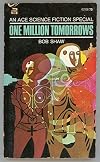
One Million Tomorrows
by Bob Shaw
On This Page
Description
The Price of Eternal LifeIn the 22nd Century, no one had to die of old age: an immortality drug was available to all. Its only drawback was the side-effect that ended a man's sex drive, so most men waited till their youth was fading before they took the final step and became "cools."But Will Carewe became the first man to test a new variety of the drug, one without any side effects at all. The limitless future, a million tomorrows, stretched before him with golden hope - until a series of show more "accidents" made him realise that someone was trying to murder him.As an immortal Carewe had an infinitely greater stake in remaining alive. So he began the battle to find out who was after him, and why... show lessTags
Recommendations









Member Reviews
In my re-read of Bob Shaw's books, I came to 1 Million Tomorrows with a little trepidation. Its preceding work in Bob's oeuvre, Shadow of Heaven, had come up with some shortcomings in plotting and a somewhat far-fetched premise that didn't really hang together, let alone allow Bob the spase to exercise his trademark ingenious imagination. It was many years since I had read this, and my memory of the book wasn't exceptionally fond.
What I found was not quite what I expected.
The year is 2197. Humanity has possessed the secret of immortality for around two hundred years, but it comes at a price - male impotence. The protagonist, Will Carewe, is invited by his employers, a large pharmaceuticals firm, to trial an new version of the show more immortality drug - one that retains full male potency. But almost from the outset, he finds that his life is in danger, as he experiences a series of accidents which prove not to be accidents. He begins to realise that for some reason, he is the focus of a conspiracy, and his employers may be behind it. And then his wife is abducted...
So we have a reasonably well constructed future thriller. I had not remembered the plot details, and I found myself turning the pages quite eagerly to try to understand quite why Carewe was the focus of such murderous intent, especially when all the pointers led back to his employers - but why should they?
Throughout the book, I kept coming across vignettes which I had remembered, though not necessarily from where. In the course of the novel, for example, Will Carewe gets stabbed and suffers a collapsed lung. Bob was personally horrified by the thought that the inside of his body consisted of a series of tubes, sacs, bladders and other squishy bits - he would much have preferred, he said, to be homogenous throughout, like an apple - and his visceral horror is well-shown as he writes about Carewe walking, running and climbing about with this collapsed lung flapping about inside his ribcage 'like a piece of wet leather'. I had forgotten that, but it came back to me with full force as I realised how vividly Bob had visualized this idea which he found so personally repugnant. On another occasion, following a chase sequence in a factory devoted to making frictionless ball-bearings, a villain falls into a vat of said ball-bearings and drowns in tiny metal spheres. This is described with quite some relish, though again I suspect Bob had succeeded in horrifying himself and put this down on paper.
Again, I found that I was now reading a Bob Shaw novel with a better appreciation of his talent for language, something which as a younger reader I did not appreciate, instead being dazzled by the science-fictional wonders on show.
Elsewhere, Bob's technical ingenuity is given full rein, with all manner of asides showing innovations Bob couldn't help but think up. Two of them - airbags and automated navigation - are now familiar to us.
Bob made a very good job of exploring quite what some of the implications of a society where a large proportion of the population were immortal would be. These implications range from macro-economics to personal interrelations, crimes and prejudices. Some of them were quite poignant; one of Carewe's neighbours is an extremely old man, who must have been an early adopter of the treatment when it first appeared in (we assume) the 1990s. But this very old man has lost so many memories; Alzheimer's Syndrome wasn't considered a major problem in 1970, when this book was written, but Carewe's conversation with this character couldn't help but make me now think of some of our reactions to that illness. And another character suffered a life-changing event connected with his mother's attitudes to sex and immortality; giving someone immortality might not always be a gift.
As ever, Bob Shaw crammed a lot into his novels. I've commented before that he probably got into a bad habit of working at a shorter length because of contractual obligations; certainly, there are a lot of ideas thrown off almost casually which could be explored at much greater length in a longer novel. And his command of prose is in no way diminished by the restrictions in length, or by the restraints imposed by one other feature of this book.
Because there is a problem with it. It is a problem common to a lot of science fiction, especially that written in earlier times. A friend of mine has coined the term "Men in Hats SF" - a tendency for science fiction writers to show us distant worlds and far-flung futures, only to have the characters (usually men) wearing hats, smoking pipes and reading newspapers. Bob Shaw was not immune from that, though in his case it's not too jarring when it happens. I also happen to think that this isn't such a terrible thing. My friend points at Men in Hats as a failure of imagination; but given that we all have things in our homes which would be familiar to people from much earlier generations, even going back centuries in the case of furniture or kitchen utensils (as examples). The failure isn't so much in imagination, it's more not being lucky in picking winners, like Bob's airbags and satnavs as I said earlier.
But science fiction can sometimes be guilty of going to the other extreme: think Logan's Run, showing us a society almost totally changed from our own, even down to common nouns, such as (in this case) a 'dhome', which is, of course, a home in a dome. This would strike many readers as rather contrived, especially when it gets used constantly throughout the novel. Changing the society, even down to quite minor details, can strike many readers, especially those not fully versed in the tropes of the genre, as superficial change for change's sake, especially if the author isn't particularly adept at slipping the references seamlessly into the text. Bob Shaw was far more competent than that, but even so in the early stages of this novel, the changes he shows us - men not yet immortal (and so still virile) sporting designer stubble and wearing codpieces to advertise their potency, or changes to womens' attitudes towards men - seem clunky and unlike his usual ability to paint pictures of situations unusual to us in a few well-chosen words.
The other matter is less obvious. We have a thriller story here, but the action of the novel depends rather on an improbably competent senior accountant turning into a man of action at a moment's notice. In a way, Will Carewe is another Bob Shaw competent hero, once more probably written in Bob's own image. And this, in turn, has issues for more modern readers as the attitudes on display, especially in relation to gender attitudes, are firmly those of the 1960s and 1970s.
But all that aside, I was pleasantly surprised by this novel. Not one of Bob's best, but a surprisingly good one and definitely better than I remembered.
(NB : the Gollancz first edition hardcover appears to be fairly rare.) show less
What I found was not quite what I expected.
The year is 2197. Humanity has possessed the secret of immortality for around two hundred years, but it comes at a price - male impotence. The protagonist, Will Carewe, is invited by his employers, a large pharmaceuticals firm, to trial an new version of the show more immortality drug - one that retains full male potency. But almost from the outset, he finds that his life is in danger, as he experiences a series of accidents which prove not to be accidents. He begins to realise that for some reason, he is the focus of a conspiracy, and his employers may be behind it. And then his wife is abducted...
So we have a reasonably well constructed future thriller. I had not remembered the plot details, and I found myself turning the pages quite eagerly to try to understand quite why Carewe was the focus of such murderous intent, especially when all the pointers led back to his employers - but why should they?
Throughout the book, I kept coming across vignettes which I had remembered, though not necessarily from where. In the course of the novel, for example, Will Carewe gets stabbed and suffers a collapsed lung. Bob was personally horrified by the thought that the inside of his body consisted of a series of tubes, sacs, bladders and other squishy bits - he would much have preferred, he said, to be homogenous throughout, like an apple - and his visceral horror is well-shown as he writes about Carewe walking, running and climbing about with this collapsed lung flapping about inside his ribcage 'like a piece of wet leather'. I had forgotten that, but it came back to me with full force as I realised how vividly Bob had visualized this idea which he found so personally repugnant. On another occasion, following a chase sequence in a factory devoted to making frictionless ball-bearings, a villain falls into a vat of said ball-bearings and drowns in tiny metal spheres. This is described with quite some relish, though again I suspect Bob had succeeded in horrifying himself and put this down on paper.
Again, I found that I was now reading a Bob Shaw novel with a better appreciation of his talent for language, something which as a younger reader I did not appreciate, instead being dazzled by the science-fictional wonders on show.
Elsewhere, Bob's technical ingenuity is given full rein, with all manner of asides showing innovations Bob couldn't help but think up. Two of them - airbags and automated navigation - are now familiar to us.
Bob made a very good job of exploring quite what some of the implications of a society where a large proportion of the population were immortal would be. These implications range from macro-economics to personal interrelations, crimes and prejudices. Some of them were quite poignant; one of Carewe's neighbours is an extremely old man, who must have been an early adopter of the treatment when it first appeared in (we assume) the 1990s. But this very old man has lost so many memories; Alzheimer's Syndrome wasn't considered a major problem in 1970, when this book was written, but Carewe's conversation with this character couldn't help but make me now think of some of our reactions to that illness. And another character suffered a life-changing event connected with his mother's attitudes to sex and immortality; giving someone immortality might not always be a gift.
As ever, Bob Shaw crammed a lot into his novels. I've commented before that he probably got into a bad habit of working at a shorter length because of contractual obligations; certainly, there are a lot of ideas thrown off almost casually which could be explored at much greater length in a longer novel. And his command of prose is in no way diminished by the restrictions in length, or by the restraints imposed by one other feature of this book.
Because there is a problem with it. It is a problem common to a lot of science fiction, especially that written in earlier times. A friend of mine has coined the term "Men in Hats SF" - a tendency for science fiction writers to show us distant worlds and far-flung futures, only to have the characters (usually men) wearing hats, smoking pipes and reading newspapers. Bob Shaw was not immune from that, though in his case it's not too jarring when it happens. I also happen to think that this isn't such a terrible thing. My friend points at Men in Hats as a failure of imagination; but given that we all have things in our homes which would be familiar to people from much earlier generations, even going back centuries in the case of furniture or kitchen utensils (as examples). The failure isn't so much in imagination, it's more not being lucky in picking winners, like Bob's airbags and satnavs as I said earlier.
But science fiction can sometimes be guilty of going to the other extreme: think Logan's Run, showing us a society almost totally changed from our own, even down to common nouns, such as (in this case) a 'dhome', which is, of course, a home in a dome. This would strike many readers as rather contrived, especially when it gets used constantly throughout the novel. Changing the society, even down to quite minor details, can strike many readers, especially those not fully versed in the tropes of the genre, as superficial change for change's sake, especially if the author isn't particularly adept at slipping the references seamlessly into the text. Bob Shaw was far more competent than that, but even so in the early stages of this novel, the changes he shows us - men not yet immortal (and so still virile) sporting designer stubble and wearing codpieces to advertise their potency, or changes to womens' attitudes towards men - seem clunky and unlike his usual ability to paint pictures of situations unusual to us in a few well-chosen words.
The other matter is less obvious. We have a thriller story here, but the action of the novel depends rather on an improbably competent senior accountant turning into a man of action at a moment's notice. In a way, Will Carewe is another Bob Shaw competent hero, once more probably written in Bob's own image. And this, in turn, has issues for more modern readers as the attitudes on display, especially in relation to gender attitudes, are firmly those of the 1960s and 1970s.
But all that aside, I was pleasantly surprised by this novel. Not one of Bob's best, but a surprisingly good one and definitely better than I remembered.
(NB : the Gollancz first edition hardcover appears to be fairly rare.) show less
You can live forever but you'll have to give up sex. That's a familiar dilemma for most of us at a certain age, but the choice facing humanity in Bob Shaw's novel is more literal and immediate. But that's really just the background to a tense murder mystery/industrial espionage thriller. The story doesn't hang together particluarly well, the narrative goes all over the place with characters and themes dropping in and out and the denoument is a little rushed. But there are lots of witty scenes and ideas that keep the story interesting throughout it's short duration.
I'm rating this book as 3 although I'm not finishing it. I will, however, hand it on to my nephew, whose tastes in science fiction will be better satisfied than mine by this book.
I bought One Million Tomorrows because I have never read anything by Northern Irish SF writer, Bob Shaw, and I was curious. I didn't really look at the cover blurb, so I was disappointed when I realized in my haste I'd bought a book about a guy who gets to have immortality and still be able to have sex. Oh, brother, thought I.
The story is better than the bare plot suggests. Shaw has an interest in the human heart as well as an informed imagination when it comes to science and technology, so the book is broader than I feared it would be. It is, in the end, a show more science fiction adventure thriller and does well in that. I stopped reading it, though, because I don't actually like the protagonist, his wife, or any other recurring character, and I have a pile of books with potentially more attractive characters sitting beside my bed giving me the come hither look.
So I'm going thither. show less
I bought One Million Tomorrows because I have never read anything by Northern Irish SF writer, Bob Shaw, and I was curious. I didn't really look at the cover blurb, so I was disappointed when I realized in my haste I'd bought a book about a guy who gets to have immortality and still be able to have sex. Oh, brother, thought I.
The story is better than the bare plot suggests. Shaw has an interest in the human heart as well as an informed imagination when it comes to science and technology, so the book is broader than I feared it would be. It is, in the end, a show more science fiction adventure thriller and does well in that. I stopped reading it, though, because I don't actually like the protagonist, his wife, or any other recurring character, and I have a pile of books with potentially more attractive characters sitting beside my bed giving me the come hither look.
So I'm going thither. show less
Ratings
Members
- Recently Added By
Author Information

118+ Works 6,002 Members
Some Editions
Series
Belongs to Publisher Series
Work Relationships
Common Knowledge
- Canonical title
- One Million Tomorrows
- Original publication date
- 1970
- People/Characters
- Will Carewe; Hyron Barenboim; Manny Pleeth; Athene Carewe; Marianne Tone; Hermione Seddon (show all 16); Vic Navarro; Ron Ritchie; Felix Parma; Kendy; Dewey Storch; Colleen Bourgou; Theodore Gwynne; Bunny Costello; Prefect McKelvey; Spinetti
- First words
- In the early part of the morning Carewe sat quietly at his desk, doing absolutely nothing.
- Last words*
- (Click to show. Warning: May contain spoilers.)Prese la pistola ipodermica, l'appoggiò al polso, si lasciò invadere da quella nuvoletta gelida; poi scese sulla spiaggia, a raggiungere sua moglie nell'inizio della loro lunga, lunghissima primavera.
*Some information comes from Common Knowledge in other languages. Click "Edit" for more information.
Classifications
Statistics
- Members
- 165
- Popularity
- 198,324
- Reviews
- 3
- Rating
- (3.27)
- Languages
- English, German, Italian
- Media
- Paper, Ebook
- ISBNs
- 6
- ASINs
- 7