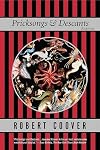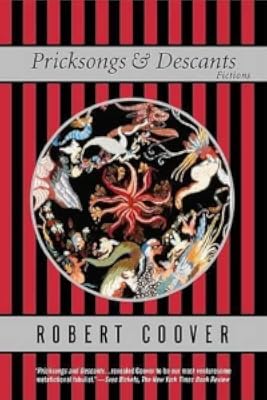
Pricksongs & Descants: Fictions
by Robert Coover
On This Page
Description
Pricksongs & Descants, originally published in 1969, is a virtuoso performance that established its author - already a William Faulkner Award winner for his first novel - as a writer of enduring power and unquestionable brilliance, a promise he has fulfilled over a stellar career. It also began Coover's now-trademark riffs on fairy tales and bedtime stories. In these riotously word-drunk fictional romps, two children follow an old man into the woods, trailing bread crumbs behind and edging show more helplessly toward a sinister end that never comes; a husband walks toward the bed where his wife awaits his caresses, but by the time he arrives she's been dead three weeks and detectives are pounding down the door; a teenaged babysitter's evening becomes a kaleidoscope of dangerous erotic fantasies-her employer's, her boyfriend's, her own; an aging, humble carpenter marries a beautiful but frigid woman, and after he's waited weeks to consummate their union she announces that God has made her pregnant. show lessTags
Recommendations



























Member Recommendations


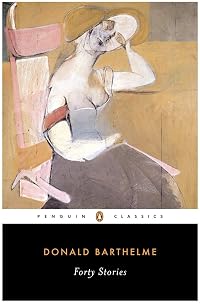
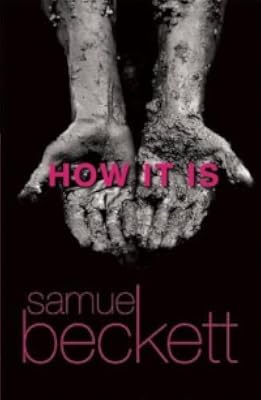
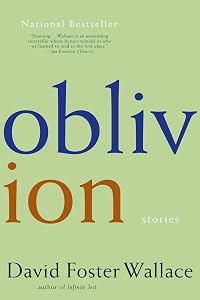
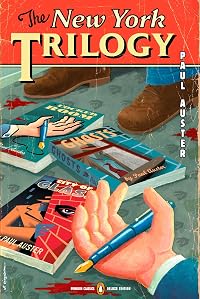
tootstorm These two story collections tend to go hand-in-hand in literary-slash-academic circles, and they're both about on equal footing. Despite this preceding reputation, the similarities aren't so extensive, as Gass takes a more modernist approach and perfects it when and where he can. At his best, his stories fill a hole left behind by Faulkner's thematic antiquity. Pure gothic dread--or not so pure, coming off Gass' experimental, innovative genius, ultimately warranting the comparisons to his more self-consciously postmodern contemporary.

Member Reviews
Robert Coover’s fiction and the fiction of all early meta-heavy fabulators in the ‘60s and ‘70s sought to subvert the prosaic conventions of language after being driven “into a blind alley by critics and analysts” out to deconstruct and destroy what critics and analysts of Coover have called literature’s “innocent magic.” In Coover’s mind, the only proper reaction to the blind alley cornering is to create a “big blast,” destroying everything and everyone, making room to rebuild something new: something fractured—using—as Coover himself explains in the Prólogo to the Cervantes-inspired collection w/in the collection: “Seven Exemplary Fictions”—“familiar mythic or historical forms to combat the content show more of those forms and to conduct the reader…to the real, away from mystification to clarification, away from magic to maturity, away from mystery to revelation.”
Old Coover’s mostly famous for his representation of fractured fairy tales and Biblical myths taking well-known FT&Ms like Noah’s ark and turning them on their heads into these “death-cunt-and-prick songs,” stretching out the version commonly understood and pulling the humanity from b/w their lines to the fiction’s surface: Noah’s Brother narrates his part of this insane project Noah’s taken up, helping his brother construct his giant ark and gather animals as a blind favor, and the stoical Noah, when his Brother questions the sanity of what they’re doing and informs Noah that his pregnant wife can’t take care of their household on her own, he has a lot of his own work to do, &c., only says “It don’t matter none your work.” In this fractured world, God’s actions carry a certain vulgarity to them, a carelessness made manifest in their lack of concern for the common people, as the Brother, his wife and their unborn child are left abandoned to the rising waves by Noah’s family; and also as Joseph’s marriage (and later life) comes to ruin when a divine pregnancy stands b/w him and his vestal, uncaring wife. Seriously, God’s an asshole.
No longer was the City of Man a pale image of the City of God, a microcosmic reflection of the macrocosm, but rather it was all there was, neither micro- nor macrocosm, yet at the same time full of potential.
I found there were two stories in P&D that really stood out from the rest, both similarly told in a broken-up non-linear fashion w/ numerous narrative lines happening simultaneously, some true, some fantasy, but it doesn’t really matter which is which as long as we understand them all at once. “The Babysitter” tells the story of—no surprise—a babysitter, every paragraph breaking b/w real and unreal, delving into the infinite number of possibilities (all of which end up being more than slightly tragic), often the concerns of the babysitter herself, worrying about possible appearances by her boyfriend and his schmuck of a friend, the children’s health, or a sudden surprise appearance by their horny father, &c. Which is real means jack: nothing is resolved(—a trick he pulls in another story: “The Elevator”). The other story, the story that dominates this collection completely, and the first real story post-prologue (of sorts)—which really brings down the overall impact of the collection, to tell you the truth: when you start every story looking and hoping for it to compare to the first—is “The Magic Poker,” and is the strongest example of the metafictional style first defined by Gass. The “Poker” is a self-aware series of narrative lines that center around this magical poker purposely inserted onto the story’s island by its creator—the narrator, the writer, the magician—as a symbol, a literary artifact; it’s also Coover’s commentary on the state of literature circa ’68, which he characterizes as a decrepit and abandoned mansion, long forgotten by its owners (also, of course, inventions of the author), vandalized by Coover himself.
Like in “Babysitter,” every paragraph is a break from whatever previous narrative line into another, as the writer bounces around between ideas, changing his mind and re-writing events and philosophizing on the state of his island, his writing and unequivocally himself. Coover’s goal, by bringing two young antithetical sisters to this island of his, is to breathe life back into the symbol, to bring thru the power of his words magic back to literature. And so the sisters: On one hand, we have Karen, prepared for life, strong, &c., who seizes the poker, kissing the handle…the shaft…the tip…&c.—you can use yr imagination, and takes it as a memento to her boat. Karen’s sister (is she ever named?) is ill-dressed for the island in tight-fitted gold pants (mmmm...awwww), scared, confused & yet aroused; so anyway she picks up this same magic poker and is split into multiple narratives, the most fascinating of which takes on the guise of a fairy tale-like story, where the caretaker’s brutish son—who’s been watching them up until this point on and off as the narrator decides on whether to include him or not, occasionally shitting into a teakettle in a ruined cottage, aka Karen’s sister’s meaningless life (But what am I going to do with shit in the teakettle? No, no, there’s nothing to be gained by burdening our fabrications with impieties. Enough that the skin of the world is littered with our contentious artifice, lepered with the stigmata of human aggression and despair, without suffering our songs to be flattened by savagery. Back to the poker)—where the caretaker’s son becomes the Beast, or a dirty fellaheen-like man, but sly, taking the magic poker in this invented magic kingdom to strip the sister/princess of her tight-fitted golden pants and win her hand in marriage (this being a contest set up by the King), but once done the princess finally kisses the phallic symbol, transforming it into a pipe-smoking, beautiful prince, who proceeds to slay the Beast, “saving” the princess by widowing her from the sort of lover she so secretly desired. Everything on the island is invoked by this literary symbol, and Coover is the symbol, a subject/object of his own fiction and his escape into language.
I could go on and on about this story all day, but man o man, I have to move on and get this over with. Look out for this collection: it’s an essential read if you want to understand the later 20th c.’s dominant literary movement, and there are sixteen more death-cunt-and-prick songs to go along with these four, standouts incl. (but are in no way limited to): “The Marker” (yeuck), “Morris in Chains (in which Barthelme’s City Life comes into play), “The Elevator” (prvsly. mentioned), "The Gingerbread House" (another FFT), & “A Pedestrian Accident.”
85%
[270]
What is life, after all, but a caravan of lifelike forgeries? show less
Old Coover’s mostly famous for his representation of fractured fairy tales and Biblical myths taking well-known FT&Ms like Noah’s ark and turning them on their heads into these “death-cunt-and-prick songs,” stretching out the version commonly understood and pulling the humanity from b/w their lines to the fiction’s surface: Noah’s Brother narrates his part of this insane project Noah’s taken up, helping his brother construct his giant ark and gather animals as a blind favor, and the stoical Noah, when his Brother questions the sanity of what they’re doing and informs Noah that his pregnant wife can’t take care of their household on her own, he has a lot of his own work to do, &c., only says “It don’t matter none your work.” In this fractured world, God’s actions carry a certain vulgarity to them, a carelessness made manifest in their lack of concern for the common people, as the Brother, his wife and their unborn child are left abandoned to the rising waves by Noah’s family; and also as Joseph’s marriage (and later life) comes to ruin when a divine pregnancy stands b/w him and his vestal, uncaring wife. Seriously, God’s an asshole.
No longer was the City of Man a pale image of the City of God, a microcosmic reflection of the macrocosm, but rather it was all there was, neither micro- nor macrocosm, yet at the same time full of potential.
I found there were two stories in P&D that really stood out from the rest, both similarly told in a broken-up non-linear fashion w/ numerous narrative lines happening simultaneously, some true, some fantasy, but it doesn’t really matter which is which as long as we understand them all at once. “The Babysitter” tells the story of—no surprise—a babysitter, every paragraph breaking b/w real and unreal, delving into the infinite number of possibilities (all of which end up being more than slightly tragic), often the concerns of the babysitter herself, worrying about possible appearances by her boyfriend and his schmuck of a friend, the children’s health, or a sudden surprise appearance by their horny father, &c. Which is real means jack: nothing is resolved(—a trick he pulls in another story: “The Elevator”). The other story, the story that dominates this collection completely, and the first real story post-prologue (of sorts)—which really brings down the overall impact of the collection, to tell you the truth: when you start every story looking and hoping for it to compare to the first—is “The Magic Poker,” and is the strongest example of the metafictional style first defined by Gass. The “Poker” is a self-aware series of narrative lines that center around this magical poker purposely inserted onto the story’s island by its creator—the narrator, the writer, the magician—as a symbol, a literary artifact; it’s also Coover’s commentary on the state of literature circa ’68, which he characterizes as a decrepit and abandoned mansion, long forgotten by its owners (also, of course, inventions of the author), vandalized by Coover himself.
Like in “Babysitter,” every paragraph is a break from whatever previous narrative line into another, as the writer bounces around between ideas, changing his mind and re-writing events and philosophizing on the state of his island, his writing and unequivocally himself. Coover’s goal, by bringing two young antithetical sisters to this island of his, is to breathe life back into the symbol, to bring thru the power of his words magic back to literature. And so the sisters: On one hand, we have Karen, prepared for life, strong, &c., who seizes the poker, kissing the handle…the shaft…the tip…&c.—you can use yr imagination, and takes it as a memento to her boat. Karen’s sister (is she ever named?) is ill-dressed for the island in tight-fitted gold pants (mmmm...awwww), scared, confused & yet aroused; so anyway she picks up this same magic poker and is split into multiple narratives, the most fascinating of which takes on the guise of a fairy tale-like story, where the caretaker’s brutish son—who’s been watching them up until this point on and off as the narrator decides on whether to include him or not, occasionally shitting into a teakettle in a ruined cottage, aka Karen’s sister’s meaningless life (But what am I going to do with shit in the teakettle? No, no, there’s nothing to be gained by burdening our fabrications with impieties. Enough that the skin of the world is littered with our contentious artifice, lepered with the stigmata of human aggression and despair, without suffering our songs to be flattened by savagery. Back to the poker)—where the caretaker’s son becomes the Beast, or a dirty fellaheen-like man, but sly, taking the magic poker in this invented magic kingdom to strip the sister/princess of her tight-fitted golden pants and win her hand in marriage (this being a contest set up by the King), but once done the princess finally kisses the phallic symbol, transforming it into a pipe-smoking, beautiful prince, who proceeds to slay the Beast, “saving” the princess by widowing her from the sort of lover she so secretly desired. Everything on the island is invoked by this literary symbol, and Coover is the symbol, a subject/object of his own fiction and his escape into language.
I could go on and on about this story all day, but man o man, I have to move on and get this over with. Look out for this collection: it’s an essential read if you want to understand the later 20th c.’s dominant literary movement, and there are sixteen more death-cunt-and-prick songs to go along with these four, standouts incl. (but are in no way limited to): “The Marker” (yeuck), “Morris in Chains (in which Barthelme’s City Life comes into play), “The Elevator” (prvsly. mentioned), "The Gingerbread House" (another FFT), & “A Pedestrian Accident.”
85%
[270]
What is life, after all, but a caravan of lifelike forgeries? show less
Pricksongs and Descants by Robert Coover
4 stars
Pricksongs and Descants is a collection of short stories by Robert Coover that was originally published in 1969. The stories are retellings of popular stories including fairy tales, bedtime stories, and a few biblical stories. The Amazon synopsis states the following: "In these riotously word-drunk fictional romps, two children follow an old man into the woods, trailing bread crumbs behind and edging helplessly toward a sinister end that never comes; a husband walks toward the bed where his wife awaits his caresses, but by the time he arrives she's been dead three weeks and detectives are pounding down the door; a teenaged babysitter's evening becomes a kaleidoscope of dangerous erotic show more fantasies-her employer's, her boyfriend's, her own; an aging, humble carpenter marries a beautiful but frigid woman, and after he's waited weeks to consummate their union she announces that God has made her pregnant."
I read this book as part of the 1001 group's Books of the Month and I was the only one (thus far) who liked the book. Unlike the others who read this book, I really enjoyed the experience of reading this collection. The writing was wonderful and the stories deliciously creepy, bizarre, and often disturbing. I also normally dislike short stories but I enjoyed these ones. I like strange, bizarre, and seemingly absurd books (perhaps this is why I like Kafka so much). I can't say I spent too much time thinking about the symbolism behind the stories but I just enjoyed the process of reading because Coover challenges this process at every twist and turn. One of the stories, "The Babysitter" was an interesting experimentation in the multiple ways a story could unfold although it wasn't my favorite in terms of content.
I enjoyed the way that Coover's stories were so different in tone, style, perspective from one to the next. In several stories he pulls the reader in the narrative (the Leper), making us wonder how we are complicit in the story. I liked the experimental nature of the stories and how he deconstructed what we normally view as fiction or fairy tales. What made this book special to me was the way that Coover played around with genre and narrative structure, deconstructing the very stories that form the fabric of our own societal mythology.
It was unlike anything I've read on the 1001 list and I quite enjoyed it. show less
4 stars
Pricksongs and Descants is a collection of short stories by Robert Coover that was originally published in 1969. The stories are retellings of popular stories including fairy tales, bedtime stories, and a few biblical stories. The Amazon synopsis states the following: "In these riotously word-drunk fictional romps, two children follow an old man into the woods, trailing bread crumbs behind and edging helplessly toward a sinister end that never comes; a husband walks toward the bed where his wife awaits his caresses, but by the time he arrives she's been dead three weeks and detectives are pounding down the door; a teenaged babysitter's evening becomes a kaleidoscope of dangerous erotic show more fantasies-her employer's, her boyfriend's, her own; an aging, humble carpenter marries a beautiful but frigid woman, and after he's waited weeks to consummate their union she announces that God has made her pregnant."
I read this book as part of the 1001 group's Books of the Month and I was the only one (thus far) who liked the book. Unlike the others who read this book, I really enjoyed the experience of reading this collection. The writing was wonderful and the stories deliciously creepy, bizarre, and often disturbing. I also normally dislike short stories but I enjoyed these ones. I like strange, bizarre, and seemingly absurd books (perhaps this is why I like Kafka so much). I can't say I spent too much time thinking about the symbolism behind the stories but I just enjoyed the process of reading because Coover challenges this process at every twist and turn. One of the stories, "The Babysitter" was an interesting experimentation in the multiple ways a story could unfold although it wasn't my favorite in terms of content.
I enjoyed the way that Coover's stories were so different in tone, style, perspective from one to the next. In several stories he pulls the reader in the narrative (the Leper), making us wonder how we are complicit in the story. I liked the experimental nature of the stories and how he deconstructed what we normally view as fiction or fairy tales. What made this book special to me was the way that Coover played around with genre and narrative structure, deconstructing the very stories that form the fabric of our own societal mythology.
It was unlike anything I've read on the 1001 list and I quite enjoyed it. show less
He pronounces it aloud, smiles faintly, sadly, somewhat wearily, then continues his tedious climb, pausing from time to time to stare back down the stairs behind him.
When the time arrives for resolution, I will be there. One day soon the followers of Coover will engage those of Barth tooth and claw. There will be no quarter. The scene will remind us of Bangkok and we will wear the shirt of Coover proudly. Through the tear-gas and vitriol we will triumph. Our cause will prevail because of the brilliance of The Magic Poker and The Babysitter. These two exercises astonish in their smutty Impressionism. It will be admitted that I was sometimes too impatient or ill-equipped to truly delight in all of the pieces presented here.
Where Barth show more paints with manic glee about Story, Coover recycles his own variations, distilling a Gestalt where the dross whispers of all outcomes and the reader's imagination trembles in capacity. Hope remains --and victory will be ours. Coover Rules! show less
When the time arrives for resolution, I will be there. One day soon the followers of Coover will engage those of Barth tooth and claw. There will be no quarter. The scene will remind us of Bangkok and we will wear the shirt of Coover proudly. Through the tear-gas and vitriol we will triumph. Our cause will prevail because of the brilliance of The Magic Poker and The Babysitter. These two exercises astonish in their smutty Impressionism. It will be admitted that I was sometimes too impatient or ill-equipped to truly delight in all of the pieces presented here.
Where Barth show more paints with manic glee about Story, Coover recycles his own variations, distilling a Gestalt where the dross whispers of all outcomes and the reader's imagination trembles in capacity. Hope remains --and victory will be ours. Coover Rules! show less
Fun. Very Barthelme-esque, and actually slightly funnier, though to my mind doesn't reach quite the same level of genius.
They're better when they have some secrets to unravel: Morris in Chains, Magic Poker and A Pedestrian Accident achieve real profundity and will stay with me forever. Others reach at that, but feel a little shallower, like The Babysitter and The Elevator - albeit they're still great fun.
Some of them are just long jokes: particularly The Hat Act and many of the Seven Exemplary Fictions: but I can't find myself to fault them, when they're that funny.
They're better when they have some secrets to unravel: Morris in Chains, Magic Poker and A Pedestrian Accident achieve real profundity and will stay with me forever. Others reach at that, but feel a little shallower, like The Babysitter and The Elevator - albeit they're still great fun.
Some of them are just long jokes: particularly The Hat Act and many of the Seven Exemplary Fictions: but I can't find myself to fault them, when they're that funny.
Quite an unusual collection of stories, to say the least. Some need multiple re-readings, or at least time to assimilate, like The Panel, and some are grotesque, like The Marker. However, some are more accessible, and even playful. The structure of some allow for multiple scenarios, like the famous " The Babysitter. Other favorites were The Pedestrian Accident, The Hat Act, The Brother and The Elevator. I read somewhere that the title of the collection comes from early music, where plucked notes lie below an upper melody or descant. That makes sense for the stories that are take offs on fairy tales, like The Doors and The Gingerbread House.
The short stories in this collection were so different from each other and from everything else I’ve ever read that it’s hard to know where to begin with this book. Some of them were retellings of well-known stories and fairy tales, although many of those were so obscure that I wasn’t familiar with the original story. There was also a lot of non-linear storytelling with Coover going back and rewriting his own plots so that you were reading several different versions of the same story at once. I liked this technique and the possibilities it raised for a story to go in many different directions, but the book as a whole wasn’t enjoyable for me. I was often lost and felt like I just wasn’t getting it. I also felt like certain plot show more elements crossed the line from unpleasant and uncomfortable into disgusting and repulsive. Another minor complaint I have to mention is that while I don’t mind it when authors throw in a little bit of foreign language, Coover really tested my patience with the amount of Spanish in the story dedicated to Cervantes. Not being able to understand large chunks of the text gets frustrating after a while. Overall, I never reached the point where I wanted to throw the book across the room, but I’m definitely glad to be finished with it. show less
A clever author, Robert Coover, from Iowa gives us this book of short stories or whatever they are. Some are rewrites of fairy tales and Bible stories and some are just repeated imaginations of various scenarios. Perhaps a good writing exercise that the author turned to profits. Not really my cup of tea.
Members
- Recently Added By
Lists

1001 Books You Must Read Before You Die
1,448 works; 1,131 members

Larry McCaffery's 20th Century Greatest Hits: 100 English-Language Books
103 works; 12 members

Significant works of postmodern fiction
86 works; 25 members
1,001 BYMRBYD Concensus
723 works; 27 members

My TBR
371 works; 3 members
Author Information

72+ Works 5,748 Members
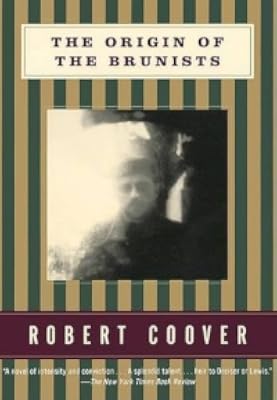
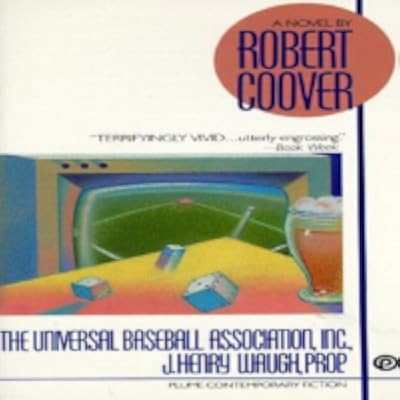
Robert Coover is a midwesterner who has earned a reputation as one of the most innovative of contemporary writers of fiction. Coover likes to experiment with an abundance of differing styles. The Origin of the Brunists (1966), his first novel, is a religious parable heavily loaded with symbolism and mythical parallels. It deals with the rise show more following an Appalachian coal-mine disaster of a sect of worshipers made up of fundamentalists and theosophists whose leader, Giovanni Bruno, is less a preacher than a silent enigma. The principal analogue is apparently meant to be the founding of the Christian religion, but Coover's extensive irony requires that he reverse many of the traditional features of the Christian legend. The Universal Baseball Association (1968), Coover's most accessible novel to date, is also dominated by religious symbolism. Over the years, J. Henry Waugh, a middle-aged bachelor and accountant, has developed an elaborately structured game, which he plays with dice. His game is based on the mathematical probabilities of baseball. Every evening Henry plays his game and maintains his extensive record books. J. Henry Waugh is a surrogate for God, and the participants in his imaginary baseball league seem almost to come to life, raising as they do age-old questions about fate and free will, success and failure, games and religions. Coover's Pricksongs and Descants (1969) is a collection of 20 short pieces and a theoretical "Prologo" in which the author states his belief that contemporary fiction should be based on familiar historical or mythical forms. Most of the stories in this volume, which was well received by critics, are based on biblical episodes or classical fairy tales retold in startling new ways. The Public Burning (1977) is based on the controversial trial of the Rosenbergs. With the exception of a novel, A Night at the Movies (1992), Coover's publications in recent years have consisted mainly of shorter works, written at various stages of his career, published in limited editions to appeal to collectors. Coover is one of the founders of the Electronic Literature Organization. In 1987 he was chosen as the winner of the Rea Award for the Short Story. Coover is indeed one of the foremost short story writers of the postmodern period, as exemplified by the "Seven Exemplary Fictions" contained in his 1969 book Pricksongs and Descants. (Bowker Author Biography) show less
Awards and Honors
Series
Belongs to Publisher Series
Work Relationships
Common Knowledge
- Original publication date
- 1969
Classifications
Statistics
- Members
- 721
- Popularity
- 39,246
- Reviews
- 9
- Rating
- (3.61)
- Languages
- English, German, Spanish
- Media
- Paper, Ebook
- ISBNs
- 20
- ASINs
- 12