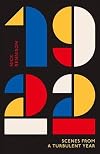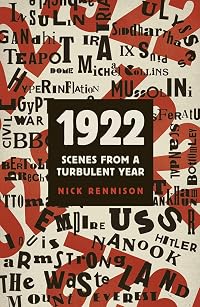
1922: Scenes from a Turbulent Year
by Nick Rennison
On This Page
Description
1922 was a year of great turbulence and upheaval. The world had just emerged from a war that had killed millions of people and a global pandemic that had ended the lives of tens of millions more. Its events reverberated throughout the rest of the twentieth century and still affect us today. Empires fell. The Ottoman Empire collapsed after more than six centuries. The British Empire had reached its zenith but its heyday was over. The Irish Free State was declared and demands for independence show more in India grew. New nations and new politics came into existence. The Soviet Union was officially created and Mussolini's Italy became the first Fascist state. In the USA, Prohibition was at its height. The Hollywood film industry, although rocked by a series of scandals, continued to grow. A new mass medium - radio - was making its presence felt and the BBC was founded. In literature it was the year of peak modernism. Both T. S. Eliot's The Waste Land and James Joyce's Ulysses were first published in full. In society, already changed by the trauma of war and pandemic, the morals of the past seemed increasingly outmoded; new ways of behaving were making their appearance. The Roaring Twenties had begun to roar and the Jazz Age had arrived. In a sequence of vividly written sketches, Nick Rennison conjures up all the drama and diversity of an extraordinary year. show lessTags
Recommendations










Member Reviews
This short book filled with “factoid” anecdotal events from 1922 with a culture heavy Western (UK, Ireland and the USA) bias might be dismissed as trivial, if it were not so educational and fun. This is not at all the type of detail heavy history book that I usually read, but it is wonderfully informative and interesting.
Despite its brevity, there are a few entries that appear to add nothing to our understanding of living in 1922, such as the death of a pope and election of his successor, which is completely unremarkable, and the accidental killing of Vladmir Nabokov’s father in a failed assassination attempt. The article that takes the prize here though is the entry that starts “May. The cricket season begins in England.”
The show more historical stories are enlivened by humour where appropriate, such as the following about radio and the formation of the BBC: “When (a famous opera singer) arrived at the Marconi works, it soon became clear that Dame Nellie (Melba) had little notion of how radio worked. She was taken on a tour by a proud employee who pointed out the 140-foot tall transmitters, from the top of which her voice would be broadcast to listeners around the world. ‘Young man,’ she boomed in reply, ‘if you think I’m going to climb up there, you are very much mistaken.’”
A useful short bibliography is provided,with an acknowledgment to Robert Grave’s social history of Britain in the inter-war years, The Long Weekend, which perhaps provided an inspiration for the style of this book.
Overall, being easy, fun and informative, this book gives an entertainingly kaleidoscopic impression of 1922, providing the reader with contemporary tabloid sensations and sporting highlights, but also detailing the truly historic political and cultural events of the time, whose importance might only be recognised with hindsight.
I received a Netgalley copy of this book, but this review is my honest opinion. show less
Despite its brevity, there are a few entries that appear to add nothing to our understanding of living in 1922, such as the death of a pope and election of his successor, which is completely unremarkable, and the accidental killing of Vladmir Nabokov’s father in a failed assassination attempt. The article that takes the prize here though is the entry that starts “May. The cricket season begins in England.”
The show more historical stories are enlivened by humour where appropriate, such as the following about radio and the formation of the BBC: “When (a famous opera singer) arrived at the Marconi works, it soon became clear that Dame Nellie (Melba) had little notion of how radio worked. She was taken on a tour by a proud employee who pointed out the 140-foot tall transmitters, from the top of which her voice would be broadcast to listeners around the world. ‘Young man,’ she boomed in reply, ‘if you think I’m going to climb up there, you are very much mistaken.’”
A useful short bibliography is provided,with an acknowledgment to Robert Grave’s social history of Britain in the inter-war years, The Long Weekend, which perhaps provided an inspiration for the style of this book.
Overall, being easy, fun and informative, this book gives an entertainingly kaleidoscopic impression of 1922, providing the reader with contemporary tabloid sensations and sporting highlights, but also detailing the truly historic political and cultural events of the time, whose importance might only be recognised with hindsight.
I received a Netgalley copy of this book, but this review is my honest opinion. show less
Thank you NetGalley and OldCastle books for the chance to read and review this book!
1922 is a short but interesting read that really sums up what the year 1922 would have felt like to someone living through it! It's interesting how much racial violence came up in the book.
I don't think a reader will find everything included in this book interesting, that being said I would give it to anyone who likes history because Nick Rennison is a good writer.
Of course, I did feel like the book focused on some countries more than others.
1922 is a short but interesting read that really sums up what the year 1922 would have felt like to someone living through it! It's interesting how much racial violence came up in the book.
I don't think a reader will find everything included in this book interesting, that being said I would give it to anyone who likes history because Nick Rennison is a good writer.
Of course, I did feel like the book focused on some countries more than others.
A month by month chronicle of the history making events of 1922. Made for lovers of history, like myself.
Ratings
Members
- Recently Added By
Published Reviews
ThingScore 100
Publishers are getting ready to celebrate the centenary of 1922, the year the world emerged from war and pandemic to become recognisably modern. It was then that James Joyce’s Ulysses and TS Eliot’s The Waste Land were published, the USSR and the BBC were established and Tutankhamun’s tomb was discovered. If this last example seems slight by comparison, it is worth remembering that the show more craze for Egyptian hieroglyphics fed directly into art deco, the visual style that is synonymous with the “roaring 20s” to this day.
Nick Rennison has sensibly got in early, bringing out his Scenes from a Turbulent Year while other authors and publishers are still putting the finishing touches to their manuscripts. In this enjoyable slice of popular history, he assembles a month-by-month almanac, including all the most notable moments from science, politics, art and culture. It makes for some unlikely associations. So, for example, January 1922 saw the second trial of Hollywood comedy actor Fatty Arbuckle for rape and manslaughter, the first successful treatment of diabetics with insulin, the death of Ernest Shackleton in Antarctica and Edith Sitwell’s debut performance of Façade to William Walton’s score. (“Drivel,” snorted the critics of a work that would become a much-loved standard throughout the 20th century).
Rennison lingers long enough on each entry to draw out its full resonance. So, for example, he explains why Shackleton’s death failed to bring about the popular outpouring of grief that had met the demise of his fellow explorer Captain Scott in 1912. The difference was that war had intervened, and the idea of plucky Englishmen going out to do risky things no longer carried the same thrill or pathos. It was simply one more sadness to add to all the others.
Enormous fun is had with the scorn heaped on new literary works that would in time be recognised as gamechangers. Joyce’s Ulysses, with its stream of consciousness narrative and its sexual frankness, struck many critics with horror when it was first published in book form. The man from the Daily Express thundered that “our first impression is that of sheer disgust” and went on to imply that his second and third impression wasn’t much better either. Even Virginia Woolf, whom you might expect to be sympathetic to Joyce’s project of literary modernism, sniffed that the whole thing reminded her of “a queasy undergraduate scratching his pimples”.
Rennison makes it clear that this book has been put together during the pandemic, which means he is reliant on existing printed and online sources. Still, there’s a certain pleasure to be had in knowing that Lord Mountbatten, married in July, called the beautiful Edwina’s breasts “Mutt” and “Jeff” or that the death of Alexander Graham Bell in August was met with all telephones in the US falling silent for a full minute. There is also a sobering lesson to be learned from the fact that the reporter from the New York Times felt confident telling his readers that a speech given by an obscure German agitator called Adolf Hitler clearly exaggerated the young man’s hatred of Jews in order to drum up popular support. In private life, the reporter suggested, Hitler’s antisemitism was “not so genuine or violent as it sounded”. show less
Nick Rennison has sensibly got in early, bringing out his Scenes from a Turbulent Year while other authors and publishers are still putting the finishing touches to their manuscripts. In this enjoyable slice of popular history, he assembles a month-by-month almanac, including all the most notable moments from science, politics, art and culture. It makes for some unlikely associations. So, for example, January 1922 saw the second trial of Hollywood comedy actor Fatty Arbuckle for rape and manslaughter, the first successful treatment of diabetics with insulin, the death of Ernest Shackleton in Antarctica and Edith Sitwell’s debut performance of Façade to William Walton’s score. (“Drivel,” snorted the critics of a work that would become a much-loved standard throughout the 20th century).
Rennison lingers long enough on each entry to draw out its full resonance. So, for example, he explains why Shackleton’s death failed to bring about the popular outpouring of grief that had met the demise of his fellow explorer Captain Scott in 1912. The difference was that war had intervened, and the idea of plucky Englishmen going out to do risky things no longer carried the same thrill or pathos. It was simply one more sadness to add to all the others.
Enormous fun is had with the scorn heaped on new literary works that would in time be recognised as gamechangers. Joyce’s Ulysses, with its stream of consciousness narrative and its sexual frankness, struck many critics with horror when it was first published in book form. The man from the Daily Express thundered that “our first impression is that of sheer disgust” and went on to imply that his second and third impression wasn’t much better either. Even Virginia Woolf, whom you might expect to be sympathetic to Joyce’s project of literary modernism, sniffed that the whole thing reminded her of “a queasy undergraduate scratching his pimples”.
Rennison makes it clear that this book has been put together during the pandemic, which means he is reliant on existing printed and online sources. Still, there’s a certain pleasure to be had in knowing that Lord Mountbatten, married in July, called the beautiful Edwina’s breasts “Mutt” and “Jeff” or that the death of Alexander Graham Bell in August was met with all telephones in the US falling silent for a full minute. There is also a sobering lesson to be learned from the fact that the reporter from the New York Times felt confident telling his readers that a speech given by an obscure German agitator called Adolf Hitler clearly exaggerated the young man’s hatred of Jews in order to drum up popular support. In private life, the reporter suggested, Hitler’s antisemitism was “not so genuine or violent as it sounded”. show less
added by kleh
Author Information

43 Works 1,185 Members
Nick Rennison is a writer, editor and bookseller. He has published books on a wide variety of subjects from Sherlock Holmes to London's blue plaques. He is a regular reviewer for the Sunday Times and for BBC History magazine. His titles for Pocket Essentials include Roget: The Man Who Became a Book and Robin Hood: Myth, History and Culture. He show more lives near Manchester. show less
Common Knowledge
- Important events
- 1922
- Original language
- English
Classifications
Statistics
- Members
- 29
- Popularity
- 951,154
- Reviews
- 3
- Rating
- (3.80)
- Languages
- English
- Media
- Paper, Ebook
- ISBNs
- 4
- ASINs
- 2