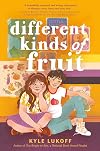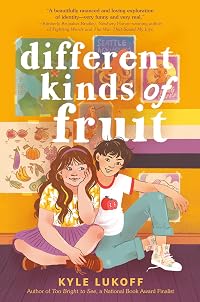
Different Kinds of Fruit
by Kyle Lukoff
On This Page
Description
Annabelle Blake fully expects this school year to be the same as every other: same teachers, same classmates, same, same, same. So she's elated to discover there's a new kid in town. To Annabelle, Bailey is a breath of fresh air. She loves hearing about their life in Seattle, meeting their loquacious (and kinda corny) parents, and hanging out at their massive house. And it doesn't hurt that Bailey has a cute smile, nice hands (how can someone even have nice hands?) and smells really good. show more Suddenly sixth grade is anything but the same. And when her irascible father shares that he and Bailey have something big--and surprising--in common, Annabelle begins to see herself, and her family, in a whole new light. At the same time she starts to realize that her community, which she always thought of as home, might not be as welcoming as she had thought. Together Annabelle, Bailey, and their families discover how these categories that seem to mean so much--boy, girl, gay, straight, fruit, vegetable--aren't so clear-cut after all. show lessTags
Recommendations



Member Reviews
Annabelle's main goal for sixth grade at her small, K-6 school, called the Lab, is to hurry on to seventh - but then a new kid called Bailey shows up, and Annabelle's year becomes something completely new and unexpected. Bailey is nonbinary and uses they/them pronouns. Annabelle's parents are weirdly cold to her new friend, and Annabelle and Bailey both think it's because they're transphobic - but the truth is so much weirder. Annabelle's dad reveals that he is a trans man, and her mother is a queer femme. Annabelle's family isn't at all what she thought - and maybe her feelings toward Bailey aren't, either. The two grow closer, and start to plan a National Coming Out Day Panel at school, with their new teacher, Amy's, support - until show more Principal Quinn nixes the idea and makes them go back to the old social studies curriculum, due to pressure from white classmate Dixon's mom.
Tahoma Falls is a small town that seems farther than 40 minutes from Seattle, where Bailey moved from. Bailey has a remarkable self-knowledge and confidence, and is generous in answering Annabelle's questions about identity and vocabulary. Annabelle is eager to learn, while being sensitive about others' privacy, and still figuring out her own gender identity and sexual orientation. She is also confident, in her way, and a hilarious chatterbox - there are several laugh-out-loud moments. Annabelle's parents, too, are well-rounded characters, and her teacher, Amy, is an excellent educator hindered by interfering parents and a less-progressive-than-advertised administration.
A truly contemporary story, rich with fascinating characters.
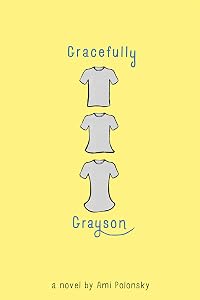
See also: You Don't Know Everything, Jilly P by Alex Gino; Gracefully Grayson by Ami Polonsky
Quotes
"Wait, what?" I said, feeling like I tripped and fell into a whole different conversation. (107)
"My favorite thing about history, about social studies, is how every single topic is related to every single other topic. And that no matter how much you think you know, there's always more to learn." (Amy, 109)
"...a lot of the categories people have come up with are fake. And that even if we pretend they're important...they don't always do a good job of describing or explaining the world." (Bailey, 149)
"They care more about what happened to them than what's going to happen for us."
"Exactly! Adults think that because they're in charge of everything right now, they should get a say in what our future looks like. But it's our future, not theirs. It's like school and our parents and everyone else is getting us ready to enter a world that doesn't even exist anymore. Or, if it does, it shouldn't." (Bailey and Annabelle, 158)
From the first day I met him I could tell that [Principal Quinn] was one of those grown-ups who liked the idea of kids, but didn't see us as actual people. (205)
I didn't think I could fight for my rights while pretending they were someone else's. (223)
Being LGBTQ was like an epic fantasy story. They had read all the books in the series, and I was struggling through the table of contents. (re: new vocabulary, 248)
And just like that, I had come out. To one person, but the difference between one person and no one was the entire world. (252)
...nothing is more than friends. (277)
"She's not the only one who wants to keep her kid safe. And she doesn't get to decide what safety means for everyone else." (Dad, 289) show less
Tahoma Falls is a small town that seems farther than 40 minutes from Seattle, where Bailey moved from. Bailey has a remarkable self-knowledge and confidence, and is generous in answering Annabelle's questions about identity and vocabulary. Annabelle is eager to learn, while being sensitive about others' privacy, and still figuring out her own gender identity and sexual orientation. She is also confident, in her way, and a hilarious chatterbox - there are several laugh-out-loud moments. Annabelle's parents, too, are well-rounded characters, and her teacher, Amy, is an excellent educator hindered by interfering parents and a less-progressive-than-advertised administration.
A truly contemporary story, rich with fascinating characters.
See also: You Don't Know Everything, Jilly P by Alex Gino; Gracefully Grayson by Ami Polonsky
Quotes
"Wait, what?" I said, feeling like I tripped and fell into a whole different conversation. (107)
"My favorite thing about history, about social studies, is how every single topic is related to every single other topic. And that no matter how much you think you know, there's always more to learn." (Amy, 109)
"...a lot of the categories people have come up with are fake. And that even if we pretend they're important...they don't always do a good job of describing or explaining the world." (Bailey, 149)
"They care more about what happened to them than what's going to happen for us."
"Exactly! Adults think that because they're in charge of everything right now, they should get a say in what our future looks like. But it's our future, not theirs. It's like school and our parents and everyone else is getting us ready to enter a world that doesn't even exist anymore. Or, if it does, it shouldn't." (Bailey and Annabelle, 158)
From the first day I met him I could tell that [Principal Quinn] was one of those grown-ups who liked the idea of kids, but didn't see us as actual people. (205)
I didn't think I could fight for my rights while pretending they were someone else's. (223)
Being LGBTQ was like an epic fantasy story. They had read all the books in the series, and I was struggling through the table of contents. (re: new vocabulary, 248)
And just like that, I had come out. To one person, but the difference between one person and no one was the entire world. (252)
...nothing is more than friends. (277)
"She's not the only one who wants to keep her kid safe. And she doesn't get to decide what safety means for everyone else." (Dad, 289) show less
middlegrade fiction with nonbinary and trans characters - 6th grader Annabelle thinks she might have a crush on new kid Bailey, whom her parents react strangely towards; their new teacher tries to create a more inclusive curriculum (climate change! social justice! a more diverse view of history!) but encounters parental resistance. The author is a trans male who relied on many of his connections with the trans and LGBTQAIP+ community; setting is a suburban town near Seattle similar to one where the author lived.
There is so much in here, and I loved all the messy layers of complexity (members of the queer community not always being supportive of one another, creating lasting trauma; the feelings of a questioning youth when deciding who show more they might come out to) and all the thought that went into making this a good story and an effective argument for inclusivity and understanding. Annabelle hadn't been exposed to much of the queer community so it is easy to relate to her (even if you think you know some, there's still a lot of folks you can learn from). Her experiences, and what she learns from her parents and friends, are full of thought-provoking content that provides plenty of new ideas to foster a healthy discussion, so this would be a great one for parents/caretakers to read alongside their kids if they have questions or just need someone to talk to as they process it all. show less
There is so much in here, and I loved all the messy layers of complexity (members of the queer community not always being supportive of one another, creating lasting trauma; the feelings of a questioning youth when deciding who show more they might come out to) and all the thought that went into making this a good story and an effective argument for inclusivity and understanding. Annabelle hadn't been exposed to much of the queer community so it is easy to relate to her (even if you think you know some, there's still a lot of folks you can learn from). Her experiences, and what she learns from her parents and friends, are full of thought-provoking content that provides plenty of new ideas to foster a healthy discussion, so this would be a great one for parents/caretakers to read alongside their kids if they have questions or just need someone to talk to as they process it all. show less
I'm really glad this book exists, because it's great to see many types of queer representation in one community, it's fabulous at centering the empowered tweens, and it goes into the intricacies of identity politics in a way that many do not. Covers a lot of good ground, decent characters. It's slow paced, internal -- very interesting, but also comes across as an answer-all-your-questions kind of book at times. I love the subject matter and the strength of Annabelle and Bailey's families, but it felt long.
Also, I wasn't in love with how the situation with token white jerk Dillon was handled -- I don't think the kid is right about anything, but the resolution/solution seemed to be shunning. Maybe that is the only way, but I hoped for a show more moment of insight in that character that just didn't come, and while I liked how the parents squared off, it still felt like the message was -- this kid is clearly wrong, we all think so, but we're not actually going to talk about why, and we'll just avoid him until he comes in line -- probably the only solution for adult bigots, but I want to believe that children are more malleable than that. show less
Also, I wasn't in love with how the situation with token white jerk Dillon was handled -- I don't think the kid is right about anything, but the resolution/solution seemed to be shunning. Maybe that is the only way, but I hoped for a show more moment of insight in that character that just didn't come, and while I liked how the parents squared off, it still felt like the message was -- this kid is clearly wrong, we all think so, but we're not actually going to talk about why, and we'll just avoid him until he comes in line -- probably the only solution for adult bigots, but I want to believe that children are more malleable than that. show less
girl on the cusp of middle school searches for understanding about herself, her parents, and the changing world around her.
At the start of sixth grade, White cisgender girl Annabelle doesn’t dare hope for surprises from her final year at her private school in the suburbs of Seattle. She itches to escape and discover wonders awaiting her outside the confines of her neighborhood—like drag brunch. However, her expectations for a boring year are turned upside down when Bailey, a White nonbinary student with the coolest rainbow shoes, and a new teacher with exciting plans for the curriculum join Annabelle’s class. Unfamiliar feelings pull Annabelle into a fast friendship with Bailey despite her father’s vocal disapproval and her show more mother’s discomfort. Confronting her parents about their attitudes uncovers a side of her family history that Annabelle never could have imagined. Annabelle’s first-person narration snaps with vivacious personality and humor. Lively banter and quirky facts contribute levity as Annabelle explores topics that weigh on her like privilege, climate change, privacy, and her own lack of vocabulary to describe her identity. Even adults in the story, particularly Annabelle’s father, face challenges to their beliefs that require them to reflect and grow. Lukoff reflects diversity in the world around Annabelle while also heightening her awareness of spaces that are not as inclusive as they claim to be and exploring what to do with that understanding.
Inquisitive, engaged, and action-seeking. (Fiction. 8-12)
(Kirkus Review) show less
At the start of sixth grade, White cisgender girl Annabelle doesn’t dare hope for surprises from her final year at her private school in the suburbs of Seattle. She itches to escape and discover wonders awaiting her outside the confines of her neighborhood—like drag brunch. However, her expectations for a boring year are turned upside down when Bailey, a White nonbinary student with the coolest rainbow shoes, and a new teacher with exciting plans for the curriculum join Annabelle’s class. Unfamiliar feelings pull Annabelle into a fast friendship with Bailey despite her father’s vocal disapproval and her show more mother’s discomfort. Confronting her parents about their attitudes uncovers a side of her family history that Annabelle never could have imagined. Annabelle’s first-person narration snaps with vivacious personality and humor. Lively banter and quirky facts contribute levity as Annabelle explores topics that weigh on her like privilege, climate change, privacy, and her own lack of vocabulary to describe her identity. Even adults in the story, particularly Annabelle’s father, face challenges to their beliefs that require them to reflect and grow. Lukoff reflects diversity in the world around Annabelle while also heightening her awareness of spaces that are not as inclusive as they claim to be and exploring what to do with that understanding.
Inquisitive, engaged, and action-seeking. (Fiction. 8-12)
(Kirkus Review) show less
Well, I've got a lot of horizon-broadening to do! Here's a family with a queer femme mom and a trans dad who gave birth to daughter Annabelle, who herself is crushing on new classmate, non-binary Bailey, and later is girlfriend to Julian, who was the other Annabelle in class. If you got all that, your family definitely has "different kinds of fruit." If not...well, families definitely come in many forms. Very much a "mirror" book for youth who are part of families across the spectrum of gender identities.
Madison's review is spot-on. Too preachy, too many issues covered. I mean, yes, they're all important, but there was no room left for believable characters. No kids are that perfect, and few parents are that clueless.
Speaking of parents, Annabelle's family seems to be able to take a lot of time off work, despite paying for private school. And they don't seem to have any other stresses, like a car that keeps breaking down, or ants in the pantry. I know, lots of books have very involved parents, but it seemed implausibly extreme here.
Nice shout-out against palm oil for the fact that it kills orangutans, but, last I checked, Nutella uses palm oil. (Aldi's store brand does not.)
"I didn't know fake air quotes could be violent until Bailey show more clawed at the word...." (Great image, but in the voice of a 6th-grader?)
"Nothing more than friends, because nothing is more than friends." show less
Speaking of parents, Annabelle's family seems to be able to take a lot of time off work, despite paying for private school. And they don't seem to have any other stresses, like a car that keeps breaking down, or ants in the pantry. I know, lots of books have very involved parents, but it seemed implausibly extreme here.
Nice shout-out against palm oil for the fact that it kills orangutans, but, last I checked, Nutella uses palm oil. (Aldi's store brand does not.)
"I didn't know fake air quotes could be violent until Bailey show more clawed at the word...." (Great image, but in the voice of a 6th-grader?)
"Nothing more than friends, because nothing is more than friends." show less
This was a wonderful hopeful book that had fully developed characters and felt like a realistic look at issues facing todays lgbtq youth while also touring on lgbtq history and inter generational relationships.
Members
- Recently Added By
Lists

Transgender Characters
91 works; 5 members
Author Information

24+ Works 1,878 Members
Awards and Honors
Awards
Distinctions
Common Knowledge
- Original publication date
- 2022
Classifications
- Genres
- Tween, Kids, LGBTQ+, Fiction and Literature, Children's Books
- DDC/MDS
- 813.6 — Literature & rhetoric American literature in English American fiction in English 2000-
- LCC
- PZ7.1 .L8456 .D — Language and Literature Fiction and juvenile belles lettres Fiction and juvenile belles lettres Juvenile belles lettres
- BISAC
Statistics
- Members
- 139
- Popularity
- 235,938
- Reviews
- 8
- Rating
- (4.06)
- Languages
- English, Italian
- Media
- Paper, Audiobook, Ebook
- ISBNs
- 8
- ASINs
- 3