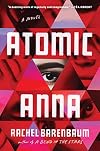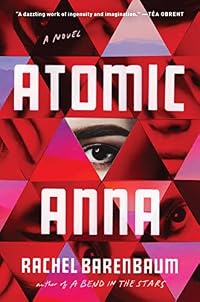
Atomic Anna
by Rachel Barenbaum
On This Page
Description
"In 1986, renowned nuclear scientist Anna Berkov is sleeping in her bed in the Soviet Union when Chernobyl's reactor melts down. At that exact moment she tears through time-her first jump-and it's an accident. When she opens her eyes, she's landed in 1992 only to discover Molly, her estranged daughter, shot in the chest. Molly, with her dying breath, begs Anna to go back in time and stop the disaster, to save Molly's daughter Raisa, and put their family's future on a better path. In the show more '60s, Molly is coming of age as an adopted refusenik in a Russian enclave of Philadelphia. Her family is full of secrets and a past they won't share. She finds solace in comic books, drawing her own series, Atomic Anna, inspired by her birth mother, and she's determined to make it in the world as an artist. When she meets the volatile, charismatic Viktor, their romance sets her life on a very different course. In the '80s, Raisa, a math prodigy, is a lonely teenager with her mother lost to a life of drugs. She devotes herself to studying until a quiet, handsome boy moves in across the street and an odd old woman claiming to be her biological grandmother begins asking for her help. As Raisa finds new issues of Atomic Anna in unexpected places, she notices each comic challenges her to solve equations leading to one impossible conclusion: time travel. And she finally understands what she has to do. Atomic Anna is a sweeping journey across time, space, and the many forms of love. As these remarkable women take responsibility for their choices and work together to prevent the greatest nuclear disaster of the 20th century, they grapple with the power their discoveries hold. No one can control how knowledge is used when it's out in the world, and just because you can change the past, does it mean you should?"-- show lessTags
Recommendations














Member Reviews
"Atomic Anna," by Rachel Barenbaum, is a saga that connects the lives of four fascinating women: Yulia Kramarova is a beautiful and passionate individual who, in the U. S. S. R., shares an apartment with a brilliant nuclear scientist, Anna Berkova. Anna's daughter, Manya (Molly), longs to be a professional cartoonist and draws female superheroes with amazing powers. Raisa, Molly's daughter, is a math prodigy like her grandmother. Anna, Molly, and Raisa face daunting challenges during their tumultuous lives. When the tragedy at Chernobyl occurs in 1986, Anna—the nuclear plant's chief engineer—is swept off her feet by the explosion and travels forward in time to 1992. What she sees upsets her greatly, and she begins to reconsider her show more decision to prioritize her loyalty to the Soviet Union and her professional responsibilities over her devotion to those who love and depend on her.
The author poignantly delves into the minds and hearts of her characters. She demonstrates that each person is a product of his or her genetic makeup and upbringing. Anna falls in love and has a baby girl, but she gives Molly to Yulia and her husband, Lazar, who sneak into America illegally. Molly pays tribute to her birth mother when she draws "Atomic Anna," and she hopes to make a living creating and selling her comic books. Yulia is a strict parent, but she is powerless to prevent Molly from behaving recklessly when a charming but irresponsible older man pursues her.
The most meaningful aspects of this ambitious novel are the complicated relationships that these women forge with one another and with the men in their lives. Although there is deep affection between them, there is also anger and miscommunication. The domestic dramas play out against the backdrop of a drab life of deprivation in the former Soviet Union as well as the struggles of Soviet Jews who try to start over in the United States. The time-travel aspect of the story does not work as well, since it is so strange and confusing. However, after reading "Atomic Anna," readers will ponder this thought-provoking dilemma: If time travel were indeed possible, what would be the consequences of trying to reshape events before they occur? show less
The author poignantly delves into the minds and hearts of her characters. She demonstrates that each person is a product of his or her genetic makeup and upbringing. Anna falls in love and has a baby girl, but she gives Molly to Yulia and her husband, Lazar, who sneak into America illegally. Molly pays tribute to her birth mother when she draws "Atomic Anna," and she hopes to make a living creating and selling her comic books. Yulia is a strict parent, but she is powerless to prevent Molly from behaving recklessly when a charming but irresponsible older man pursues her.
The most meaningful aspects of this ambitious novel are the complicated relationships that these women forge with one another and with the men in their lives. Although there is deep affection between them, there is also anger and miscommunication. The domestic dramas play out against the backdrop of a drab life of deprivation in the former Soviet Union as well as the struggles of Soviet Jews who try to start over in the United States. The time-travel aspect of the story does not work as well, since it is so strange and confusing. However, after reading "Atomic Anna," readers will ponder this thought-provoking dilemma: If time travel were indeed possible, what would be the consequences of trying to reshape events before they occur? show less
[b:Atomic Anna|58684535|Atomic Anna|Rachel Barenbaum|https://i.gr-assets.com/images/S/compressed.photo.goodreads.com/books/1643682020l/58684535._SY75_.jpg|90047595] has a great concept: a Soviet atomic scientist named Anna accidentally discovers time travel during the Chernobyl disaster. She uses this discovery to visit her estranged American daughter and grand-daughter, who gradually work out what's going on. Unfortunately I found the execution disappointing. The depiction of the USSR is simply not convincing. I winced when the phrase, "But here's the thing," was used in 1943 Moscow, then was utterly incredulous when someone says that Stalin, "murdered millions" to an NKVD agent in the late 1940s. I'm pretty sure that wasn't common show more knowledge until well after Stalin's death and also that even being accused of criticising him in such a way would have got you a one way ticket to the gulags! This anachronistic style reminded me of Natasha Pulley's novels, particularly [b:The Half Life of Valery K|58532153|The Half Life of Valery K|Natasha Pulley|https://i.gr-assets.com/images/S/compressed.photo.goodreads.com/books/1649657367l/58532153._SY75_.jpg|87458643] as that's set in the USSR and deals with nuclear power. Pulley gets away with it by also throwing in plenty of charming whimsy, however [b:Atomic Anna|58684535|Atomic Anna|Rachel Barenbaum|https://i.gr-assets.com/images/S/compressed.photo.goodreads.com/books/1643682020l/58684535._SY75_.jpg|90047595] has a grittier tone that made it very hard to overlook. The narrative structure, which jumps backward and forward in time, would also have worked better had the decades sounded different from one another.
The other major difficulty I found with appreciating [b:Atomic Anna|58684535|Atomic Anna|Rachel Barenbaum|https://i.gr-assets.com/images/S/compressed.photo.goodreads.com/books/1643682020l/58684535._SY75_.jpg|90047595] is that Anna's family drama is supposed to be more interesting than the Chernobyl disaster. Indeed, Anna is repeatedly told, in subtext and actual text, to use her time machine to look after family rather than saving Chernobyl. This was not what I expected or wanted from the novel. I was hoping for some examination of how difficult it would have been for one person with a time machine to prevent the disaster, the potential to inadvertently make it a lot worse (if Chernobyl had exploded most of Europe would be uninhabitable), and whether the fall of the USSR would be delayed/prevented if it didn't happen. After reading Svetlana Alexievich's incredible [b:Chernobyl Prayer: Voices from Chernobyl|29675406|Chernobyl Prayer Voices from Chernobyl (Penguin Modern Classics)|Svetlana Alexievich|https://i.gr-assets.com/images/S/compressed.photo.goodreads.com/books/1459250416l/29675406._SY75_.jpg|1103107], it was a shame to find this catastrophe treated as a shallow plot device. Neither was there any of the creeping terror of radiation poisoning that worked well in [b:The Half Life of Valery K|58532153|The Half Life of Valery K|Natasha Pulley|https://i.gr-assets.com/images/S/compressed.photo.goodreads.com/books/1649657367l/58532153._SY75_.jpg|87458643]. I assumed Molly's frequently-mentioned digestive ailment would be radiation or time travel related, but this was never explained so presumably it was Anxiety Stomach.
I initially thought to give [b:Atomic Anna|58684535|Atomic Anna|Rachel Barenbaum|https://i.gr-assets.com/images/S/compressed.photo.goodreads.com/books/1643682020l/58684535._SY75_.jpg|90047595] three stars, but reviewing it has resulted in revising this down to two. Part of this is undoubtedly my expectations not matching the novel itself; another part is unconvincing and anachronistic writing. The sci-fi world-building also had its flaws. It seemed like Anna's machine jumped between alternate timelines, but the narrative was more focused on the theory than the practice of time travel. Some rules were set out, however this was among the less satisfactory time travel depictions I've come across. Perhaps the clincher was the ending, which expected me to care about Anna, Molly, and Raisa rather than everyone who suffered as a result of Chernobyl. I did not find them convincing or appealing enough characters for that to be the case, thus was disappointed. My expectations were quite high, but I don't think they were wholly unreasonable given the promising blurb. show less
The other major difficulty I found with appreciating [b:Atomic Anna|58684535|Atomic Anna|Rachel Barenbaum|https://i.gr-assets.com/images/S/compressed.photo.goodreads.com/books/1643682020l/58684535._SY75_.jpg|90047595] is that Anna's family drama is supposed to be more interesting than the Chernobyl disaster. Indeed, Anna is repeatedly told, in subtext and actual text, to use her time machine to look after family rather than saving Chernobyl. This was not what I expected or wanted from the novel. I was hoping for some examination of how difficult it would have been for one person with a time machine to prevent the disaster, the potential to inadvertently make it a lot worse (if Chernobyl had exploded most of Europe would be uninhabitable), and whether the fall of the USSR would be delayed/prevented if it didn't happen. After reading Svetlana Alexievich's incredible [b:Chernobyl Prayer: Voices from Chernobyl|29675406|Chernobyl Prayer Voices from Chernobyl (Penguin Modern Classics)|Svetlana Alexievich|https://i.gr-assets.com/images/S/compressed.photo.goodreads.com/books/1459250416l/29675406._SY75_.jpg|1103107], it was a shame to find this catastrophe treated as a shallow plot device. Neither was there any of the creeping terror of radiation poisoning that worked well in [b:The Half Life of Valery K|58532153|The Half Life of Valery K|Natasha Pulley|https://i.gr-assets.com/images/S/compressed.photo.goodreads.com/books/1649657367l/58532153._SY75_.jpg|87458643]. I assumed Molly's frequently-mentioned digestive ailment would be radiation or time travel related, but this was never explained so presumably it was Anxiety Stomach.
I initially thought to give [b:Atomic Anna|58684535|Atomic Anna|Rachel Barenbaum|https://i.gr-assets.com/images/S/compressed.photo.goodreads.com/books/1643682020l/58684535._SY75_.jpg|90047595] three stars, but reviewing it has resulted in revising this down to two. Part of this is undoubtedly my expectations not matching the novel itself; another part is unconvincing and anachronistic writing. The sci-fi world-building also had its flaws. It seemed like Anna's machine jumped between alternate timelines, but the narrative was more focused on the theory than the practice of time travel. Some rules were set out, however this was among the less satisfactory time travel depictions I've come across. Perhaps the clincher was the ending, which expected me to care about Anna, Molly, and Raisa rather than everyone who suffered as a result of Chernobyl. I did not find them convincing or appealing enough characters for that to be the case, thus was disappointed. My expectations were quite high, but I don't think they were wholly unreasonable given the promising blurb. show less
The personal completes with science and disaster in this novel. Anna Berkova is a talented Soviet scientist, whose work helped the Soviets built both atomic weapons and nuclear reactors. Then, when Chernobyl explodes, she accidentally time-travels for the first time - a consequence of nuclear explosion that she's been working towards for decades. But when Anna time-travels, she discovers the family she's cut herself off from is in danger. As Anna travels across time to save her family and correct mistakes, she struggles to find a way to save them and to prevent the Chernobyl disaster, ultimately realizing she can't do both. An interesting and enjoyable read, even if I found the conclusion slightly jarring.
Thank you Net Galley and Grand Central for an ARC of Atomic Anna by Rachel Barenbaum. I lean more toward reading historical fiction, but this science fiction intrigued me and didn't disappoint! This book was about how a scientist who created nuclear power in USSR and then regretted the Chernobyl disaster of 1986. She used time travel to try to change the past to save everyone from that disaster as well as her family. This sweeping story tells tales from 1917 through the 1990s and is set in Russia, US (Philadelphia), and Germany. I love how the author weaved in all the science and history in this book. If you are looking for an interesting science fiction/time travel book, I recommend this one.
A vast and complex novel covering three generations of women culminating in their goal of stopping the Chernobyl meltdown thus saving many people. Anna is a Russian scientist that is a key player in their countries' nuclear research. She also develops a working time machine.Her daughter Molly writes a comic strip based on her mom's adventures. Raisa is Anne's granddaughter who has the mathematical savvy to help Anna stop the meltdown.The novel is thought provoking but is confusing at times with the constant time and location shifts.
. Barenbaum’s latest novel is a “One Book, One Hadassah” pick for the month of June. This hard to put down time-travel story follows three generations of Jewish women as they attempt to prevent the Chernobyl nuclear disaster. It grapples with themes of love and responsibility and the bonds between mother and daughters. The New York Times Book Review calls it “masterfully plotted”.
Book Review….. Atomic Anna by Rachel Barenbaum
Three brilliant women.
1986
When Chernobyl’s reactor melts down, Anna Berkova, renowned nuclear scientist is thrown back in time. She lands in 1992 to her estranged daughter Molly shot in the chest. Molly begs her to go back in time to prevent the disaster and to save Molly's daughter Raisa, and put their family on a better path.
60s Philadelphia
Molly is coming of age as an adopted refusenik. Her family is full of secrets and a past they won’t share. With dreams of being an artist she finds peace in comic books and drawing her own comic Atomic Anna. When she meets. But when she meets the charming Viktor their romance will change the course of her whole life!
Two life-changing show more mistakes.
80s
Raisa, is a lonely teen and math prodigy, until a handsome boy moves in across the street and a woman shows up saying she is her grandmother. When Raisa finds issues of Atomic Anna, she notices each comic has an equation that leads to one impossible conclusion: time travel. And she finally understands what she has to do.
One chance to reset the future.
Atomic Anna is a fantasy and science fiction with a twist! It's based on the Chernobyl disaster. That was one of the reasons I was drawn to this book. I can't remember reading sci-fi that was based on a real life event. Obviously it's told from multiple points of view and timelines so there is a lot going on but the author brings all the layers together nicely. The main characters are very realistic. They have their flaws, emotions and personalities making it easy to like them. The book offers up a few genres coming of age, sci-fi historical fiction and thriller so it can appeal to a lot of different readers. But in the end it is about family and friendship bonds and sacrifice and redemption!
Thank you Grand Central Pub and Rachel Barenbaum for sharing this book with me! show less
Three brilliant women.
1986
When Chernobyl’s reactor melts down, Anna Berkova, renowned nuclear scientist is thrown back in time. She lands in 1992 to her estranged daughter Molly shot in the chest. Molly begs her to go back in time to prevent the disaster and to save Molly's daughter Raisa, and put their family on a better path.
60s Philadelphia
Molly is coming of age as an adopted refusenik. Her family is full of secrets and a past they won’t share. With dreams of being an artist she finds peace in comic books and drawing her own comic Atomic Anna. When she meets. But when she meets the charming Viktor their romance will change the course of her whole life!
Two life-changing show more mistakes.
80s
Raisa, is a lonely teen and math prodigy, until a handsome boy moves in across the street and a woman shows up saying she is her grandmother. When Raisa finds issues of Atomic Anna, she notices each comic has an equation that leads to one impossible conclusion: time travel. And she finally understands what she has to do.
One chance to reset the future.
Atomic Anna is a fantasy and science fiction with a twist! It's based on the Chernobyl disaster. That was one of the reasons I was drawn to this book. I can't remember reading sci-fi that was based on a real life event. Obviously it's told from multiple points of view and timelines so there is a lot going on but the author brings all the layers together nicely. The main characters are very realistic. They have their flaws, emotions and personalities making it easy to like them. The book offers up a few genres coming of age, sci-fi historical fiction and thriller so it can appeal to a lot of different readers. But in the end it is about family and friendship bonds and sacrifice and redemption!
Thank you Grand Central Pub and Rachel Barenbaum for sharing this book with me! show less
Members
- Recently Added By
Author Information

2+ Works 537 Members
Awards and Honors
Classifications
Statistics
- Members
- 243
- Popularity
- 133,292
- Reviews
- 8
- Rating
- (3.39)
- Languages
- English
- Media
- Paper, Audiobook, Ebook
- ISBNs
- 9
- ASINs
- 2