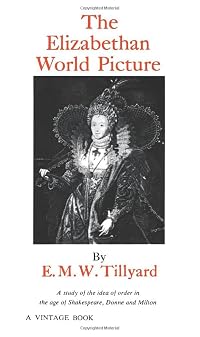
The Elizabethan World Picture
by E. M. W. Tillyard
On This Page
Description
This illuminating account of ideas of world order prevalent in the Elizabethan Age and later is an indispensable companion for readers of the great writers of the sixteenth and seventeenth centuries Shakespeare and the Elizabethan dramatists, Donne and Milton, among many others. The basic medieval idea of an ordered Chain of Being is studied by Tillyard in the process of its various transformations by the dynamic spirit of the Renaissance. Among his topics are: Angels; the Stars and Fortune; show more the Analogy between Macrocosm and Microcosm; the Four Elements; the Four Humors; Sympathies; Correspondences; and the Cosmic Dance ideas and symbols that inspirited the imaginations not only of the Elizabethans, but also of the Renaissance as such. This idea of cosmic order was one of the genuine ruling ideas of the Elizabethan Age, and perhaps the most characteristic. Such ideas, like our everyday manners, are the least disputed and the least paraded in the creative literature of the time. The province of this book is some of the notions about the world and man that were quite frequently taken for granted by the ordinary educated Elizabethan; the commonplaces too familiar for the poets to make detailed use of, except in explicitly educational passages, but essential as basic assumptions and invaluable at moments of high passion. The objective of The Elizabethan World Picture is to extract and explain the most ordinary beliefs about the constitution of the world as pictured in the Elizabethan Age and through this exposition to help the ordinary reader to understand and to enjoy the great writers of the age. In attempting this, Tillyard has brought together a number of pieces of elementary lore. This classic text is a convenient factual aid to extant interpretations of some of Spenser, Donne, or Milton. show lessTags
Recommendations
















Member Reviews
This is one of the most difficult books I've read since I was in college. In fact it wouldn't surprise me to find that this was written as a graduate college text. It's a small volume, coming in at just 109 pages, but in many ways, except for the fact it is obviously written in English, with the odd Latin phrase or two, it might as well have been written by Martians for as much as I was able to glean from it. However, I did learn quite a bit from it. It's learning that requires digestion for the understanding.
The book presents a view of the world seen through the eyes of the Elizabethans. It pulls together several literary sources of the time and mines them for their world view. This is where it gets tough, Elizabethan English is hard show more enough to read just for enjoyment, throw in the philosophical aspects of the time and you have an intellectual (at least for me) nightmare.
The Elizabethan world lived by the Great Chain of Being with its links and planes and correspondences all culminating in the great Cosmic Dance. Sounds easy, right? Not hardly. It seems Aquinas's question about how many angels could dance on the head of a pin was a plain simple inquiry, not a comment on the ethereal nature of angelic existence. The Elizabethans understood this to be a simple question. This worldview stretched all the way back to the ancient Greeks. By the time of the Elizabethans this view was as much a part of the fabric of life as physics, biology, chemistry, and cosmology are at the heart of ours. That's what made this so difficult. Unless you can think like an Elizabethan much of this is unknown territory. It's this difference in system that makes it so hard to come to grips with. Unless one is accustomed to thinking in terms of the four elements, the four humors, and the relationship of each link to its fellows both above and below, this book, while it does its best to explain these things, is still something of a slog.
One other aspect of things here is that the modern was bearing down on the Elizabethans and so there is a mix of proto-modern thinking alongside the harmony and music of existence, but after two thousand years, the mechanisms and devices used to construct meaning in the world were becoming less and less adequate for the task at hand. A whole new world had been discovered, alchemy was moving into science, Copernicus had redefined the shape of the solar system and removed the earth from its center in favor of the sun. Knowledge was expanding and new schemes of organizing were having to be created to include these discoveries. Life was becoming less certain. Without these changes Locke and the political philosophers of fifty or a hundred years after Elizabeth could never have created our modern world with its modern sensibilities. The Elizabethans were living under that old Chinese curse: they were living in interesting times. Not unlike our own, when some would take us back to the system that sufficed to explain the world for so long.
I am in the unfortunate position of having to rate a book that I feel completely unqualified to rate. I expect the author accomplished his goal of describing the philosophical underpinnings of the time, but they are so foreign to us today they seem almost fantastic. I gave this three and a half stars based mostly on not knowing what I don't know about the quality of the book. I expect a scholar, or someone buried in this history would give it more or fewer stars. For all I know, this is the definitive work on this aspect of the Elizabethan world view and should get five stars. I feel wholly inadequate to the task of placing this book in its niche. I learned a lot, and once I digest it will reread it with an eye to greater understanding. At that time the rating may be reviewed. show less
The book presents a view of the world seen through the eyes of the Elizabethans. It pulls together several literary sources of the time and mines them for their world view. This is where it gets tough, Elizabethan English is hard show more enough to read just for enjoyment, throw in the philosophical aspects of the time and you have an intellectual (at least for me) nightmare.
The Elizabethan world lived by the Great Chain of Being with its links and planes and correspondences all culminating in the great Cosmic Dance. Sounds easy, right? Not hardly. It seems Aquinas's question about how many angels could dance on the head of a pin was a plain simple inquiry, not a comment on the ethereal nature of angelic existence. The Elizabethans understood this to be a simple question. This worldview stretched all the way back to the ancient Greeks. By the time of the Elizabethans this view was as much a part of the fabric of life as physics, biology, chemistry, and cosmology are at the heart of ours. That's what made this so difficult. Unless you can think like an Elizabethan much of this is unknown territory. It's this difference in system that makes it so hard to come to grips with. Unless one is accustomed to thinking in terms of the four elements, the four humors, and the relationship of each link to its fellows both above and below, this book, while it does its best to explain these things, is still something of a slog.
One other aspect of things here is that the modern was bearing down on the Elizabethans and so there is a mix of proto-modern thinking alongside the harmony and music of existence, but after two thousand years, the mechanisms and devices used to construct meaning in the world were becoming less and less adequate for the task at hand. A whole new world had been discovered, alchemy was moving into science, Copernicus had redefined the shape of the solar system and removed the earth from its center in favor of the sun. Knowledge was expanding and new schemes of organizing were having to be created to include these discoveries. Life was becoming less certain. Without these changes Locke and the political philosophers of fifty or a hundred years after Elizabeth could never have created our modern world with its modern sensibilities. The Elizabethans were living under that old Chinese curse: they were living in interesting times. Not unlike our own, when some would take us back to the system that sufficed to explain the world for so long.
I am in the unfortunate position of having to rate a book that I feel completely unqualified to rate. I expect the author accomplished his goal of describing the philosophical underpinnings of the time, but they are so foreign to us today they seem almost fantastic. I gave this three and a half stars based mostly on not knowing what I don't know about the quality of the book. I expect a scholar, or someone buried in this history would give it more or fewer stars. For all I know, this is the definitive work on this aspect of the Elizabethan world view and should get five stars. I feel wholly inadequate to the task of placing this book in its niche. I learned a lot, and once I digest it will reread it with an eye to greater understanding. At that time the rating may be reviewed. show less
Don't be fooled by its skinny appearance: this book is packed with great insight. How Tillyard manages to put so many facts in such a small space, all while keeping it beautifully readable, I shall never know. No single book has offered me such a vivid glimpse into Shakespeare's world.
Yes, this book is dry. Very dry. However, it is an excellent description of how the Great Chain of Being works, and how it underpins the Elizabethan way of looking at the world, with particular reference to the works of Shakespeare, Sidney and Milton.
This is great book for showing the gulf between the way the Elizabethans viewed the world and the way we do. Not just for academics.
This was a great book to break down Shakespearean literature and the Elizabethan world picture. Its helped understand literature more fully.
Standard college text explaining the chain of being as the dominant world picture for the world as ordered.
clear exposition both of chain of being and theory of correspondences
Members
- Recently Added By
Lists

"I'd Group-Read That"
20 works; 6 members

University literature
145 works; 5 members

Books You Read For University
184 works; 3 members

Ten books that most shaped your view of history
91 works; 12 members

Books Read in 2026
2,060 works; 68 members
Author Information

23+ Works 1,780 Members
Series
Belongs to Publisher Series
Peregrine Books (Y27)
Pelican Books (A1484)
Common Knowledge
- Original publication date
- 1943
- People/Characters
- William Shakespeare; John Milton; Edmund Spenser; Ben Jonson; Boethius; John Davies (show all 20); John Davies of Hereford; Queen Elizabeth I; Christopher Goodman; Dionysius, the Areopagite; George Hakewill; Richard Hooker; Nemesius; John Norden; Henry Peacham; Plato; Walter Raleigh; Annibale Romei; Raymond de Sebonde; Philip Sidney
- Important places
- Great Britain
- Important events
- Elizabethan Era
- Blurbers
- A. L. Rowse
- Original language
- English
Classifications
- Genres
- Nonfiction, Literature Studies and Criticism, History
- DDC/MDS
- 820.9003 — Literature & rhetoric English & Old English literatures English and Old English (Anglo-Saxon) literatures History, description, critical appraisal of works in more than one form
- LCC
- PR428 .P5 .T5 — Language and Literature English English Literature By period Modern Elizabethan era (1550-1640)
- BISAC
Statistics
- Members
- 1,232
- Popularity
- 20,068
- Reviews
- 11
- Rating
- (3.79)
- Languages
- English, German, Spanish
- Media
- Paper, Ebook
- ISBNs
- 13
- ASINs
- 20