On This Page
Description
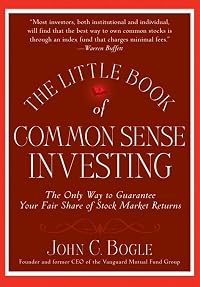
The best-selling investing "bible" offers new information, new insights, and new perspectives. The Little Book of Common-Sense Investing is the classic guide to getting smart about the market. Legendary mutual fund pioneer John C. Bogle reveals his key to getting more out of investing: low-cost index funds. Bogle describes the simplest and most effective investment strategy for building wealth over the long term: buy and hold, at very low cost, a mutual fund that tracks a broad stock market show more Index such as the S&P 500. While the stock market has tumbled and then soared since the first edition of Little Book of Common Sense was published in April 2007, Bogle's investment principles have endured and served investors well. This tenth anniversary edition includes updated data and new information but maintains the same long-term perspective as in its predecessor. Bogle has also added two new chapters designed to provide further guidance to investors: one on asset allocation, the other on retirement investing. A portfolio focused on index funds is the only investment that effectively guarantees your fair share of stock market returns. Bogle shows you how to make index investing work for you and help you achieve your financial goals and finds support from some of the world's best financial minds: not only Warren Buffett, but Benjamin Graham, Paul Samuelson, Burton Malkiel, Yale's David Swensen, Cliff Asness of AQR, and many others. This new edition of The Little Book of Common-Sense Investing offers you the same solid strategy as its predecessor for building your financial future. - Build a broadly diversified, low-cost portfolio without the risks of individual stocks, manager selection, or sector rotation. - Forget the fads and marketing hype and focus on what works in the real world. - Understand that stock returns are generated by three sources (dividend yield, earnings growth, and change in market valuation) in order to establish rational expectations for stock returns over the coming decade. - Recognize that in the long run, business reality trumps market expectations. - Learn how to harness the magic of compounding returns while avoiding the tyranny of compounding costs. While index investing allows you to sit back and let the market do the work for you, too many investors trade frantically, turning a winner's game into a loser's game. The Little Book of Common-Sense Investing is a solid guidebook to your financial future. show lessTags
Recommendations


Member Reviews
Reading this book is like eating a plate of vegetables—your (financial) health will benefit for years to come if you commit to it, but the journey getting there is going to be a boring one.
That being said, this approach to investing is what I've been seeking out ever since I became interested in personal finance. The smoke and mirrors horse race that is the daily financial market is of little interest to me mostly because it appears to be almost entirely noise (and increasingly more evidently fraught with corruption).
The advice found in The Little Book of Common Sense Investing is the proverbial tortoise racing against the hare, the hare being the more active investor. Slow and steady wins 99.9% of the time, but in the least show more exciting way possible. Pick what you value. show less
That being said, this approach to investing is what I've been seeking out ever since I became interested in personal finance. The smoke and mirrors horse race that is the daily financial market is of little interest to me mostly because it appears to be almost entirely noise (and increasingly more evidently fraught with corruption).
The advice found in The Little Book of Common Sense Investing is the proverbial tortoise racing against the hare, the hare being the more active investor. Slow and steady wins 99.9% of the time, but in the least show more exciting way possible. Pick what you value. show less
If you're investing in the stock market, you should start with this book. Hands down. It compares the long term performance of index investing to managed or mutual fund investing. The statistics and studies are compelling. Over 20-30 years, there is no comparison to index investing. It wins 100%.
If I was building a book list as a curriculum to learn investing, this would be first on the list. It's underlying principle is all about the power of compounding. In fact, the third last page sums this principle up wonderfully. I quote, "I am 85 years old and have never earned more than $25,000 a year. I started investing in 1974 with $500 (55YO). I have only bought - never sold. I remember when things were not going well, your advice was, show more 'stay the course.' (Author) He enclosed a list of his investments at the start of 2004: Total value, $1,391, 407".
Based on the studies in this book, it's alarming how over 10+ years, 90-something percent of managed funds underperform the broad stock market indices; In this case, the S&P500. This occurs for a variety of reasons, too many to discuss here, but still, the stats are black and white in favour of index investing. The book's case is that passive investing beats active investing easily over 20+ years, especially when factoring in brokerage and management costs.
An interesting point also from the book is the author's principle of asset allocation. Here, he advocats an investor direct 90% of their spare income (after living expenses) to passive index funds with the remaining 5-10% used for funny-money to speculate on other direct investment. Thinking about it, he has a very valid point. If an investment technique or strategy can significantly beat the market, then a 5-10% asset allocation will quickly catch and outperform the 90% passive allocation. If it can't, then just stick with the 90% passive index investing for the long term. Simple really.
This book is bundled with studies and statistics that shouldn't be ignored. show less
If I was building a book list as a curriculum to learn investing, this would be first on the list. It's underlying principle is all about the power of compounding. In fact, the third last page sums this principle up wonderfully. I quote, "I am 85 years old and have never earned more than $25,000 a year. I started investing in 1974 with $500 (55YO). I have only bought - never sold. I remember when things were not going well, your advice was, show more 'stay the course.' (Author) He enclosed a list of his investments at the start of 2004: Total value, $1,391, 407".
Based on the studies in this book, it's alarming how over 10+ years, 90-something percent of managed funds underperform the broad stock market indices; In this case, the S&P500. This occurs for a variety of reasons, too many to discuss here, but still, the stats are black and white in favour of index investing. The book's case is that passive investing beats active investing easily over 20+ years, especially when factoring in brokerage and management costs.
An interesting point also from the book is the author's principle of asset allocation. Here, he advocats an investor direct 90% of their spare income (after living expenses) to passive index funds with the remaining 5-10% used for funny-money to speculate on other direct investment. Thinking about it, he has a very valid point. If an investment technique or strategy can significantly beat the market, then a 5-10% asset allocation will quickly catch and outperform the 90% passive allocation. If it can't, then just stick with the 90% passive index investing for the long term. Simple really.
This book is bundled with studies and statistics that shouldn't be ignored. show less
This is the first of several books on investing that I plan to read to better educate myself and take greater personal control of my finances. If John Bogle had his way, it would probably be my last. That is because his investment strategy is rather simple. He thinks most investors should pick a very low-cost index fund, his pick would be the S & P 500 or a total market fund, both of which are near identical. He advises you to purchase this as early as you can and then hold onto it for as long as you can, basically until you retire. With this simple strategy, he argues you will capture most of the growth of the total market, which is better than the vast majority of investors who believe they can beat the market through timing, stock show more picking, having talented money managers, or some other strategy. This value strategy may be a bit boring, but he makes a strong argument, through pure math and statistics, that it is sound. If you're really into cryptocurrency, poker, trying to figure out what company or sector will be the hottest, or other high stakes and exciting gambles, you won't necessarily gravitate to this kind of investing. It's just too plain vanilla and dull and won't give you the returns to turn on your adrenaline. On the other hand, this slow and steady approach to wealth-building might just be the advice that you should follow. show less
This is the first book that I have read on index investing and I was a little disappointed. The author spells out his investment strategy of using index funds to cover the whole market very eloquently in the first couple of chapters. After that the little book of common sense investing does not seem so little as the later chapters drag on and just seem to constantly repeat what has already been stated.
Also it is a bit too US centric for a a potential investor from the UK.
Also it is a bit too US centric for a a potential investor from the UK.
I came to this after reading Tim Hale's "Smarter Investing”, where John Bogle's name was mentioned several times. The goal of this book is to convince the reader that "the classic index fund is the only investment that guarantees the achievement" of investment success and the author sets about his task with zeal. It’s a short volume that gives a good, straightforward overview of the arguments as to why index funds make sense for most (all ?) investors who are looking to invest in equities (and bonds as well). The writing style is clear and logical (if sometimes repetitious) with plenty of data to support the argument. Each chapter ends with a selection of quotes from market practitioners and academics and is a good source of show more bibliographic material.
I would have liked more discussion of asset allocation than just the few pages in the last chapter (although to be fair it is a short book) and I thought that the author was overly dismissive of Exchange Traded Funds (ETFs). He's also not shy in name-dropping his own company Vanguard and their range of index funds. (Vanguard are an extremely impressive company however !)
Overall, this book is interesting reading and achieved its aim of convincing this reader. Worth buying. show less
I would have liked more discussion of asset allocation than just the few pages in the last chapter (although to be fair it is a short book) and I thought that the author was overly dismissive of Exchange Traded Funds (ETFs). He's also not shy in name-dropping his own company Vanguard and their range of index funds. (Vanguard are an extremely impressive company however !)
Overall, this book is interesting reading and achieved its aim of convincing this reader. Worth buying. show less
I'm 29-going-on-30 and wishing that I had absorbed the wisdom imparted in this book when I first signed up for a 401k. But here I am, seven years later, finally having a real understanding of where I should stash my retirement nest egg.
The premise behind this book is simple - index funds have proven to be the wisest vehicle to throw your money in to achieve long-term profits. Bogle does an excellent job of explaining why this is, utilizing the "humble arithmetic" behind his thesis. For those who are like my old self and unsure of the best way to invest your retirement savings, look into low-cost index funds. And don't just throw your money in there...purchase this book and understand WHY you should.
The premise behind this book is simple - index funds have proven to be the wisest vehicle to throw your money in to achieve long-term profits. Bogle does an excellent job of explaining why this is, utilizing the "humble arithmetic" behind his thesis. For those who are like my old self and unsure of the best way to invest your retirement savings, look into low-cost index funds. And don't just throw your money in there...purchase this book and understand WHY you should.
I read this book in 8th grade, and I honestly didn't learn anything from this book since I've been a nerd about this stuff years before. It's a great book for those new to investing and have no idea what to invest in.
Book summed up in 1 sentence: Invest in indexes with low expense ratios, low turnover costs and sales charges (e.g. VOO, VTI).
Here are some other takeaways so you don't have to read this book:
-Inflation and expense ratios can diminish the after-cost return, which factors in expense ratio, sales charge, and turnover costs. These costs are too large to be ignored. For instance, a 9.5% return could very quickly result in a real return of 4.5% after 2% expenses and 3% inflation. Another thing to consider is that as costs show more increase, so does volatility and risk—where volatility is a measure of risk. This measurement can be used to calculate the risk-adjusted return.
-Low-cost index funds negate these effects with expense ratios as low as 0.04% and leave you with the fair share of low-cost equity returns: they outperform high-cost index funds and actively managed mutual funds after all factors considered. Note that the reason mutual funds carry higher expense ratios is since they require more hands-on management.
-“In the short run the stock market is a voting machine…in the long run it is a weighing machine.”-Benjamin Graham
-Don't look for the needle; buy the haystack show less
Book summed up in 1 sentence: Invest in indexes with low expense ratios, low turnover costs and sales charges (e.g. VOO, VTI).
Here are some other takeaways so you don't have to read this book:
-Inflation and expense ratios can diminish the after-cost return, which factors in expense ratio, sales charge, and turnover costs. These costs are too large to be ignored. For instance, a 9.5% return could very quickly result in a real return of 4.5% after 2% expenses and 3% inflation. Another thing to consider is that as costs show more increase, so does volatility and risk—where volatility is a measure of risk. This measurement can be used to calculate the risk-adjusted return.
-Low-cost index funds negate these effects with expense ratios as low as 0.04% and leave you with the fair share of low-cost equity returns: they outperform high-cost index funds and actively managed mutual funds after all factors considered. Note that the reason mutual funds carry higher expense ratios is since they require more hands-on management.
-“In the short run the stock market is a voting machine…in the long run it is a weighing machine.”-Benjamin Graham
-Don't look for the needle; buy the haystack show less
Members
- Recently Added By
Author Information

17+ Works 2,760 Members
John Clifton Bogle was born in Montclair, New Jersey on May 8, 1929. He received a bachelor's degree in economics from Princeton University in 1951. After graduation, he was hired by the Wellington Fund, a Philadelphia-based fund management company. He was named president of Wellington in 1967. He founded the Vanguard Group of Investment Companies show more in 1974. In 1976, he founded the Vanguard Index Trust, the first index fund for individual investors. In 1977, he started selling mutual funds directly to investors rather than through brokers, thus eliminating the sales fees. He officially stepped down as chief executive of Vanguard in January 1996 and remained as chairman until the end of 1999. He wrote several books including Bogle on Mutual Funds, Common Sense on Mutual Funds, and The Clash of the Cultures: Investment vs. Speculation. He died from esophageal cancer on January 16, 2019 at the age of 89. (Bowker Author Biography) show less
Series

Common Knowledge
- Canonical title
- The Little Book of Common Sense Investing
- Original title
- The Little Book of Common Sense Investing
- Alternate titles
- The Little Book of Common Sense Investing: The Only Way to Guarantee Your Fair Share of Market Returns
- Original publication date
- 2007
- Original language*
- Inglês
- Canonical DDC/MDS
- 332.6327
*Some information comes from Common Knowledge in other languages. Click "Edit" for more information.
Classifications
- Genres
- Business, Nonfiction, General Nonfiction
- DDC/MDS
- 332.6327 — Society, Government, and Culture Economics Banking & Money Investing Personal Investing Types Of Investments And Other Topics Funds
- LCC
- HG4530 .B635 — Social sciences Finance Finance Investment, capital formation, speculation Investment companies. Investment trusts.
- BISAC
Statistics
- Members
- 1,127
- Popularity
- 22,322
- Reviews
- 18
- Rating
- (3.93)
- Languages
- 6 — English, German, Italian, Korean, Spanish, Portuguese (Brazil)
- Media
- Paper, Audiobook, Ebook
- ISBNs
- 28
- ASINs
- 9