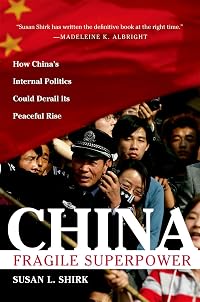
China: Fragile Superpower
by Susan L. Shirk
On This Page
Description
Once a sleeping giant, China today is the world's fastest growing economy--the leading manufacturer of cell phones, laptop computers, and digital cameras--a dramatic turn-around that alarms many Westerners. But in China: The Fragile Superpower, Susan L. Shirk opens up the black box of Chinese politics and finds that the real danger lies elsewhere--not in China's astonishing growth, but in the deep insecurity of its leaders. China's leaders face a troubling paradox: the more developed and show more prosperous the country becomes, the more insecure and threatened they feel. Shirk, a former Deputy Assistan show lessTags
Recommendations












Member Reviews
Susan Shirk was Deputy Assistant Secretary of State responsible for relations with China in the Clinton administration and she is now director of the University of California's Institute on Global Conflict and Cooperation.
In this extremely well informed book she reflects on her lifetimes' experience with Chinese affairs and explains why China is more of a "fragile" superpower than is immediately apparent to Western observers.
The basic problem is that Communist ideology doesn't convince the Chinese (or anyone else) any longer, so in fear for their own survival, the Chinese Communist leadership have fomented and appropriated a strident form on nationalism directed at the Japanese, Taiwanese and Americans,in that order.
She gives full show more credit to the economic reforms and openness initiated by Deng Xiaoping, quoting the World Bank in saying that since 1979 the reforms have lifted 400 million people out of poverty, which is a remarkable figure. The Chinese take pride in their achievement but her opinion is that a combination of pride and nationalism + a newly informed population thanks to the Internet, risks popular demands for military action that the Politbureau could not hold back (and remain in power) - in other words, they would become hostages of their their own nationalist creation.
The Chinese people also leave the Communist government alone while they provide the economic conditions for the growth to absorb the rural workforce as it migrates to the cities. A war would obviously break this link but she doesn't really consider the (more likely) disruption caused by an economic crisis.
As of 2010 the Chinese economy is overheating and could expect some economic instability, either from interior conditions or from the exterior ones resulting from the high level of integration of China into the world economy.
I feel that this is an important point that she doesn't explore sufficiently, but otherwise I'd easily give the book 5 stars. show less
In this extremely well informed book she reflects on her lifetimes' experience with Chinese affairs and explains why China is more of a "fragile" superpower than is immediately apparent to Western observers.
The basic problem is that Communist ideology doesn't convince the Chinese (or anyone else) any longer, so in fear for their own survival, the Chinese Communist leadership have fomented and appropriated a strident form on nationalism directed at the Japanese, Taiwanese and Americans,in that order.
She gives full show more credit to the economic reforms and openness initiated by Deng Xiaoping, quoting the World Bank in saying that since 1979 the reforms have lifted 400 million people out of poverty, which is a remarkable figure. The Chinese take pride in their achievement but her opinion is that a combination of pride and nationalism + a newly informed population thanks to the Internet, risks popular demands for military action that the Politbureau could not hold back (and remain in power) - in other words, they would become hostages of their their own nationalist creation.
The Chinese people also leave the Communist government alone while they provide the economic conditions for the growth to absorb the rural workforce as it migrates to the cities. A war would obviously break this link but she doesn't really consider the (more likely) disruption caused by an economic crisis.
As of 2010 the Chinese economy is overheating and could expect some economic instability, either from interior conditions or from the exterior ones resulting from the high level of integration of China into the world economy.
I feel that this is an important point that she doesn't explore sufficiently, but otherwise I'd easily give the book 5 stars. show less
How China's internal politics could derail its peaceful rise
Excellent, easy to read. Great intro to China
An examination of China's role in the world and the role that China ought to play.
Once a sleeping giant, China today is the world's fastest growing economy--the leading
manufacturer of cell phones, laptop computers, and digital cameras--a dramatic turn-around that
alarms many esterners. But in China: The Fragile Superpower, Susan L. Shirk opens up the
black box of Chinese politics and finds that the real danger lies elsewhere--not in China's
astonishing growth, but in the deep insecurity of its leaders. China's leaders face a troubling
paradox: the more developed and prosperous the country becomes, the more insecure and
threatened they feel. Shirk, a former Deputy Assistant Secretary of State responsible for China,
knows many of today's Chinese rulers personally and has studied them for three decades. She
offers invaluable show more insight into how they think--and what they fear. In this revealing book,
readers see the world through the eyes of men like President Hu Jintao and former President
Jiang Zemin. We discover a fragile communist regime desperate to survive in a society turned
upside down by miraculous economic growth and a stunning new openness to the greater
world. Indeed, ever since the 1989 pro-democracy protests in Tiananmen Square and the fall of
communism in the Soviet Union, Chinese leaders have been haunted by the fear that their days
in power are numbered. Theirs is a regime afraid of its own citizens, and this fear motivates
many of their decisions when dealing with the U.S. and other foreign nations. In particular, the
fervent nationalism of the Chinese people, combined with their passionate resentment of Japan
and attachment to Taiwan, have made relations with these two regions a minefield. It is here,
Shirk concludes, in the tangled interactions between Japan, Taiwan, China, and the United
States, that the greatest danger lies. Shirk argues that rising powers such as China tend to
provoke wars in large part because other countries mishandle them. Unless we understand
China's brittle internal politics and the fears that motivate its leaders, we face the very real
possibility of avoidable conflict with China. This book provides that understanding. --from
Amazon.com show less
manufacturer of cell phones, laptop computers, and digital cameras--a dramatic turn-around that
alarms many esterners. But in China: The Fragile Superpower, Susan L. Shirk opens up the
black box of Chinese politics and finds that the real danger lies elsewhere--not in China's
astonishing growth, but in the deep insecurity of its leaders. China's leaders face a troubling
paradox: the more developed and prosperous the country becomes, the more insecure and
threatened they feel. Shirk, a former Deputy Assistant Secretary of State responsible for China,
knows many of today's Chinese rulers personally and has studied them for three decades. She
offers invaluable show more insight into how they think--and what they fear. In this revealing book,
readers see the world through the eyes of men like President Hu Jintao and former President
Jiang Zemin. We discover a fragile communist regime desperate to survive in a society turned
upside down by miraculous economic growth and a stunning new openness to the greater
world. Indeed, ever since the 1989 pro-democracy protests in Tiananmen Square and the fall of
communism in the Soviet Union, Chinese leaders have been haunted by the fear that their days
in power are numbered. Theirs is a regime afraid of its own citizens, and this fear motivates
many of their decisions when dealing with the U.S. and other foreign nations. In particular, the
fervent nationalism of the Chinese people, combined with their passionate resentment of Japan
and attachment to Taiwan, have made relations with these two regions a minefield. It is here,
Shirk concludes, in the tangled interactions between Japan, Taiwan, China, and the United
States, that the greatest danger lies. Shirk argues that rising powers such as China tend to
provoke wars in large part because other countries mishandle them. Unless we understand
China's brittle internal politics and the fears that motivate its leaders, we face the very real
possibility of avoidable conflict with China. This book provides that understanding. --from
Amazon.com show less
I'm about halfway through with the book and it has proven to be quite an illuminating work. Maybe it's a bit repetitive, but interesting and not very difficult to read or to follow. That's an important thing, especially considering that university presses sometimes publish works that are illegible without a dictionary by your side. Anyway, the only thing about it is that the book is barely 3 years old, but things move so quickly in the world that it's already a bit behind. I wish this latest economic depression and topplings of regimes in several Arab countries had been taken into account too. But well, there's nothing you can do about that. And for those who wish to know more about how China functions, this is a must-read book.
Feb 20, 2011Estonian
Ratings
Members
- Recently Added By
Lists

The China Project Book List
100 works; 2 members
Author Information

8 Works 255 Members
Susan L. Shirk is Director of the University of California's Institute on Global Conflict and Cooperation, and Professor at UC-San Diego
Awards and Honors
Notable Lists
Common Knowledge
- Important places
- China
Classifications
- Genres
- Politics and Government, Nonfiction, General Nonfiction, History
- DDC/MDS
- 320.951 — Society, government, & culture Political science Types of Government Political situation and conditions Asia China and adjacent areas
- LCC
- JC311 .S525 — Political Science Political theory Political theory. The state. Theories of the state Nationalism. Nation state
- BISAC
Statistics
- Members
- 178
- Popularity
- 184,077
- Reviews
- 6
- Rating
- (3.82)
- Languages
- English
- Media
- Paper, Audiobook, Ebook
- ISBNs
- 9
- ASINs
- 2