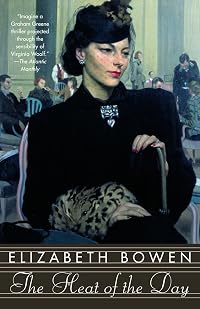
The Heat of the Day
by Elizabeth Bowen
On This Page
Description
Elizabeth Bowen recreates the tense and dangerous atmosphere of London during the bombing raids of World War II. Many people have fled the city, and those who stayed behind find themselves thrown together in an odd intimacy born of crisis. Stella Rodney is one of those who chose to stay. But for her, the sense of impending catastrophe becomes acutely personal when she discovers that her lover, Robert, is suspected of selling secrets to the enemy, and that the man who is following him wants show more Stella herself as the price of his silence. Caught between these two men, not sure whom to believe, Stella finds her world crumbling as she learns how little we can truly know of those around us. show lessTags
Recommendations




















Member Reviews
This is one of those completely unskimmable novels, that you are therefore forced to take slowly. It is set in London in the middle years of WWII and I found the details of this period (I gather Bowen wrote the novel actually during that time) fascinating - I knew about black out blinds, but it had never occurred to me that train windows would also need to be blacked out, nor had I realized the difficulties there would be in travelling to neutral Ireland.
The characters were very interesting and stayed with me while I wasn't reading, although Robert, Stella's boyfriend and possible Nazi spy, remained a bit opaque to me. Obviously Harrison, the intelligence officer who pursues Stella and makes this claim about Robert, is intentionally show more opaque and mysterious. There were sections which were very funny - any involving Robert's mother and sister and most involving the appallingly young (since he is serving his country) Roderick.
This was hard work, but worth the effort. show less
The characters were very interesting and stayed with me while I wasn't reading, although Robert, Stella's boyfriend and possible Nazi spy, remained a bit opaque to me. Obviously Harrison, the intelligence officer who pursues Stella and makes this claim about Robert, is intentionally show more opaque and mysterious. There were sections which were very funny - any involving Robert's mother and sister and most involving the appallingly young (since he is serving his country) Roderick.
This was hard work, but worth the effort. show less
This is the third novel I've read by [[Elizabeth Bowen]], and she is a hit or miss author for me. It took me a while to get into [The Heat of the Day]. Bowen writes densely. It's easy to miss a big plot point in a long descriptive passage, so you have to read closely.
This book was published in 1948, but takes place in 1942 London. I wondered when she actually wrote the novel. It has an immediacy regarding WWII that is impactful. The main character is Stella, who is in a relationship with a man named Robert. In the opening scenes, a stranger named Harrison approaches her and tells her that Robert is a spy. As the book unfolds, Stella has to decide who to believe and whether or not she even wants to know. The parallel story involves her show more adult son, Roderick, who is in the Army. He inherits an Irish estate from his father's family, who Stella had divorced early in their marriage. This inheritance brings up the past and secrets are revealed. There are two other side plots - one involving Robert's family and one involving a young woman, Louie, who meets Harrison in the opening scene. I never did understand what Louie's story was meant to add to the book.
Once I got past the opening scenes and got my bearings, the plot carried the book along for me. The setting is also strong. However, sometimes I felt like Bowen was over-writing the material and putting the reader too far removed from the characters. The book is a bit meandering, but in the end I'm glad I read it. show less
This book was published in 1948, but takes place in 1942 London. I wondered when she actually wrote the novel. It has an immediacy regarding WWII that is impactful. The main character is Stella, who is in a relationship with a man named Robert. In the opening scenes, a stranger named Harrison approaches her and tells her that Robert is a spy. As the book unfolds, Stella has to decide who to believe and whether or not she even wants to know. The parallel story involves her show more adult son, Roderick, who is in the Army. He inherits an Irish estate from his father's family, who Stella had divorced early in their marriage. This inheritance brings up the past and secrets are revealed. There are two other side plots - one involving Robert's family and one involving a young woman, Louie, who meets Harrison in the opening scene. I never did understand what Louie's story was meant to add to the book.
Once I got past the opening scenes and got my bearings, the plot carried the book along for me. The setting is also strong. However, sometimes I felt like Bowen was over-writing the material and putting the reader too far removed from the characters. The book is a bit meandering, but in the end I'm glad I read it. show less
Upon closing this book, I had the strange sensation of not knowing exactly how I felt about it--and it occurred to me that that gave me much in common with the characters themselves, who were if nothing else confused about their world and themselves. In the end, the book was impressive enough to win a 3.5 rating, but I rounded down to a 3 because of some chapters in which my attention began to wonder.
This is a World War II story set primarily in London during the blitz and when the future outcome of the fighting was difficult to predict. The main character, Stella, is told, by a somewhat shady character who claims to be an intelligence operative, that her boyfriend of two years is a spy, betraying the English to the Germans. She show more struggles, as well one would, between what she believes she knows about this man and what she might possibly be missing. To ask is to accuse. Everything is on the line, and how much can one really know about anyone in such an unnatural and dangerous time?
Bowen is a good writer and anything but formulaic. She weaves a mystery that is not easily unraveled. But it is the psychological aspect of her writing that shines, her exploration of the inner man and woman. It is what Stella does with the information, how she navigates this thin line, that makes her and the story interesting.
”Oh, I should doubt,” she exclaimed, “whether there's any such thing as an innocent secret! Whatever has been buried, surely, corrupts? Nothing keeps innocence innocent but daylight. A truth's just a truth, to start with, with no particular nature, good or bad--but how can any truth not go bad from being years underground? Dug up again after years and laid on the mat, it’s inconvenient, shocking--apart from anything else there’s no place left in life for it any more. To dig up someone else's truth for them would seem to me sheer malignancy; to dig up one's own, madness--I never would.”
If I had one complaint, it is that we are presented with several superfluous characters who do not add anything to the story, but who consume a great deal of paper and effort. I kept waiting for the tie-in, which never came, and which left me feeling a slight bit cheated. I also felt that the dialogue between the main characters was too often stilted and cold...I’m not sure even the WWII British would have spoken to one another in quite this way.
show less
This is a World War II story set primarily in London during the blitz and when the future outcome of the fighting was difficult to predict. The main character, Stella, is told, by a somewhat shady character who claims to be an intelligence operative, that her boyfriend of two years is a spy, betraying the English to the Germans. She show more struggles, as well one would, between what she believes she knows about this man and what she might possibly be missing. To ask is to accuse. Everything is on the line, and how much can one really know about anyone in such an unnatural and dangerous time?
Bowen is a good writer and anything but formulaic. She weaves a mystery that is not easily unraveled. But it is the psychological aspect of her writing that shines, her exploration of the inner man and woman. It is what Stella does with the information, how she navigates this thin line, that makes her and the story interesting.
”Oh, I should doubt,” she exclaimed, “whether there's any such thing as an innocent secret! Whatever has been buried, surely, corrupts? Nothing keeps innocence innocent but daylight. A truth's just a truth, to start with, with no particular nature, good or bad--but how can any truth not go bad from being years underground? Dug up again after years and laid on the mat, it’s inconvenient, shocking--apart from anything else there’s no place left in life for it any more. To dig up someone else's truth for them would seem to me sheer malignancy; to dig up one's own, madness--I never would.”
If I had one complaint, it is that we are presented with several superfluous characters who do not add anything to the story, but who consume a great deal of paper and effort. I kept waiting for the tie-in, which never came, and which left me feeling a slight bit cheated. I also felt that the dialogue between the main characters was too often stilted and cold...I’m not sure even the WWII British would have spoken to one another in quite this way.
show less
As writers we are used to being told ‘trust the reader’. As a reader, this novel is a definite case for remembering to ‘trust the author’. ‘The Heat of the Day’ by Elizabeth Bowen, published in 1949, is now recognised as a classic novel about the Second World War. It tells the story of Stella Rodney and her relationship with two men, her lover Robert and Harrison, the man who suspects Robert of selling secrets to the enemy and sees this as a way of winning Stella’s love. This is not a spy novel, rather its threads and tentacles of story are woven as intricately as the lives of the three principal characters overlap with the bigger-scale events of war.
War is at the centre of it all, brooding over every minute, every show more decision, every pause. London, emptied of evacuees and people fleeing for safety, becomes a smaller place where strangers wish each other good luck in anticipation of that night’s bombing, where you awake in the morning and realize you are still alive. ‘Out of mists of morning charred by the smoke from ruins each day rose to a height of unmisty glitter; between the last sunset and first note of the siren the darkening glassy tenseness of evening was drawn fine. From the moment of waking you tasted the sweet autumn not less because of an acridity on the tongue and nostrils; and as the singed dust settled and smoke diluted you felt more and more called upon to observe the daytime as a pure and curious holiday from fear.’ On the whole though, the war is absent from the page. This is a story about people in extra-ordinary times.
The storyline is at times perplexing and vague and it is at those moments that I remembered to trust Elizabeth Bowen and enjoy to her language. This is the first of her novels I have read. Her stated interest was in the contrasts between life ‘with the lid on’ and what happens ‘when the lid comes off’. In ‘The Heat of the Day’, war causes the lid to be lifted. The theme of time runs throughout the novel. Daily life in London goes on but as if time is suspended from normality. Shackles have been removed and people behave differently, carelessness is common. It is in this vacuum that Stella, who lives in a rented furnished apartment with few things of her own, is given an ultimatum by Harrison. Louie, another displaced woman living in London waiting for her soldier husband who may or may not come home, appears in the first chapter as she listens to a band play in a park. Both women lie to the men in their lives, both have sex outside their monogamous relationships. Neither Robert or Harrison are as they seem. Harrison’s job is never explained, and Robert’s supposed treachery remains ill-defined.
This is a novel of shadows, appropriate as most of the novel happens at night during the blackout when the way is lit by torchlight and people blunder into furniture in darkened rooms. A very different read.
Read more of my book reviews at http://www.sandradanby.com/book-reviews-a-z/ show less
War is at the centre of it all, brooding over every minute, every show more decision, every pause. London, emptied of evacuees and people fleeing for safety, becomes a smaller place where strangers wish each other good luck in anticipation of that night’s bombing, where you awake in the morning and realize you are still alive. ‘Out of mists of morning charred by the smoke from ruins each day rose to a height of unmisty glitter; between the last sunset and first note of the siren the darkening glassy tenseness of evening was drawn fine. From the moment of waking you tasted the sweet autumn not less because of an acridity on the tongue and nostrils; and as the singed dust settled and smoke diluted you felt more and more called upon to observe the daytime as a pure and curious holiday from fear.’ On the whole though, the war is absent from the page. This is a story about people in extra-ordinary times.
The storyline is at times perplexing and vague and it is at those moments that I remembered to trust Elizabeth Bowen and enjoy to her language. This is the first of her novels I have read. Her stated interest was in the contrasts between life ‘with the lid on’ and what happens ‘when the lid comes off’. In ‘The Heat of the Day’, war causes the lid to be lifted. The theme of time runs throughout the novel. Daily life in London goes on but as if time is suspended from normality. Shackles have been removed and people behave differently, carelessness is common. It is in this vacuum that Stella, who lives in a rented furnished apartment with few things of her own, is given an ultimatum by Harrison. Louie, another displaced woman living in London waiting for her soldier husband who may or may not come home, appears in the first chapter as she listens to a band play in a park. Both women lie to the men in their lives, both have sex outside their monogamous relationships. Neither Robert or Harrison are as they seem. Harrison’s job is never explained, and Robert’s supposed treachery remains ill-defined.
This is a novel of shadows, appropriate as most of the novel happens at night during the blackout when the way is lit by torchlight and people blunder into furniture in darkened rooms. A very different read.
Read more of my book reviews at http://www.sandradanby.com/book-reviews-a-z/ show less
I re-read this book because I’m doing a massive purge of my book collection in the coming months, and had absolutely no recollection of what this book was actually about, besides the fact that I know I read it for some course during my undergraduate degree. Upon finishing the re-read, I totally get why this book was wiped from my memory entirely - because it’s pretty unmemorable. The story starts out strong with interesting characters (a group of British spies in a love-triangle), a great setting (London during the Blitz), and a lot of potential tension (duh, spies), but about midway through the story the author seems to waver. The language becomes simplified and less descriptive, some of the characters develop weird quirks with no show more actual motivation, and then the whole thing winds up with a never-really explained suicide/murder and a passive aggressive anti-confrontation with no one actually moving forward. It’s really too bad that the author never managed to keep the story tightly knit, since there was a lot of potential for it to be a slightly more feminized take on the espionage genre and an interesting alternative to Le Carré’s high-tension paper-capers and Fleming’s overly-masculine 007. show less
Bowen is a gifted writer but drowns in her own subterranean world. Published in 1948, the style leans very heavily on description, a choice that apparently left less time for showing deeper insight into characters. For a novel to be character driven, the reader must be shown certainly not all, but enough, of not just the character’s motivations but any transformations. The book does a fairly good job of capturing a point in time, during WW11 London, where people of all walks of life felt uprooted and vulnerable, as the characters each reach out in their own way, fumbling blindly in the dark, for some kind of connection to others, no matter how desultory or unfulfilling. People are strange, families are annoying, world events intrude show more on lives, everyone has a backstory that for the most part remains hidden: this commonplace isn’t enough to warrant a novel.
The weakest part of the book is the character of Robert, the lover of the protagonist Stella: there was simply not enough development to allow him to be anything more than a vague representative of disenchantment, of a desperate desire for Something Else. His reveal is anticlimactic at best, an afterthought at worst. It isn’t so much that a reader may not like any of the characters (I have never understood why that should be an issue) it’s that it would be hard to care one way or another about what happens to them.
This book is neither a ‘thriller’ not anything approaching Woolf or Graham Greene, despite the front cover blurb. Despite some excellent passages, the concept of the book outshines its execution. There is enough promise in the book to encourage reading Bowen’s other work. show less
The weakest part of the book is the character of Robert, the lover of the protagonist Stella: there was simply not enough development to allow him to be anything more than a vague representative of disenchantment, of a desperate desire for Something Else. His reveal is anticlimactic at best, an afterthought at worst. It isn’t so much that a reader may not like any of the characters (I have never understood why that should be an issue) it’s that it would be hard to care one way or another about what happens to them.
This book is neither a ‘thriller’ not anything approaching Woolf or Graham Greene, despite the front cover blurb. Despite some excellent passages, the concept of the book outshines its execution. There is enough promise in the book to encourage reading Bowen’s other work. show less
This novel follows the lives of two women and two men living in London during the war. The characters are people who have not been evacuated and they remain in the city for work, or lack of anywhere else to live. The main character, Stella, is a widow who has a son in the army. She is seeing Robert, a wounded Dunkirk evacuee who is working in The War Office. Harrison (whose first name we do not learn until near the end of the book) is a strange person who likes to imply that he is somehow involved in counter-espionage. Louie is a factory worker whose husband is off fighting in the war and she finds herself bored and wandering London wondering what to do and what to think. Her character is easily led and rather flighty.
“The Heat of the show more Day” gives the reader a taste of what it was like for ordinary people living in blitz-torn London. The people remaining in the city are portrayed as having a high level of comradery in which everybody was friends but they never got too close because they knew their friend of tonight might not be around tomorrow after the nighttime air-raids.
There is a lot of internal consideration of feelings and convoluted thinking about that the other person meant by their words or actions, or even lack of words.
The story points of view are those of Stella and Louie, the main female characters. Knowing Elizabeth Bowen’s background I can see she identified with Stella. The scenes in which Stella visits an inherited stately home in Ireland are obviously informed by Bowen’s own family seat, Bowen’s Court, in Farahy, County Cork, which she visited frequently as a child and which she inherited in 1930.
Louie is a rather two dimensional character. She is portrayed as not having a lot of wit. I think her character suffers from Bowen’s attempting to write a working class character from a rather elite status.
Strong points in this book include the explanation, through Louie’s reading and interpretation of newspapers, of how the news media is used to manipulate the thoughts of the masses, especially at a time of national emergency. This element is reminiscent of current times with multimedia channels being used to influence political thought and to lead the masses by the nose. I was amazed at how sharp this element was.
I shan’t discuss the plot as the environment in which it takes place, and the thoughts and emotions of the people involved, are more important in this book than who did what and when. show less
“The Heat of the show more Day” gives the reader a taste of what it was like for ordinary people living in blitz-torn London. The people remaining in the city are portrayed as having a high level of comradery in which everybody was friends but they never got too close because they knew their friend of tonight might not be around tomorrow after the nighttime air-raids.
There is a lot of internal consideration of feelings and convoluted thinking about that the other person meant by their words or actions, or even lack of words.
The story points of view are those of Stella and Louie, the main female characters. Knowing Elizabeth Bowen’s background I can see she identified with Stella. The scenes in which Stella visits an inherited stately home in Ireland are obviously informed by Bowen’s own family seat, Bowen’s Court, in Farahy, County Cork, which she visited frequently as a child and which she inherited in 1930.
Louie is a rather two dimensional character. She is portrayed as not having a lot of wit. I think her character suffers from Bowen’s attempting to write a working class character from a rather elite status.
Strong points in this book include the explanation, through Louie’s reading and interpretation of newspapers, of how the news media is used to manipulate the thoughts of the masses, especially at a time of national emergency. This element is reminiscent of current times with multimedia channels being used to influence political thought and to lead the masses by the nose. I was amazed at how sharp this element was.
I shan’t discuss the plot as the environment in which it takes place, and the thoughts and emotions of the people involved, are more important in this book than who did what and when. show less
Members
- Recently Added By
Lists

1001 Books You Must Read Before You Die
1,448 works; 1,134 members

The Guardian's 1000 Novels Everyone Must Read
1,005 works; 551 members

Best Books Set in London
157 works; 42 members

The Guardian's 100 Best Novels Written in English
105 works; 13 members

Anthony Burgess 99 Post War Novels
99 works; 7 members

1,001 BYMRBYD Concensus
723 works; 27 members

My TBR
371 works; 3 members
Author Information

74+ Works 9,059 Members
Elizabeth Bowen, distinguished Anglo-Irish novelist, was born in Dublin in 1899, traveled extensively, lived in London, and inherited the family estate-Bowen's Court, in County Cork. Her account of the house, Bowen's Court (1942), with a detailed fictionalized history of the family in Ireland through three centuries, has charm, warmth, and show more insight. Seven Winters is a fragment of autobiography published in England in 1942. The "Afterthoughts" of the original edition are critical essays in which she discusses and analyzes, among others, such literary figures as Virginia Woolf, E. M. Forster, Katherine Mansfield, Anthony Trollope, and Eudora Welty. Bowen's stories, mostly about people of the British upper middle class, portray relationships that are never simple, except, perhaps, on the surface. Her concern with time and memory is a major theme. Beautifully and delicately written, her stories, with their oblique psychological revelations, are symbolic, subtle, and terrifying. A Time in Rome (1960) is her brilliant evocation of that city and its layered past. In 1948, Bowen was made a Commander of the British Empire. Bowen died in 1973. (Bowker Author Biography) show less
Awards and Honors
Distinctions
Notable Lists
Series
Belongs to Publisher Series
Work Relationships
Is abridged in
Common Knowledge
- Canonical title
- The Heat of the Day
- Original publication date
- 1948
- Important places
- London, England, UK
- Important events
- The Blitz (1940 | 1941)
- Related movies
- The Heat of the Day (1989 | IMDb)
- Dedication
- To Charles Ritchie
- First words
- That Sunday, from six o'clock in the evening, it was a Viennese orchestra that played.
- Quotations
- The very soil of the city at this time seemed to generate more strength: in parks the outsize dahlias, velvet and wine, and the trees on which each vein in each yellow leaf stretched out perfect against the sun blazoned out t... (show all)he idea of the finest hour.
- Last words
- (Click to show. Warning: May contain spoilers.)They passed overhead, disappearing in the direction of the West.
Classifications
Statistics
- Members
- 1,227
- Popularity
- 20,076
- Reviews
- 33
- Rating
- (3.44)
- Languages
- English, French, German, Spanish
- Media
- Paper, Audiobook, Ebook
- ISBNs
- 23
- ASINs
- 32