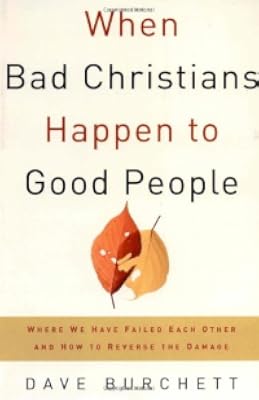
When Bad Christians Happen to Good People: Where We Have Failed Each Other and How to Reverse the Damage
by Dave Burchett
On This Page
Description
"Dave allowed God to navigate him through the pain of religious moralism to arrive at insightful, compelling, and gracious wisdom. He remains a sincere lover of God's church and people as he directs weary pilgrims to safer lodging." --John Lynch, coauthor of TrueFaced and Bo's Café Have you been betrayed by a Christian friend? Are you disillusioned with the church? If you have been hurt by Christians, you know all about anger and resentment. But what about a workable solution? How can show more the words and actions of "bad Christians" be addressed so the mistakes are not repeated? When Bad Christians Happen to Good People offers a workable response and, ultimately, a new way of living. In this revised and updated edition, you will find healing for hurts infl icted by others. At the same time, you will discover ways to help Christians and church leaders recognize the damage that is done by unexamined assumptions, words, and actions. After dealing with his own hurt, Dave Burchett now shows believers how to: ■ Live as Jesus followers, not rule enforcers ■ Stop using religious performance as the standard for accepting others ■ Let go of moralism, legalism, and an allegiance to trying harder ■ Discover God's grace as a daily reality, not just a word to use in evangelism Working toward a solution will benefi t your own life at the same time it helps others. Whether you have been a bad Christian in the past, or have been hurt by one, there is a better way to live. Discussion Guide Included for Individual and Small-Group Use show lessTags
Recommendations



























Member Reviews
-I received this book through Library Early Reviews in exchange for an honest review-
Anyone willing to be honest with themselves will admit that Christianity has found itself with a negative connotation/reputation. Christians are seen as homophobic, anti-intellectual, bigoted, judgmental - the list goes on and on. What's funny, though, is that I have heard time and time again how this external issue or that external issue is the greatest threat to, or issue within, Christianity - I strongly disagree. From what I've seen and experienced, the greatest "threat" to Christianity (in terms of its credibility, its reputation, etc), the greatest issue we face, is us - Christians.
It is the un-Christlike way in which so many of us choose to show more behave, the way so many of us choose to treat non-Christians in a manner which contradicts the message and character of the person we claim to emulate and follow, thereby being the thing that most undermines Christianity itself. And while the author and I may disagree on what it means to be a Christian, or other matters of faith (my theology vastly differs from his), we do agree that the lack of grace, humility, love, compassion, and other Christ-like qualities among Christians is a BIG problem.
In this book, author Dave Burchett addresses this problem, going into things like ungracious and unloving attitudes, as well as other things that make people "bad" Christians.
He mentions three D's :
Division, Distraction, and Derision
and touches on how to avoid these issues - by asking oneself "Would Jesus Spend Time on This" (the chapter devoted to this is obviously more in depth than just the one phrase).
He mentions three "critical phenomena" as well, paralleling McWhorter's ideas pertaining to the idea of hindrances in African American advancement with Christianity and how its reputation and ability to also “advance” is affected by them as well.
These three phenomena are : Victimization (we, in the group where I discuss religion, call it a “persecution complex”), Separatism, and Anti-intellectualism (though I disagree with his insinuations that not believing in things he considers to be foundational or fundamental to the faith makes one Biblically or spiritually illiterate (I reject much of traditional theology, and I don’t believe myself, after years of study and a thorough understanding of doctrine, to be illiterate in either sense), and I probably mean anti-intellectualism in a much different way than he does…). These are very important issues within Christianity.
As well as touching on those issues, I greatly appreciate and agree with the author speaking against legalism and using fear in faith, noting how it (fear) is easy to exploit, saying “faith based in fear has the potential to become like a marriage based on abuse” (page 51), because legalism is one of the things I believe Jesus himself had issue with, and I believe the use of fear to enforce belief is manipulative and abusive.
Having been witness to many Christians acting in an un-Christ-like way when discussing or debating religion with non-Christians (or even the "wrong" kind of Christians), I also appreciate his saying:
“It is not our job to defeat those we disagree with. Instead, we are to speak the truth in love with respect, honor, and compassion for the listener” (page 128)
and
“A secure follower of Christ can respond with assurance and dignity and without venom. You don’t have to agree with something to give it the courtesy of respect” - (page 64)
He tells us that though we are called to be a light unto the world, we should be a light of grace, acceptance, and love, and not act as a spotlight to shine on the faults of others, reminding us that "redemption, not condemnation, is the heart of Christ’s message." (page 42)
Out of all the points he makes I think my favorite has to do with how Christians go on and on about issues like homosexuality, abortion, premarital/extramarital sex, pornography, and so on, but how we SHOULD be more concerned about gossip, greed, selfishness, materialism, bitterness, pride, lack of forgiveness,
racism, envy, lust, sexism, classism, indifference, homophobia, a lack of compassion, and the like.
I also loved his idea for a "Bill of Rights for Unbelievers", especially since it includes some of the issues we Christians have such a hard time with, like "I have the right to never have faith forced on me" or to "never
be treated in a condescending manner" (page 214).
There's even a study guide at the end for those of you who like that sort of thing, lol.
I do want to head towards a conclusion, though, with a quote that is something Christians everywhere really should hear and consider, since it pertains to an issue that is relevant not only on the large scale of Christian-dome, but also applies on an individual level:
"While a just God will judge fairly, Christianity has too far often wrongly taken it upon itself to judge and condemn those who don’t believe. In our zeal for evangelism, we have sinned against other cultures, races, and creeds. There is no biblical basis for the brutal tactics of some; no support for these acts can be found in Jesus’ ministry on earth or anywhere in the New Testament”. (page 112)
I enjoyed this book. I would recommend it to any Christian. We could all take a minute to consider for ourselves whether or not our personal walk in faith lines up with our "talk", or if we feel Jesus really would be pleased with how we exhibit our faith for the world. And this book does help one to do that. show less
Anyone willing to be honest with themselves will admit that Christianity has found itself with a negative connotation/reputation. Christians are seen as homophobic, anti-intellectual, bigoted, judgmental - the list goes on and on. What's funny, though, is that I have heard time and time again how this external issue or that external issue is the greatest threat to, or issue within, Christianity - I strongly disagree. From what I've seen and experienced, the greatest "threat" to Christianity (in terms of its credibility, its reputation, etc), the greatest issue we face, is us - Christians.
It is the un-Christlike way in which so many of us choose to show more behave, the way so many of us choose to treat non-Christians in a manner which contradicts the message and character of the person we claim to emulate and follow, thereby being the thing that most undermines Christianity itself. And while the author and I may disagree on what it means to be a Christian, or other matters of faith (my theology vastly differs from his), we do agree that the lack of grace, humility, love, compassion, and other Christ-like qualities among Christians is a BIG problem.
In this book, author Dave Burchett addresses this problem, going into things like ungracious and unloving attitudes, as well as other things that make people "bad" Christians.
He mentions three D's :
Division, Distraction, and Derision
and touches on how to avoid these issues - by asking oneself "Would Jesus Spend Time on This" (the chapter devoted to this is obviously more in depth than just the one phrase).
He mentions three "critical phenomena" as well, paralleling McWhorter's ideas pertaining to the idea of hindrances in African American advancement with Christianity and how its reputation and ability to also “advance” is affected by them as well.
These three phenomena are : Victimization (we, in the group where I discuss religion, call it a “persecution complex”), Separatism, and Anti-intellectualism (though I disagree with his insinuations that not believing in things he considers to be foundational or fundamental to the faith makes one Biblically or spiritually illiterate (I reject much of traditional theology, and I don’t believe myself, after years of study and a thorough understanding of doctrine, to be illiterate in either sense), and I probably mean anti-intellectualism in a much different way than he does…). These are very important issues within Christianity.
As well as touching on those issues, I greatly appreciate and agree with the author speaking against legalism and using fear in faith, noting how it (fear) is easy to exploit, saying “faith based in fear has the potential to become like a marriage based on abuse” (page 51), because legalism is one of the things I believe Jesus himself had issue with, and I believe the use of fear to enforce belief is manipulative and abusive.
Having been witness to many Christians acting in an un-Christ-like way when discussing or debating religion with non-Christians (or even the "wrong" kind of Christians), I also appreciate his saying:
“It is not our job to defeat those we disagree with. Instead, we are to speak the truth in love with respect, honor, and compassion for the listener” (page 128)
and
“A secure follower of Christ can respond with assurance and dignity and without venom. You don’t have to agree with something to give it the courtesy of respect” - (page 64)
He tells us that though we are called to be a light unto the world, we should be a light of grace, acceptance, and love, and not act as a spotlight to shine on the faults of others, reminding us that "redemption, not condemnation, is the heart of Christ’s message." (page 42)
Out of all the points he makes I think my favorite has to do with how Christians go on and on about issues like homosexuality, abortion, premarital/extramarital sex, pornography, and so on, but how we SHOULD be more concerned about gossip, greed, selfishness, materialism, bitterness, pride, lack of forgiveness,
racism, envy, lust, sexism, classism, indifference, homophobia, a lack of compassion, and the like.
I also loved his idea for a "Bill of Rights for Unbelievers", especially since it includes some of the issues we Christians have such a hard time with, like "I have the right to never have faith forced on me" or to "never
be treated in a condescending manner" (page 214).
There's even a study guide at the end for those of you who like that sort of thing, lol.
I do want to head towards a conclusion, though, with a quote that is something Christians everywhere really should hear and consider, since it pertains to an issue that is relevant not only on the large scale of Christian-dome, but also applies on an individual level:
"While a just God will judge fairly, Christianity has too far often wrongly taken it upon itself to judge and condemn those who don’t believe. In our zeal for evangelism, we have sinned against other cultures, races, and creeds. There is no biblical basis for the brutal tactics of some; no support for these acts can be found in Jesus’ ministry on earth or anywhere in the New Testament”. (page 112)
I enjoyed this book. I would recommend it to any Christian. We could all take a minute to consider for ourselves whether or not our personal walk in faith lines up with our "talk", or if we feel Jesus really would be pleased with how we exhibit our faith for the world. And this book does help one to do that. show less
An excellent critique on many of the customs and practices of modern Evangelical Christianity, their incompatibility with the Gospel, and how they repel people from Christ.
The author focuses on the judgmental environment present in many churches, how divisions are manifest, the many barely profitable (if at all) matters which Christians focus on as opposed to what is truly important, the disconnect between Christian profession and Christian practice, the use of jargon incomprehensible to non-Christians, the inanity of Christian merchandising, the ugliness manifest in the culture wars, the distance between what Jesus actually taught and what many Christians believe, relative ignorance of theology, a lack of true love, and the need for show more grace.
This is an important exhortation for all to hear. Your toes will be stepped on at some point or another. Yet, in the end, the author does well at showing what is truly important in terms of the Gospel and how we can do better at reflecting Christ than culture, upbringing, and tradition.
Highly recommended.
**--book received as part of early review program show less
The author focuses on the judgmental environment present in many churches, how divisions are manifest, the many barely profitable (if at all) matters which Christians focus on as opposed to what is truly important, the disconnect between Christian profession and Christian practice, the use of jargon incomprehensible to non-Christians, the inanity of Christian merchandising, the ugliness manifest in the culture wars, the distance between what Jesus actually taught and what many Christians believe, relative ignorance of theology, a lack of true love, and the need for show more grace.
This is an important exhortation for all to hear. Your toes will be stepped on at some point or another. Yet, in the end, the author does well at showing what is truly important in terms of the Gospel and how we can do better at reflecting Christ than culture, upbringing, and tradition.
Highly recommended.
**--book received as part of early review program show less
There's a dirty little secret in the Christian world: Christians can be mean. And not just merely mean but backbiting, cruel, underhanded, deceitful...you name it, Christians can prove that they are only human after all. So, what do you do when the "good" Christians in your life actually turn out to be a negative influence in your life? How do you move on?
Burchett takes his reader through the problems plaguing the modern church, and also reveals what he sees as the underlying/root causes of these issues. Finally, he ends with a call to the church to go back to its roots, so to speak. He encourages Christians to follow Jesus' life and example more closely, examine their lives in light of Biblical truth more honestly, and to live as show more simply in faith as is possible. Hurts happen, but there is not only a remedy, but a cure.
Burchett's writing is clear, open, honest, and enlightening. He uses the most simple of truths to convey his message, but it still hits hard. I love how he expressed himself near the end of the book "Christians must understand what the gospel is and how to communicate it effectively. We must demonstrate love and an attitude of service to others. And we must grow in Christ and offer something different from what society offers. Grace. It is our distinctive." Such a plain truth, but important nonetheless. Firstly, Burchett does not wildly point fingers all around. He approached his audience with gentleness, identifying himself as a culprit along with the reader. Secondly, he brings focus back on Christ and serving others. Lastly, he reminds the reader that grace is not just something that has been bestowed up on them, but that it is something that every Christian should extend to each person with which they come in contact. Only then can we see healing and a reversal of the damage "bad" Christians have caused in our world. show less
Burchett takes his reader through the problems plaguing the modern church, and also reveals what he sees as the underlying/root causes of these issues. Finally, he ends with a call to the church to go back to its roots, so to speak. He encourages Christians to follow Jesus' life and example more closely, examine their lives in light of Biblical truth more honestly, and to live as show more simply in faith as is possible. Hurts happen, but there is not only a remedy, but a cure.
Burchett's writing is clear, open, honest, and enlightening. He uses the most simple of truths to convey his message, but it still hits hard. I love how he expressed himself near the end of the book "Christians must understand what the gospel is and how to communicate it effectively. We must demonstrate love and an attitude of service to others. And we must grow in Christ and offer something different from what society offers. Grace. It is our distinctive." Such a plain truth, but important nonetheless. Firstly, Burchett does not wildly point fingers all around. He approached his audience with gentleness, identifying himself as a culprit along with the reader. Secondly, he brings focus back on Christ and serving others. Lastly, he reminds the reader that grace is not just something that has been bestowed up on them, but that it is something that every Christian should extend to each person with which they come in contact. Only then can we see healing and a reversal of the damage "bad" Christians have caused in our world. show less
 This review was written for LibraryThing Early Reviewers.
A provocative title. If I were Al Gore I might call it, “an inconvenient truth.”
We all know THAT guy.
The one who calls himself a vegetarian but eats his avocado sandwiches with turkey on occasion.
Or the one that quotes Romans 3:23 “All have sinned and fallen short of the glory of God,”
while he acts as if God’s grace was only designed for those people with real problems.
Not his pornography addiction, because really, he’s not injuring anybody, is he?
Or perhaps you know the guy that acts really involved on Sundays, but really doesn’t invest into anyone at Church and complains about the lack of discipleship he sees going on?
Or maybe you just don’t notice them because they are actually you. Don’t worry, we’re all show more scrubs.
The hardest things for us to hear are the things that speak against us.
In his book, Dave Burchett reveals the Church giving itself over to a pseudo-Christian worldview
placated with planks of loveless attitudes, nonsensical distractions, and divisive theologies.
Burchett helps to unveil the places where our Churches are willing to preach the love of Jesus,
but refuse to be His hands and feet stretched out into the community in order to reincarnate His love.
Churches that cry out for unity within the shadows of their long, lonely corridors.
Churches that need grace.
Dave Burchett hopes to root his audience into the eternal relevance of the Gospel of Jesus,
in order to mobilize God’s love in the relevancies of culture. He wrote this book to place action in our faith.
Through his storytelling Dave engages his audience with the painfully honest experiences
he has encountered in heartless church-life that have shaped his family and matured his faith.
It’s great to see a man who was hurt by the church only to see his own
hurtful tendencies fleshed out and redeemed in the grace of Christ.
His blunt commentary is thought-provoking, entertaining, and uproarious at times.
He never shades away from speaking against those who argue over what is
[relatively] important, but Gospel[ly] irrelevant.
If it’s not of eternal relevance should the Church consider it an important issue?
Dave supposes we should reconsider the value we place on
the issues Jesus wouldn’t spend His time on, and focus on His heart.
Bad Christians is a great read for anyone seeking Hope after being caught in the crossfire of divisive Christianity.
Dave’s experiences within the shadows of the Church speak of how those who have
been broken, judged, and dehumanized can come to the love of Christ and receive freedom, relief, and redemption.
For it is in the grace of Christ that the wounded (and those who blindly wound) must come to be healed.
May this book remove planks from the eyes/worldviews of many, and open us to consider the True Reality of Christ. show less
We all know THAT guy.
The one who calls himself a vegetarian but eats his avocado sandwiches with turkey on occasion.
Or the one that quotes Romans 3:23 “All have sinned and fallen short of the glory of God,”
while he acts as if God’s grace was only designed for those people with real problems.
Not his pornography addiction, because really, he’s not injuring anybody, is he?
Or perhaps you know the guy that acts really involved on Sundays, but really doesn’t invest into anyone at Church and complains about the lack of discipleship he sees going on?
Or maybe you just don’t notice them because they are actually you. Don’t worry, we’re all show more scrubs.
The hardest things for us to hear are the things that speak against us.
In his book, Dave Burchett reveals the Church giving itself over to a pseudo-Christian worldview
placated with planks of loveless attitudes, nonsensical distractions, and divisive theologies.
Burchett helps to unveil the places where our Churches are willing to preach the love of Jesus,
but refuse to be His hands and feet stretched out into the community in order to reincarnate His love.
Churches that cry out for unity within the shadows of their long, lonely corridors.
Churches that need grace.
Dave Burchett hopes to root his audience into the eternal relevance of the Gospel of Jesus,
in order to mobilize God’s love in the relevancies of culture. He wrote this book to place action in our faith.
Through his storytelling Dave engages his audience with the painfully honest experiences
he has encountered in heartless church-life that have shaped his family and matured his faith.
It’s great to see a man who was hurt by the church only to see his own
hurtful tendencies fleshed out and redeemed in the grace of Christ.
His blunt commentary is thought-provoking, entertaining, and uproarious at times.
He never shades away from speaking against those who argue over what is
[relatively] important, but Gospel[ly] irrelevant.
If it’s not of eternal relevance should the Church consider it an important issue?
Dave supposes we should reconsider the value we place on
the issues Jesus wouldn’t spend His time on, and focus on His heart.
Bad Christians is a great read for anyone seeking Hope after being caught in the crossfire of divisive Christianity.
Dave’s experiences within the shadows of the Church speak of how those who have
been broken, judged, and dehumanized can come to the love of Christ and receive freedom, relief, and redemption.
For it is in the grace of Christ that the wounded (and those who blindly wound) must come to be healed.
May this book remove planks from the eyes/worldviews of many, and open us to consider the True Reality of Christ. show less
This review was written for LibraryThing Early Reviewers.We all know people who used to go to church but quit going because of the way we Christians treat each other. Likewise, we know Christians who are back-biters, gossips and bitter people. We have seen these people use the gospel of Grace to make people feel like guilty, lowly sinners. We’ve seen volunteers get used up and spit out while those with special needs often are isolated and forgotten. Christians can be really big jerks and there are a lot of wounded people because of it. This is exceptionally heartbreaking because too often ‘good people’ like me, also fit the profile of the bad Christian.
David Burchett is also no stranger to bad Christians. When he and his wife Joni had their daughter Katie they knew that she was show more terminal, could not open her eyes and she had a deformity which left tissue exposed at the back of her skull (which they covered with a dressing). The church that they attended informed them that Katie would no longer be welcome in the nursery because of the risk she posed to other kids and the trauma it would inflict on nursery workers if Katie died on their watch. The Burchetts were not consulted about this and no concerns were ever communicated to them until they were told that their daughter was not welcome in the Nursery.
And so Burchett wrote this book exploring all the ways we Christians do damage to each other and fail to communicate God’s love to those outside of the church. The book divides into three parts. In part one Burchett discusses the way we Christians treat one another (i.e. unfriendliness, schism, fear-based Christianity). In part two he explores how we interact with the wider culture (i.e. hypocrisy, Christianese, Jesus-Junk and ‘the culture wars.’ Part three suggests how we Christians are to be in the world (gracious, humble, well-versed in the Bible and what we believe).
I never read the first edition of this book but it is refreshing to hear how Burchett feels he’s grown since when he first wrote this book (this edition came out in 2011; the original edition is copyrighted, 2002). As Burchett describes it, writing this book was cathartic for him because he could err his grievances about all the ways we Christians hurt one another. His own book called him to hold himself to the same standards, but something was missing. He didn’t yet know the meaning of grace–at least as an experiential reality. At a conference put on by an organization called TrueFaced (also a book authored by Bill Thrall, Bruce McNicol, and John Lynch) he was transformed by the notion that God has already wired us to be the saints he’s making us into and is calling us to inhabit that reality. He was blown away by the reality of God’s grace.
So if you chose to read this book, you will hear stories and critiques of the way we Christians have often been saints behaving badly. You will also read suggestions and exhortations to step out and be Christians who serve the world, love one another and give their lives sacrificially for God’s mission. But you also will hear a testimony of God’s grace–that it is the Spirit at work in us, transforming us into what we already have become in Christ.
This book has an eight week discussion guide making it usable for small groups. The chapters are short and pithy with good humor and could be good springboards for discussion. But when I read Burchett say, “If you only have the budget to buy one in the near future, I would tell you to buy TrueFaced (205),” I wonder if I should recommend this book or tell you to just get the book Burchett likes. I haven’t read TrueFaced, so you get no recommendation from me, but I liked this book and am grateful for Burchett’s exhortations and practical challenges.
Readers of my blog may notice that this book covers similar ground to another of my recent reviews, Accidental Pharisee by Larry Osborne. Osborne’s book is more narrowly focused on how we become Pharisees (albeit unwittingly) with our pride, attitudes, exclusivity etc. This book does address the problem of hypocrisy but also talks about how we can be better at communicating the gospel to the wider culture. Both authors have good things to say and are challenging. I think Osborne was more personally helpful in taking stock of personal attitudes where I got off track, but Burchett offers good critique of Christian culture and the ways in which we hurt (or exclude) others.
Thank you to Waterbrook Multnomah for providing me with a copy of this book in exchange for this review. show less
David Burchett is also no stranger to bad Christians. When he and his wife Joni had their daughter Katie they knew that she was show more terminal, could not open her eyes and she had a deformity which left tissue exposed at the back of her skull (which they covered with a dressing). The church that they attended informed them that Katie would no longer be welcome in the nursery because of the risk she posed to other kids and the trauma it would inflict on nursery workers if Katie died on their watch. The Burchetts were not consulted about this and no concerns were ever communicated to them until they were told that their daughter was not welcome in the Nursery.
And so Burchett wrote this book exploring all the ways we Christians do damage to each other and fail to communicate God’s love to those outside of the church. The book divides into three parts. In part one Burchett discusses the way we Christians treat one another (i.e. unfriendliness, schism, fear-based Christianity). In part two he explores how we interact with the wider culture (i.e. hypocrisy, Christianese, Jesus-Junk and ‘the culture wars.’ Part three suggests how we Christians are to be in the world (gracious, humble, well-versed in the Bible and what we believe).
I never read the first edition of this book but it is refreshing to hear how Burchett feels he’s grown since when he first wrote this book (this edition came out in 2011; the original edition is copyrighted, 2002). As Burchett describes it, writing this book was cathartic for him because he could err his grievances about all the ways we Christians hurt one another. His own book called him to hold himself to the same standards, but something was missing. He didn’t yet know the meaning of grace–at least as an experiential reality. At a conference put on by an organization called TrueFaced (also a book authored by Bill Thrall, Bruce McNicol, and John Lynch) he was transformed by the notion that God has already wired us to be the saints he’s making us into and is calling us to inhabit that reality. He was blown away by the reality of God’s grace.
So if you chose to read this book, you will hear stories and critiques of the way we Christians have often been saints behaving badly. You will also read suggestions and exhortations to step out and be Christians who serve the world, love one another and give their lives sacrificially for God’s mission. But you also will hear a testimony of God’s grace–that it is the Spirit at work in us, transforming us into what we already have become in Christ.
This book has an eight week discussion guide making it usable for small groups. The chapters are short and pithy with good humor and could be good springboards for discussion. But when I read Burchett say, “If you only have the budget to buy one in the near future, I would tell you to buy TrueFaced (205),” I wonder if I should recommend this book or tell you to just get the book Burchett likes. I haven’t read TrueFaced, so you get no recommendation from me, but I liked this book and am grateful for Burchett’s exhortations and practical challenges.
Readers of my blog may notice that this book covers similar ground to another of my recent reviews, Accidental Pharisee by Larry Osborne. Osborne’s book is more narrowly focused on how we become Pharisees (albeit unwittingly) with our pride, attitudes, exclusivity etc. This book does address the problem of hypocrisy but also talks about how we can be better at communicating the gospel to the wider culture. Both authors have good things to say and are challenging. I think Osborne was more personally helpful in taking stock of personal attitudes where I got off track, but Burchett offers good critique of Christian culture and the ways in which we hurt (or exclude) others.
Thank you to Waterbrook Multnomah for providing me with a copy of this book in exchange for this review. show less
Dave Burchett, in a humorous and humble way, points to one of the most important aspects of Christianity today. The most convincing argument for and against Christianity is the way of life of its Christians. Here Dave takes us on a journey through his own life circumstances (his recounting of a personal tragedy in the opening chapter was especially hard to swallow) in a way that nudges you to reflect on your own life and the life of the church. I recommend this book heartily.
This review was written for LibraryThing Early Reviewers.While I applauded the author's intent -- to get his readers to be more thoughtful regarding the way they express the faith they profess -- there ar many other works which accomplish his primary purpose better. I would likely not recommend this work.
This review was written for LibraryThing Early Reviewers.Members
- Recently Added By
Author Information
4 Works 337 Members
Dave Burchett is an Emmy Award-winning television sports director for Fox Sports, ESPN, and NBC with a background in radio. He and his wife, Joni, are former staff members of Campus Crusade's Athletes in Action. They live in Garland. Texas, and are the parents of three sons
Classifications
Statistics
- Members
- 240
- Popularity
- 135,521
- Reviews
- 11
- Rating
- (3.83)
- Languages
- English
- Media
- Paper, Ebook
- ISBNs
- 4
- ASINs
- 2