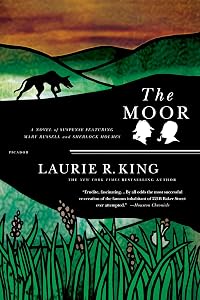
The Moor
by Laurie R. King 
Mary Russell (4), Mary Russell: Chronological Order (September-November 1923)
On This Page
Description
In the eerie wasteland of Dartmoor, Sherlock Holmes summons his devoted wife and partner, Mary Russell, from her studies at Oxford to aid the investigation of a death and some disturbing phenomena of a decidedly supernatural origin. Through the mists of the moor there have been sightings of a spectral coach made of bones carrying a woman long-ago accused of murdering her husband--and of a hound with a single glowing eye. Returning to the scene of one of his most celebrated cases, The Hound show more of the Baskervilles, Holmes and Russell investigate a mystery darker and more unforgiving than the moors themselves, in Laurie R. King's The Moor. show lessTags
Recommendations













Member Reviews
Mary is called from her studies in Oxford to join her husband Sherlock Holmes on Dartmoor. At first resentful, Mary soon becomes interested in investigating the death of an itinerant tin miner and rumors of a ghostly carriage and a hound with a single glowing eye. They are staying at the home of the Reverend Sabine Baring-Gould who is a long-time friend of Sherlock's. Baring-Gould is nearly ninety and dying but he is still a force to be reckoned with on the moor. He is the author of more than 150 books on a wide variety of topics (and Mary reads quite a number of them while in his home). He's most famous for collecting the traditional songs of Dartmoor and trying to preserve the culture that he fears will be lost when communication gets show more easier.
Dartmoor is the scene of one of Sherlock's most famous cases - The Hound of the Baskervilles -- and Baskerville Hall and its new owner American Richard Ketteridge play an important part in this story. I enjoyed the vivid descriptions of the land and the people of Dartmoor as Mary came to appreciate the stark beauty of the land. Even without the supernatural creatures who are supposed to inhabit the land, the fogs and marshes provide enough danger for any traveler. Add in the British military using part of the moor to test artillery and test out a new sort of tank and you have a dangerous place to spend time.
This was an excellent episode in this series. I liked seeing how Mary and Holmes are getting along after two years of marriage. show less
Dartmoor is the scene of one of Sherlock's most famous cases - The Hound of the Baskervilles -- and Baskerville Hall and its new owner American Richard Ketteridge play an important part in this story. I enjoyed the vivid descriptions of the land and the people of Dartmoor as Mary came to appreciate the stark beauty of the land. Even without the supernatural creatures who are supposed to inhabit the land, the fogs and marshes provide enough danger for any traveler. Add in the British military using part of the moor to test artillery and test out a new sort of tank and you have a dangerous place to spend time.
This was an excellent episode in this series. I liked seeing how Mary and Holmes are getting along after two years of marriage. show less
The MoorIn this, the fourth book about Mary Russell and her relationship with Sherlock Holmes, the main character is neither Mary nor Sherlock but the louring presence of Dartmoor, which clings to this novel like fog on wool.
Lauries R, King's prose is vivid and memorable helping me to experience the desolation of Dartmoor in winter. This is how she describes a trudge across the moor by Mary and Holmes:
"A meandering ridge on an approaching hill resembling the work of some huge prehistoric mole, became, on closer examination, an ancient stone wall nearly subsumed by the slow encroachment of the turf. A distance sweep of russet across a hillside, a scurf of firs and dying bracken and fern was cut by the dark of another ancient wall drawn show more along its side.
It was I supposed, picturesque enough, given the limited pallet of drab colours, but as a piece of impressionist art it served to evoke only the disagreeable feelings of restlessness, melancholia and a faint thread of menace."
As the trudge across the damp turf continues we see its impact on the spirit:
"By midday I was as grey and silent as anything else in that bleak place; edgy, with an unidentifiable sense of waiting and aching for a spot of colour."
But the novel is not all atmosphere. There is a strong and ingenious plot, stronger, I think than that of "The Hound Of The Baskervilles", that provides an opportunity to explore every aspect of life on the moor, including a wonderful scene in which the men of the moor sing in harmony for Mary in the local inn. The plot also takes us back to Baskerville hall, this time in the hands of an American, and shows us how times move on, even if the moor remains the same.
I enjoyed seeing Mary and Holmes working together, each understanding what the other would do and moving wordlessly to make it happen. Mary is no Watson, following where Holmes leads, she is an equal partner, trusted and depended upon.
There are two places where we get an insight into how this partnership works In her first walk across the moor, Mary tells us that the atmosphere was so spooky that:
"I might very well have heard the soft pad of the Baskerville hound behind me and felt its warm breath on the back of my neck. However, with Holmes beside me as a talisman, the spooks kept their distance and what might have been a place of animosity and danger was rendered merely desolate to the point of being grim."
"Talisman". What a wonderful word to describe one's partner , summoning up trust and safety and power.
We get to see how Holmes views Mary, his advice to a young man looking for a woman is:
"You look around for a woman with brains and spirit. You'll never be bored."
Reading this book is like settling into a favourite armchair next to a fire: comforting and deeply relaxing. show less
Lauries R, King's prose is vivid and memorable helping me to experience the desolation of Dartmoor in winter. This is how she describes a trudge across the moor by Mary and Holmes:
"A meandering ridge on an approaching hill resembling the work of some huge prehistoric mole, became, on closer examination, an ancient stone wall nearly subsumed by the slow encroachment of the turf. A distance sweep of russet across a hillside, a scurf of firs and dying bracken and fern was cut by the dark of another ancient wall drawn show more along its side.
It was I supposed, picturesque enough, given the limited pallet of drab colours, but as a piece of impressionist art it served to evoke only the disagreeable feelings of restlessness, melancholia and a faint thread of menace."
As the trudge across the damp turf continues we see its impact on the spirit:
"By midday I was as grey and silent as anything else in that bleak place; edgy, with an unidentifiable sense of waiting and aching for a spot of colour."
But the novel is not all atmosphere. There is a strong and ingenious plot, stronger, I think than that of "The Hound Of The Baskervilles", that provides an opportunity to explore every aspect of life on the moor, including a wonderful scene in which the men of the moor sing in harmony for Mary in the local inn. The plot also takes us back to Baskerville hall, this time in the hands of an American, and shows us how times move on, even if the moor remains the same.
I enjoyed seeing Mary and Holmes working together, each understanding what the other would do and moving wordlessly to make it happen. Mary is no Watson, following where Holmes leads, she is an equal partner, trusted and depended upon.
There are two places where we get an insight into how this partnership works In her first walk across the moor, Mary tells us that the atmosphere was so spooky that:
"I might very well have heard the soft pad of the Baskerville hound behind me and felt its warm breath on the back of my neck. However, with Holmes beside me as a talisman, the spooks kept their distance and what might have been a place of animosity and danger was rendered merely desolate to the point of being grim."
"Talisman". What a wonderful word to describe one's partner , summoning up trust and safety and power.
We get to see how Holmes views Mary, his advice to a young man looking for a woman is:
"You look around for a woman with brains and spirit. You'll never be bored."
Reading this book is like settling into a favourite armchair next to a fire: comforting and deeply relaxing. show less
Mary Russell is reluctantly dragged away from her studies after receiving a telegram from Holmes requesting her presence in Dartmoor. Holmes had been in Dartmoor visiting an old friend, but got drawn into an investigation after a local is killed. The case in question involves a ghostly carriage made of bones and a spectral hound haunting the Moor. Rather begrudgingly, Mary helps to scout for clues in the foggy, cold, and damp Moor. What both her and Holmes find are a handful of supernatural sightings that draw suspicious parallels between this case and one of Holmes' most famous investigations, The Hound of the Baskervilles.
Like a lot of Sherlock Holmes fans, The Hound of the Baskervilles holds a special place in my heart. So revisiting show more the setting of that mystery with Mary and Holmes had my geeky heart all a titter.
The pacing here was a lot faster than in some of the other Mary Russell books, which was a relief after slogging through the slow moving A Letter of Mary. My only complaint is pretty mild, Mary was going through a bit of a mid-life crisis that involved a hesitance to fully join Holmes in the case until near the end. So she sort of emotionally checked out during the first half of the investigation. While she was still physically involved, there was a lot of background noise involving her reluctance to be there at all. King did a good job of attributing this to a psychological backlash due to the events of the previous three books but, with such an awesome mystery going on, I got frustrated that Mary wasn't getting into it. However, Holmes more than made up for Mary's standoffish attitude. He was, luckily, more present here than he had been in the previous books and seemed really in his element. It was great seeing Holmes get to dash about and really get into the mystery, which is something we hadn't fully gotten to see in the first three novels.
Most of the action takes place in a huge echoing mansion and the chilly moor, which seems so far removed from the London/Sussex settings of the previous novels that it was a refreshing change. I also really adored the moor atmosphere because I'm a huge fan of Gothic mysteries. The moor offered a great eerie and isolated feeling typically found in that genre and it really upped the suspense.
This is, by far, my favorite out of the series so far. I highly recommend it. show less
Like a lot of Sherlock Holmes fans, The Hound of the Baskervilles holds a special place in my heart. So revisiting show more the setting of that mystery with Mary and Holmes had my geeky heart all a titter.
The pacing here was a lot faster than in some of the other Mary Russell books, which was a relief after slogging through the slow moving A Letter of Mary. My only complaint is pretty mild, Mary was going through a bit of a mid-life crisis that involved a hesitance to fully join Holmes in the case until near the end. So she sort of emotionally checked out during the first half of the investigation. While she was still physically involved, there was a lot of background noise involving her reluctance to be there at all. King did a good job of attributing this to a psychological backlash due to the events of the previous three books but, with such an awesome mystery going on, I got frustrated that Mary wasn't getting into it. However, Holmes more than made up for Mary's standoffish attitude. He was, luckily, more present here than he had been in the previous books and seemed really in his element. It was great seeing Holmes get to dash about and really get into the mystery, which is something we hadn't fully gotten to see in the first three novels.
Most of the action takes place in a huge echoing mansion and the chilly moor, which seems so far removed from the London/Sussex settings of the previous novels that it was a refreshing change. I also really adored the moor atmosphere because I'm a huge fan of Gothic mysteries. The moor offered a great eerie and isolated feeling typically found in that genre and it really upped the suspense.
This is, by far, my favorite out of the series so far. I highly recommend it. show less
Reading this, the fourth episode in King's Mary Russell series, was made more enjoyable by immediately preceding it with a re-read of [b:The Hound of the Baskervilles|8921|The Hound of the Baskervilles|Arthur Conan Doyle|http://photo.goodreads.com/books/1311281165s/8921.jpg|3311984]. The plot and characters of arguably the greatest of Sherlock Holmes stories was thus firmly in my head, ready to inform my reading of King's offering.
A very good offering it is. King does a superb job of evoking the most important "character" in the novel - and in The Hound of the Baskervilles for that matter - that is, Dartmoor itself: dark, lonely, mysterious, beautiful and threatening. Russell and Holmes are, as ever, on form. The supporting cast are show more equally well-drawn. The mystery ties neatly into the events of The Hound of the Baskervilles and is satisfying, if not particularly enthralling.
This novel does have its weaknesses. The weaving into the narrative of the life and works of Sabine Baring-Gould, while well done, was a touch excessive for my taste. I learned more about a man I'd never heard of before than I really wanted to know. And what I learned did not make me want to go out and learn even more. There was also a bit too much running around on Dartmoor done by Russell (and by Holmes, for that matter), to no great effect. The moor excursions provide plenty of local colour, but most of their travels on it only marginally advance the plot.
Still, I enjoyed this novel despite its weaknesses. King is an intelligent writer. She respects the Sherlock Holmes canon. Her version of Holmes is recognisable and Mary Russell is an interesting creation. Plus, between them Doyle and King have made me really want to visit Dartmoor. Preferably by daylight, in fine weather. And not on horseback.
Overall, I thought that this installment was marginally less sucessful than number 3, but still most enjoyable. Possibly closer to 3-1/2 stars. show less
A very good offering it is. King does a superb job of evoking the most important "character" in the novel - and in The Hound of the Baskervilles for that matter - that is, Dartmoor itself: dark, lonely, mysterious, beautiful and threatening. Russell and Holmes are, as ever, on form. The supporting cast are show more equally well-drawn. The mystery ties neatly into the events of The Hound of the Baskervilles and is satisfying, if not particularly enthralling.
This novel does have its weaknesses. The weaving into the narrative of the life and works of Sabine Baring-Gould, while well done, was a touch excessive for my taste. I learned more about a man I'd never heard of before than I really wanted to know. And what I learned did not make me want to go out and learn even more. There was also a bit too much running around on Dartmoor done by Russell (and by Holmes, for that matter), to no great effect. The moor excursions provide plenty of local colour, but most of their travels on it only marginally advance the plot.
Still, I enjoyed this novel despite its weaknesses. King is an intelligent writer. She respects the Sherlock Holmes canon. Her version of Holmes is recognisable and Mary Russell is an interesting creation. Plus, between them Doyle and King have made me really want to visit Dartmoor. Preferably by daylight, in fine weather. And not on horseback.
Overall, I thought that this installment was marginally less sucessful than number 3, but still most enjoyable. Possibly closer to 3-1/2 stars. show less
Mary Russell and her husband Sherlock Holmes are called in to solve a murder on Dartmoor. An old haunt for Sherlock where he solved tbe case of The Hound of the Baskervilles.
I was first drawn to this book by its mysterious cover and the premise. I haven't read a Sherlock Holmes book before although I know who he is and what types of stories he does feature in. This book is the fourth in the series but my first. I know nothing about Mary Russell and how she came to marry Holmes so I'm thrown straight into it.
The book is very wordy and has wonderful descriptions of Dartmoor. I enjoyed the descriptions and liking a good walk myself I could picture myself up there covered in mud.
However this is what the book seems to be all about, the show more moors. Mary and Sherlock seem to spend an awful lot of time walking the moors. Not a lot else seems to happen in the book. As much as I was enjoying the descriptions of the landscape and all the ghostly goings on, superstitions and old stories, I was bored.
The story started of promising and I was thinking my type of book, but oh no I had had enough. Skimming the last 100 pages just to see what was what.
Unfortunately not enough in this book to thrill me and to reach out for more in the series. Lovely descriptions though. I also think that perhaps I needed to have read The Hound of the Baskervilles. show less
I was first drawn to this book by its mysterious cover and the premise. I haven't read a Sherlock Holmes book before although I know who he is and what types of stories he does feature in. This book is the fourth in the series but my first. I know nothing about Mary Russell and how she came to marry Holmes so I'm thrown straight into it.
The book is very wordy and has wonderful descriptions of Dartmoor. I enjoyed the descriptions and liking a good walk myself I could picture myself up there covered in mud.
However this is what the book seems to be all about, the show more moors. Mary and Sherlock seem to spend an awful lot of time walking the moors. Not a lot else seems to happen in the book. As much as I was enjoying the descriptions of the landscape and all the ghostly goings on, superstitions and old stories, I was bored.
The story started of promising and I was thinking my type of book, but oh no I had had enough. Skimming the last 100 pages just to see what was what.
Unfortunately not enough in this book to thrill me and to reach out for more in the series. Lovely descriptions though. I also think that perhaps I needed to have read The Hound of the Baskervilles. show less
The whole sub genre of Sherlock Holmes-type mysteries is by its very nature highly intellectual, what with all the deductive reasoning, but this entry in the Mary Russell series is especially so. I was quite tickled to realize that big chunks of the mystery here were to be solved through clues gleaned from extensive reading. I love that Mary can be very--perhaps most--helpful to Holmes from her cozy fireside wingback. It is a position to be envied, and aspired to: armchair detective. Of course there is a fair amount of traipsing that occurs in this story, as Russell and Holmes slog up, down and across the moor, a place unique and moody, gloomy and beautiful, inspiring and deadly. The descriptions are rich and gorgeous, and make me want show more to see it for myself. I hope it exists as Laurie King writes it here, because it sounds like a weird and wonderful landscape. show less
King leaves few stops unpulled in this atmospheric tale. For those of us who love settings that qualify as characters, Dartmoor permeates every page of this fourth book in her marvelous series. The land, the weather, the abandoned mines, the remote farms, the legends and tales... King brings it all to life-- sometimes to creepy, hair-raising life.
Although Sir Arthur Conan Doyle's The Hound of the Baskervilles is the quasi-foundation of this book, it's not necessary to have read it before picking up The Moor. If you have read it, you'll begin King's book with a shiver of anticipation for the spooky things that certainly lie ahead. And they do. I found the author's depiction of Dartmoor enough to give me goosebumps without the sightings show more of bony coaches and one-eyed hounds or the strange new inhabitants of Baskerville Hall.
As usual, King knows how to make us feel as though we've stepped right into England in 1924, and she certainly knows how to tell a story, but it's her characters who make the books truly memorable. Holmes is Holmes. You'd recognize him anywhere, and he's perfectly at home in the early twentieth century. Mary Russell is brilliant in her own way and incredibly strong-willed. If these two were horses, few people would ever dream of harnessing them together. Only the very wise would be able to see that it's the only pairing either of them would accept. One of the treats of reading this series is to watch these two individuals-- who spend a lot of their time apart-- gradually learn that they can become a couple without sacrificing the parts of themselves that they hold most dear.
Even though I found that I could deduce most of the mystery this time around (I'm still not sure why), The Moor was a delight to read. Atmosphere, setting, time period, Sherlock Holmes, and one woman strong enough to stand side by side with the world's greatest detective. Get comfortable and immerse yourself in this tale. show less
Although Sir Arthur Conan Doyle's The Hound of the Baskervilles is the quasi-foundation of this book, it's not necessary to have read it before picking up The Moor. If you have read it, you'll begin King's book with a shiver of anticipation for the spooky things that certainly lie ahead. And they do. I found the author's depiction of Dartmoor enough to give me goosebumps without the sightings show more of bony coaches and one-eyed hounds or the strange new inhabitants of Baskerville Hall.
As usual, King knows how to make us feel as though we've stepped right into England in 1924, and she certainly knows how to tell a story, but it's her characters who make the books truly memorable. Holmes is Holmes. You'd recognize him anywhere, and he's perfectly at home in the early twentieth century. Mary Russell is brilliant in her own way and incredibly strong-willed. If these two were horses, few people would ever dream of harnessing them together. Only the very wise would be able to see that it's the only pairing either of them would accept. One of the treats of reading this series is to watch these two individuals-- who spend a lot of their time apart-- gradually learn that they can become a couple without sacrificing the parts of themselves that they hold most dear.
Even though I found that I could deduce most of the mystery this time around (I'm still not sure why), The Moor was a delight to read. Atmosphere, setting, time period, Sherlock Holmes, and one woman strong enough to stand side by side with the world's greatest detective. Get comfortable and immerse yourself in this tale. show less
Members
- Recently Added By
Published Reviews
If Sherlock Holmes had taken a wife -- which happens to be the cheeky premise of the enchanting, if unorthodox, historical mysteries of Laurie R. King -- he could not have chosen better than Mary Russell, an Oxford scholar with brains and humor. . . . Sherlockians have their choice of being amused or affronted by these artful embellishments on the Holmes canon, and few will appreciate the show more curiously wan characterization of the great detective. But there's no resisting the appeal of King's thrillingly moody scenes of Dartmoor and her lovely evocation of its legends. show less
added by InfoQuest
Lists

Crime and Mysteries to Read
746 works; 31 members

Female Author
1,235 works; 67 members

British Mystery
469 works; 14 members

Books Read in 2012 (Numbered)
168 works; 6 members

Detective Stories
343 works; 5 members

Books Read in 2016
4,666 works; 199 members
Author Information

80+ Works 46,743 Members
Laurie R. King is the bestselling author of "A Darker Place," four contemporary novels featuring Kate Martinelli, and five acclaimed Mary Russell mysteries. She lives in northern California. Her newest book is the ninth one in the Mary Russell mystery series, The Language of Bees. (Publisher Provided) Laurie R. King is a mystery writer, who holds show more a bachelor's degree and a master's degree in theology. Her first novel, Grave Talent, was published in 1993 and won the Edgar Award for Best First Novel. Since then, she has written over twenty books including the Mary Russell Mysteries series, the Stuyvesant and Grey series, the Kate Martinelli Mystery series, A Darker Place, Folly, and Keeping Watch. She has also co-authored a number of nonfiction works and anthologies including Crime Writing, The Grand Game, and Studies in Sherlock. Laurie's title, Dreaming Spies, is a 2015 New York Times Bestseller. (Bowker Author Biography) show less
Laurie R. King is a LibraryThing Author, an author who lists their personal library on LibraryThing.
Some Editions
Series


Work Relationships
Is contained in
Is a (non-series) sequel to
Has as a student's study guide
Common Knowledge
- Canonical title
- The Moor
- Original title
- The Moor
- Original publication date
- 1998-01
- People/Characters
- Mary Russell; Sherlock Holmes; Sabine Baring-Gould; Richard Kitterage; David Scheiman; Josiah Gorton (show all 7); Randolph Pethering
- Important places
- Dartmoor, Devon, England, UK
- Important events
- Interbellum (1918 | 1939)
- Epigraph
- "When I obtained a holiday from my books, I mounted my pony and made for the moor." -- A Book of Dartmoor
- Dedication
- For Ruth Cavin, editor extraordinaire, with undying thanks and affection. A blessing on you and your house
- First words
- The telegram in my hand read:
RUSSELL NEED YOU IN DEVONSHIRE. IF FREE TAKE EARLIEST TRAIN CORYTON. IF NOT FREE COME ANYWAY. BRING COMPASS.
HOLMES - Quotations
- Why was it, I reflected irritably, that Holmes' little adventures never took us to luxury hotels in the south of France, or to warm, sandy Caribbean beaches?
I decided that the butler must have worked in Ketteridge's house for some time, since he was not only resigned to his employer's hasty willingness to do away with his services by opening doors for himself, but he did not even... (show all) react to receiving an apology from his employer. Perhaps, I amended my diagnosis, he had merely worked for Americans before.
The horse was as solid and without frills as his name, capable of two gaits: a leisurely stroll and a spine-snapping trot. An experimental urge towards a canter met with a slowing of the trot and a laying back of the ears, a ... (show all)clear message that he was going as fast as he could, damn it, and if I didn't like it, I could just get down and run myself.
it began to feel almost as if there were another person in the rock shelter with us—or if not a person, then at least a Presence. It did not seem to me, as Holmes had suggested, an evil presence, nor even a terribly powerfu... (show all)l one, but I thought it old, very old, and patient. It felt, I decided, as if the moor itself were holding watch with us. - Last words
- (Click to show. Warning: May contain spoilers.)We tucked the old man in with travelling rugs and placed a hot brick beneath his shoes, and with Holmes at his side and myself driving, we took the Reverend Sabine Baring-Gould up onto the moor for one last earthly look at that region he loved best in all the world.
- Original language
- English
Classifications
Statistics
- Members
- 2,570
- Popularity
- 7,406
- Reviews
- 72
- Rating
- (3.78)
- Languages
- 5 — Dutch, English, German, Japanese, Croatian
- Media
- Paper, Audiobook, Ebook
- ISBNs
- 30
- ASINs
- 12