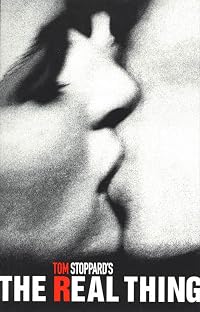
The Real Thing
by Tom Stoppard
On This Page
Description
The Real Thing is one of Tom Stoppard's most enduring and highly acclaimed dramatic works, first performed in 1982 at The Strand Theatre in London, starring Felicity Kendal and Roger Rees. The Real Thing begins with Max and Charlotte, a couple whose marriage is on the verge of collapse. Charlotte is an actress who has been appearing in a play about marriage written by her husband, Henry. Max, her leading man, is also married to an actress, Annie. Both marriages are at the point of rupture show more because Henry and Annie have fallen in love. But is it the real thing? Tom Stoppard combines his characteristically brilliant wordplay and wit with flashes of insight that illuminate the nature-and the mystery-of love, creating a multi-toned play that challenges the mind while searching out the innermost secrets of the heart. Winner of the Tony Award for Best Play, The Real Thing is brilliant and heartfelt, an extraordinary theatrical exploration of marriage, fidelity, and the creative life. show lessTags
Recommendations



















Member Reviews
I picked this up after s.penkevich's review. I had not read a play in a while, and was immediately intrigued.
It is such a joy! For the amount of hurt in there, it is amazing how Stoppard is able to cover it up with satirical cynicism. Great commentary on love, trust, friendship, and infidelity. Highly recommend.
Another few lines on a similar note ...
I also really like how it show more explores the duplicity of love. It can be so complete that it borders on selfless, and at the same time so utterly selfish!
Another fun read! Will definitely check out other plays from Stoppard. I like his sense of humour and witty spews. show less
It is such a joy! For the amount of hurt in there, it is amazing how Stoppard is able to cover it up with satirical cynicism. Great commentary on love, trust, friendship, and infidelity. Highly recommend.
There’s something scary about stupidity made coherent. I can deal with idiots, and I can deal with sensible argument, but I don’t know how to deal with you.
Another few lines on a similar note ...
HENRY Don’t get too good at that.
DEBBIE What?
HENRY Persuasive nonsense. Sophistry in a phrase so neat you can’t see the loose end that would unravel it. It’s flawless but wrong. A perfect dud.
I also really like how it show more explores the duplicity of love. It can be so complete that it borders on selfless, and at the same time so utterly selfish!
The trouble is, I can’t find a part of myself where you’re not important. I write in order to be worth your while and to finance the way I want to live with you. Not the way you want to live. The way I want to live with you. Without you I wouldn’t care. I’d eat tinned spaghetti and put on yesterday’s clothes.
Another fun read! Will definitely check out other plays from Stoppard. I like his sense of humour and witty spews. show less
While this does bear the hallmarks of a Tom Stoppard play, it is not up to his usual standard. There is very little hilarity in the jokes, and the dialogue is rather uninspired. The short pieces of a play within a play were written to be deliberately bad, and he did achieve that to some rather hilarious results. The problem is that the plot feels contrived, and the characters are not sympathetic, nor are the unlikable in a particularly interesting way. They are flat. The premise of adultery wrapped up in more adultery, and the inability to maintain a constant, faithful relationship with one person is banal by virtue of being overdone. Overall, a work not worthy of a genius, and one wonders why it won prizes.
Two couples negotiate marriage, creativity, love and infidelity in 1980s London. A beautifully clever scene involves a cricket bat vs. a plank of wood as a comparison of good writing vs. bad.
I forgive a lot for the cricket-bat metaphor. This starts out being one play, a truly fascinating one, about metafiction and the nature of belief and the power of context, but turns out to be a different one, with politics visible and Stoppard's weakness with writing women on full display. It's still good and interesting, but it's a simplified Arcadia, and I'm sorry for that.
This play about love (when is it the "real thing"?) & jealousy doesn't age as well as some of Stoppard's other plays. That said, it is still a fun play to read & I would love to see it performed. The Stoppard touch is evident with certain scenes & pieces of dialogue repeating throughout the play, with differing emphasis or characters. The strength of the play (in my humble opinion) is in the exploration of how couples react to the infidelity (real and imagined).
I wasn't a huge fan of this play, but that's probably due to my lack of interest in romantic themes in literature. The Life Imitates Art angle had potential, but didn't engage me enough to make a difference, and there was never a point that I really felt invested in any of the characters. Not a bad play, but not really for me.
Wow - what a great play. I was fortunate enough to see this on Broadway a few years back with the incomparable Jennifer Ehle.
Members
- Recently Added By
Lists

My Play Collection
769 works; 3 members
Author Information

113+ Works 23,576 Members
When the National Theatre needed a last-minute substitute for a canceled production of As You Like It, Kenneth Tynan decided to stage Rosencrantz and Guildenstern Are Dead, a work by an unfamiliar author that had received discouraging notices from provincial critics at its Edinburgh Festival debut. Of course, the play, when it opened in April show more 1967, met with universal acclaim. In New York the next year, it was chosen best play by the Drama Critics Circle. In such an unlikely way, Tom Stoppard came to light. Born in Czechoslovakia, a country he left (for Singapore) when he was an infant, he began his literary career as a journalist in Bristol, where play reviewing led to playwriting. After Rosencrantz and Guildenstern, Stoppard's reputation suffered through the production of a number of minor works, whose intellectual preoccupations were shrugged off by reviewers: Enter a Free Man (1968; "an adolescent twinge of a play," N.Y. Times), The Real Inspector Hound (1968; "lightweight," N.Y. Times), and After Magritte. But in the 1970s, the initial enthusiasms aroused by Rosencrantz and Guildenstern were more than vindicated by the production of two full-length plays, Jumpers (1974) and the antiwar play Travesties (1975), whose immense verbal and theatrical inventiveness made them absolute successes on both sides of the Atlantic. Stoppard's method from the start has been to contrive explanations for highly unlikely encounters---of objects (the ironing board, old lady, and bowler hat of After Magritte), characters (Joyce, Lenin, and Tzara in Travesties), and even plays (Hamlet, Rosencrantz and Guildenstern, The Importance of Being Earnest, Travesties, and The Real Thing, 1982). In the 1970s, Tynan called for Stoppard---as a Czech and as an artist---to engage himself politically. But although political subjects have since found their way into pieces from Every Good Boy Deserves Favor (1977) to Squaring the Circle (1985), politics and art seem to have become just two more of the playwright's irreconcilables, which meet, but never join, in the logical frames of his comedy. The presence of political material---such as the Lenin sections that nearly ruin the second part of Travesties---has occasionally strained the structure of the plays. But in The Real Thing Stoppard is comfortable enough with the satire on art and activism to bring a third subject, love, into the mix. Stoppard has acknowledged his Eastern European heritage nonpolitically, in a series of adaptations of plays by Arthur Schnitzler (see Vol. 2), Johann Nestroy, and Ferenc Molnar. (Bowker Author Biography) Tom Stoppard is the author of many plays, including Rosencrantz and Guildenstern Are Dead, Jumpers, Travesties, and The Invention of Love. He lives in London. (Publisher Provided) show less
Awards and Honors
Series
Belongs to Publisher Series
Haagse Comedie (27)
Work Relationships
Is contained in
Has as a supplement
Has as a student's study guide
Common Knowledge
- Original publication date
- 1982
- Original language
- English
- Disambiguation notice
- 1. The Real Thing
Faber and Faber, 1982 [ISBN: 0571132006] 83pp
Faber and Faber [pb], 1983 (revised) [ISBN: 0571119832] 83pp
Faber and Faber [book club edition], 1983
2. The Real Thing [revised, "Broadway edition"... (show all)]
Faber and Faber, 1984 [ISBN: 057112528X] 81pp
Faber and Faber [pb], 1984 [ISBN: 0571125298] 81pp
Samuel French [pb], 1984 [ISBN: 057361458X] 65pp
Faber and Faber [pb], 1986 (further revised) [ISBN: 0571119832] 82pp
Samuel French [pb], 1986 [ISBN: 0573016372] 65pp *
Faber and Faber [pb], 2000 [ ISBN: 0571125298] 96pp *
0571119832 1982 softcover
057112528X 1984 hardcover
0571125298 1984 softcover USA
0571132006 1983 hardcover
Classifications
Statistics
- Members
- 811
- Popularity
- 33,836
- Reviews
- 9
- Rating
- (4.03)
- Languages
- Dutch, English
- Media
- Paper, Audiobook, Ebook
- ISBNs
- 16
- ASINs
- 8