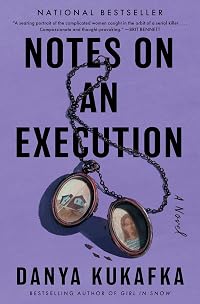
Notes on an Execution
by Danya Kukafka
On This Page
Description
"Ansel Packer is scheduled to die in twelve hours. He knows what he's done, and now awaits execution, the same chilling fate he forced on those girls, years ago. But Ansel doesn't want to die--he wants to be celebrated, understood. Through a kaleidoscope of women--a mother, a sister, a homicide detective--we learn the story of Ansel's life. As the clock ticks down, these three women sift through the choices that culminate in tragedy, exploring the rippling fissures that such destruction show more inevitably leaves in its wake"-- show lessTags
Recommendations




Member Reviews
Ansel Packer is on Death Row and is due to be executed in 12 hours. The novel is structured in alternating chapters between second-person narration as the hours tick down in Ansel's cell and chapters by various women in his life: his mother, his sister-in-law, and the female detective who tracked him down. Their stories take place over decades and are told in the third person.
In an afterward, the author writes about the enduring fascination with the serial killer and the myth of the savage yet charming man-next-door, who is the last person you would ever expect. She writes:
I'm baffled by this myth, a uniquely American fiction we have glorified for decades. Average men become interesting when they start hurting women.
Notes on an show more Execution was born from a desire to dissect this exhausted narrative...
There is a universe out there, made up of girls and women, stranded by a fiction we insist upon repeating. I wrote this book to give them a chance to exist beyond the men who steal the narrative. The story of the serial killer is bigger than the bodies he leaves behind—it encompasses an infinite web, an elaborate tangle of predominantly female trauma and endurance. There is a question lurking in the dark corners of that weary tale. I wrote this novel because I needed to ask. I needed to look. I am tired of seeing Ted Bundy's face. This is a book for the women who survive.
The stories of the women who are murdered are not told, it's the stories of the women who survive, but are nonetheless traumatized by their contact with the murderer.
The use of the second person narrative in the chapters dealing with Ansel was at first baffling, but ultimately brilliant. It moves the reader from the particular to the ubiquitous and also involves the reader in an uncomfortable way. I also liked how the author layer by layer removes the power and attraction from Ansel and reveals him to be mundane, boring, and ultimately irrelevant to the story. It is the lives of the survivors which are important, and the memory of the murdered women, who cannot be reduced to merely The Girls he killed, and who they might have become five, ten, fifty years later. This is a book which surprised me, and I'm glad I will have the chance to discuss it with my book group, for there is a lot here that begs reflection. show less
In an afterward, the author writes about the enduring fascination with the serial killer and the myth of the savage yet charming man-next-door, who is the last person you would ever expect. She writes:
I'm baffled by this myth, a uniquely American fiction we have glorified for decades. Average men become interesting when they start hurting women.
Notes on an show more Execution was born from a desire to dissect this exhausted narrative...
There is a universe out there, made up of girls and women, stranded by a fiction we insist upon repeating. I wrote this book to give them a chance to exist beyond the men who steal the narrative. The story of the serial killer is bigger than the bodies he leaves behind—it encompasses an infinite web, an elaborate tangle of predominantly female trauma and endurance. There is a question lurking in the dark corners of that weary tale. I wrote this novel because I needed to ask. I needed to look. I am tired of seeing Ted Bundy's face. This is a book for the women who survive.
The stories of the women who are murdered are not told, it's the stories of the women who survive, but are nonetheless traumatized by their contact with the murderer.
The use of the second person narrative in the chapters dealing with Ansel was at first baffling, but ultimately brilliant. It moves the reader from the particular to the ubiquitous and also involves the reader in an uncomfortable way. I also liked how the author layer by layer removes the power and attraction from Ansel and reveals him to be mundane, boring, and ultimately irrelevant to the story. It is the lives of the survivors which are important, and the memory of the murdered women, who cannot be reduced to merely The Girls he killed, and who they might have become five, ten, fifty years later. This is a book which surprised me, and I'm glad I will have the chance to discuss it with my book group, for there is a lot here that begs reflection. show less
A man sits on death row, counting down the days and hours. The book alternates between his thoughts and the lives of the three women that have been impacted by this man, though in very different ways. Is this a bad man, or was there good inside of him? What caused him to do what he did? Nature vs. Nurture. This excellent book gives the reader much to think about, to question. Why do we remember the names of the killers, but seldom remember the name of the victims? The question of fate. The what ifs asked by those left behind. What if I had noticed sooner? Helped sooner? What did I miss, not see? Murder doesn't happen in a vacuum. It doesn't just affect those gone, but those left behind. To think, ponder, why? Regret.
An impactful book. show more One that holds many truths, realities. One that would make an excellent book discussion. It has many layers, and although fiction, it could be nonfiction, taken right out of today's headlines.
ARC from Edelweiss show less
An impactful book. show more One that holds many truths, realities. One that would make an excellent book discussion. It has many layers, and although fiction, it could be nonfiction, taken right out of today's headlines.
ARC from Edelweiss show less
My daughter brought Danya Kukafka's NOTES ON AN EXECUTION to my attention, declaring I needed to read it immediately because it was so good. Since my family members recommending books to me so very rarely happens, I did what she asked, and I'm glad I did.
NOTES ON AN EXECUTION is like nothing I've read before. Ms. Kukafka makes Ansel so believable and so real that I questioned whether the story was fictional. Plus, in a rare situation, I struggled with two of the three women at the heart of Ansel's story. It is so unusual for me to find the serial killer more empathetic than the killer's inadvertent victims.
There is no doubt that Lavender is an innocent, barely more than a child herself, no money, no skills, and under the thumb of an show more abusive husband. I see her actions as nothing more than what she needs to do to survive and to give her child a chance for a better life. I don't fault her for her later choices; I consider them part of her ongoing survival. Having never given a child up for adoption before, I can't truly empathize with her, but I do recognize that the pain of separating from your child would be unbearable. I also imagine that it is a pain that would never ease, so her actions, or inactions as they were, make sense to me.
Even Hazel's actions make sense to me, given her family dynamic, especially the inadvertent competition her parents created between her and her sister. I can see how easy it would be in that scenario to gloat about her sister's fall from grace while also mourning her loss. Again, nothing Hazel does surprises me or seems out of place for her character and her relationship to Ansel.
I do have a problem with Saffy, which makes me view Ansel as the more sympathetic of the two and, therefore, has me secretly wishing he would escape justice. I view her as a meddling know-it-all who hides behind her career to justify her actions despite the directive to stop her private investigation. Everything Saffy does leads directly to Ansel's incarceration, and, one could argue, to at least one of Ansel's victims. I don't think Saffy sees her actions as anything but justified, even though they scream more of vengeance owed than justice served.
As for Ansel, he is the power behind NOTES ON AN EXECUTION. He is so earnest that even though you know that there is no justification for his actions, you recognize that his rage comes from his formative years living in fear of his father, as well as undiagnosed trauma from those days. He is someone who needs mental health therapy more than anything. Even when we see him for who he really is, still deeply traumatized and suffering, you question whether the sentence given to him by the justice system is true justice.
Ansel's life theory - that everyone is both good and bad, and it is our choices that decide how we manifest either side - is an interesting one. I've said something similar to my husband once or twice, but I also recognize that it isn't just our choices that determine which way we go. So much affects our decisions that to ignore them is to reduce those choices to nothing but a coin toss. That is where Ansel's manifesto falls short - he fails to take into account our history, our environment, and the people who taught us.
NOTES ON AN EXECUTION did more to convince me that a death sentence is a cruel and unusual punishment, and we need to eliminate that option in our judicial system as soon as possible. Everything about Ansel's last days filled me with terror because it was all a psychological game at that point. I don't know if Ansel's experiences are de rigeur for all death row inmates, but I doubt there is anything more terrifying to experience than the lead-up to the deed itself.
Ms. Kukafka's NOTES ON AN EXECUTION is the type of novel that begs to be discussed. It is the type of novel where everyone will have a slightly different impression of the characters and the story itself. You needn't even bring up the political hot potato item of the death penalty to have a lively conversation with others. Ms. Kukafka makes it so easy to forget that the entire thing is fictional, and that blurred line between fact and fiction will add heightened emotions to those discussions. It is books like NOTES ON AN EXECUTION that make me wish I were in a book club. show less
NOTES ON AN EXECUTION is like nothing I've read before. Ms. Kukafka makes Ansel so believable and so real that I questioned whether the story was fictional. Plus, in a rare situation, I struggled with two of the three women at the heart of Ansel's story. It is so unusual for me to find the serial killer more empathetic than the killer's inadvertent victims.
There is no doubt that Lavender is an innocent, barely more than a child herself, no money, no skills, and under the thumb of an show more abusive husband. I see her actions as nothing more than what she needs to do to survive and to give her child a chance for a better life. I don't fault her for her later choices; I consider them part of her ongoing survival. Having never given a child up for adoption before, I can't truly empathize with her, but I do recognize that the pain of separating from your child would be unbearable. I also imagine that it is a pain that would never ease, so her actions, or inactions as they were, make sense to me.
Even Hazel's actions make sense to me, given her family dynamic, especially the inadvertent competition her parents created between her and her sister. I can see how easy it would be in that scenario to gloat about her sister's fall from grace while also mourning her loss. Again, nothing Hazel does surprises me or seems out of place for her character and her relationship to Ansel.
I do have a problem with Saffy, which makes me view Ansel as the more sympathetic of the two and, therefore, has me secretly wishing he would escape justice. I view her as a meddling know-it-all who hides behind her career to justify her actions despite the directive to stop her private investigation. Everything Saffy does leads directly to Ansel's incarceration, and, one could argue, to at least one of Ansel's victims. I don't think Saffy sees her actions as anything but justified, even though they scream more of vengeance owed than justice served.
As for Ansel, he is the power behind NOTES ON AN EXECUTION. He is so earnest that even though you know that there is no justification for his actions, you recognize that his rage comes from his formative years living in fear of his father, as well as undiagnosed trauma from those days. He is someone who needs mental health therapy more than anything. Even when we see him for who he really is, still deeply traumatized and suffering, you question whether the sentence given to him by the justice system is true justice.
Ansel's life theory - that everyone is both good and bad, and it is our choices that decide how we manifest either side - is an interesting one. I've said something similar to my husband once or twice, but I also recognize that it isn't just our choices that determine which way we go. So much affects our decisions that to ignore them is to reduce those choices to nothing but a coin toss. That is where Ansel's manifesto falls short - he fails to take into account our history, our environment, and the people who taught us.
NOTES ON AN EXECUTION did more to convince me that a death sentence is a cruel and unusual punishment, and we need to eliminate that option in our judicial system as soon as possible. Everything about Ansel's last days filled me with terror because it was all a psychological game at that point. I don't know if Ansel's experiences are de rigeur for all death row inmates, but I doubt there is anything more terrifying to experience than the lead-up to the deed itself.
Ms. Kukafka's NOTES ON AN EXECUTION is the type of novel that begs to be discussed. It is the type of novel where everyone will have a slightly different impression of the characters and the story itself. You needn't even bring up the political hot potato item of the death penalty to have a lively conversation with others. Ms. Kukafka makes it so easy to forget that the entire thing is fictional, and that blurred line between fact and fiction will add heightened emotions to those discussions. It is books like NOTES ON AN EXECUTION that make me wish I were in a book club. show less
I was surprised by how much I liked this book as it is well outside my regular reading wheelhouse. I guess this is properly classed as a psychological thriller, but it seems to me that a thriller should have some mystery to it, and there is none here. We know very early on where Ansel Packer's life is headed, he is a serial killer and he is on death row. I saw a couple GR reviews that indicated the mystery was in the "why" but that is not correct. Kukafka is pleasingly assured writer and does not let herself get sucked into the why, because that is a false narrative. There is no why. What answer could suffice to tell us why a person murders people, especially people he does not even know? Yes, Ansel drew a very unfortunate hand when show more born, and the fallout from that made his misfortune continue. (I won't say more because it would spoil many things.) It is important to understand the genesis of Ansel's inner rage, though it does not explain the ways in which it manifested.
I have written in other reviews about how I like mysteries where the mystery is not the point, but rather the structure on which the stories of the people impacted are told. Louise Penny, for example, is great at this. This book does exactly that. Ansel is in prison about to be executed for murdering women, that is the structure, but his story is not what matters most. This book tells the story and displays the harm mostly from the perspectives of women whose lives were profoundly affected by Ansel (not those murdered) and those stories are not entirely focused on the ways in which their connections to Ansel impacted them or impacted him. We learn about these women, we get to know them, and we get to know the people around them who also suffered collateral damage because of Ansel. We hear from Ansel too, but not to get the "true story." T0 say he is an unreliable narrator is to grossly understate that facts. We get Ansel's story because it is intriguing, and also helps to build out the stories of the women. It doesn't answer the impossible question, the why, but it informs the experiences of the women in the book. (We don't get to know the murdered women's stories, but even though their personal stories do not get to the page their loses are made bigger and realer and more tragic through Ansel's thoughts.) In some ways I think Kukafka had goals similar to Emma Cline in The Girls (which I kind of hated) but she does a much better job of subtly driving home the stories of these women, who are so much more important than Ansel, who in the end is another mediocre white guy with a horrible early life who believes he is special. None of that means he should also be murdered. I cannot imagine anyone reading this and being comfortable with Ansel's execution. Ansel is damaged, evil, but not unsympathetic. There is so such thing as "pure evil." Ansel is a human being, with human needs, and human dreams. The author does not go for the easy black and white good vs. evil tropes so common in crime literature.
I heartily recommend this one. show less
I have written in other reviews about how I like mysteries where the mystery is not the point, but rather the structure on which the stories of the people impacted are told. Louise Penny, for example, is great at this. This book does exactly that. Ansel is in prison about to be executed for murdering women, that is the structure, but his story is not what matters most. This book tells the story and displays the harm mostly from the perspectives of women whose lives were profoundly affected by Ansel (not those murdered) and those stories are not entirely focused on the ways in which their connections to Ansel impacted them or impacted him. We learn about these women, we get to know them, and we get to know the people around them who also suffered collateral damage because of Ansel. We hear from Ansel too, but not to get the "true story." T0 say he is an unreliable narrator is to grossly understate that facts. We get Ansel's story because it is intriguing, and also helps to build out the stories of the women. It doesn't answer the impossible question, the why, but it informs the experiences of the women in the book. (We don't get to know the murdered women's stories, but even though their personal stories do not get to the page their loses are made bigger and realer and more tragic through Ansel's thoughts.) In some ways I think Kukafka had goals similar to Emma Cline in The Girls (which I kind of hated) but she does a much better job of subtly driving home the stories of these women, who are so much more important than Ansel, who in the end is another mediocre white guy with a horrible early life who believes he is special. None of that means he should also be murdered. I cannot imagine anyone reading this and being comfortable with Ansel's execution. Ansel is damaged, evil, but not unsympathetic. There is so such thing as "pure evil." Ansel is a human being, with human needs, and human dreams. The author does not go for the easy black and white good vs. evil tropes so common in crime literature.
I heartily recommend this one. show less
Listened to this on audio. This was a very interesting take on the crime thriller. We already know who did it, he's on death row for killing several young girls back in the day. Today is is last day and we watch the him has he goes thru his day on his way to the execution chamber. Intercut with this we go back in time to meet the women in his life, those who raised him, those he killed and those who caught him. What's absent, to good effect, is all the violence of the actual crimes. We know he did it, we don't have to "see" it, we just get to meet and understand the people around him. A good quick read.
Ansel Packer has killed four women and now he faces execution. He believes that he shouldn't die, he believes in his philosophy of life. However the story isn't about Ansel, it's about three women whose lives he has impacted - his mother, the twin sister of his wife and the detective who personal history with Ansel goes right back to the start.
I liked Kukafka's previous novel but this is something special. She has taken the traditional story of the serial killer and turned it on its head, made it into a feminist story and a celebration of womanhood. Each of the characters is distinct and with their own motivations, the setting in the beautiful but wild north is exquisitely described. There is no dwelling on violence, just a sense of show more menace and a sense that not everyone listens. show less
I liked Kukafka's previous novel but this is something special. She has taken the traditional story of the serial killer and turned it on its head, made it into a feminist story and a celebration of womanhood. Each of the characters is distinct and with their own motivations, the setting in the beautiful but wild north is exquisitely described. There is no dwelling on violence, just a sense of show more menace and a sense that not everyone listens. show less
Not gonna lie, that was a difficult read. Ansel Packer is counting down the hours until his execution after some brutal murders. I found it quite unsettling that his story was narrated in second person. It made being with him during his last 12 hours an uncomfortably intimate experience as his inevitable death drew closer. The writing is sublime and the tension palpable.
“You are a fingerprint. When you open your eyes on the last day of your life, you see your own thumb. In the jaundiced prison light, the lines on the pad of your thumb look like a dried-out riverbed, like sand washed into twirling patterns by water, once there and now gone.”
Whilst we see Ansel's point of view, it is actually the women in his life that drive the show more story and peel back the layers of time so we can build a picture of how such a man came to be. Their voices are powerful and haunting because we as readers know how his life will unfold and the devastation he will bring. Their accounts are raw and they felt like real women, not just characters in a story. This move away from a typical serial killer novel to where the focus lies with the women made the story more absorbing in my opinion. What is equally hard hitting is that we aren't there to hate Ansel. In fact, I felt compassion for the boy left alone. “In most of your memories, your mother is gone. And before she is gone, always, she is leaving.” That mixed with the feelings of revulsion I felt for his actions made for a head and heart spinning experience. After all “No one is all bad. No one is all good. We live as equals in the murky gray between.”
Content warning: I want to give an open warning about the animal harm in this book. None of the harm is on page but there are gruesome descriptions of animal bodies. There is also domestic abuse. show less
“You are a fingerprint. When you open your eyes on the last day of your life, you see your own thumb. In the jaundiced prison light, the lines on the pad of your thumb look like a dried-out riverbed, like sand washed into twirling patterns by water, once there and now gone.”
Whilst we see Ansel's point of view, it is actually the women in his life that drive the show more story and peel back the layers of time so we can build a picture of how such a man came to be. Their voices are powerful and haunting because we as readers know how his life will unfold and the devastation he will bring. Their accounts are raw and they felt like real women, not just characters in a story. This move away from a typical serial killer novel to where the focus lies with the women made the story more absorbing in my opinion. What is equally hard hitting is that we aren't there to hate Ansel. In fact, I felt compassion for the boy left alone. “In most of your memories, your mother is gone. And before she is gone, always, she is leaving.” That mixed with the feelings of revulsion I felt for his actions made for a head and heart spinning experience. After all “No one is all bad. No one is all good. We live as equals in the murky gray between.”
Content warning: I want to give an open warning about the animal harm in this book. None of the harm is on page but there are gruesome descriptions of animal bodies. There is also domestic abuse. show less
Members
- Recently Added By
Lists

Books published and read in 2022
82 works; 5 members

Fiction: Crime, Detective, Mystery
350 works; 3 members

Anticipated 2022 & Early 2023 Releases
209 works; 4 members

2022 GoodReads Choice Fiction Awards
20 works; 1 member

Books Read in 2024
4,623 works; 126 members
Author Information

3 Works 1,708 Members
Some Editions
Awards and Honors
Awards
Distinctions
Notable Lists
Common Knowledge
- Canonical title
- Notes on an Execution
- Original publication date
- 2022
- People/Characters
- Ansel Packer; Saffy Singh
- Important places
- Texas, USA; Adirondack Mountains, New York, USA
- Epigraph
- I am awake in the place where women die. --Jenny Holzer (1993)
- Dedication
- For Dana Murphy
- First words
- You are a fingerprint.
- Last words
- (Click to show. Warning: May contain spoilers.)It's good here.
- Original language
- English
Classifications
Statistics
- Members
- 1,283
- Popularity
- 19,013
- Reviews
- 53
- Rating
- (4.03)
- Languages
- 6 — English, French, German, Italian, Portuguese, Swedish
- Media
- Paper, Audiobook, Ebook
- ISBNs
- 23
- ASINs
- 7