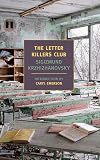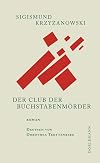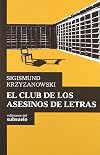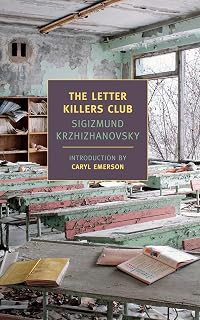
The Letter Killers Club
by Sigismund Krzyżanowski
On This Page
Description
"Writers are professional killers of conceptions. The logic of the Letter Killers Club, a secret society of "conceivers" who commit nothing to paper on principle, is strict and uncompromising. Every Saturday they meet in a fire-lit room hung with blank black bookshelves to present their "pure and unsubstantiated" conceptions: a rehearsal of Hamlet hijacked by an actor who vanishes with the role; the double life of a medieval merry cleric derailed by a costume change; a machine-run world that show more imprisons men's minds while conscripting their bodies; a dead Roman scribe stranded this side of the River Acheron. The overarching scene of this short novel is set in Soviet Moscow, in the ominous 1920s. Known only by pseudonym, like Chesterton's anarchists in fin-de-sic̈le London, the Letter Killers are as mistrustful of one another as they are mesmerized by their despotic president. Sigizmund Krzhizhanovsky is at his philosophical and fantastical best in this extended meditation on madness and silence, the word and the soul unbound"-- show lessTags
Recommendations





Member Reviews
I really liked this one. It was cheeky, professional, and even experimental, given it was written around 1926.
The framing device is an original spin on a classic trope. Seven authors, who have arrived at the conclusion that their published ideas are diverting their readers' creativity and interfering with their readers' capacity for original ideas, decide to cease publishing. Instead, they hold weekly gatherings where they narrate their stories and themes to each other through speech only. Thus having become the titular killers of letters, they invite a "pure reader" -- one who reads and reads without really reflecting on the contents -- to judge the quality of the tales: would they stand up next to traditionally published works?
The show more novel is told in seven chapters, in which the seven letter killers take turns spinning their yarns. There's a reworking of Hamlet, in which familiar characters are doubled to bring out the duplicities inherent in the play; references to specific actors and Shakespeare trivia abound. There's a medieval-style fable about three vagrants who scour the world for the answer to the question: "what is the ultimate purpose of the mouth: talking, kissing, or eating?" supported with many references to the Church Fathers and the Scholastics. There's a science fiction tale in which trained bacteria have disconnected the nerves that operate muscles from those that operate thoughts, and via manipulation of the "ether wind" the resulting bodies can be remote-controlled and forced into menial labour.
Krzhizhanovsky has penned an enjoyable collection of semi-unfinished stories to explore themes of storytelling, the independence of art, and the relation between thoughts and their physical containers. The tales on offer are amusingly diverse, a group of sassy challenges to more mainstream fiction. Not all of them are memorable, but the ones that stand out more than make up for that. All share, though, a flighty quality, and a sense of impish humour. Throughout I felt like Krzhizhanovsky had had enormous fun writing these tales, and his panache was infectious.
I will most definitely read more of Krzhizhanovsky's works! show less
The framing device is an original spin on a classic trope. Seven authors, who have arrived at the conclusion that their published ideas are diverting their readers' creativity and interfering with their readers' capacity for original ideas, decide to cease publishing. Instead, they hold weekly gatherings where they narrate their stories and themes to each other through speech only. Thus having become the titular killers of letters, they invite a "pure reader" -- one who reads and reads without really reflecting on the contents -- to judge the quality of the tales: would they stand up next to traditionally published works?
The show more novel is told in seven chapters, in which the seven letter killers take turns spinning their yarns. There's a reworking of Hamlet, in which familiar characters are doubled to bring out the duplicities inherent in the play; references to specific actors and Shakespeare trivia abound. There's a medieval-style fable about three vagrants who scour the world for the answer to the question: "what is the ultimate purpose of the mouth: talking, kissing, or eating?" supported with many references to the Church Fathers and the Scholastics. There's a science fiction tale in which trained bacteria have disconnected the nerves that operate muscles from those that operate thoughts, and via manipulation of the "ether wind" the resulting bodies can be remote-controlled and forced into menial labour.
Krzhizhanovsky has penned an enjoyable collection of semi-unfinished stories to explore themes of storytelling, the independence of art, and the relation between thoughts and their physical containers. The tales on offer are amusingly diverse, a group of sassy challenges to more mainstream fiction. Not all of them are memorable, but the ones that stand out more than make up for that. All share, though, a flighty quality, and a sense of impish humour. Throughout I felt like Krzhizhanovsky had had enormous fun writing these tales, and his panache was infectious.
I will most definitely read more of Krzhizhanovsky's works! show less
In an industry usually concerned with “moving units,” cashing in on the latest literary by-product of a reality television non-personality, or pushing out fiction that degrades the genre to a near metaphysical endpoint, it is a rare occasion when a publisher can be said to have acted “heroically.” The Letter Killers Club by Sigizmund Krzhizhanovsky (hereafter referred to as SK) represents an occasion to celebrate. With a downright intimidating name (unlike the two-syllable names of thriller writers on bestseller lists), the novel revolves around the machinations and stories told by a secret society in the 1920s Soviet Union. It is heroic to publish such a perplexing little volume by a Ukrainian Soviet writer who, according to show more the copy on the back cover, “went unpublished, though he was active among Moscow’s literati in the 1920s.” Seriously, why publish this? One could make more money releasing another volume of Ghostwriters Working for the Kardashian Machine. Let’s add zombies to Jane Austen or androids to Tolstoy. “Hey, at least people are reading!” quoth the sycophants of the Lowest Common Denominator.
Don’t let the author’s name or the strange plot dissuade you from reading this remarkable novel. Written in 1926 when Soviet Modernism slowly faded into the Stalinist Philistinism of the 1930s, the novel follows the meetings of a secretive group named “the Letter Killers Club.” Totalitarian paranoia taints the barbed elliptical narratives of the group members, creating stories that bristle with erudition, humor, and beauty.
“The Letter Killers Club” involves each member taking an alias that is a nonsense syllable. The names (Rar, Mov, Tyd, etc.) sound like the characters from Samuel Beckett’s Endgame (1957). The group gathers in a dark study. Empty bookshelves surround them. Every week a single member tells his story, but is duty bound not to publish his “conception.” The strictures recall the random oppressions of the police state. While the 1920s saw an aesthetic flowering in the Soviet Union, its totalitarian terrors existed under the aegis of Lenin and the Party. Stalin simply intensified and expanded the Reign of Terror. The rigidity of the rules also predicts the severity of Oulipo (a literary movement that began in the 1960s).
The meetings frame the stories, each meeting offering a different genre. The first story is actually a play, a heretical dissection of Hamlet. The play splits the characters into two entities; ergo Guildenstern becomes Guilden and Stern. Dueling Hamlets recite the “To be or not be” speech. In addition, the play’s actors go to The Land of Roles meeting previous actors who played Hamlet. The story is playful and postmodern, anticipating Tom Stoppard’s riff on the Bard’s most famous play. The fourth-wall-breaking and Land of Roles remind one of the anarchic interrelationships of Los Angeles and Toontown in Who Framed Roger Rabbit? (Robert Zemeckis, 1988).
Another story involves the transmission of a virus that turns people in automatons. Part science fiction, part biological horror, and part political satire, the story explores the same territory of Yevgeny Zamyatin’s We (1921). In this case, a scientist desires to make the mentally insane more productive members of society with a technique of remotely controlling the brain functions. What started as a technology “for the common good” becomes an instrument of totalitarian control.
The people turning into automatons because of technology should make people pause and think about the ties between self, autonomy, the state, and surveillance. (Whether it is Facebook or the National Security Agency, sacrificing one’s privacy to a monolithic institution usually involves a willing self-sacrifice. Our chains are self-inflicted.)
Other stories include a fable set in medieval times and a tale of a recently deceased Roman missing his requisite obol for his journey across the River Acheron. To complicate matters, the narrators get interrupted, chastised, or, a la “Exquisite Corpse”, other members finish the stories. The interruptions and snide commentary should be familiar to anyone seeing an Internet comment thread. If you disliked a casting choice in a movie involving a Marvel superhero or something similar, then you’ll enjoy the snark targeted at the storyteller. The snark and commentary in this cabal-like setting stands in stark contrast to the public uniformity of the police state. Even with the strictures and severity, the narratives, albeit unwritten, transcend the terror and stifling monotony outside the dark walls.
SK’s The Letter Killers Club is a monumental literary discovery, a gem buried in the Soviet Archives and only unearthed in 1976. With its daring experimentalism and acid commentary on state power, the book still stands as a work of revolutionary power.
http://driftlessareareview.com/2011/11/24/the-letter-killers-club-by-sigizmund-k... show less
Don’t let the author’s name or the strange plot dissuade you from reading this remarkable novel. Written in 1926 when Soviet Modernism slowly faded into the Stalinist Philistinism of the 1930s, the novel follows the meetings of a secretive group named “the Letter Killers Club.” Totalitarian paranoia taints the barbed elliptical narratives of the group members, creating stories that bristle with erudition, humor, and beauty.
“The Letter Killers Club” involves each member taking an alias that is a nonsense syllable. The names (Rar, Mov, Tyd, etc.) sound like the characters from Samuel Beckett’s Endgame (1957). The group gathers in a dark study. Empty bookshelves surround them. Every week a single member tells his story, but is duty bound not to publish his “conception.” The strictures recall the random oppressions of the police state. While the 1920s saw an aesthetic flowering in the Soviet Union, its totalitarian terrors existed under the aegis of Lenin and the Party. Stalin simply intensified and expanded the Reign of Terror. The rigidity of the rules also predicts the severity of Oulipo (a literary movement that began in the 1960s).
The meetings frame the stories, each meeting offering a different genre. The first story is actually a play, a heretical dissection of Hamlet. The play splits the characters into two entities; ergo Guildenstern becomes Guilden and Stern. Dueling Hamlets recite the “To be or not be” speech. In addition, the play’s actors go to The Land of Roles meeting previous actors who played Hamlet. The story is playful and postmodern, anticipating Tom Stoppard’s riff on the Bard’s most famous play. The fourth-wall-breaking and Land of Roles remind one of the anarchic interrelationships of Los Angeles and Toontown in Who Framed Roger Rabbit? (Robert Zemeckis, 1988).
Another story involves the transmission of a virus that turns people in automatons. Part science fiction, part biological horror, and part political satire, the story explores the same territory of Yevgeny Zamyatin’s We (1921). In this case, a scientist desires to make the mentally insane more productive members of society with a technique of remotely controlling the brain functions. What started as a technology “for the common good” becomes an instrument of totalitarian control.
The people turning into automatons because of technology should make people pause and think about the ties between self, autonomy, the state, and surveillance. (Whether it is Facebook or the National Security Agency, sacrificing one’s privacy to a monolithic institution usually involves a willing self-sacrifice. Our chains are self-inflicted.)
Other stories include a fable set in medieval times and a tale of a recently deceased Roman missing his requisite obol for his journey across the River Acheron. To complicate matters, the narrators get interrupted, chastised, or, a la “Exquisite Corpse”, other members finish the stories. The interruptions and snide commentary should be familiar to anyone seeing an Internet comment thread. If you disliked a casting choice in a movie involving a Marvel superhero or something similar, then you’ll enjoy the snark targeted at the storyteller. The snark and commentary in this cabal-like setting stands in stark contrast to the public uniformity of the police state. Even with the strictures and severity, the narratives, albeit unwritten, transcend the terror and stifling monotony outside the dark walls.
SK’s The Letter Killers Club is a monumental literary discovery, a gem buried in the Soviet Archives and only unearthed in 1976. With its daring experimentalism and acid commentary on state power, the book still stands as a work of revolutionary power.
http://driftlessareareview.com/2011/11/24/the-letter-killers-club-by-sigizmund-k... show less
An absolutely brilliant frame story where the connections and correspondences between stories and the frame itself are multifaceted and frustratingly complex. The ingenuity, variety, and wit on display are dazzling. The implicit critiques of not only Bolshevism but modernism are withering. Like the Canterbury Tales in reverse, this one ends in spring--spring rendered as winter's "death agony."
After finishing this book, I'm left slightly puzzled (not being clued into the philosophical and literary puzzles littered throughout) but also in awe of Krzhizhanovsky's skill as a writer. His brand of surrealism is a masterly foil for his thoughts, vision and humour. If one can squeeze 3 or 4 short stories as a subtext of a major plot to explain the subtle power of words...wow.
I had read some short stories by Krzhizhanovsky previously and thought they were very good. His loose, metafictional novella The Letter Killers Club was also clever and enjoyable. The author tells the story of a group of writers – or non-writers – who meet every week to tell their stories. An outsider, the narrator, joins them and watches as the group falls apart. Much of the book is made up of the stories which are varied, ironic and delve into the nature of writing and creation. Many can also be seen as a comment on the Soviet system under which Krzhizhanovsky never found any success. Sometimes they can feel a little random but this is another interesting work by the author – will be looking for more.
The narrator, visiting a show more famous writer, learns how the club came about – the famous writer was forced to sell all his books and spent hours recreating their content, retelling the stories and taking the words and imagining something else. He finally wrote some of his imaginings down and was published and became successful. However, writing it down destroyed the work and after awhile the writer decided he would write no more, forming the group where stories were only told and never written.
The stories are an odd bunch. One is a riff on Hamlet, where the characters of Ophelia and Guildenstern are split in two and must compete for their roles as well as having outside lives. One half of Guildenstern visits the hall of Hamlets where he finds every actor who has played that role. A bit like the Stoppard take, clever and fun, though sometimes this one could feel a bit jumpy and random. The next stories are paired – they take place in a quasi-historical France, one describing the almost blasphemous custom of the Feast of the Ass, the other the sad story of a travelling priest/jester who gets stuck as a jester. The third story is similar to some of Krzhizhanovsky’s sci-fi shorts – it describes the mind control system generated by biological and technological means, where a person’s body can be separated from their mind and controlled. At first the government claims it will only be used on the mentally ill, as a kind of humane way to give them some use. Then unsurprisingly they use it on the rest of the population and make their zombies kill anyone who resists. The fourth story is an ironic philosophical comedy where three friends drunkenly debate the primary use of a mouth – for eating, talking or kissing. They set off on a quest to find the answer and endure several mishaps. The last story finds the Roman Mark Sept waiting on the bank of the Acheron as the obol necessary to pay the ferryman, Charon, was taken by the daughter of his slave. Several endings are provided by the group.
A number of interpretations could be provided for the stories of the group. One would be, of course, allegorical representations of the Soviet state. The writers refusing to publish and telling their stories to empty shelves in secret can be seen as a reaction to the repression. Many of the stories feature doublings – the two sides of the characters of Hamlet, the split personality of Francoise and the goliard in the French pair of stories, the separated mind and body in the sci fi piece. Russia is traditionally depicted with a face to the West and one to the East and the public/private divide that characterized the author’s life also necessitated something of a double life. The dystopia – with its attempts to control citizens in the name of progress - provides an obvious parallel as well.
However, both the framing stories and the stories of the group look at the creative process. The famous writer’s decision to start the meetings stems more from a personal crisis and the dissatisfaction with the actual writing – he feels he is losing something by permanently setting down his ideas. The stories are ironic, loose and metafictional, with members suggesting beginnings and endings, stories bleeding into one another or members appearing in the stories. There’s often an idea of deconstruction – besides divided characters, the fourth story is a deconstruction of the functions of a mouth, and the Hamlet take a breakdown of the play. However, although releasing the stories serves a function, in the end the club is under attack both internally and externally. Parallels can be found in the stories – too much talking isn’t a good thing in the fourth one and the importance of the book is underlined in the Hamlet riff. The ending also suggests that permanently setting something down is necessary even if it can be painful in different ways. Despite the oddities, the stories are all enjoyable in their own right – entertaining or dramatic or funny. Another good tale from Krzhizhanovsky. show less
The narrator, visiting a show more famous writer, learns how the club came about – the famous writer was forced to sell all his books and spent hours recreating their content, retelling the stories and taking the words and imagining something else. He finally wrote some of his imaginings down and was published and became successful. However, writing it down destroyed the work and after awhile the writer decided he would write no more, forming the group where stories were only told and never written.
The stories are an odd bunch. One is a riff on Hamlet, where the characters of Ophelia and Guildenstern are split in two and must compete for their roles as well as having outside lives. One half of Guildenstern visits the hall of Hamlets where he finds every actor who has played that role. A bit like the Stoppard take, clever and fun, though sometimes this one could feel a bit jumpy and random. The next stories are paired – they take place in a quasi-historical France, one describing the almost blasphemous custom of the Feast of the Ass, the other the sad story of a travelling priest/jester who gets stuck as a jester. The third story is similar to some of Krzhizhanovsky’s sci-fi shorts – it describes the mind control system generated by biological and technological means, where a person’s body can be separated from their mind and controlled. At first the government claims it will only be used on the mentally ill, as a kind of humane way to give them some use. Then unsurprisingly they use it on the rest of the population and make their zombies kill anyone who resists. The fourth story is an ironic philosophical comedy where three friends drunkenly debate the primary use of a mouth – for eating, talking or kissing. They set off on a quest to find the answer and endure several mishaps. The last story finds the Roman Mark Sept waiting on the bank of the Acheron as the obol necessary to pay the ferryman, Charon, was taken by the daughter of his slave. Several endings are provided by the group.
A number of interpretations could be provided for the stories of the group. One would be, of course, allegorical representations of the Soviet state. The writers refusing to publish and telling their stories to empty shelves in secret can be seen as a reaction to the repression. Many of the stories feature doublings – the two sides of the characters of Hamlet, the split personality of Francoise and the goliard in the French pair of stories, the separated mind and body in the sci fi piece. Russia is traditionally depicted with a face to the West and one to the East and the public/private divide that characterized the author’s life also necessitated something of a double life. The dystopia – with its attempts to control citizens in the name of progress - provides an obvious parallel as well.
However, both the framing stories and the stories of the group look at the creative process. The famous writer’s decision to start the meetings stems more from a personal crisis and the dissatisfaction with the actual writing – he feels he is losing something by permanently setting down his ideas. The stories are ironic, loose and metafictional, with members suggesting beginnings and endings, stories bleeding into one another or members appearing in the stories. There’s often an idea of deconstruction – besides divided characters, the fourth story is a deconstruction of the functions of a mouth, and the Hamlet take a breakdown of the play. However, although releasing the stories serves a function, in the end the club is under attack both internally and externally. Parallels can be found in the stories – too much talking isn’t a good thing in the fourth one and the importance of the book is underlined in the Hamlet riff. The ending also suggests that permanently setting something down is necessary even if it can be painful in different ways. Despite the oddities, the stories are all enjoyable in their own right – entertaining or dramatic or funny. Another good tale from Krzhizhanovsky. show less
An interesting conceit, but I suspect the whole thing went over my head: are the stories meant to be related in any way? Are the story-tellers being characterized by their stories, or not? Exactly where is the irony here? The introduction tells us that K was deeply concerned with the idea of the literary concept, and the tension between the purity of the concept and the fact that literature is only literature once it has been exuded into the world, usually in book form. That's interesting, and while the Letter Killers Club is obviously tied to this, I had a great deal of trouble working out what the individual stories-- meta-theatricality, a medievalist novella, early dystopia, extended fable, and Roman fable--have to do with this show more theme.
In fact, the more I think about it, the happier I am with the idea that the individual stories (all very entertaining and interesting) really don't have much to do with the interesting but not entertaining frame. I'd love for someone to convince me otherwise. show less
In fact, the more I think about it, the happier I am with the idea that the individual stories (all very entertaining and interesting) really don't have much to do with the interesting but not entertaining frame. I'd love for someone to convince me otherwise. show less
Sigizmund Krzhizhanovsk's novel, The Letter Killers Club, opens when an un-named narrator informs us he has been invited to attend the weekly meeting of seven well-respected authors. The author's have come to the conclusion, most of them late in their careers, that by writing down their ideas they prevent others from having them. So instead of writing, they now meet once a week to tell stories to each other.
The rest of the novel consists of the narrator's account of the ideas and stories shared at the meetings.
It's a very interesting book.
The introduction states that Mr. Krzhizhanovsk is a writer interested in ideas rather than characters and plots. Judging from The Letter Killers Club I agree, to a point. While the novel is full of show more ideas, many of them wonderful, some of them over my head, there is still a plot and there are still characters.
The plot centers around the idea of silence and a commentary on it. The conflict of the novel adressess the question of how do you write about silence. What can you say about the absence of words? This question goes back to the origins of the club itself.
The club's creator tells the narrator how he came to be an author. As a young man he had a prized collection of books, great works, that he read again and again. Due to a family emergency he was forced to sell off his collection leaving him with an empty bookcase. He began writing to replace the missing books. Each of his own works is simply his attempt to retell the stories in the books he had to sell. Eventually, he realized that be setting down ideas in print, no one could ever have those ideas again. They were his. People could encounter them in his books, but they could not discover them.
I think that's brilliant.
I suspect that the ideas Mr. Krzhizhanovsk presents in The Letter Killers Club must have had special resonance in his native Russia where he lived under Communist dictatorial rule. The question of whether or not stories once written prevent people from forming their own ideas seems like a profound comment on a culture that repressed speech the way the U.S.S.R. once did.
But that's one question I'll have to leave to people better informed than I am.
What I loved about The Letter Killers Club can be found in this, slightly long, passage about the student who tried to write the commentary on silence. Once he finished his work, or thought he had finished it, he purchased a very old copy of the Bible. In it, he found the word "S-um" written in the margin. Intrigued, he begins looking for other marginalia.
Running an eye down the Vulgate's margins, he noticed another mark in ink bracketing two verses: "Behold my servant, whom I have chosen...." and so on, and "He shall not strive, nor cry; neither shall any man hear his voice in the streets." A vague presentiment compelled him to scan the margins with more care, page by page; three chapters later he found the faint score of a fingernail: "...O Lord, thou son of David; my daughter is grievously vexed with a devil. But he answered her not a word." the margins that followed appeared to be blank. but the composer of Commentary on Silence was too intrigued to abandon his search; examining the pages in the light, he discovered several more marks grown faint, the work of someone's sharp fingernail--and opposite these: "And when he was accused of the chief priests and elders, he answered nothing. Then said Pilate unto him, Hearest thou not how many things they witness against thee? And he answered to him never a word; insomuch that the governor marveled greatly." Or: "But Jesus stooped down, and with his finger wrote on the ground, as though he heard them not"; some marks could be seen only with a magnifying glass, others stood out; some where shorter than a dash and picked out only three or for words--for instance, "And he withdrew himself into the wilderness..." or "But Jesus held his peace"; others extended down a series of verses, setting off whole episodes and stories--and every time it was a story about questions never answered, about a silent Jesus. That of which the old St. Gall Neumes spoke as though stammering, but spoke all the same, was marked and scored--with fingernail skipping words to the end. Now it was clear: on the yellowed pages of that tattered tome, beside the four who had spoken, a fifth Gospel with no need of words was giving forth from the book's blank margins: The Gospel According to Silence. Now the S-um, too, made sense: it was simply a flattened Silentium. Can one speak about silence without destroying it? Can one comment on what.... Well, in a word, book killed book---with a single blow---and I won't describe how my person-theme's manuscript burned. Let's just say it burned like....
There is so much in this passage to comment on. The marks the student finds in the Bible are not written with pen or pencil, but with a fingernail, evidence of a reader's thoughts but these thoughts remain both unspoken and unwritten. All these moments when Jesus does not speak or refuses to speak force the reader to wonder why. Would answering the questions force Jesus to reveal too much? Does he not know the answers? Does he fear the way his audience might respond to them? Is silence simply the best answer available?
These questions plague the members of The Letter Killers Club throughout the novel and add up to a decent plot, if you ask me. But it's a plot you'll have to look for in the margins at times. show less
The rest of the novel consists of the narrator's account of the ideas and stories shared at the meetings.
It's a very interesting book.
The introduction states that Mr. Krzhizhanovsk is a writer interested in ideas rather than characters and plots. Judging from The Letter Killers Club I agree, to a point. While the novel is full of show more ideas, many of them wonderful, some of them over my head, there is still a plot and there are still characters.
The plot centers around the idea of silence and a commentary on it. The conflict of the novel adressess the question of how do you write about silence. What can you say about the absence of words? This question goes back to the origins of the club itself.
The club's creator tells the narrator how he came to be an author. As a young man he had a prized collection of books, great works, that he read again and again. Due to a family emergency he was forced to sell off his collection leaving him with an empty bookcase. He began writing to replace the missing books. Each of his own works is simply his attempt to retell the stories in the books he had to sell. Eventually, he realized that be setting down ideas in print, no one could ever have those ideas again. They were his. People could encounter them in his books, but they could not discover them.
I think that's brilliant.
I suspect that the ideas Mr. Krzhizhanovsk presents in The Letter Killers Club must have had special resonance in his native Russia where he lived under Communist dictatorial rule. The question of whether or not stories once written prevent people from forming their own ideas seems like a profound comment on a culture that repressed speech the way the U.S.S.R. once did.
But that's one question I'll have to leave to people better informed than I am.
What I loved about The Letter Killers Club can be found in this, slightly long, passage about the student who tried to write the commentary on silence. Once he finished his work, or thought he had finished it, he purchased a very old copy of the Bible. In it, he found the word "S-um" written in the margin. Intrigued, he begins looking for other marginalia.
Running an eye down the Vulgate's margins, he noticed another mark in ink bracketing two verses: "Behold my servant, whom I have chosen...." and so on, and "He shall not strive, nor cry; neither shall any man hear his voice in the streets." A vague presentiment compelled him to scan the margins with more care, page by page; three chapters later he found the faint score of a fingernail: "...O Lord, thou son of David; my daughter is grievously vexed with a devil. But he answered her not a word." the margins that followed appeared to be blank. but the composer of Commentary on Silence was too intrigued to abandon his search; examining the pages in the light, he discovered several more marks grown faint, the work of someone's sharp fingernail--and opposite these: "And when he was accused of the chief priests and elders, he answered nothing. Then said Pilate unto him, Hearest thou not how many things they witness against thee? And he answered to him never a word; insomuch that the governor marveled greatly." Or: "But Jesus stooped down, and with his finger wrote on the ground, as though he heard them not"; some marks could be seen only with a magnifying glass, others stood out; some where shorter than a dash and picked out only three or for words--for instance, "And he withdrew himself into the wilderness..." or "But Jesus held his peace"; others extended down a series of verses, setting off whole episodes and stories--and every time it was a story about questions never answered, about a silent Jesus. That of which the old St. Gall Neumes spoke as though stammering, but spoke all the same, was marked and scored--with fingernail skipping words to the end. Now it was clear: on the yellowed pages of that tattered tome, beside the four who had spoken, a fifth Gospel with no need of words was giving forth from the book's blank margins: The Gospel According to Silence. Now the S-um, too, made sense: it was simply a flattened Silentium. Can one speak about silence without destroying it? Can one comment on what.... Well, in a word, book killed book---with a single blow---and I won't describe how my person-theme's manuscript burned. Let's just say it burned like....
There is so much in this passage to comment on. The marks the student finds in the Bible are not written with pen or pencil, but with a fingernail, evidence of a reader's thoughts but these thoughts remain both unspoken and unwritten. All these moments when Jesus does not speak or refuses to speak force the reader to wonder why. Would answering the questions force Jesus to reveal too much? Does he not know the answers? Does he fear the way his audience might respond to them? Is silence simply the best answer available?
These questions plague the members of The Letter Killers Club throughout the novel and add up to a decent plot, if you ask me. But it's a plot you'll have to look for in the margins at times. show less
Members
- Recently Added By
Lists

Top Five Books of 2015
811 works; 241 members
Author Information

35+ Works 1,911 Members
Some Editions
Awards and Honors
Series
Belongs to Publisher Series
Common Knowledge
- Canonical title
- The Letter Killers Club
- Original title
- Клуб убийц букв
- Alternate titles*
- The Letter Killers Club
- People/Characters
- Hig; Mov; Rar; Fev; Das; Zez (show all 7); Tyd
- First words
- "Bubbles over a drowned man."
"What?" - Quotations*
- Outre le bureau qui faisait office de cimetière des fictions, ma chambre était meublée d'un lit, d'une chaise et d'une étagère à livres - quatre longues planches occupant tout un mur et qui ployaient sous le faix des le... (show all)ttres. Ordinairement, le poêle n'avait rien à brûler et moi rien à manger. Mais j'avais pour ces livres une vénération quasi religieuse, comme d'autres pour des icônes. Les vendre ... cette idée ne m'effleurait pas jusqu'au jour où elle me fut imposée par un télégramme : "Mère décédée samedi. Présence indispensable. Venez." Le télégramme s'était abattu sur mes livres dans la matinée ; le soir même, les rayonnages étaient vides et je fourrais dans ma poche la bibliothèque métamorphosée en trois ou quatre billets de banque. La mort de celle qui vous a donné la vie est un évènement grave, très grave. C'est toujours, et pour chacun, un coin noir enfoncé dans la vie. Une fois acquittées les obligations funèbres, je m'en suis retourné vers mon misérable logis à mille verstes de là. Le jour du départ, je ne voyais rien de ce qui m'entourait, et c'est seulement à mon retour que l'effet produit par les rayonnages vides a pénétré mon esprit. Après m'être déshabillé et installé à la table, j'ai tourné les yeux vers le vide suspendu aux quatre planches noires. Quoique délivrées du poids des livres, les planches avaient conservé leur courbure, comme ployées sous la charge du vide. J'ai bien essayé de regarder ailleurs, mais, comme je l'ai déjà dit, il n'y avait dans la chambre que les rayonnages et le lit. Je me suis déshabillé et couché dans l'espoir que le sommeil chasserait la dépression. Eh bien non, après un bref répit, la même sensation m'a réveillé. J'étais couché le visage tourné vers les rayonnages et je voyais un reflet de lune tressauter le long des planches dénudées, comme si une vie à peine perceptible était en train de naître - à touches timides - là-bas, dans l'absence des livres. Bien sûr, tout cela n'était que coup d'archet sur des nerfs trop tendus, et quand le jour les eut relâchés, j'ai tranquillement examiné la béance des planches baignées de soleil et je me suis installé à mon bureau pour reprendre ma besogne habituelle. J'eus besoin d'un renseignement et ma main gauche, d'un geste quasi automatique, alla vers les rangées de livres pour ne rencontrer que le vide. Et puis encore une fois, et encore. Dépité, j'ai scruté la non-bibliothèque envahie d'un essaim de poussières de soleil, en faisant un effort de mémoire pour revoir la page et la ligne requises. Mais les lettres imaginaires que renfermait la reliure imaginaire bondissaient dans tous les sens, et au lieu de la ligne que je cherchais, j'obtenais un papillotement bigarré de mots, les lignes se brisaient et formaient des dizaines de combinaisons nouvelles. J'en ai choisi une que j'ai précautionneusement insérée dans mon texte.
- Original language
- Russian
*Some information comes from Common Knowledge in other languages. Click "Edit" for more information.
Classifications
- Genres
- General Fiction, Fiction and Literature
- DDC/MDS
- 891.73 — Literature & rhetoric Asian Literature East Indo-European and Celtic literatures Russian and East Slavic languages Russian fiction
- LCC
- PG3476 .K782 .K5813 — Language and Literature Slavic languages and literatures. Baltic languages. Albanian language Slavic. Baltic. Albanian Russian literature Individual authors and works 1917-1960
- BISAC
Statistics
- Members
- 425
- Popularity
- 72,357
- Reviews
- 13
- Rating
- (3.71)
- Languages
- 6 — Dutch, English, French, German, Russian, Spanish
- Media
- Paper, Ebook
- ISBNs
- 7
- ASINs
- 3