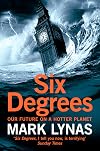
Six Degrees: Our Future on a Hotter Planet
by Mark Lynas
On This Page
Description
In accessible journalistic prose, author Lynas distills what environmental scientists predict about the consequences of human pollution for the next hundred years, degree by degree. At 1 degree Celsius, most coral reefs and many mountain glaciers will be lost. A 3-degree rise would spell the collapse of the Amazon rainforest, disappearance of Greenland's ice sheet, and the creation of deserts across the Midwestern United States and southern Africa. A 6-degree increase would eliminate most show more life on Earth, including much of humanity. Based on authoritative scientific articles, the latest computer models, and information about past warm events in Earth history, this promises to be an eye-opening warning that humanity will ignore at its peril.--From publisher description. show lessTags
Recommendations





Member Reviews
Mark Lynas's Six Degrees: Our Future on a Hotter Planet, written in 2008, presents in devastating detail the likely trajectory of the climate change crisis if we remain on our current course. Lynas shows, degree by degree Celcius, the alarming consequences of global warming. He effectively buttresses the case by citing evidence from earlier warmer periods of the earth's atmospheric and geologic history, as well as examples of the effects currently underway. The prospects are frightening, particularly for future generations.
While reading the book, I checked the NASA website to see the trends (carbon dioxide, global temperature, arctic ice minimum, sea level, etc.) for the last decade which, of course, continue apace. That day the U.S. show more president, who earlier this year pulled the United States out of the Paris Agreement, nominated a climate change denier to be the next head of NASA. Those interested in viewing the agency's relevant data are advised to do so quickly, as the information soon will likely be removed, just as all climate change data was deleted from the Environmental Protection Agency's website the day the president was inaugurated. show less
While reading the book, I checked the NASA website to see the trends (carbon dioxide, global temperature, arctic ice minimum, sea level, etc.) for the last decade which, of course, continue apace. That day the U.S. show more president, who earlier this year pulled the United States out of the Paris Agreement, nominated a climate change denier to be the next head of NASA. Those interested in viewing the agency's relevant data are advised to do so quickly, as the information soon will likely be removed, just as all climate change data was deleted from the Environmental Protection Agency's website the day the president was inaugurated. show less
In this book, the author divides the chapters to look at what would happen as the global average temperature rises 1 degree Celsius, 2 degrees, 3, 4, 5, and 6 degrees. More fires and drought in California and Australia. Melting of ice sheets in the Arctic and Antarctic. Melting of glaciers in mountainous regions in Pakistan, Nepal, and China near K2 and Everest, leading to less runoff for places that rely on that water. Water levels rising to wipe out New Orleans, put more of New York and London underwater, hurricanes and flooding in Houston, Gakveston, New York. Sand dunes and no water in Africa. All of these causing humans to starve and die or to move to other places already suffering themselves who won’t want newcomers to take up show more the precious resources that remain. Oceans and forests will be taking on more carbon than they can handle, often speeding up the warming and other consequences.
The author used scientific models and peer-reviewed articles to research this book.
I really liked the way he organized this book. Unfortunately, in the conclusion, he talked about ideally reducing emissions in the next decade. The book was published in 2008, and as far as I’ve been paying attention, things have (really, to no surprise, sadly) only gotten worse. There is no slow down, let alone reduction in emissions, I don’t believe. I feel like this is something everyone should read to educate themselves. show less
The author used scientific models and peer-reviewed articles to research this book.
I really liked the way he organized this book. Unfortunately, in the conclusion, he talked about ideally reducing emissions in the next decade. The book was published in 2008, and as far as I’ve been paying attention, things have (really, to no surprise, sadly) only gotten worse. There is no slow down, let alone reduction in emissions, I don’t believe. I feel like this is something everyone should read to educate themselves. show less
Mark Lynas aggregates a lot of studies on climate change - both forward-looking modeling and past-looking geological examination - to postulate about what the world would look like at each stage of overall warming - from 1 to 6 degrees. Although this was a tough book to get through - it reminded me of Jared Diamond's Collapse in that it often seemed repetitive - I am really glad I made the effort to complete it. The book was strongest when it stuck to the science & weakest when Lynas attempted to project the social-political consequences of a shrinking, heating, starving world. Despite the chapter on solutions, I was left feeling profoundly pessimistic at the end. Books of this sort, that deal with global issues that are tough to show more understand & require immense coordinated action by multiple actors at all levels - governments, corporations, individuals, international organizations - tend to reinforce my feeling of utter insignificance & impotence before a problem of such a massive scale. show less
The IPCC says that in the 21st century global warming could bring temperatures anywhere from 1 to 6 degrees hotter. Lynas uses peer-reviewed scientific literature to show what these temperature rises could mean. In 6 chapters he outlines 6 degrees, 1 degree for each chapter. Fundamentally, once temps get past 2 or 3 degrees, like a wild fire burning out of control, the planet will continue to heat up no matter we do because nature starts releasing massive stores of CO2 from burning forests, melting tundra, warming oceans etc.. once it reaches 6 degrees it could wipe out most life on the planet.
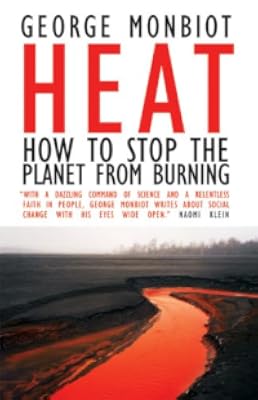
This is the first comprehensive attempt I have seen to outline what exactly a warmer world will be like, based on the most recent peer reviewed show more scientific literature. It is one part of the learning curve about global warming but an important part. It should be read in conjunction with other books, such as Monbiot's "Heat" which offers solutions to keep temps below 2 or 3 degrees.
This is scary stuff and we don't have much time, 8 or 10 years, to make drastic changes. Once things reach a certain temperature its out of our control and the higher temps become just a matter of time. There is a fire smoldering in the kitchen and we need to get off the couch and turn off the TV and do something about it before it burns down the house. show less
This is the first comprehensive attempt I have seen to outline what exactly a warmer world will be like, based on the most recent peer reviewed show more scientific literature. It is one part of the learning curve about global warming but an important part. It should be read in conjunction with other books, such as Monbiot's "Heat" which offers solutions to keep temps below 2 or 3 degrees.
This is scary stuff and we don't have much time, 8 or 10 years, to make drastic changes. Once things reach a certain temperature its out of our control and the higher temps become just a matter of time. There is a fire smoldering in the kitchen and we need to get off the couch and turn off the TV and do something about it before it burns down the house. show less
This book tracks the effects on the Earth of incremental one degree rises that scientists theorize could happen during climate change brought about by man made global warming. This was an interesting and frightening account, backed by hard scientific evidence. Lynas writes well, taking into account economics and history as well as climate science in developing his thesis for the book.
Gives a vivid description of the effects of various levels of global warming. If you think that a few degrees of warming sounds like no big deal, read this book.
Interesting but slightly depressing book about the effects of global warming one degree at a time.
Members
- Recently Added By
Lists

Climate Change
87 works; 7 members

Climate Change
39 works; 2 members

Books That Go Bump in the Night
42 works; 6 members

Recommended Books about Climate Change
30 works; 2 members

Speculative non-fiction
25 works; 2 members
Author Information

12+ Works 1,106 Members
Awards and Honors
Common Knowledge
- Canonical title
- Six Degrees: Our Future on a Hotter Planet
- Original publication date
- 2007
- Important places
- Planet Earth
- Important events
- climate crisis
- Related movies
- Six Degrees Could Change the World (2008 | IMDb)
- Epigraph
- From the weeping ground there sprang a wind,
flaming with vermillion light,
which overmastered all my senses,
and I dropped like a man pulled down by sleep.
Dante, Inferno, Canto III:
Dante enter... (show all)s the First Circle of Hell - Dedication
- To my wife, Maria; son, Tom; and daughter, Rosa, in the hope that most of the predictions here need not come true.
- First words
- The knock on the door came at night.
- Last words
- (Click to show. Warning: May contain spoilers.)More than anything, it would be a society that survived and prospered and that passed on this glorious inheritance - of ice caps, rain forests, and thriving civilizations - to countless generations, far into the future.
Classifications
Statistics
- Members
- 592
- Popularity
- 49,629
- Reviews
- 17
- Rating
- (3.95)
- Languages
- 8 — Chinese, Dutch, English, French, Italian, Norwegian (Bokmål), Portuguese, Swedish
- Media
- Paper, Ebook
- ISBNs
- 16
- UPCs
- 1
- ASINs
- 3